Extra biblical evidence

  • Thread starter Thread starter rivera01
  • Start date Start date
Status
Not open for further replies.
One also has to wonder what was pulling the chariots since all of the Egyptians’ animals were supposedly killed during the 5th plague of pestilence and then infected with boils during the 6th plague and then killed again during the 7th plague of hail.
That’s true. The so-called Documentary Hypothesis - which I’m not really a fan of - tries to answer this by postulating that the plagues were pieced together from the different sources: the Yahwist, Elohist, or the Priestly source (although there is no agreement on which plagues go with which ‘source’). ‘Exaggerations’ and ‘continuity errors’ are explained by virtue of oral tradition: these were originally stories passed down by word-of-mouth through different groups and then combined together. But then there’s also this possible soluton.
 
I think you’re referring to Akhenaten. As this article points out, however, some have speculated that if there was a transferal it may have gone the other way, i.e. that the Hebrews got their notion of monotheism from him.
They would.
But how about this for another theory. The Pharaoh before Akhenaten Chased the Hebrews and died in the red sea. The Hebrews got clean away. But plagues continued to plague Egypt from time to time during the next administration prompting the Pharaoh Akhenaten to harken back to the tales of the Egyptian priests as they huddled around their braziers after Moses left. Akhenaten then tries to petition the Hebrew God to once again end the plagues that are besetting Egypt. Even going so far as to start a brand new religion, a monotheistic one, something unheard of in the Empire until then.
 
One tentative bit of evidence, I think, is that Egypt always had multiple gods, I mean lots and lots. And their culture was always like this. But then, one day, a pharaoh whose name I forget, suddenly wiped out all their old religion and every god they ever had. And he created for the first one and only time a monotheistic religion in Egypt. Albeit that the new mono-god was the sun, or appeared to be the sun. The Pharaoh even built a new capitol city for the sun god where acres of altars were used for sacrificing vegetarian foods to the new god.
It was around this time that the hebrews and their monotheistic religion were believed to have been in Egypt.

I kinda like to think that all the plagues happened and this particular pharaoh decided the hebrew god was a bit more effective than their native gods and he tried to wipe out all gods but this one bright sun god in the sky, even to the extent of building a new city dedicated to him and starting a system of sacrificing maybe like Melchisedech with bread and wine sacrificed on altars though the pharaoh did add most other vegetarian food types too.

I think there was also evidence of epidemics of some sort at that time too.
Actually the people were to worship Akhenaten as the intermediary between the Aten and the people, while only Akhenaten (and Nefertiti his wife) could worship the Aten directly. One of the innovations of Atenism is that it strengthened the role of the pharaoh: whereas in traditional Egyptian religion the priests and scribes had a monopoly of sorts, Akhenaten’s reforms cut away both the philosophical and economic bases of priestly power, abolishing the cults of all other deities, and with them the large and lucrative industry of sacrifices and tributes that the priests controlled. In fact, it would seem that the relationship of god and king was redefined in a way that benefited Akhenaten himself.

And Akhenaten’s reforms weren’t “sudden.” Amenhotep IV introduced the worship of the Aten during the fifth year of his reign, raising the Aten - the solar disk, originally thought of simply as an aspect of the sun god Ra - to the status of supreme god, after initially permitting the continued worship of the traditional gods. To drive home this promotion of the Aten, Amenhotep changed his name to Akhenaten ‘Useful to Aten/[He who serves] the spirit of the Aten’ and constructed a new capital in honor of the god, Akhetaten ‘Horizon of the Aten’ (which conveniently separated the pharaoh and his court from the influence of the priesthood and from the traditional centres of worship!)

At first, Akhenaten presented the Aten as a variant of the familiar supreme deity Amun-Ra (itself the result of an earlier rise to prominence of the cult of Amun, resulting in Amun becoming merged with the sun god Ra), in an attempt to put his ideas in a familiar religious context. Aten is the name given to the solar disc, whereas the full title of Akhenaten’s god was Ra-Horakhty who rejoices on the horizon in his name of [the] Light which is [in] the sun disk (Aten), often abbreviated to Ra-Horus-Aten. The name is really a summary of Akhenaten’s creed: just as Akhenaten took the role of ‘Light’ (the god Shu), so his new city, Akhetaten, ‘the horizon of the Aten’, was the place where the Aten - here identified as Ra-Horakhty ‘Ra-Horus of the (Two) Horizons’ - rejoiced. In another break from tradition, the god’s title was written within a cartouche (you know, the oval name ring), along with the titles normally given to a pharaoh.

Theoretically, the Aten needed no temples and no priesthood, but Akhenaten, as much as he would have liked to worship the Aten 24-7, had other things to do, so bowing to concessions he appointed a high priest (with a rather curious name - Meryra ‘Beloved of Ra’!) shortly after taking up residence in Akhetaten. Plus, temples were built for the worship of the Aten, although unlike in traditional temples where the sanctuary is enshrouded in darkness and priests worship the gods in private, the worship of Aten demanded open-air temples filled with tables piled high with offerings for the god’s direct consumption. Akhetaten in fact is one huge temple to the Aten, since the visible sun could be observed and worshipped overhead from the city at any time of day.
 
(Continued)

http://upload.wikimedia.org/wikipedia/commons/thumb/e/e4/Aten_disk.jpg/300px-Aten_disk.jpg

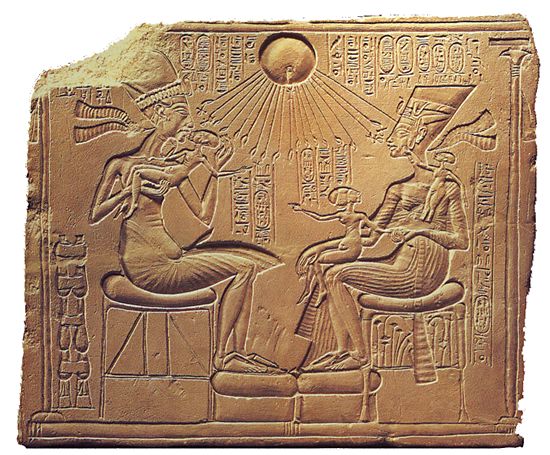
It was in the ninth year of Akhenaten’s reign that Atenism’s direction changed: now the Aten is declared to be not merely the supreme god as he had earlier declared, but the only god. Akhenaten thus forbade worship of all others, including the veneration of idols, even privately in people’s homes—an arena the Egyptian state had previously not touched in religious terms. In place of the images of the old gods were representations of Akhenaten and his family worshipping the Aten (as in the pic above), portrayed as a rayed solar disk in which the rays (commonly depicted ending in hands) appear to represent the unseen spirit of the Aten.

The ritual regicide of the old supreme god Amun was staged by the pharaoh, and Amun’s temples throughout Egypt, and of all the old gods were defaced. The word for ‘gods’ (plural) was proscribed, and even the hieroglyph for ‘mother’ has been excised and re-written, because it had the same sound in ancient Egyptian as the sound of name of the Theban goddess Mut. The Aten’s name is also written differently after Year 9, to emphasise the radicalism of the new regime: no longer was “Aten” written using the hieroglyph of a rayed solar disc, but instead spelled phonetically, to drive home further the idea that the Aten was not simply the disc or orb of the sun (Ra) but a universal spiritual presence.

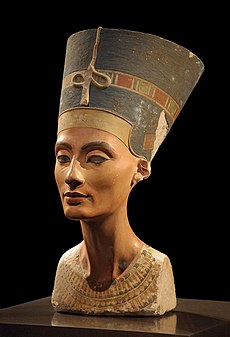
Due to the ban, some in the royal court changed their names to reflect their new allegiance. Despite it, however, some courtiers kept names that smacked of the ‘old religion’ such as Ahmose (‘the moon is born/child of the moon’). Remember Akhenaten’s high priest Meryra? Plus, the sculptor who made the famous Nefertiti bust, and other works of royal portraiture is named Thutmose (‘child of Thoth’). In addition, an overwhelmingly large number of amulets in Akhetaten (Amarna) also show that talismans of the household-and-childbirth gods Bes and Taweret, the eye of Horus, and amulets of other traditional deities, were openly worn by its citizens. All of this would suggest that although Akhenaten shifted funding away from traditional temples at first, his policies were fairly tolerant until some point toward the end of the reign, when he began to be really strict about his ‘new’ religion.

Akhenaten also promulgated a hymn in praise of the Aten which also served as a creed for his faith. It used the vernacular of the day rather than the classical forms of old, and was probably even composed by the king himself. It begins:

Splendid you rise in heaven’s lightland, 

O living Aten, creator of life! 

When you have dawned in eastern lightland, 

You fill every land with your beauty. 

You are beauteous, great, radiant, 

High over every land; 

Your rays embrace the lands,

To the limit of all that you made. 

Being Re, you reach their limits,

You bend them for the son whom you love;

Though you are far, your rays are on earth, 

Though one sees you, your strides are unseen.

It continues:

How many are your deeds,

Though hidden from sight, 

O Sole God beside whom there is none!

You made the earth as you wished, you alone,

All peoples, herds, and flocks; 

All upon earth that walk on legs, 

All on high that fly on wings,

The lands of Khor and Kush, 

The land of Egypt. 

You set every man in his place, 

You supply their needs;

Everyone has his food, 

His lifetime is counted. 

Their tongues differ in speech, 

Their characters likewise; 

Their skins are distinct,

For you distinguished the peoples.
 
The hymn closes with these words:

You are in my heart, 

There is no other who knows you, 

Only your son, Neferkheprure, Sole-one-of-Re, 

Whom you have taught your ways and your might.

Those on earth come from your hand as you made them, 

When you have dawned they live, 

When you set they die;

You yourself are lifetime, one lives by you. 

All eyes are on your beauty until you set,

All labor ceases when you rest in the west; 

When you rise you stir everyone for the King, 

Every leg is on the move since you founded the earth. 

You rouse them for your son who came from your body, 

The King who lives by Maat, the Lord of the Two Lands,

Neferkheprure, Sole-one-of-Re, 

The Son of Re who lives by Maat, the Lord of crowns,

Akhenaten, great in his lifetime; 

And the great Queen whom he loves, the Lady of the Two Lands, 

Nefer-nefru-Aten Nefertiti, living forever.

The closing lines of the hymn illustrate one of the most striking elements of Akhenaten’s revolution: the prominence given to his wife Nefertiti (ca. 1370 BC-ca. 1330 BC). In one sense, Nefertiti was merely following in the footsteps of her dynastic forebears: royal women in the Eighteenth Dynasty (ca. 1550-ca. 1292 BC) - the dynasty Akhenaten and Tutankhamun were born to - had grown accustomed to playing an important role in the affairs of state. But Nefertiti went further: at Ipet-isut (Karnak), she had been granted her own temple, the Mansion of the Benben (hwt-ben-ben), where her husband (then still Amenhotep IV) was not even depicted. There she is portrayed carrying out ritual actions previously restricted to the king, such as smiting a bound captive or inspecting prisoners.
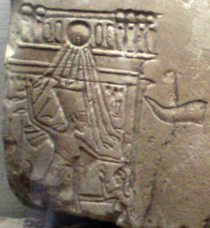


The boundary stelae of years 4 and 5 mark the boundaries of the new city and suggest that the move to the new city of Akhetaten occurred around that time. commissioned to mark the first anniversary of the royal couple’s visit to Akhetaten, Nefertiti is shown at the same scale as the king, denoting her equal rank. (In Egyptian artworks, the gods are the largest in size, with pharaohs being the next biggest - if they are portrayed. Generally speaking, people of higher status would be drawn or sculpted larger than inferiors. Normally the pharaoh is portrayed larger than his wives or children - see the image of Akhenaten and his family worshipping the Aten in the last post.) The inscription also heaps lavish praise upon Nefertiti: “Great in the palace, fair of face, adorned with the twin plumes, lady of joy who receives praises; one rejoices at the hearing of her voice, the King’s Great Wife whom he loves, the Lady of the Two Lands.”

Every public act that Akhenaten did Nefertiti mirrored. When he changed his name from Amenhotep to Akhenaten and his royal titles to include a reference to the Aten, for instance, she added an epithet to her own name (Nefertiti = ‘the beautiful one has come’), Nefer-nefru-Aten ‘beautiful are the beauties of the Aten’. While Akhenaten was viewed as Shu, the primordial god of air and the son of the creator (Atum in traditional mythology, another god conflated with Ra as Atum-Ra - notice the pattern here?), Nefertiti in turn was identified with Shu’s sister-wife Tefnut. Nefertiti has adopted the goddess’ flat-topped headdress as her own, and made it the public symbol of her authority. In some eyes, Akhenaten and Nefertiti are joint rulers on earth with the Aten in heaven.


 
(Continued)

I mentioned in an earlier post that the common people were to worship Akhenaten as the intermediary, while only Akhenaten and Nefertiti had direct ‘access’ to the god. What happened basically is that the royal family - Akhenaten, Nefertiti, and six daughters born to them within two years of living in Akhetaten/Amarna (one son born of a minor wife was deemed too minor to be included in the official record) - had become for all intents and purposes a ‘holy family’ to be worshipped, supplanting the traditional groupings of deities.

One of the unique characteristics of Egyptian art during Akhenaten’s time is the very naturalistic portrayal of him and his family. Up to then a pharaoh’s divine nature was expressed in art by repose, even immobility; by contrast, Akhenaten’s family are shown taking part in decidedly naturalistic activities, showing affection for each other, and being caught in mid-action. This was the only time naturalism was favored in the history of Egyptian royal art. It was unprecedented even to acknowledge, let alone publicise, expressions of affection and emotion between members of the royal family.


In the above picture you can see Akhenaten and Nefertiti relaxing with their three eldest daughters: Meritaten (‘Beloved of the Aten’, the eldest) is cradled and kissed by Akhenaten, while Meketaten (‘Behold the Aten/Protected by the Aten’, the second daughter) sits on her mother’s knee, gesturing towards her father, while Ankhesenpaaten (‘Living for the Aten’, the third daughter - more famous as Tuthankamun’s half-sister and wife Ankhesenamun - ‘Living for Amun’) pulls at Nefertiti’s earring.

Whereas officially, worship of the Aten had supplanted that of the old gods, in reality it was really the royal family - as representatives of the Aten - who replaced them in most cases. Since the cult of the Aten was an exclusive religion, ordinary citizens wishing to obtain blessings from the god had to worship its representatives on earth as intermediaries. In place of processions was the royal chariot drive into the central city. Statues of Akhenaten and Nefertiti had replaced images of deities. In the tombs of favored officials, cut into the cliffs ringing Akhenaten, the offering formula was no longer addressed to Osiris, god of the dead, as it once were, but to the king and occasionally, his wife. The only eternal existence now on offer to the deceased was to bask in the Aten’s rays during the day, receiving a share of offerings from the temple, and to return to one’s tomb at night, watched over by the pharaoh. Residents of Akhetaten even kept statues and images of the royal family in their household shrines in place of images of the old gods. The size of one’s shrine was a public measure of one’s royalty to the regime, every bit as important as a status symbol as a granary or a garden would have in those days. For the humble citizens in the city barred from the Aten’s formal temples, there was one public place of worship: a chapel of the king’s statue.

Now as you may know, these measures made Akhenaten rather unpopular; fear of rebellion really hunted his whole regime. Loyal officials warned dissidents that “as soon as [Akhenaten] rises, he exerts his power against the one who ignores his Teachings.” But even in the capital, Akhenaten was preoccupied with surrounding himself with his personal safety and relied heavily on the loyalty of his security personnel. As well as the police force, there were soldiers and “heads of the army who stand in the presence of his majesty.” An armed escort accompanied Akhenaten during his daily chariot ride into the city. An entire block behind the King’s House was devoted to barracks for paramilitary purposes, and there were additional outposts throughoutt he city. A complex network of tracks criss-crossing the plain allowed systematic policing of the desert (well-known as a hiding-place for outlaws) behind Akhetaten. The king also had his own elite bodyguard which included foreign soldiers, less likely, perhaps to harbor a grudge against the pharaoh. In addition, senior members of the administration may have been drawn from foreign families: the vizier Aper-El, the king’s chief physician Pentu, and the royal chamberlain Tutu were all perhaps of non-Egyptian descent. So the thing is, despite being living gods on earth and the sole path to salvation, the royal family had to look far afield for unquestioned loyalty.
 
(Continued)

Just one thing about the Aten. During the Middle Kingdom the Aten was a minor, provincial form of the sun god Ra which was worshipped in a small town in the neighborhood of Heliopolis (where the main cult of Ra was). The Aten was seen as the material embodiment of the sun; Ra meanwhile was the invisible element of the sun god, dwelling inside the visible Aten.

Early mentions of the Aten can be found in The Story of Sinuhe from the Twelfth Dynasty (1991-1803 BC). Sinuhe was an official during the reign of Amenemhat I (1991 BC-1962 BC). In the beginning of the story, when Amenemhat is assassinated, he is described as follows:

The Prince, Count, Governor of the domains of the sovereign in the lands of the Asiatics, true and beloved Friend of the King, the Attendant Sinuhe, says:

I was an attendant who attended his lord, a servant of the royal harem, waiting on the Princess, the highly praised Royal Wife of King Sesostris in Khenemsut, the daughter of King Amenemhet in Kanefru, Nefru, the revered.

Year 30, third month of the inundation, day 7: the god ascended to his horizon. The King of Upper and Lower Egypt, Sehetepibra [Amenemhat’s throne name: “The one who satisfies the heart of Ra”], flew to heaven and united with the sun-disk (Aten), the divine body merging with its maker. Then the residence was hushed; hearts grieved; the great portals were shut; the courtiers were head-on-knee; the people moaned.

By analogy with the sun, the term “silver Aten” was sometimes used to refer to the moon. In the early 16th century BC, Ahmose I (reigned ca. 1550- ca.1525 BC), the liberator of Egypt from the Hyksos, was said to be “likened to Aten when he shines.” His successor, Amenhotep I (reigned ca. 1526-ca. 1506 BC) was upon death said to become “united with Aten coalescing with the one from whom he had come.”

The beginnings of the rise of Aten to that of state god can be traced back to Thutmose IV (ca. 1401-ca. 1391 BC/ca. 1397-ca. 1388 BC) and the Dream Stele which he erected between the paws of the Sphinx at Giza to bestow legitimacy upon his unexpected kingship. After the rebellion of Thebes against the Hyksos and with the rule of Ahmose I, the god Amun (patron god of Thebes) acquired national importance as the premier deity - he was conflated with Ra as Amun-Ra - as Thebes became the most important city in Egypt and the capital of a new dynasty. The pharaohs of that new dynasty attributed all their successful enterprises to Amun, and they lavished much of their wealth and captured spoil on the construction of temples dedicated to Amun: as a result, the priests of Amun were wealthy, powerful and very influential. However, Thutmose fails to mention Amun in the text of the stela and for his divine father and future sponsors, and instead chooses Horemakhet-Khepri-Ra-Atum, a fusion of Horemakhet ‘Horus in the horizon’, god of the dawn (i.e. the sphinx itself); Khepri, god of the rising sun symbolized by a dung beetle; Ra, the sun god; and the creator god Atum, identified with the sunset. In other words, different gods representing different aspects of the sun:

One of these days it happened that prince Thutmose came travelling at the time of midday. He rested in the shadow of this great god. [Sleep and] dream [took possession of him] at the moment the sun was at zenith. Then he found the majesty of this noble god speaking from his own mouth like a father speaks to his son, and saying: "Look at me, observe me, my son Thutmose. I am your father Horemakhet-Khepri-Ra-Atum. I shall give to you the kingship [upon the land before the living]…

Horemakhet, who was fast being assimilated with Horakhty 'Horus of the (Two) Horizons), was fast becoming a major solar divinity in his own right. On a large scarab of Thutmose IV now in the British Museum, London, are eight columns of hieroglyphs celebrating the reception of a tribute or prince from Mitanni (an Indo-Aryan and Hurrian state in northern Syria). It reads:

“The princes of Naharin [Mitanni], bearing their gifts, behold Menkhepe[ru]re [Thutmose’s royal name: “Established in forms is Ra”] as he comes forth from his palace. They hear his voice like that of the son of Nut, his bow in his hand like the son of the successor of Shu. If he arouses himself to fight, with Aten before him, he destroys the mountain countries, trampling the desert countries, treading as far as Naharin and Karoy, in order to make the inhabitants of foreign lands like subject to the rule of Aten forever.

Here we see Aten being invoked and used in context with a foreign country for the first time. The mention of Aten becomes used more and more during Thutmose’s reign and even mentioned as a fully fledged deity in the tombs of twin architects Suty and Hor, ‘Overseer of Works’ of Amun in Thebes. Also during this time, Aten had become a manifestation of the living king.
 
(Last post for now)

Thutmose was succeeded by Amenhotep III, his son by a minor wife, Mutemwiya (reigned ca. 1391-ca. 1353 BC/ca. 1388-ca. 1351 BC). Although the solar, Heliopolitan influence was still gaining strength, Amenhotep used Amun-Ra as his divine father in his theological text upon the walls of the Luxor Temple (dedicated to the Theban triad: Amun, his consort Mut and their son Khonsu) - possibly to combine the strengths, wealth and support of the solar cult of Heliopolis and the Theban cult of Amun to reinforce his kingship. (In fact, note Amenhotep’s name: “Amun is satisfied.”)

During Amenhotep’s reign, the solar Aten was extensively worshipped as a god, when it was depicted as a falcon-headed man much like Ra. The Aten was featuring more and more as a prominent deity, with the king even calling himself a fully fledged god: Aten-tjehen “the dazzling sun-disk.” Temples were built to the Aten at Heliopolis and Memphis as well as naming the king’s palace at Malqata “the Palace of the Dazzling Sun-disk.” The term Aten-tjehen was also used for a company of royal troops and for the state barge which was moored in front of the royal palace. Still, Amenhotep kept a good relationship with the Theban cult of Amun, showing no favouritism to the Aten: there was a large temple of Amun in Malqata.

During the first of Amenhotep’s three Sed Festivals (held during the 30th, 34th, and 37th years of his reign), written upon the mud wine-jar sealings found at the king’s palace in Malqata, the king is seen in the solar disk for the first time. More specifically, the jar sealings show an image of a seated god (neb) holding a feather (maat) in his hands and crowned with the solar disk (Ra). This image is enclosed within a larger disk (Aten), which rides in a boat over the sky sign (pet). Below this is the hieroglyphic sign for “dazzling” (tjehen). These hieroglyphs as a whole spell out Nebmaatra-aten-tjehen “Nebmaatra [Amenhotep’s throne name: “The lord of truth is Ra”] is the Dazzling Sun-disk.” This may also symbolize that either Amenhotep has become the solar disk - he is the Aten himself, or he has been assimilated with the Aten.

http://img600.imageshack.us/img600/2028/omo.gif

Maybe that is why Akhenaten (Amenhotep IV) did not have a problem with desecrating his father’s name during the destruction of the name of Amun (i.e. carving out the names of Amun wherever they appeared, even in the name of his own father, Amenhotep) - he possibly thought that his father was the Aten.

When Amenhotep died, he left behind a country that was at the very height of its power and influence, commanding immense respect in the international world; however, he also bequeathed an Egypt that was wedded to its traditional political and religious certainties under the Amun priesthood. The resulting upheavals from his son Akhenaten’s reforming zeal would shake these old certainties to their very foundations and bring forth the central question of whether a pharaoh was more powerful than the existing domestic order as represented by the Amun priests and their numerous temple estates.

All in all, Akhenaten’s revolutionary reforms did not suddenly come out of nowhere. On the contrary as we can see there was already some buildup leading to it.
 
Status
Not open for further replies.
Back
Top