The hymn closes with these words:
You are in my heart,
There is no other who knows you,
Only your son, Neferkheprure, Sole-one-of-Re,
Whom you have taught your ways and your might.
Those on earth come from your hand as you made them,
When you have dawned they live,
When you set they die;
You yourself are lifetime, one lives by you.
All eyes are on your beauty until you set,
All labor ceases when you rest in the west;
When you rise you stir everyone for the King,
Every leg is on the move since you founded the earth.
You rouse them for your son who came from your body,
The King who lives by Maat, the Lord of the Two Lands,
Neferkheprure, Sole-one-of-Re,
The Son of Re who lives by Maat, the Lord of crowns,
Akhenaten, great in his lifetime;
And the great Queen whom he loves, the Lady of the Two Lands,
Nefer-nefru-Aten Nefertiti, living forever.
The closing lines of the hymn illustrate one of the most striking elements of Akhenaten’s revolution: the prominence given to his wife
Nefertiti (ca. 1370 BC-ca. 1330 BC). In one sense, Nefertiti was merely following in the footsteps of her dynastic forebears: royal women in the
Eighteenth Dynasty (ca. 1550-ca. 1292 BC) - the dynasty Akhenaten and Tutankhamun were born to - had grown accustomed to playing an important role in the affairs of state. But Nefertiti went further: at Ipet-isut (
Karnak), she had been granted her own temple, the Mansion of the Benben (
hwt-ben-ben), where her husband (then still Amenhotep IV) was not even depicted. There she is portrayed carrying out ritual actions previously restricted to the king, such as smiting a bound captive or inspecting prisoners.
The
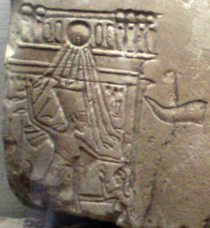
boundary stelae of years 4 and 5 mark the boundaries of the new city and suggest that the move to the new city of Akhetaten occurred around that time. commissioned to mark the first anniversary of the royal couple’s visit to Akhetaten, Nefertiti is shown at the same scale as the king, denoting her equal rank. (
In Egyptian artworks, the gods are the largest in size, with pharaohs being the next biggest - if they are portrayed. Generally speaking, people of higher status
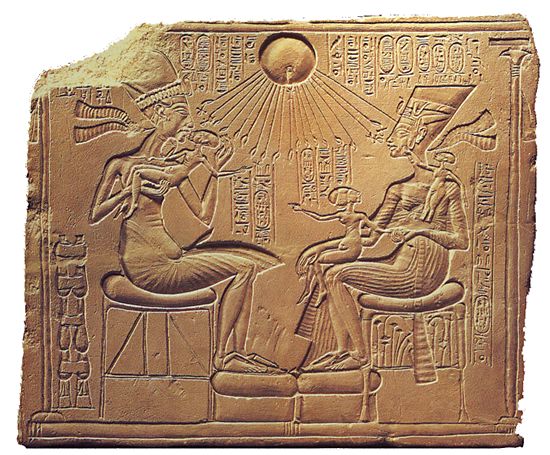
would be drawn or sculpted larger than inferiors. Normally the pharaoh is portrayed larger than his wives or children - see the image of Akhenaten and his family worshipping the Aten in the last post.) The inscription also heaps lavish praise upon Nefertiti: “Great in the palace, fair of face, adorned with the twin plumes, lady of joy who receives praises; one rejoices at the hearing of her voice, the King’s Great Wife whom he loves, the Lady of the Two Lands.”
Every public act that Akhenaten did Nefertiti mirrored. When he changed his name from Amenhotep to Akhenaten and his royal titles to include a reference to the Aten, for instance, she added an epithet to her own name (
Nefertiti = ‘the beautiful one has come’),
Nefer-nefru-Aten ‘beautiful are the beauties of the Aten’. While Akhenaten was viewed as
Shu, the primordial god of air and the son of the creator (
Atum in traditional mythology, another god conflated with Ra as
Atum-Ra - notice the pattern here?), Nefertiti in turn was identified with Shu’s sister-wife
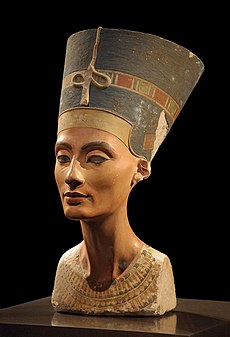
Tefnut. Nefertiti has adopted the goddess’ flat-topped headdress as her own, and made it the public symbol of her authority. In some eyes, Akhenaten and Nefertiti are joint rulers on earth with the Aten in heaven.