Female deacons?

  • Thread starter Thread starter Anonymous1970
  • Start date Start date
Status
Not open for further replies.
However, if one were to make the argument that the Alb should be worn: their argument is that anyone who enters the Sanctuary should wear an alb.

So that would mean that Lectors and Cantors should be wearing them too.
Fair point. It would also mean no lay-person speaking to the congregation at the end of Mass about various things, or no layperson speaking to the congregation before Mass (as happens on ocassion). We then also need to reinstate altar rails to create a clear separation between the sanctuary and the rest of the church.
 
Last edited:
I specifically used the term "female deacon’ because there is no gender differentiation between male deacons and female deacons in the Koine Greek which was used in the bible. Both use the word ‘diakonos’. The feminization of the term deacon to deaconess is a somewhat modern permutation and had no meaning in the early church. It does not seem to have been used before the sixteenth century. Yes, it is important to point out that what many protestant churches consider the office of deaconess to be was the role which female deacons in the early Church fulfilled, but it is unhistorical to call them that.
Nevertheless, the term “female deacon” is misleading.

If someone says “female dentist” that means that we’re discussing a dentist who just happens to be female. In other words, the exact same as a male dentist. The same with any other profession.

There were no female deacons in the early Church because they did not have the same role, nor did they receive ordination, as did the deacons.

The term “female deacon” is a mis-translation of the text because it implies something in English which is untrue.
 
Though she was an EMHC, there’s nothing that would prevent the church from having female deacons. The church cannot have female priests, but can have deaconesses as they assist the deacons and maybe can even have deacon roles as they’re in the liturgy role not the Eucharist role.

As long as they’re not the mass celebrant or consecrating the Eucharist (which they cannot do), there’s nothing in the church’s tradition that would prevent this. A female deacon might even be able to marry couples under the direction of a priest similar to what a male deacon can do now and what happened in our situation. It required a dispensation from the bishop, however as the deacon was our officiant in a Methodist church. So we have two officiating people on our marriage license (her childhood pastor & our Catholic deacon). We were supposed to have a third officiant but he cancelled at the last minute. That was definitely a letdown for my wife.
 
Last edited:
Yeah, I don’t like this at all.

Not because they are women, but because I fear it will be over run by members of the “women priests” movement.

I also fail to understand what the purpose of a Deaconess would be in today’s world? Unless we go back to naked baptism (which was a main purpose of the Deaconess), what will they do? Would they be given the ability to preach homilies (something they never were allowed to do)? From what I’ve read, the Deaconess did NOT have a role to play at mass. The only liturgical function they had involved helping with the Baptism of naked women.

So the question is what purpose would they serve and what would role would they fill that isn’t already being serviced by lay women?

Most importantly, I fear this will lead to the ordination of current “female dissenters” in many dioceses, and send the unintended message that female priests are on their way. I fear this is essentially just clericalizing women.
Take some comfort by putting it into context.

These new deaconesses will be serving missionary churches in the Congo.

I’ve never been there, but it seems to me that there could be a genuine need for women to assist at the baptism of other women; and likewise to help catechize them. I can see the benefit there.

You’re asking about “today’s world” if you mean OUR society then yes, but mission territory in the Congo is quite different from what most members here would consider to be their typical experiences.
 
Ask some women and they’ll give you the answer.
So what particular function requires a deacon who is female?

Is this whole argument about the needs of the Church or about the wishes of individuals?

The Anglican church started down this route, look where it has led you. It didn’t just stop at deacons did it?
 
Last edited:
So what particular function requires a deacon who is female?

Is this whole argument about the needs of the Church or about the wishes of individuals?

The Anglican church started down this route, look where it has led you. It didn’t just stop at deacons did it?
In tradition, the deaconess did support the roles of the deacon. They weren’t the head figure of the church, the celebrant, or consecrating the Eucharist. They weren’t one of the 12 apostles. Mary Magdalene did find an empty tomb. So woman had a role to play spiritually even if it wasn’t the head of the Church.

The Anglican church went in many wrong directions: pro gay-marriage including pro same-sex sexual attraction (mutual masturbation), female priests, a break an apostolic succession, and worst of all, not protecting the sanctity of life believing that abortion and a woman’s right to do with her body at least when it comes to supporting a baby for nine months trumps the life that is created.

But if a woman (or a man) can do with their body as they choose, what’s to prevent suicide or the use of illicit drugs? It dehumanizes the person and violates the dignity of every human life that God had intended.
 
Last edited:
Though she was an EMHC, there’s nothing that would prevent the church from having female deacons. The church cannot have female priests, but can have deaconesses as they assist the deacons and maybe can even have deacon roles as they’re in the liturgy role not the Eucharist role.

As long as they’re not the mass celebrant or consecrating the Eucharist (which they cannot do), there’s nothing in the church’s tradition that would prevent this. A female deacon might even be able to marry couples under the direction of a priest similar to what a male deacon can do now and what happened in our situation. It required a dispensation from the bishop, however as the deacon was our officiant in a Methodist church. So we have two officiating people on our marriage license (her childhood pastor & our Catholic deacon). We were supposed to have a third officiant but he cancelled at the last minute. That was definitely a letdown for my wife.
Lets make sure we are using proper terms:

A Deaconess isn’t necessarily the same thing as a “Female Deacon.”

Deacons receive the Sacarment of Holy Orders, a sacrament that is limited to men. So if Holy Orders is not applicable to women, you can’t have “female Deacons.”

A Deaconess on the other hand was a female who assisted the clergy with ministry to women, esp with baptism- since it used to happen in the nude.

Deaconess were typically widows and consecrated virgins, and PERHAPS also sometimes the wife of a Deacon or priest.

The role was not the same.

My issue with the return of Deaconess is “what will they do that lay women and religious sisters can’t already do?”


My issue with the return of Deaconess is “what will they do that lay women and religious sisters can’t already do?”
Quite frankly, nothing.

However, there is still a value to restoring (and I do mean an actual, authentic, honest restoration) an office of deaconess.

Just as we have deacons who are not members of religious orders, there can be a value to having deaconesses who are likewise not members of religious orders.

By having an office of deaconess instead of lay women, there is a structure and hierarchy. On the one hand, she can legitimately say that she represents the Church and she has been appointed by the bishop to perform that role. It likewise means that the bishop has a means of supervision.

It also goes without saying that a deaconess would have to undergo some formal training and spiritual formation before being installed. This could only be a good thing.

To expand on the second point, nuns/sisters have a proper role in the Church (an important one to be valued and upheld, surely). They have their own legitimate charisms. So, being a nun should not be the same as being a deaconess any more than we would say that being a brother should be the same thing as being a deacon.

The real problem is that if the Church were to truly and honestly restore the office of deaconess, it would not be anything like what certain people are now demanding. The ones clamoring for deaconesses now would be the most disappointed should such a thing actually happen.

 
40.png
phil19034:


My issue with the return of Deaconess is “what will they do that lay women and religious sisters can’t already do?”
Quite frankly, nothing.

However, there is still a value to restoring (and I do mean an actual, authentic, honest restoration) an office of deaconess.

Just as we have deacons who are not members of religious orders, there can be a value to having deaconesses who are likewise not members of religious orders.

By having an office of deaconess instead of lay women, there is a structure and hierarchy. On the one hand, she can legitimately say that she represents the Church and she has been appointed by the bishop to perform that role. It likewise means that the bishop has a means of supervision.

It also goes without saying that a deaconess would have to undergo some formal training and spiritual formation before being installed. This could only be a good thing.

To expand on the second point, nuns/sisters have a proper role in the Church (an important one to be valued and upheld, surely). They have their own legitimate charisms. So, being a nun should not be the same as being a deaconess any more than we would say that being a brother should be the same thing as being a deacon.

The real problem is that if the Church were to truly and honestly restore the office of deaconess, it would not be anything like what certain people are now demanding. The ones clamoring for deaconesses now would be the most disappointed should such a thing actually happen.
Well said Father
 
The ones clamoring for deaconesses now would be the most disappointed should such a thing actually happen.
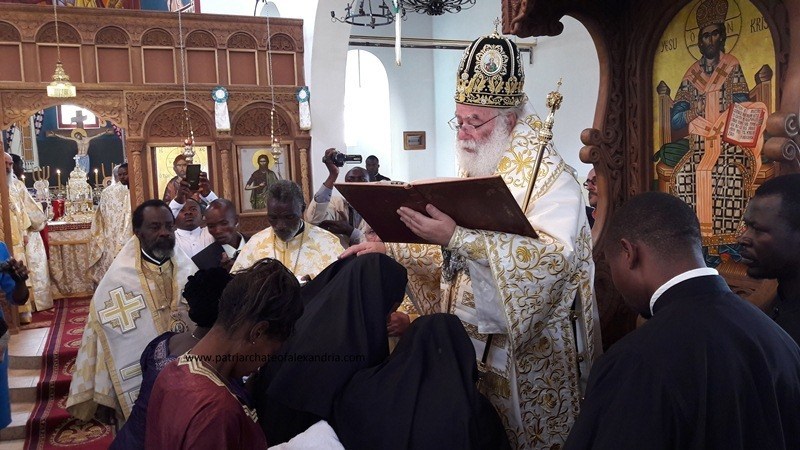
Agreed. It would be at most a ceremonial role. I realized that nuns weren’t members of the clergy or ordained ministers and lived a consecrated life with vows of chastity, poverty, and obedience.

I did think though that because deacons support the priest and aren’t performing the roles of priests that there might be an acceptable carve-out that could be acceptable.

Thanks for all the information.
 
Last edited:
We lay ministers have all that. .It’s already been done all across the US. We don’t need to be deaconesses.
 
Probably this will happen in cases of extreme shortage of men and priests like the situation is described to be in Congo, and the deaconesses will act mainly in missionary churches.
I would suggest this as a better source for the Patriarch’s actions

 
Yes, it is more informative. And the article states at the end that there is also a need to prepare the parishioners who will receive the deaconesses which is obviously a problem in itself.
 
Yes, it is more informative. And the article states at the end that there is also a need to prepare the parishioners who will receive the deaconesses which is obviously a problem in itself.
I think the Orthodox have a much much better chance of getting this right than if this were to be tried in the West.

If it were done in the West, it’s safe to predict that the abuses would be rampant and immediate. I would give it just a few weeks (if that) after the first installations and parish assignments before certain places, on a parish level, would begin the novelty of female deacons rather than deaconesses.

I shudder to think what a disaster it would be if the restoration of deaconesses were to occur, on an experimental basis, in some place like California, for example.

The Orthodox have a better perspective on keeping legitimate traditions as opposed to innovations (not to say that they don’t adapt–they do). As such, they’re more likely to have deaconesses as deaconesses and be willing to accept that.

I’m pleased that the Coptic Orthodox are the first to do this (in our time). We can trust that they will get it right. They can provide a model for a contemporary restoration of deaconesses for the rest to follow. Let us hope they do exactly that.
 
Status
Not open for further replies.
Back
Top