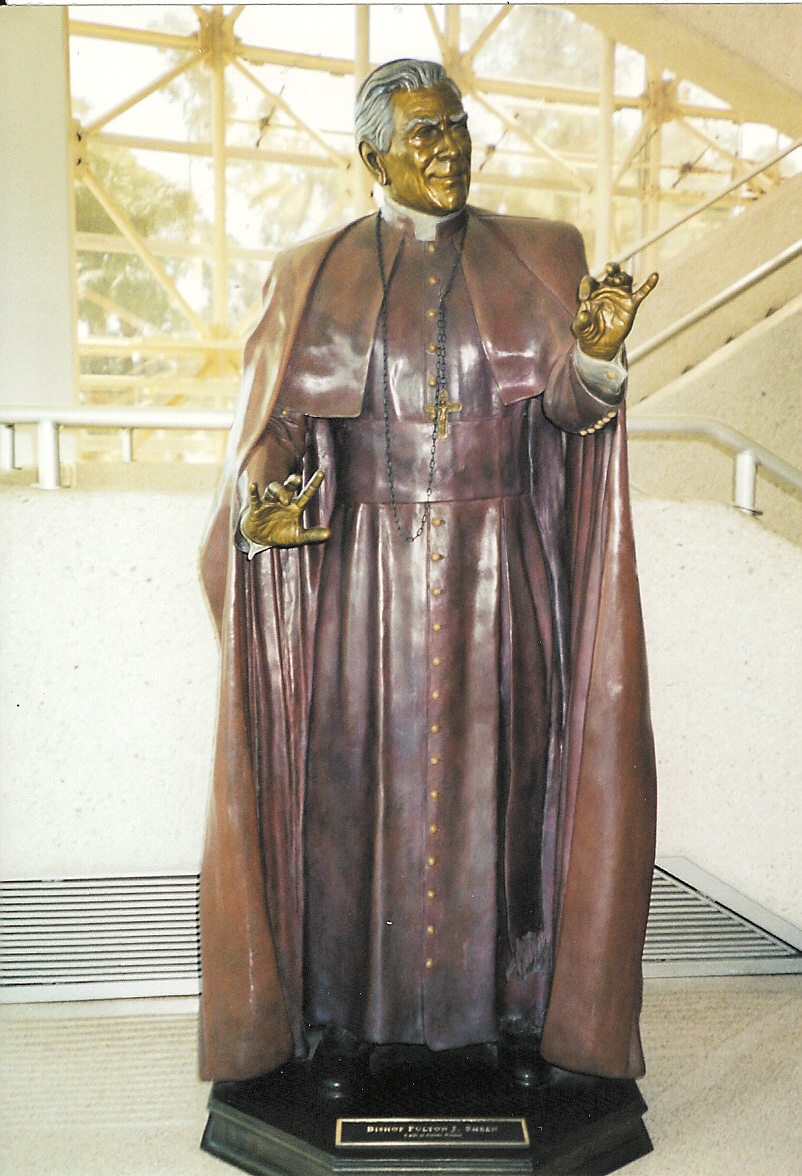
The Venerable Archbishop Fulton Sheen passed away while in the presence of our Lord in the Blessed Sacrament. Here’s something about it:
A selection from A Treasure in Clay, the autobiography of Archbishop Sheen.
On the day of my Ordination, I made two resolutions:
- I would offer the Holy Eucharist every Saturday in honor of the Blessed Mother to solicit her protection on my priesthood. The Epistle to the Hebrews bids the priest offer sacrifices not only for others, but also for himself, since his sins are greater because of the dignity of the office.
- I resolved also to spend a continuous Holy Hour every day in the presence of our Lord in the Blessed Sacrament.
In the course of my priesthood I have kept both of these resolutions. The Holy Hour had its origin in a practice I developed a year before I was ordained. The big chapel in St. Paul’s Seminary would be locked by six o’clock; there were still private chapels available for private devotions and evening prayers. This particular evening during recreation, I walked up and down outside the closed major chapel for almost an hour. The thought struck me - why not make a Holy Hour of adoration in the presence of the Blessed Sacrament? The next day I began, and the practice is now well over sixty years old.
Briefly, here are some reasons why I have kept up this practice, and why I have encouraged it in others:
First, the Holy Hour is not a devotion; it is a sharing in the work of redemption. Our Blessed Lord used the words “hour” and “day” in two totally different connotations in the Gospel of John. “Day” belongs to God; the “hour” belongs to evil. Seven times in the Gospel of John, the word “hour” is used, and in each instance it refers to the demonic, and to the moments when Christ is no longer in the Father’s Hands, but in the hands of men. In the Garden, our Lord contrasted two “hours” - one was the evil hour “this is your hour” - with which Judas could turn out the lights of the world. In contrast, our Lord asked: “Could you not watch one hour with Me?”. In other words, he asked for an hour of reparation to combat the hour of evil; an hour of victimal union with the Cross to overcome the anti-love of sin.
Secondly, the only time Our Lord asked the Apostles for anything was the night he went into his agony. Then he did not ask all of them … perhaps because he knew he could not count on their fidelity. But at least he expected three to be faithful to him: Peter, James and John. As often in the history of the Church since that time, evil was awake, but the disciples were asleep. That is why there came out of His anguished and lonely Heart the sigh: “Could you not watch one hour with me?” Not for an hour of activity did He plead, but for an hour of companionship.
The third reason I keep up the Holy Hour is to grow more and more into his likeness. As Paul puts it: “We are transfigured into his likeness, from splendor to splendor.” We become like that which we gaze upon. Looking into a sunset, the face takes on a golden glow. Looking at the Eucharistic Lord for an hour transforms the heart in a mysterious way as the face of Moses was transformed after his companionship with God on the mountain. Something happens to us similar to that which happened to the disciples at Emmaus. On Easter Sunday afternoon when the Lord met them, he asked why they were so gloomy. After spending some time in his presence, and hearing again the secret of spirituality - “The Son of Man must suffer to enter into his Glory” - their time with him ended and their “hearts were on fire.”
Read more