You hear calls for ethanol. What’s wrong with that? EROEI (energy return on energy invested). At one time for every barrel of oil equivolent energy put in an estimated 100 barrels oil was recovered that went to run economic GDP. Now it’s estimated to be 20 to 1.
Why is oil so impotant to population and food? A picture is worth a 1000 words
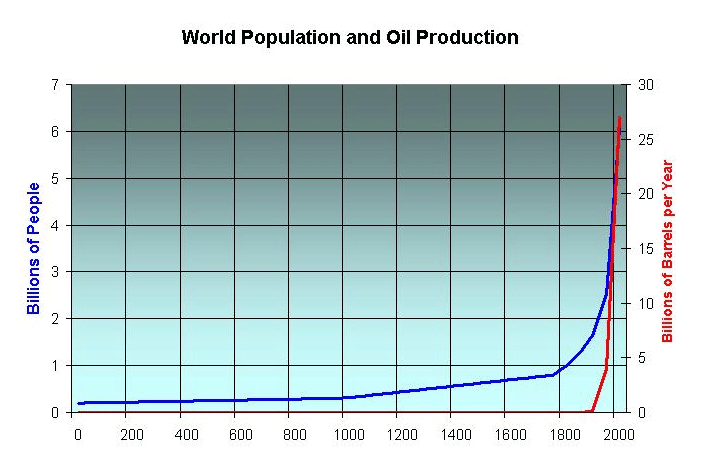
what happens to population when petroleum supplies truns south?
Leaving the petrochemicals out for now, are we going to use hydrogen for transportation? We mine oil and gas so, unlike hydrogen, we don’t have to use some energy source to make petroleum. Unlike oil were is was 100-1 net postive EROEI, hydrogen will always be a negative EROEI. So to use hydrogen we have to use someother source of energy to make it. What are we going to use? Coal? Nuclear? Wind? Solar? Hydro?
We have 100s of years of coal just here in the US don’t we? Or do we? What you always hear is that we have that much at “current rates of consumption.” But consumption never stays at current rates. On average consumption grows every year. For example: in 1991 the USGS estimated the US had 500 years of coal reserves. But from 1971 to 1991 the US rate of growth in coal usages grew on average
only 2.86% per year. If you put $100 in the savings at 7% interest this compound rate will grow to $200 in 10 years (70/rate%) and $400 by 20 years. So at a 2.86% compound use of coal, hypothitically, how long would that 500 year supply (at the then 1991 current usage) last? 70-96 years.
As oil depletes are we going to do what WWII Germany did and make liquid fuel from coal? Are we going to use coal to generate electricity for plug-in cars? Are we going to use it to generate electricity to crack hydrogen from water? If we do, what will the annual rate of consumption growth be? We are already using coal at a rate of 100 railcars every 5 minutes. At some point new railroad lines would have to be built just for logistics.
Nuclear: IIRC (trusting my memory) there are about 439 nuclear prower plants worldwide. Both Professors
David Goodstein of Caltech and
Richard Smalley of Rice argued that the world will need at least 10 terrawatts of energy by 2050. 10 terawatts is equal to 10,000 nuclear power plants generating 1 gigawatt each. But as Goodstein points out 10,000 nuclear plants, using lightwater reaction, would use up the estimated uranium supply in about “two decades.” We going to use breeder reactors? That give us more time. Of course you have the added problem of weapons grade material to go with it. And when are we going to start on this project?
As Samlley said in the above link: If he could put his pro growth, repulican right hand and flip a switch to turn on a gigawatt of power, he’d have to flip that switch everyday for 27 years to get to 10 terawatts.
So when is this peak oil petroleum cruch going to happen? Some say it already has. Technically, worldwide oil production has been flat sind 2005. Will we see average production declining soon, or will it stay flat for 10 to 15 years as former head of Saudi ARAMCO’s production and exploration (and Brown Universtiy Ph.D),
Dr Sadad Al-Husseini, now believes, or will production grow to 112 million barrels by 2017 as Dan Yergin (author of the “Prize”), chairman of CERA, believes?
CERA look at 811 large fields worldwide and came up with an estimated decline rate of 4.5% on existing fields. But at the Neil King, reporter for the Wall Street Journal, pointed out: a 4.5% decline is 4 million barrels per day loss. And it just so happens that Iran produces 4 million barrels per day. So, to keep annual production flat at 85-86 million per day a new Iran needs to be brought on line every year. CERA believes the oil industry is doing twice that amount. It needs to, because…to get to 112 million barrels per day by 2017 (nine years) the oil industry needs to bring on line the equivolent of 9 new Saudi Arabias. Will the industry be able to do this? Will geo politics hamper the logistics of doing so? Since people tend to believe whatever they want to I’ll leave that up to you.

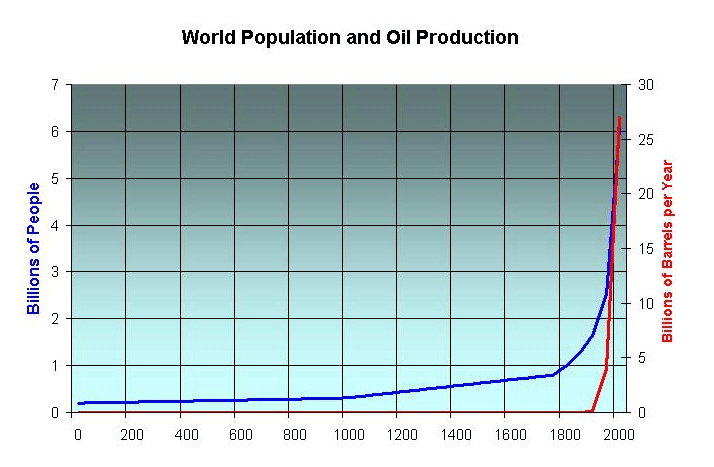
 Okay…no offense, Doug50, but this chart is a joke. You can play with data quite a lot if you adjust the scales, and that is just what is done in this chart. Rather than going with an x-axis from 0 AD to 2000+AD at 200 year increments, try changing it to an 1800AD to 2000+AD axis…not so dramatic.