
Golden Calf

  • Thread starter Thread starter PJD1987
  • Start date Start date
Status
Not open for further replies.
P

PJD1987

Guest
I was always told that Iconography in the Catholic Church is not idol-worship because we use it as meditation and to bring us closer to the Lord, not worshiping the statute or whatnot itself. However, in Bible Study today, one girl pointed out a note in the NAB on Exodus 32:5 which reads,

“The calf…a feast of the Lord: from this it is clear that the golden calf was intended as an image, not of a false god, but of the Lord Himself, His strength being symbolized by the strength of a young bull. The Israelites, however, had been forbidden to represent the Lord under any visible form. Cf Ex 20,4”

I had always thought they were worshiping the calf itself and therefore constituted false worship and idolatry. However, it’s clear from this note that the calf was a representation of the Lord. They were in the wrong for doing it, even though they were worshiping the Lord. How does this differ from Catholic icons?

I mean, I know that parts of the Mosaic Law no longer apply to us because of the New Covenant Jesus established, maybe I answered my own question in that, but I feel like there’s got to be a more in depth answer than just that which can be used to defend any number of Christian practices. I’m interested to see any thoughts on the subject that might take it a step further than simply, “the Mosaic Law no longer applies”.

Thank you in advance! God Bless!

-PJD1987
 
They were worshiping the calf. They were impatient waiting for Moses to come down off Mt. Sinai with the 10 commandments. So Aaron told the people to gather their gold and make a calf and they were worshiping it. Moses was very mad when he found out.

Exodus 32
7 With that, the LORD said to Moses, “Go down at once to your people, whom you brought out of the land of Egypt, for they have become depraved.
8 They have soon turned aside from the way I pointed out to them, making for themselves a molten calf and worshiping it, sacrificing to it and crying out, ‘This is your God, O Israel, who brought you out of the land of Egypt!’
9 I see how stiff-necked this people is,” continued the LORD to Moses.

Moses repremanded the people for what they had done.
30 On the next day Moses said to the people, “You have committed a grave sin. I will go up to the LORD, then; perhaps I may be able to make atonement for your sin.”

As Catholics, we read the Bible in context, not just one verse. Please take time to read the whole chapter of Exodus 32 and see that through Moses’ pleading with God, the people were given a second chance.
 
Never heard this idea about the calf representing God before at all, I’m not sure I buy that note. It’s a note, not actually Scripture anyway. But even so, we aren’t worshipping the image of a statue or icon itself, just using it as a visual to help us focus. It brings our sense of vision into a prayer and worship, so is an aid, that’s all. At least that’s what my RCIA Director said about this sort of thing.

But I’d be interested to hear what others have to say, especially about this note because it doesn’t seem to be the scenario that Scripture gives of the Israelites’ worship of the calf at all.
 
They were lapsing back into some of the practices from egypt. Worshiping a calf was one of them. They had gods with different forms, and one was a calf.

They made an image and used it as you would expect. The did not worship the material object itself but worshipped what it represented, what they believe was a god.
 
I was always told that Iconography in the Catholic Church is not idol-worship because we use it as meditation and to bring us closer to the Lord, not worshiping the statute or whatnot itself. However, in Bible Study today, one girl pointed out a note in the NAB on Exodus 32:5 which reads,

"The calf…a feast of the Lord: from this it is clear that the golden calf was intended as an image, not of a false god, but of the Lord Himself, His strength being symbolized by the strength of a young bull. The Israelites, however, had been forbidden to represent the Lord under any visible form. Cf Ex 20,4"

I had always thought they were worshiping the calf itself and therefore constituted false worship and idolatry. However, it’s clear from this note that the calf was a representation of the Lord. They were in the wrong for doing it, even though they were worshiping the Lord. How does this differ from Catholic icons?

I mean, I know that parts of the Mosaic Law no longer apply to us because of the New Covenant Jesus established, maybe I answered my own question in that, but I feel like there’s got to be a more in depth answer than just that which can be used to defend any number of Christian practices. I’m interested to see any thoughts on the subject that might take it a step further than simply, “the Mosaic Law no longer applies”.

Thank you in advance! God Bless!

-PJD1987
I find this note to be rather disturbing in light of the previous verses leading up to this. Look at Ex 32:1 and see if this is to be a “god” or just a representation of God
1 When the people saw that Moses delayed to come down from the mountain, the people gathered themselves together to Aaron, and said to him, “Up, make us gods, who shall go before us; as for this Moses, the man who brought us up out of the land of Egypt, we do not know what has become of him.”
Does this sound like the isrealites were making a mere representational “image”?

Another thing that disturbs me is the timing here. The NAB note is making use of a command that the Isrealites had not yet received. It refers back to vs 20:4 but this verse is God giving the commands to Moses and we know that Moses broke the tablets when he came down the Mountian (Ex 32:19),before these commands were promulgated to the tribes.
Why would God flair up so mightily agianst their making a “representation” of Him, when He hadn’t yet told them not to…
On the other hand, He had every right to flair up against them for making a replacement for Him after He had brought them out of Egypt by the working of many signs and wonders…

No I don’t think that note makes much sense.

Peace
James
 
Also remember that Israel had just left Egypt which worshipped cows specifically the great celestial cow who brought order out of the chaos. Then remember that Aaron said “this (cow) is the God who brought you out of the land of Egypt” thus combining Jehovah and the Egyptian Gods. This very sin (synchritism) is the same for which the people fell under condemnation when they placed Baal and Ashera next to the Altar of the LORD as well as when Jeroboam erected a golden cow in Dan and in Ephraim. This is not only a sin of idolatry, which it is, but also a sin of robbing God of the glory due Him by making Him equal to the pagan gods.

On the question of icons…

My favorite Saint is Augustine. When I read Augustine and meditate on his life I never think

“Augustine is so great I wish he were God or at least equal to God”

but rather

“Augustine was a flawed and fallen man who by grace was saved by God and having been saved devoted himself to the LORD and gave his days to the Church. He was mightily used by God in spite of his own admitted and various flaws, and I thank God for his grace in giving us Augustine to help us see God more clearly.”

Do you see the difference? If we meditate on the humble service of Mary or the quiet dignity of Joseph in what surely was a trying and embarrassing moment for him or on John’s life of love and peace or Peter in spite of his many flaws being used so mightily by God, are we worshipping these people or taking their example and using their lives to point us to the God who they worshipped who used them to show us the way? You see because God has never spoken to me, I rely on those to whom He has spoken and used and gifted to see Him and meditate on Him. And I think the Saints would say this is a proper and fitting service to God especially in that they devoted their whole lives to the proper and fitting service to God.

God Bless
 
As Catholics, we read the Bible in context, not just one verse. Please take time to read the whole chapter of Exodus 32 and see that through Moses’ pleading with God, the people were given a second chance.
With all due respect, I have read the whole chapter and I understand the fact that Moses was upset and plead with God who spared the people. It is not just taking one verse out of context, in fact I’m trying to apply it to a broader context in light of the New Testament and Catholic Practice and asking about the footnote of which I had never heard before.
 
They were lapsing back into some of the practices from egypt. Worshiping a calf was one of them. They had gods with different forms, and one was a calf.

They made an image and used it as you would expect. The did not worship the material object itself but worshipped what it represented, what they believe was a god.
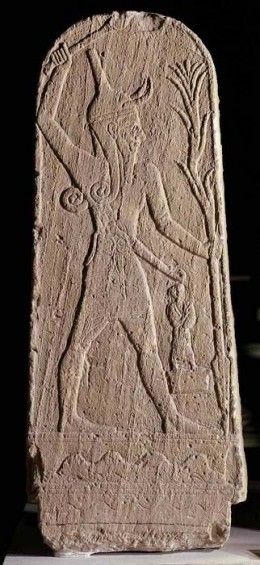
We need not just look at Egypt. Bull worship was a pretty common thing in the Ancient Near East. Because horned animals were symbols of strength and viritility, many a king and deity throughout the ANE were either portrayed with horns or were associated with these animals. The Canaanite gods El, his son the storm god Hadad (Ba’al), and Moloch, for example, were sometimes depicted in bovine form, or at least (as in the picture below) depicted with horns.

 
Another thing that disturbs me is the timing here. The NAB note is making use of a command that the Isrealites had not yet received. It refers back to vs 20:4 but this verse is God giving the commands to Moses and we know that Moses broke the tablets when he came down the Mountian (Ex 32:19),before these commands were promulgated to the tribes.

Why would God flair up so mightily agianst their making a “representation” of Him, when He hadn’t yet told them not to…
Apologies to Mr. Cecil B. DeMille, but his depiction of the Commandments being given in private (apparently to Moses only) as the ignorant Israelites were doing their own thing down the mountain is a little off. 😉

And the Lord said to Moses, “Go down and warn the people, lest they break through to the Lord to look and many of them perish. Also let the priests who come near to the Lord consecrate themselves, lest the Lord break out against them.” And Moses said to the Lord, “The people cannot come up to Mount Sinai, for you yourself warned us, saying, ‘Set limits around the mountain and consecrate it.’” And the Lord said to him, “Go down, and come up bringing Aaron with you. But do not let the priests and the people break through to come up to the Lord, lest he break out against them.” So Moses went down to the people and told them. And God spoke all these words, saying,

“I am the Lord your God, who brought you out of the land of Egypt, out of the house of slavery.
“You shall have no other gods before me.
“You shall not make for yourself a carved image, or any likeness of anything that is in heaven above, or that is in the earth beneath, or that is in the water under the earth. You shall not bow down to them or serve them, for I the Lord your God am a jealous God, visiting the iniquity of the fathers on the children to the third and the fourth generation of those who hate me, but showing steadfast love to thousands of those who love me and keep my commandments.”

If we go by the above passage from Exodus (and not by The Ten Commandments :D), God started to speak while Moses was down on the mountain with the Israelites. The Commandments was thus given publicly, in the sight and hearing of all the sons of Israel (thus, they were not ignorant of the ban all along - which makes their sin more grave! :p). Exodus 20:18-26 make this more explicit:

Now when all the people saw the thunder and the flashes of lightning and the sound of the trumpet and the mountain smoking, the people were afraid and trembled, and they stood far off and said to Moses, “You speak to us, and we will listen; but do not let God speak to us, lest we die.” Moses said to the people, “Do not fear, for God has come to test you, that the fear of him may be before you, that you may not sin.” The people stood far off, while Moses drew near to the thick darkness where God was.

And the Lord said to Moses, “Thus you shall say to the people of Israel: ‘You have seen for yourselves that I have talked with you from heaven. You shall not make gods of silver to be with me, nor shall you make for yourselves gods of gold. An altar of earth you shall make for me and sacrifice on it your burnt offerings and your peace offerings, your sheep and your oxen. In every place where I cause my name to be remembered I will come to you and bless you. If you make me an altar of stone, you shall not build it of hewn stones, for if you wield your tool on it you profane it. And you shall not go up by steps to my altar, that your nakedness be not exposed on it.’

God gives out three chapters’ worth of statutes, then after a short interlude down the mountain (Exodus 24), summons Moses up Sinai and continues to talk for seven more chapters. Only after that does He hand over the Tablets. If you read Exodus without Chuck Heston in your mind, you can see how much DeMille, master showman that he is, has left out or altered! 😃

For the record, the proclamation of the Commandments in the 1995 TV film Moses (starring Ben Kingsley in the title role) is more closer to the Biblical account: it is a public event, and is separate from the giving of the Tablets of the Law (which is never shown offscreen).
 
I was always told that Iconography in the Catholic Church is not idol-worship because we use it as meditation and to bring us closer to the Lord, not worshiping the statute or whatnot itself. However, in Bible Study today, one girl pointed out a note in the NAB on Exodus 32:5 which reads,

"The calf…a feast of the Lord: from this it is clear that the golden calf was intended as an image, not of a false god, but of the Lord Himself, His strength being symbolized by the strength of a young bull. The Israelites, however, had been forbidden to represent the Lord under any visible form. Cf Ex 20,4"

I had always thought they were worshiping the calf itself and therefore constituted false worship and idolatry. However, it’s clear from this note that the calf was a representation of the Lord. They were in the wrong for doing it, even though they were worshiping the Lord. How does this differ from Catholic icons?
If the ‘calf’ is indeed intended to be either a representation of the Lord as a bull in lieu of ANE deities or a representation of His heavenly mount like the fantastic, animal-human hybrid guardian beasts that were the mounts of gods and kings (cf. the cherubim) - in which case He would be pictured as invisibly riding upon the calf - then the sin here would be that (1) God had expressly told them not to make and worship cultic images, but here they are doing it anyway; and (2) related to (1), the Israelites were worshipping the Lord in the wrong manner, in express violation of what he has ordered them to do. In Exodus 20:22-26, just after God has proclaimed His commandments to the people, he tells Moses to make a simple altar of earth or stone for His worship (and later gives out instructions for the Tabernacle and its furnishings to Moses) with no idol - representation of Him or no - in sight: “you shall not make gods of silver to be with me, nor shall you make for yourselves gods of gold.” But did the Israelites do any of that in Exodus 32?

Note that all this occurred after they have ratified the Covenant, agreeing to its terms (Exodus 24)!

http://img208.imageshack.us/img208/8764/god20cherubimz.jpg

http://www.bible-people.info/gold_leaf_bull_phoenician.jpg
 
Apologies to Mr. Cecil B. DeMille, but his depiction of the Commandments being given in private (apparently to Moses only) as the ignorant Israelites were doing their own thing down the mountain is a little off. 😉

And the Lord said to Moses, “Go down and warn the people, lest they break through to the Lord to look and many of them perish. Also let the priests who come near to the Lord consecrate themselves, lest the Lord break out against them.” And Moses said to the Lord, “The people cannot come up to Mount Sinai, for you yourself warned us, saying, ‘Set limits around the mountain and consecrate it.’” And the Lord said to him, “Go down, and come up bringing Aaron with you. But do not let the priests and the people break through to come up to the Lord, lest he break out against them.” So Moses went down to the people and told them. And God spoke all these words, saying,

“I am the Lord your God, who brought you out of the land of Egypt, out of the house of slavery.
“You shall have no other gods before me.
“You shall not make for yourself a carved image, or any likeness of anything that is in heaven above, or that is in the earth beneath, or that is in the water under the earth. You shall not bow down to them or serve them, for I the Lord your God am a jealous God, visiting the iniquity of the fathers on the children to the third and the fourth generation of those who hate me, but showing steadfast love to thousands of those who love me and keep my commandments.”

If we go by the above passage from Exodus (and not by The Ten Commandments :D), God started to speak while Moses was down on the mountain with the Israelites. The Commandments was thus given publicly, in the sight and hearing of all the sons of Israel (thus, they were not ignorant of the ban all along - which makes their sin more grave! :p). Exodus 20:18-26 make this more explicit:

Now when all the people saw the thunder and the flashes of lightning and the sound of the trumpet and the mountain smoking, the people were afraid and trembled, and they stood far off and said to Moses, “You speak to us, and we will listen; but do not let God speak to us, lest we die.” Moses said to the people, “Do not fear, for God has come to test you, that the fear of him may be before you, that you may not sin.” The people stood far off, while Moses drew near to the thick darkness where God was.

And the Lord said to Moses, “Thus you shall say to the people of Israel: ‘You have seen for yourselves that I have talked with you from heaven. You shall not make gods of silver to be with me, nor shall you make for yourselves gods of gold. An altar of earth you shall make for me and sacrifice on it your burnt offerings and your peace offerings, your sheep and your oxen. In every place where I cause my name to be remembered I will come to you and bless you. If you make me an altar of stone, you shall not build it of hewn stones, for if you wield your tool on it you profane it. And you shall not go up by steps to my altar, that your nakedness be not exposed on it.’

God gives out three chapters’ worth of statutes, then after a short interlude down the mountain (Exodus 24), summons Moses up Sinai and continues to talk for seven more chapters. Only after that does He hand over the Tablets. If you read Exodus without Chuck Heston in your mind, you can see how much DeMille, master showman that he is, has left out or altered! 😃

For the record, the proclamation of the Commandments in the 1995 TV film Moses (starring Ben Kingsley in the title role) is more closer to the Biblical account: it is a public event, and is separate from the giving of the Tablets of the Law (which is never shown offscreen).
Frankly - I had no thought of the movie in mind as I was writing my post.
But I accept your correction on the context. It seems I need to go back and review the flow of the events…

Peace
James
 
They were worshiping the calf. The calf and/or female cow are representation of the Goddess Hathor (a goddess of fertility, cosmetics, perfumes, sex, music, beauty) in Ancient Egyptian culture. If the calf had been a bull instead then that would represent Ra, Apis, Amun, and the list goes on. The calf was most likely a goddess idol in Exodus. So in a way the Israelites were not only worshiping a false god, it was a feminine one. It would basically be like they were going against the idea of a Father in Heaven.
 
They were worshiping the calf. The calf and/or female cow are representation of the Goddess Hathor (a goddess of fertility, cosmetics, perfumes, sex, music, beauty) in Ancient Egyptian culture. If the calf had been a bull instead then that would represent Ra, Apis, Amun, and the list goes on. The calf was most likely a goddess idol in Exodus. So in a way the Israelites were not only worshiping a false god, it was a feminine one. It would basically be like they were going against the idea of a Father in Heaven.
That’s it. Because the text never explicitly identifies who the statue is supposed to represent (aside from Aaron’s cryptic comment in Exodus 32:4 “This is your God”/“these are your gods”; the Hebrew word for ‘God’/‘gods’ here, ’ĕlōheyḵā, is rather ambiguous and can be taken both ways - now the text does have ’ēlleh “these” in the plural, but the jury is still out on whether this usage indeed suggests a plurality of deities or whether this was a ‘plural of majesty’, influenced by the use of ’ĕlōheyḵā, or something else), we have a large pool of possible candidates. Because frankly, everywhere you turn, you’ll find bull/bovine worship. Levantine cultures (such as the Canaanites) did this, the Egyptians did this, Mesopotamian cultures (such as the Babylonians) did this, the Minoans did this. In fact aurochs, the ancestor of domestic cattle, are depicted in many Paleolithic European cave paintings such as those found at Lascaux and Livernon in France, which show a fascination with the animal even at so early a stage in human history. So for the Israelite this was a pretty easy error to fall into.

For the record, the word traditionally translated as “calf” here, 'egel, can actually also mean “young bull” or “bullock”. Note the choice of words here: some interpret the use of 'egel (‘calf’/‘young bull’) here as deliberate, to show contempt to the idol and belittle it.
 
Frankly - I had no thought of the movie in mind as I was writing my post.
But I accept your correction on the context. It seems I need to go back and review the flow of the events…

Peace
James
That’s it. Even if we consciously never think of it, DeMille’s conception of the events loom large over the minds of many folks today. Frankly, just how many people today picture the parting of the Reed Sea (nope, that’s not a misspelling :p) as the waters starting to part from the side where the Israelites are, when Exodus says:

And Moses stretcheth out his hand towards the sea, and Jehovah causeth the sea to go on by a strong east wind all the night, and maketh the sea become dry ground, and the waters are cleaved, and the sons of Israel go into the midst of the sea, on dry land, and the waters [are] to them a wall, on their right and on their left.

As any good map would tell you, the Israelites were journeying eastward toward the Promised Land. The account notes that the sea was parted by an “east wind,” which originates in the east and blows westward. So if the parting of the sea really happened like DeMille showed it, the sea would have parted from the opposite eastern shore first!
 
I was always told that Iconography in the Catholic Church is not idol-worship because we use it as meditation and to bring us closer to the Lord, not worshiping the statute or whatnot itself. However, in Bible Study today, one girl pointed out a note in the NAB on Exodus 32:5 which reads,

"The calf…a feast of the Lord: from this it is clear that the golden calf was intended as an image, not of a false god, but of the Lord Himself, His strength being symbolized by the strength of a young bull. The Israelites, however, had been forbidden to represent the Lord under any visible form. Cf Ex 20,4"
This also seems to be very strongly borne out by the context.

He took this from their hand, and fashioned it with a graving tool and made it into a molten calf; and they said, “This is your God, O Israel, who brought you up from the land of Egypt.” 5 Now when Aaron saw this, he built an altar before it; and Aaron made a proclamation and said, “Tomorrow shall be a feast** to the LORD**.” 6 So the next day they rose early and offered burnt offerings, and brought peace offerings; and the people sat down to eat and to drink, and rose up to play. 7 Then the LORD spoke to Moses, "Go down at once, for your people, whom you brought up from the land of Egypt, have corrupted themselves. 8 "They have quickly turned aside from the way which I commanded them. They have made for themselves a molten calf, and have worshiped it and have sacrificed to it and said, `This is your God, O Israel, who brought you up from the land of Egypt!’ "
 
I guess my question becomes then (since it’s the consensus that they were worshiping the calf): Why does the footnote state something completely contradictory to the text and what everyone here is saying?

I’m very confused :confused:

And if someone could comment on the correlation I was trying to make between what they were doing and Catholic statutes and icons, that would be great.

Thank you for all your wonderful responses.

God Bless,
Paul
 
I guess my question becomes then (since it’s the consensus that they were worshiping the calf): Why does the footnote state something completely contradictory to the text and what everyone here is saying?

I’m very confused :confused:

And if someone could comment on the correlation I was trying to make between what they were doing and Catholic statutes and icons, that would be great.

Thank you for all your wonderful responses.

God Bless,
Paul
Well I can’t really say why the footnote says what it dones…

As for statues and icons the simplest answer would be that no catholic would say they were worshiping the statue or icon, which is precisely what Scripture says the Isrealites were doing before the golden calf.
In addition, think about it, if you go into a stor to buy a picture or statue, what do you ask for? Isn’t it usuallly something like, “I’d like to by a Sacred Heart statue”. Or you might say, " What a lovely picture of Jesus"…You’d never go in thinking you were buying “Jesus”. You know full well that you are buying an image, an artists conception of Jesus.

Big difference.

Peace
James
 
Status
Not open for further replies.
Back
Top