Having some difficulty with accepting the Brown Scapular

  • Thread starter Thread starter LifeInSunshine
  • Start date Start date
Status
Not open for further replies.
I loath to introduce here a term attributed to John Calvin, but I don’t know another one that expresses this idea as well: “irresistible grace.” I don’t mean that God deprives us of choice in some situations. Rather, I mean that in some situations God offers something that he knows the human will find irresistible, like offering meatloaf and mashed potatoes or cake and ice cream to someone who has not eaten anything for two weeks.
“Irresistible grace.” I was introduced to that term at a church gathering that featured speakers from the Ligonier Ministries (Reformed Church). They used the term extensively in their salvation message which was tied into a rather skewed teaching or of the doctrine of predestination.

I don’t quite understand your bringning the term into this, but what do you think? Do you also believe that sometimes God doesn’t allow a “no” from us so that He can fulfill His plans? Another example would be Noah. He was ordered by God to build an ark. Had Noah not done so, every living creature would have been destroyed in the great flood.

Come to think of it, we don’t always give our kids and grandkids choices either. 🙂
 
NOTE: All bolding in quotations is mine.
APOLOGY: Please accept my apology for (1) writing such a long post (I have never written one as long as this one before) and; (2) for allowing the thread to be taken off-topic. I didn’t mean for this to happen. I wanted to express my appreciation to all who posted information about the Brown Scapular. I didn’t expect my faith in the Catholic Church to be questioned and attacked in such a way.
Because we are going off topic (though I think it’s important), I’m going to take extra time to try and shorten my response to you. No need to apologize! Hopefully I’ll get to this tomorrow.
 
Good morning, LittleSolder! 🙂 As hoped for, I was able to tend to this matter of the fear of the Lord this morning, so here goes…
**
Quote from article: “Today, it seems to me, most prefer to dwell upon the love of God, yet find no durable comfort in it. Love of the world pervades the visible church, instead of a hatred for sin. Fear of man prevails, and God is a convenience for Sundays and emergencies. There is no comfort in such a thing.”**

Your comment: “On the contrary, I find much comfort when dwelling upon the love of God, and this comfort is durable.”

My response: I think we all like to find comfort in love, LittleSoldier. What I think the author is getting at here is that until we appreciate another side of God, in which His wrath burns against sin and evil, we can’t fully appreciate His love. I think the author’s point is true that in our churches today, we have an unbalanced representation of God. He is portrayed as One who exudes the “warm and fuzzies” that we look to as love and ignore God’s hatred for sin and evil.

I agree somewhat with what is written here, but I believe that hatred of sin should not exist because of fear of God’s wrath; rather it should exist because sin hurts and offends God who loves us.

Quote from the article: “It sins carelessly, obstinately, persistently. While it trembles at the displeasure of men, and swoons in their praise, it is callous to God, unconcerned with being offensive to God, unconcerned for His pleasure. It says, “No one will know. No one is perfect. Don’t be so judgmental and legalistic!” It complains at exhortation, despises reproof and instruction, refuses to submit, seeks its own way, and justifies itself.
**
And what does the fear of the Lord look like? “The fear of the LORD is to hate evil.” (Pr 8:13) Fundamentally, it is a disposition to hate sin. It is a hatred of sin that moves one to depart from it: “by the fear of the LORD men depart from evil.” (Pr 16:6). The fear of the Lord will not disobey God, regardless of the consequences. It will seek to know God’s will and follow after Him. It loves instruction in holiness and the knowledge of God, of His ways and of His pleasure.”**

Your Comment: “This makes it appear that “fear of the Lord” is some sort of creature with volition and emotions."

My response: I thought it was an effective way of describing what the “fear of the Lord’ is. I don’t think the author intended it to have its own volition and emotions.

Your comment: “I agree somewhat with what is written here, but I believe that hatred of sin should not exist because of fear of God’s wrath; rather it should exist because sin hurts and offends God who loves us.”

My response: Somewhere in the article, the author did touch on your point - that hatred of sin should exist because sin hurts and offends God. I can’t find it now and I’m running out of time. But the reality still exists that God absolutely abhors sin and His wrath burns against it. Much is said about the wrath of God in scripture and it’s worth a study.

Thankfully the author does touch on the positive – “Certainly, in the fear of the Lord, there is comfort. It is the comfort of eternal safety, of strong confidence (14:26). It brings the assurance of being grounded on the rock (Matt 7:25), the hope of God’s ultimate purpose being fulfilled in us, the joy of His name being magnified, the fullness of His good pleasure in us.”
Well, my time’s up for now and this turned out to be much longer than I’d hoped for. Final word on this comes from Proverbs 9:10 - “The fear of the LORD is the beginning of wisdom: and the knowledge of the holy is understanding.”
 
I have a question about the brown scapular as well.
Does it have to be the Mount Carmel Scapular? I have a brown scapular of Our Lady of the Seven Sorrows. Will a person wearing this scapular obtain the benefits of the brown scapular of Mt. Carmel?
Thank you for your answers…Joan
 
Good morning, LittleSolder! 🙂 As hoped for, I was able to tend to this matter of the fear of the Lord this morning, so here goes…
**
Quote from article: “Today, it seems to me, most prefer to dwell upon the love of God, yet find no durable comfort in it. Love of the world pervades the visible church, instead of a hatred for sin. Fear of man prevails, and God is a convenience for Sundays and emergencies. There is no comfort in such a thing.”**

Your comment: “On the contrary, I find much comfort when dwelling upon the love of God, and this comfort is durable.”

My response: I think we all like to find comfort in love, LittleSoldier. What I think the author is getting at here is that until we appreciate another side of God, in which His wrath burns against sin and evil, we can’t fully appreciate His love. I think the author’s point is true that in our churches today, we have an unbalanced representation of God. He is portrayed as One who exudes the “warm and fuzzies” that we look to as love and ignore God’s hatred for sin and evil.

I agree somewhat with what is written here, but I believe that hatred of sin should not exist because of fear of God’s wrath; rather it should exist because sin hurts and offends God who loves us.

Quote from the article: “It sins carelessly, obstinately, persistently. While it trembles at the displeasure of men, and swoons in their praise, it is callous to God, unconcerned with being offensive to God, unconcerned for His pleasure. It says, “No one will know. No one is perfect. Don’t be so judgmental and legalistic!” It complains at exhortation, despises reproof and instruction, refuses to submit, seeks its own way, and justifies itself.
**
And what does the fear of the Lord look like? “The fear of the LORD is to hate evil.” (Pr 8:13) Fundamentally, it is a disposition to hate sin. It is a hatred of sin that moves one to depart from it: “by the fear of the LORD men depart from evil.” (Pr 16:6). The fear of the Lord will not disobey God, regardless of the consequences. It will seek to know God’s will and follow after Him. It loves instruction in holiness and the knowledge of God, of His ways and of His pleasure.”**

Your Comment: “This makes it appear that “fear of the Lord” is some sort of creature with volition and emotions."

My response: I thought it was an effective way of describing what the “fear of the Lord’ is. I don’t think the author intended it to have its own volition and emotions.

Your comment: “I agree somewhat with what is written here, but I believe that hatred of sin should not exist because of fear of God’s wrath; rather it should exist because sin hurts and offends God who loves us.”

My response: Somewhere in the article, the author did touch on your point - that hatred of sin should exist because sin hurts and offends God. I can’t find it now and I’m running out of time. But the reality still exists that God absolutely abhors sin and His wrath burns against it. Much is said about the wrath of God in scripture and it’s worth a study.

Thankfully the author does touch on the positive – “Certainly, in the fear of the Lord, there is comfort. It is the comfort of eternal safety, of strong confidence (14:26). It brings the assurance of being grounded on the rock (Matt 7:25), the hope of God’s ultimate purpose being fulfilled in us, the joy of His name being magnified, the fullness of His good pleasure in us.”
Well, my time’s up for now and this turned out to be much longer than I’d hoped for. Final word on this comes from Proverbs 9:10 - “The fear of the LORD is the beginning of wisdom: and the knowledge of the holy is understanding.”
I do hope you will respond to the rest of my post. Please take your time - I’m not going anywhere. I feel the article you referenced is absolutely incorrect and I have posted an article which is much more in line with my views on “fear of God.” Maybe there is a way to start a new thread by copying and pasting to form a new OP. Let me think about that possibility for a bit. I’m aware we have taken this thread off-topic but I think what I have written is extremely important and I want to see your responses.

Most holy Mother, please pray for us
who struggle with faith and understanding;
please pray that we are given wisdom.
 
I do hope you will respond to the rest of my post. Please take your time - I’m not going anywhere. I feel the article you referenced is absolutely incorrect and I have posted an article which is much more in line with my views on “fear of God.” Maybe there is a way to start a new thread by copying and pasting to form a new OP. Let me think about that possibility for a bit. I’m aware we have taken this thread off-topic but I think what I have written is extremely important and I want to see your responses.

Most holy Mother, please pray for us
who struggle with faith and understanding;
please pray that we are given wisdom.
I was thinking the same thing today - that a new thread on the topic of God’s Love and God’s Wrath would be fitting. Go ahead if you want to…I’ll find you! 🙂
 
I have a question about the brown scapular as well.
Does it have to be the Mount Carmel Scapular? I have a brown scapular of Our Lady of the Seven Sorrows. Will a person wearing this scapular obtain the benefits of the brown scapular of Mt. Carmel?
Thank you for your answers…Joan
The Mt. Carmel Scapular/Brown Scapular can be purchaed for a nominal fee at any religious store or online or from the Carmelites and needs a special blessing. But it is NOT the same thing as what I think you have. The Brown Scapular requires one to participate in the confraternity or become a 3rd order Carmelite to gain the promises.

I think you have what is called The Black Scapular of the Seven Dolors of Mary," or “The Our Lady of Sorrows Scapular”. It has on its front a depiction of Our Lady of Sorrows. This has its own unique promises and is associate with the Servite Order who are devoted to honoring Mary’s 7 sorrows as prophesied by Simeon. You may enroll in the The Confraternity of Our Lady of Sorrows and participate in all the benefits of the Servites daily prayers and devotions.
Seven Dolors Promises:
  1. “I will grant peace to their families.”
  2. “They will be enlightened about the divine mysteries.”
  3. “I will console them in their pains and I will accompany them in their work.”
  4. “I will give them as much as they ask for as long as it does not oppose the Adorable Will of my Divine Son or the sanctification of their souls.”
  5. “I will defend them in their spiritual battles with the infernal enemy and I will protect them at every instant of their lives.”
  6. “I will visibly help them at the moment of their death; they will see the face of their mother.”
  7. “I have obtained (this Grace) from my Divine Son, that those who propagate this devotion to my tears and sorrows, will be taken directly from this earthly life to eternal happiness since all their sins will be forgiven and my Son will be their eternal consolation and joy.”
More info here on the black scapular:
en.wikipedia.org/wiki/Seven_Dolors_of_Mary

and here:
marysprayersrosaries.com/sevensorrows.asp

You may want to join The Confraternity of Our Lady of Sorrows to participate in all their prayers.

===
If you want to get 5 of the most popular scapulars all in one and work on all 5 of the devotions check out the 5 fold scapular:

The Fivefold Scapular is a sacramental made up of the five most popular scapulars in the Catholic Church: the Brown Scapular, the Blue Scapular, the Black Scapular, the Red Scapular, and the White Scapular.

en.wikipedia.org/wiki/Fivefold_Scapular

James
 
Thank you JVD for the very enlightening post!
It was exactly what I wanted to know!
God Bless!
Joan 🙂
 
Hi all! I am currently in the process of converting to Catholicism (previously Protestant) and am having a wonderful time learning Church teachings. Most teachings I am able to prayerfully accept, but the only one that I am seriously confused about is the use of the Brown Scapular. From what I’ve been reading online, the Brown Scapular was given to a member of the Church by Mary, with her promise that she would save its devout wearers from purgatory early.
What bothers/concerns me about the scapular is this: how can we be assured heaven by wearing a garment, albeit a blessed one? I know that the scapular is not supposed to be viewed as a magical object, but how can it not be when we are granted a lessened stay in Purgatory for wearing it?
I really don’t mean to be offensive on the subject, I’m just confused!
Any help on the subject would be greatly appreciated 🙂

Sources I’m reading from:
sistersofcarmel.com/brown-scapular-information.php
The other day I was paying for a meal at the cafeteria and I looked up to notice that the cashier person was wearing a Rosary around his neck.

Seeing the Rosary gave me an interior joy because not very many people know that I carry one in my pocket at all times and I pray it everyday so, I thought I had found someone who shares my devotion.

Not so. I said, " oh, you’re a catholic! I didn’t know"…(naive huh?) He said, " oh no, I just wear that…"

Oh! was my reply. He must’ve seen my sadness but nothing else was said.
I have never seen him wearing a Rosary around his neck ever again after that day.

The promises that the Immaculate, Perpetual Virgin, Mother of God has attached to the Brown Scapular must be believed. Otherwise its just an irreverent fashion accessory - meaningless to the wearer.

Similar to [Madonna’s] Rosary wearing trend…pearls to the pigs and holy things to the dogs…

Hope this helps.
 
It seems funny to me to think that someone would wear a scapular as a fashion accessory because when people see mine and ask me what it is, I get one of two reactions: either a big genuine smile when I show them the representations of the sacred hearts of Mary and Jesus, or a disappointed and patronizing “Oh”, as if they wished they hadn’t asked; but mostly it’s ignored or overlooked by others, so that it’s something private- and that’s the way I like it.
 
Just when you think it can’t get any worse, a little more research brings on more shocking revelation about the brown scapular. Quotation from: memorare.com/mary/scapularbrown.html
"* Enrollment involves a priest blessing the first brown scapular with this prayer:

Receive this blessed habit; praying the most holy Virgin, than by Her merits thou may wear it without stain; and that She may guard thee from all evil and bring thee to life everlasting. R. Amen. By the power granted me, I admit thee to the participation of all the spiritual good works, which through the gracious help of Jesus Christ are performed by the religious of Mount Carmel. In the name of the Father, and the Son, + and of the Holy Spirit. R. Amen.

May the Creator of Heaven and earth, Almighty God, bless + thee; Who has deigned to unite thee to the confraternity of the Blessed Virgin Mary of Mount Carmel. We beseech Her, in the hour of thy death, to crush the head of the old serpent; so that thou may in the end win the everlasting palm and crown of the heavenly inheritance. Through Christ our Lord. R. Amen."*

Correct me if I’m wrong, but it seems like the bolded portion is in reference to Genesis 3:15 - "And I will put enmity
Between you and the woman,
And between your seed and her Seed;
He shall bruise your head,
And you shall bruise His heel.”

Again, a deliberate attempt to credit Mary with the work of Jesus. Please, please. Anyone taken up with this devotion - have a look for yourself and study God’s word, allowing Him to guide and direct your paths. This whole issue of the scapular takes you away from Jeus, it does nothing to bring you to faith in Him. It is intended to direct your focus to Mary instead.
 
…
May the Creator of Heaven and earth, Almighty God, bless + thee; Who has deigned to unite thee to the confraternity of the Blessed Virgin Mary of Mount Carmel. We beseech Her, in the hour of thy death, to crush the head of the old serpent; so that thou may in the end win the everlasting palm and crown of the heavenly inheritance. Through Christ our Lord. R. Amen."
Correct me if I’m wrong, but it seems like the bolded portion is in reference to Genesis 3:15 - "And I will put enmity
Between you and the woman,
And between your seed and her Seed;
He shall bruise your head,
And you shall bruise His heel.”

Again, a deliberate attempt to credit Mary with the work of Jesus. Please, please. Anyone taken up with this devotion - have a look for yourself and study God’s word, allowing Him to guide and direct your paths. This whole issue of the scapular takes you away from Jesus, it does nothing to bring you to faith in Him. It is intended to direct your focus to Mary instead.

You need to take into consideration that the Catholic Church is ancient. We are 2,000 years old. There are old traditions held since the earliest times that form our culture as a people. Not as many Catholic know the old traditions (little t) in the modern church here in the USA but in the “old country” and among the religious orders it is held that Mary would be the one who crushed the head of the serpent. There is much old art and statutes that depict this belief. Part of it comes from ambiguities in the ancient languages as to the gender of the subject being addressed in the Genesis verses you cite. English has no ambiguities (except when using “men” to mean humanity) as to which sex is the subject since we have no masculine and feminine forms of words as do Latin, Aramaic, Greek, Hebrew etc… So in our translations of the Old Testament there are nuances and word plays that are completely lost to us in the translations - there are just no expressions that can “get us there” unless one injects the underlying foreign word itself. You are using a Genesis verse translation that has elected to read-in its own theology - the translators have acted as the magisterium for you and pushed you along a course of thought and semantic that they in their (infallable?) judgement think is best for you. It is essentially their belief - not necessarily God’s word as you imagine it or as you render it in your own religious context and traditions. This phenomena, not unique to this case, is why some Catholic smile or get perturbed at the very idea of a Protestant bible where publishers and ordinary secular men act on their own pedigree and initiative as their own secular magisterium. In fact it was such oridinary men acting from an economic motive who elected to stop publishing the deuterocanonical texts that were in the original Protestant bibles as reference material (saved them shipping & publishing costs and bumped the margins of profit).

Here is the translation from Douay Rheims. See how it all completely changes.

Genesis 3:15 [Douay Rheims] regarding the serpent, “I will put enmities between thee and the woman, and thy seed and her seed: she shall crush thy head, and thou shalt lie in wait for her heel.”

Thus there is a longstanding Catholic tradition that toward the End of Time the Blessed Virgin Mary will crush the head of Satan, after her devotees have promoted her honor and devotion and directed countless prayers for her intercession during a long period of that time.

The Holy Father Blessed Pius IX wrote on this score in his bull Ineffabilis Deus, declaring the dogma of the Immaculate Conception of the Blessed Virgin Mary [December 8, 1854] stated: “Hence, just as Christ, the Mediator between God and man, assumed human nature, blotted the handwriting of the decree that stood against us, and fastened it to the cross, so the most holy Virgin, united with Him by a most intimate and indissoluble bond, was with Him and through Him, eternally at enmity with the evil serpent, and most completely triumphed over him, and thus crushed his head with her immaculate foot.”

The differences result from the ambiguity of the Hebrew as to who will do the crushing and whose heel will be struck at.

There is an interesting article on EWTN worth reading. Here is a snippet:

The Douay-Rheims Latin Vulgate Translation of Gen. 3:15 said:
ewtn.com.au/vexperts/showmessage.asp?Pgnu=1&Pg=Forum8&recnu=1&number=563958

When Pope John Paul II published the latest version of the Vulgate in 1999, the Latin reflects this ambiguity. It says “ipsum conteret” (he or it will crush), as does what follows “eius calcaneum” (his to its heel). While his promulgation of the Vulgate merely confirms the ambiguity of the scholarly trend, it is not one that should trouble Catholics. If the text says, “he shall crush the head of the serpent and it shall strike at his heel,” it merely affirms what the Catholic faith has always affirmed, the defeat of Satan is the work of Christ. In this, Mary’s role as his singular cooperator, as the Woman, the New Eve, is contained, not diminished. As many saints and mystics have said, her role will be uniquely important preceding the Second Coming, as it was preceding the First. That role depends on who and what she is in salvation history, and not on this text.

James
 
You need to take into consideration that the Catholic Church is ancient. We are 2,000 years old. There are old traditions held since the earliest times that form our culture as a people. Not as many Catholic know the old traditions (little t) in the modern church here in the USA but in the “old country” and among the religious orders it is held that Mary would be the one who crushed the head of the serpent. There is much old art and statutes that depict this belief. Part of it comes from ambiguities in the ancient languages as to the gender of the subject being addressed in the Genesis verses you cite. English has no ambiguities (except when using “men” to mean humanity) as to which sex is the subject since we have no masculine and feminine forms of words as do Latin, Aramaic, Greek, Hebrew etc… So in our translations of the Old Testament there are nuances and word plays that are completely lost to us in the translations - there are just no expressions that can “get us there” unless one injects the underlying foreign word itself. You are using a Genesis verse translation that has elected to read-in its own theology - the translators have acted as the magisterium for you and pushed you along a course of thought and semantic that they in their (infallable?) judgement think is best for you. It is essentially their belief - not necessarily God’s word as you imagine it or as you render it in your own religious context and traditions. This phenomena, not unique to this case, is why some Catholic smile or get perturbed at the very idea of a Protestant bible where publishers and ordinary secular men act on their own pedigree and initiative as their own secular magisterium. In fact it was such oridinary men acting from an economic motive who elected to stop publishing the deuterocanonical texts that were in the original Protestant bibles as reference material (saved them shipping & publishing costs and bumped the margins of profit).
Thank you for that bit of historical background. Now the question remains as always - what is the truth?
Here is the translation from Douay Rheims. See how it all completely changes.
Genesis 3:15 [Douay Rheims] regarding the serpent, "I will put enmities between thee and the woman, and thy seed and her seed: she shall crush thy head, and thou shalt lie in wait for her heel."
Interestingly, the Revised Standard Version Catholic Edition words Genesis 3:15 this way: “I will put enmity between you and the woman, and between your seed and her seed; he shall bruise your head, and you shall bruise his heel.”
So we have two opposing versions. Again, we’re left with the question - What is the truth?
Which Catholic version is correct? It’s not possible for both to be right.
Thus there is a longstanding Catholic tradition that toward the End of Time the Blessed Virgin Mary will crush the head of Satan, after her devotees have promoted her honor and devotion and directed countless prayers for her intercession during a long period of that time.
While that may be Catholic tradition, I don’t find anything in scripture that would substantiate it. Instead, the main theme of the Bible directs us to Jesus Christ and His conquer over Satan and sin. Right from Genesis to Revelation. I would have to ask myself, if I were Catholic, which version of Genesis 3:15 is consistent with the main theme of scripture - Douay Rheims or RSV Catholic Version? What makes more sense - the Conquerer bruises Satan’s head or the one who gave birth to the Conquerer?
The Holy Father Blessed Pius IX wrote on this score in his bull Ineffabilis Deus, declaring the dogma of the Immaculate Conception of the Blessed Virgin Mary [December 8, 1854] stated: “Hence, just as Christ, the Mediator between God and man, assumed human nature, blotted the handwriting of the decree that stood against us, and fastened it to the cross, so the most holy Virgin, united with Him by a most intimate and indissoluble bond, was with Him and through Him, eternally at enmity with the evil serpent, and most completely triumphed over him, and thus crushed his head with her immaculate foot.”
If I had the time right now, I would like to write an exhaustive refuation of that dogma, but it would end up as a book and wouldn’t fit anywhere here. 🙂 For now, I would just urge everyone to go to your Bibles to see if that sort of dogma is consistent with scripture. My short answer to that is a resounding “no”. It is yet another attempt to elevate Mary’s position to what only Jesus could do. We must never take our focus off Christ. He is the Conquerer over Satan and our Deliverer from Satan’s evil forever and ever.

I am almost in agreement with your last paragrah, but don’t have time to get into it just now…more later. Have a good day!
 
Thank you for that bit of historical background. Now the question remains as always - what is the truth?
Both renderings are the truth. Here’s how:

Here’s Jimmy Akin’s elaboration on this:This Rock:WHO WILL CRUSH THE SERPENT’S HEAD? By James Akin

Emphasis mine.

*The difference turns on who will crush the serpent’s head and whom the serpent tries to strike. The Douay-Rheims uses feminine pronouns—“she” and “her”—implying that the woman is the person being described. Modern translations use masculine pronouns—“he” and “his”—implying that the seed of the woman is the serpent-crusher.

This disparity results from a manuscript difference. Modern translations follow what the original Hebrew of the passage says. The Douay-Rheims follows a textual variant found in many early Fathers and some editions of the Vulgate, though not the original. Jerome followed the Hebrew of this text in his edition of the Vulgate. The variant probably originated as a copyist’s error, when a scribe failed to note that the subject of the verse had shifted from the woman to the seed of the woman.

Today, people notice this variant because the expression found in the Douay-Rheims has been the basis of popular Catholic art showing a serene Mary standing over a crushed serpent. Her representation as Our Lady of Grace usually depicts her in this way.

Christians have recognized since the first century that the woman and her seed of Genesis 3:15 do not simply stand for Eve and one of her righteous sons, such as Abel or Seth. They prophetically foreshadow Mary and Jesus. The first half of the verse (speaking of the enmity between the serpent and the woman) has been applied to Mary, and so the second half (speaking of the crushed head and heel striking) also has been applied to Mary.

Though the variant that uses “she” and “her” probably came from a copyist’s error, the idea it expresses is true. There is a [ed: valid scriptural] sense in which Mary crushed the serpent’s head and in which she was struck at by the serpent. She didn’t do these things directly, but indirectly, through her Son. It was Jesus who directly crushed the serpent’s head from the cross and Jesus whom the serpent directly struck on the cross. Yet Mary cooperated in these events.

She, not anyone else, was the person who agreed to become the human channel through which Christ would enter the world in order to crush the serpent’s head (Luke 1:38). She herself was wounded when the serpent struck Jesus. Simeon had prophesied to her that “a sword will pierce through your own soul also,” a prophecy fulfilled when Mary saw her Son hanging from the cross (John 19:25–27).

Thus Jesus directly crushed the serpent and was directly struck by the serpent, while Mary indirectly crushed it and was indirectly struck by it, due to her cooperation in becoming the mother of Christ.

Therefore, though the she/her and he/his readings of Genesis 3:15 are different, both are true, and Catholics have long recognized this. A footnote provided a couple of hundred years ago by Bishop Challoner, in his revision of the Douay-Rheims version, state, “The sense is the same: for it is by her seed, Jesus Christ, that the woman crushes the serpent’s head.” (For more information, see A Catholic Commentary on Holy Scripture, Bernard Orchard, O.S.B., ed. [New York: Thomas Nelson and Sons, 1953], p. 186.) *

I might add here that the original copyist error may have been providential in italicizing this cooperative linkage and scriptural sense seen in the role of Seed of the Woman. Further, the early Church fathers have a fair amount to say about these same verses - some speaking of Christ as the one who crushes and some referring to Mary as the one who crushes.

[continued]

James
 
[from prior]

**The Church Fathers on Genesis 3:15 **

St. Justin Martyr (120-165 AD) was the first Church Father to draw an explicit comparison between Eve and Mary: *"For Eve, being a virgin and undefiled, conceiving the word that was from the serpent, brought forth disobedience and death; but the Virgin Mary, taking faith and joy, when the Angel told her the good tidings, that the Spirit of the Lord should … overshadow her, and therefore the Holy One that was born of her was Son of God, answered, “Be it done to me according to Thy word.” 20 *

The concept of Genesis 3:15 being the Proto-evangel, or “First Gospel” is attributed to St. Irenaeus of Lyons (135-202) from his work Against Heresies: *“For this end did He put enmity between the serpent and the woman and her seed, they keeping it up mutually: He, the sole of whose foot should be bitten, having power also to tread upon the enemy’s head; but the other biting, killing, and impeding the steps of man, until the seed did come appointed to tread down his head, - which was born of Mary, of whom the prophet speaks: ‘Thou shalt tread upon the asp and the basilisk; thou shalt trample down the lion and the dragon (Psalm 91:13).’”
  • Irenaeus, Against Heresies, Chapter 23, Number 7 21
“Christ has therefore, in His work of recapitulation, summed up all things, both waging war against our enemy, and crushing him who had at the beginning led us away captives in Adam, and trampled upon his head, as thou can perceive in Genesis that God said to the serpent, ‘And I will put enmity between thee and the woman, and between thy seed and her seed; He shall be on the watch for thy head, and thou on the watch for his heel.’ For from that time, He who should be born of a woman, namely from the Virgin, after the likeness of Adam, was preached as keeping watch for the head of the serpent. This is the seed of which the apostle says in the Letter to the Galatians, ‘that the law of works was established until the seed should come to whom the promise was made (Galatians 3:19).’ This fact is exhibited in a still clearer light in the same Epistle where he thus speaks: ‘But when the fullness of time was come, God sent forth His Son, made of a woman (Galatians 4:4).’ For indeed the enemy would not have been fairly vanquished, unless it had been a man born of a woman who conquered him. For it was by means of a woman that he got the advantage over man at first, setting himself up as man’s opponent. And therefore does the Lord profess Himself to be the Son of man, comprising in Himself that original man out of whom the woman was fashioned, in order that , as our species went down to death through a vanqushed man, so we may ascend to life again through a victorious one; and as through a man death received the palm of victory against us, so again by a man we may receive the palm against death.”
  • St. Irenaeus, Against Heresies, Book V, 21, 1 22
St. Jerome (347-420) translated the Hebrew texts while living an ascetic life in Bethlehem and completed his work in 405. St. Jerome’s Latin Vulgate Bible was the standard Bible in Western civilization for over 1000 years. He employed the word she for the epicene form in Genesis 3:15. This of course had a profound effect on Marian devotion. St. Jerome captured the meaning at the time through an expression: “Death through Eve, life through Mary.” One still sees today statues of Mary trampling the head of the serpent. 6

Gospel linkage to The Woman of Genesis

St. John in his Gospel was the first to implicitly refer to Mary as Eve, the “woman” of Genesis 3:15. St. John’s Gospel refers to Mary, the mother of Jesus, as woman at the wedding feast at Cana (John 2:1-5). When Mary informs Jesus that they have no wine, he calls his mother “woman,” that his “hour has not yet come.”

As Jesus was dying on the cross, he called out to his mother, “Woman, behold your son (John 19:26).”

Father George Montague (Our Father, Our Mother - Mary and the Faces of God. Franciscan University Press, Steubenville, Ohio, pp. 113-136,) notes that “woman” was not the customary way for a semitic son to call his mother, so that together in these two scenes, “woman” suggests much deeper symbolism. Jesus is the offspring of the woman, and by naming Mary with this title, Jesus is suggesting that the earlier promise of salvation is being fulfilled.

Montague sees this motif of the conquest of Satan through the woman’s son in Revelation 12. St. John continues in Chapter 12 of the Book of Revelation to refer to the “woman’ clothed with the sun.” One can trace development from the “seed of the woman” and painful birth in Genesis 3:15-16 to the concept of the “woman in travail” in Micah’s prophecy of the Messiah coming from Bethlehem to the “woman in travail” in Revelation 12:2-5. He further notes that the word “offspring” in Revelation 12:17 is the same word used in Genesis 3:15 for the “seed” of the woman who would crush the head of the serpent.

I hope this helps clarify. Catholics of course know that Jesus is the one who is to conquer Satan but we also know that Mary is a huge part of it and that she is the instrument by which Christ achieves the conquest as Her Seed. She is after all Jesus’ mother and New Eve. Just as St. Michael conquered the rebelling angels in heaven through the power of God Mary too is instrumental in conquering Satan on earth for her role in bringing forth Messiah.

Bottom Line: The Marian devotion is not in any way an attempt by Catholic to usurp Jesus power and honor and give them to Mary.

James

 
Thank you for that bit of historical background. Now the question remains as always - what is the truth?
And now more insights…

I have found an extremely interesting exposition on this entire Genesis 3:15 translation dispute that I highly recommend reading. I have editorialized and reproduced some of it here. But here is the original: She Shall Crush Your Head (By David Hughes and Rick Salbato)

The historical evidence proves that St. Jerome put a lot of deliberate thought into the original Latin language bible - The Vulgate. He had very good resons for deliberately choosing the words “she” over alternative words “he” or “it” in the Genesis 3:15 verses.

In the Douay Rheims English version of the Bible and all older Catholic Versions it is rendered as:

Genesis 3:15 “I will put enmities between you and the woman, and your seed and her seed: she will crush your head, and you shall lie in wait for her heel.”

To say it bluntly - Jerome did not trust the Jewish manuscripts without a cross check to the Greek LXX (Septuagint). It is helpful to keep in mind that are original bible translations happened after the temple was destroyed and the Jews were displaced. The Jews hated the Christians to put it mildly. They had a campaign of falsifying and corrupting texts and broadcasting all manner of anti-Christian polemics to try to discredit the new religion. Saint Jerome, in writing the Latin and Greek Vulgates, took the old Testament from the Septuagint but checked the wording against the Hebrew. He did not trust the new revised post-diaspora Hebrew writings as the principal source since the apostles used the LXX.

“How shall we deal with the Hebrew originals in which these passages and others like them are omitted, passages so numerous that to reproduce them all would require books without number. — Yet the Septuagint has rightly kept its place in the churches, either because it is the first of all the versions in time, make before the coming of Christ or else because it has been used by the apostles.” – St. Jerome in a letter to Pammachius on the Best Method of Translating (AD 395)

the subject verses were always translated by the Catholic version as “She” until the time of the King James translation. Protestant scholars chose to interpret the Hebrew as - “IT” shall crush thy head. And now in the past 50 years, most Protestant, as well as new Catholic translations have translated the Hebrew passage as “HE” (not without some serious concern among traditional Catholics).

But St. Jerome, who was translating the original texts for the Church, was using BOTH the ancient Hebrew, and the Greek Septuagint. In his best judgment, he chose to translate the word: “ipsa” to yield - i.e. “SHE will crush thy head.” To dismiss St. Jerome’s translation as a MISTAKE - is wrong headed since this man was very scholarly and in tune with the source material like no other person on the planet.

There are very good reasons to keep the original translation as “she”.
The original Hebrew word only means: “the former” - the word implies no number and no gender – that is WHY the older revised “literal” translations often used the phrase: “IT” shall crush thy head". But this is a neutral form of translation that does not take into account context. Using the word “it” is an attempt at neutrality and makes it clear to the reader that there is no specific underlying linguistic linkage to gender, which would clearly identify WHO will crush the serpents head. The original word COULD refer to BOTH (He and She), since the word used, simply means: “the former” - i.e. “the just referred to”. Since that last reference was enmity “between your seed and her seed” - it is not clear if “the former” refers to “her” or to “her seed”. But further context analysis ties this down tighter.

Key Point:
Generally, women are not referred to as having “seed” - they are spoken of “having children”. The use of the word “seed” - is the author’s way to makes it clear that God is directly speaking to the serpent. It is a complete context LEAP, which seems to be begging for an alternate interpretation to translate the word as “HE”. “HE” is absolutely NOT implicit within the passage itself, because there is no gender or singularity at all implied. One must make a stretch to force the translation to read: “he shall crush thy head” - since, if one chooses to look at this phrase as “the former” it must address “SEED” in the plural! Further, the original manuscript simply does NOT say “he”. But, the original does not CLEARLY say “she” either. It literally states only “the former” - i.e. “that referred to previously”.

[continued]

James
 
[from prior]
If one wants to take a purely literal approach, and to isolate the phrase completely out of it’s context, the easiest way to translate this passage would be to say: "it will crush thy head". But, this impersonal “it” simply does not seem or “sound” appropriate, to Protestants, or to Catholics or to any modern person! Therefore, the modern translators make a complete leap (of faith), to second guess the meaning of the scripture - and to disregard Jerome’s interpretation - and to then change the wording fairly arbitrarily to “he” (flip a coin?). But this is definately a FORCED interpretation for the convenience of the modern English ear as well as an insertion of modern theological belief in what the scriptures mean. Again, there is no reference to “he” present anywhere in the original. After the fact - modern translator’s from the vantage point of post-resurrection Christianity (not the point of view of the author of prophecy) there is a clear attempt by the translator to imply that this prophecy must of course be Christ (a male), who fills the role as “he”. So it seems safe to the translator to use “he” as the one who shall crush the head of the serpent. But this “he” is CLEARLY never mentioned, or even implied, in the Hebrew. The closest the Hebrew will actually permit, if one chooses to translate the passage out of context - is an ambiguous “it”.

However, this modern interpretation overlooks the obvious thrust of the original passage, which is: **“I will place enmity between you and the woman.” **. The top focus is on the woman since she is the first transgressor in heeding Satan. This much is exegetically, and hermeneutically indisputable. The fact that there is another 2nd enmity established between the "off-spring of the woman, and the off-spring of the serpent - is also indisputable. So, any attempt to establish “Christ” as the one who is to “crush” the head of the serpent in the first enmity - is simply NOT affirmed nor established by this scripture for purposes of translation - that is a theological conclusion that can come out of it after it is translated. There is no way that this determination of “he” can be made, based on linguistics alone without forcing a theological bias or presumption. What IS clear - is that there is an enmity established between the woman and the serpent, and her offspring and his (serpent’s).

It is an equally rational explanation, to prefer what St. Jerome chose to do - which is to presume that the one specific “singular” refers to the other specific singular. I.E. “She (singular) shall crush YOUR head (singular) - and you (singular) will strike at HER (singular) heel.” This translation is not only acceptable linguistically and is theologically neutral (i.e. no anachronistic injections of knowledge or theological theory), but it simply makes more sense given the context of the passage.

**There is an enmity between the serpent and the woman established - and there is also a clear prophetic victor: The Woman, (not some “it”). **

If one chooses to dispute with St. Jerome about his interpretation of this passage, it must be acknowledged that the Hebrew does not provide a clear solution linguistically. If one DEMANDS a forced “literal” translation, to an isolated phrase, removed from context, one is not far off - to use the term “it”. – But this literal translation uses the word “it” - precisely because the “it” does not point to either the woman, or to one of her off-spring. – “It” can only be used to designate “the former”.

Keeping the translation as “her” makes this is an extremely interesting and important passage. The differences are subtle but have profound implications for scripture when it is seen holistically with respect to “the woman” as New Eve. The symmetry is all there between OT Genesis and NT Revelation and the spiritual equations of an ancient wrong are balanced with respect to first transgressor (Eve) and the weaker sex humiliating Satan by crushing his head under foot as new Adam (Christ) has made it all possible. It is probably not meant to be literal but it probably does signal a final eschatological role for Mary. And this plays well with what we are seeing in massive numbers of private Marian revelations all over the globe.

If you want to get stunned silly - then read the full short article I linked too and see how the approved Guadalupe revelations tie in perfectly with all this. When Mary appeared at Guadulope (aka Coatlaxopeuh) Mary said Her name was, “Coatlaxopeuh”, which means “She who crushes the serpent”. The Indians of Mexico were at that time still clinging on to their Mother goddess, Tonantzin. This goddess is depicted in statues with her head as a combination of loathsome snakes and her garment as a mass of writhing serpents. There is no way this can be coincidental and I’d say from this alone that “she” is the proper translation and St. Jerome is confirmed to be correct.

James
 
…I don’t find anything in scripture that would substantiate it.
That is because you have not yet been given the deeper revelation.
The main theme of the Bible directs us to God’s enduring love & mercy & His plan for redemption & salvation; the same Mercy given to Adam and Eve in the garden in not obliterating humanity at the instant they transgressed him; the same Mercy extended to Cain as our parent’s first sin worked its way into all humanity to drag it ever down in dignity & break human unity to murder our brothers (Satan fighting God through His disobedient creation). The main theme is holistic with respect to God’s Mercy and Love for all of humanity and in righting ancient wrongs and making all things new again. It is concerned too with God’s Justice and in offsetting the sin of Eve in allowing Satan to work through her to divide human unity and attack the very images of God present in both sexes - offsetting the sin of Adam who took the corrupted council of his own kind over his Creator and not so much as resisting evil (at least Eve wrestled with Satan in her discourse and put up resistance).

You should look to the symmetry in the original transgression - man and woman joined together in marriage. See how God’s Justice restores the human unity what was cloven by mutual consent to sin. Revelation’s Woman is the new Eve who’s offspring battle with the
descendants of Satan’s seed - it is Mary.

Borrowing from the prior article let me insert here this:
One thing is absolutely certain from scripture,SOMETHING (it), will crush the head of the serpent. From our post-resurrection vantage point we see that Christ, SAVED humanity by his redemption - but this is not the CRUSHING HUMILIATION of the HEAD of serpent, which is implicit in Genesis 3:15. God intends to not only defeat Satan (by Christ) but to also humiliate Satan in the most severe way - through a mild, obedient and lowly handmade of the Lord - Woman. The crushing of the head of the serpent is MORE than “rectification” of the damage caused the serpent. It is the CRUSHING HUMILIATION of the HEAD of the Serpent.

The serpent is most adequately humiliated, not by a composite of sinful, yet predestined souls (The Woman’s Seed), – nor he is he adequately humiliated by Christ - who was “immediately, straight away snatched up to heaven and seated at the right hand of God” before the serpent ever has a chance to even do battle with him! (Rev. 12:7) No – Satan immediately goes away to “make war on the REST of “her” children.” No where - is there any reference to Christ doing battle with Satan – there is only a reference of Christ being IMMEDIATELY lifted straight up to God, and placed on his throne - and then to Satan going away enraged - to make war on the REST of her children. (Rev. 12:7) Satan is never even given so much as a MOMENT to do battle with Christ - let alone is there time for Christ to crush his head - in this final Apocalyptic conclusion of the enmity first referenced in Genesis. There is NO battle staged - or fought - between Christ and Satan. Rather, the battle is immediately rendered with: “the rest of her children.” So - who is the one who crushes Satan’s head? - the woman - or the rest of her children? It is clear here that it is Mary (“she” in Genesis 3:15) and not “it” (her children) who humiliates Satan by crushing his head (after Christ has spiritually defeated Satan).

We need only look at the countless [Catholic images that survived the Protestant destruction of Catholic art during their rampage of Churches] of the Serpent being crushed under the feet of Mary to know who God intended to refer to in Genesis 3:15. God, in his Almighty providence has set this in stone - in hundreds of thousands, if not MILLIONS of images - that have been carved, or cast, for many, many centuries.

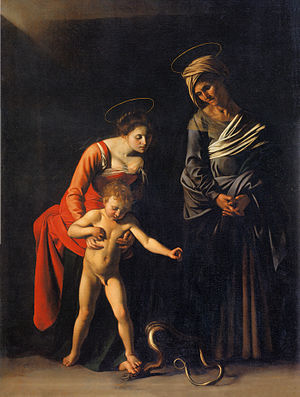
Here is a Counter Reformation artwork by Caravaggio depicting Mary crushing Satan’s head with the help of Jesus’ spiritual force working through her. What was it you said about the Gen 3:15 scriptures “can’t mean both (he and she)”?

Madonna and Child with St. Anne (Dei Palafrenieri) (Caravaggio)


“terribilis ut castrorum acies ordinata,” (as terrible as an army set in battle array).

*Who is this who ascends like the rising dawn, beautiful as the moon, bright as the sun, terrible as an army drawn up in battle array. Song of songs 6.9
*
If I had the time right now, I would like to write an exhaustive refuation [sp] of that dogma, but it would end up as a book and wouldn’t fit anywhere here. 🙂
…
It is yet another attempt to elevate Mary’s position to what only Jesus could do.
Then you are asserting yourself to have a higher pedigree than such giants as St. Jerome and of our popes who have studied scriptures and all the Vatican archives all their lives and also benefited from the apostolic succession and 2,000 years of scholarship and maturation of the faith. Do you really think you have a superior pedigree? 😉

Your judgement’s suffer from an intellect bereft of a fully illumined light of faith. Catholic focus is on Jesus just as you say. And if you read scripture you will see Mary (our spiritual mother) saying the same thing: “Do whatever he tells you” (John 2:5) and “My soul magnifies the Lord” ( Luke 1:46) and "I am the servant of the Lord; may it be to me as you say (Luke 1:38). And we should listen to Jesus too: “Behold your mother” (John 19:27) when He gave her to His Church.

Mary has a post-resurrection role and it is to crush heresies and humiliate a defeated Satan.

James
 
Originally posted by JVD:
Though the variant that uses “she” and “her” probably came from a copyist’s error, the idea it expresses is true. There is a [ed: valid scriptural] sense in which Mary crushed the serpent’s head and in which she was struck at by the serpent. She didn’t do these things directly, but indirectly, through her Son. It was Jesus who directly crushed the serpent’s head from the cross and Jesus whom the serpent directly struck on the cross. Yet Mary cooperated in these events.
Thank you for acknowledging the copyist error. Got time for a story? I like analogies – they have a way of drawing out a point that needs to be made.

A gunman bolted into the schoolroom in which Charles was teaching his class of 30 youngsters Arithmetic that day. Almost immediately, the gunman ordered all the children down onto the floor, yelling “See this?! You’re all going to die!”. A million thoughts flew through Charles’ head. He was responsible for these children and he needed to do something quickly.

The crazed gunman then turned to Charles – “Get out! I only want the children! There ain’t one of ‘em that’s safe with me! Get out!!!” Charles, drawing on his skills as a former police officer, turned to the gunman and started talking. Miraculously, Charles calmly walked and talked the man out of the classroom and into a vacant area behind the school. Outside, Charles overcame the gunman, who succumbed to a shot from the very weapon he was going to use on the children.

The town’s newspaper covered the horrible event, praising Charles for his brave and selfless actions which saved the community’s children from certain tragedy.
The newspaper story ended with the statement, “She confronted the evil one head-on and won the victory, saving the lives of our children”.

It didn’t take long, and the editor of the newspaper was deluged with phone calls and emails pointing out his error – surely he meant to write “He” and not “She” in that final sentence of his story. The editor admitted there was a mistake, but his reply to all the concerned citizens in the next day’s paper was:

“Thank you for pointing out the error, however the idea it expresses is true. There is a sense in which Charles’ mother Margaret overcame and shot the gunman. She didn’t do these things directly, but indirectly, through her son. It was Charles who directly overcame and killed the gunman, thereby freeing the children from eminent harm. Yet Margaret cooperated in these events because she bore her son, Charles and she nurtured and raised him to be an oustanding police officer.

As you can see, the whole story is totally absurd as it truly is when the same idea is applied to Christ’s work on the cross being applied to Mary (because she was the person who “agreed to become the human channel through which Crhist would enter the world in order to crust the serpent’s head (luke 1:38)”. (continued)
 
The whole idea of allowing the “he/she” issue to remain ambiguous can actually be refuted with one verse from the Bible – Heb 2:14 - “Forasmuch then as the children are partakers of flesh and blood, he also himself likewise took part of the same; that through death he might destroy him that had the power of death, that is, the devil;”

Jesus alone was the one who bore the sins of the world when He went to the cross. Jesus alone was beaten and hung on the cross and He alone bore the excruciating pain of each blow for our sins. Jesus alone was the unblemished Lamb who was slain as the perfect sacrifice because we sin. How dare we or anyone attribute those things to anyone other than Jesus because He is God and no human being can even come close to sharing the burden of the cross in the capacity that He did.
Originally posted by JVD:
Therefore, though the she/her and he/his readings of Genesis 3:15 are different, both are true
That is like saying the black is white and white is black. Two opposing ideas cannot possibly be true.
Originally posted by JVD:
and Catholics have long recognized this. A footnote provided a couple of hundred years ago by Bishop Challoner, in his revision of the Douay-Rheims version, state, “The sense is the same: for it is by her seed, Jesus Christ, that the woman crushes the serpent’s head.” (For more information, see A Catholic Commentary on Holy Scripture, Bernard Orchard, O.S.B., ed. [New York: Thomas Nelson and Sons, 1953], p. 186.)
That is only an attempt at trying to cover a doctrinal error. It needs to be seen for what it is.
Originally posted by JVD:
I hope this helps clarify. Catholics of course know that Jesus is the one who is to conquer Satan but we also know that Mary is a huge part of it and that she is the instrument by which Christ achieves the conquest as Her Seed. She is after all Jesus’ mother and New Eve. Just as St. Michael conquered the rebelling angels in heaven through the power of God Mary too is instrumental in conquering Satan on earth for her role in bringing forth Messiah.
Bottom Line: The Marian devotion is not in any way an attempt by Catholic to usurp Jesus power and honor and give them to Mary.
But it does. (continued)
 
Status
Not open for further replies.
Back
Top