[from prior]
**The Church Fathers on Genesis 3:15 **
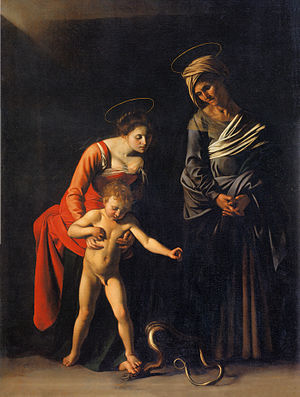
St. Justin Martyr (120-165 AD) was the first Church Father to draw an explicit comparison between Eve and Mary: *"For Eve, being a virgin and undefiled, conceiving the word that was from the serpent, brought forth disobedience and death; but the Virgin Mary, taking faith and joy, when the Angel told her the good tidings, that the Spirit of the Lord should … overshadow her, and therefore the Holy One that was born of her was Son of God, answered, “Be it done to me according to Thy word.” 20 *
The concept of Genesis 3:15 being the Proto-evangel, or “First Gospel” is attributed to St. Irenaeus of Lyons (135-202) from his work Against Heresies: *“For this end did He put enmity between the serpent and the woman and her seed, they keeping it up mutually: He, the sole of whose foot should be bitten, having power also to tread upon the enemy’s head; but the other biting, killing, and impeding the steps of man, until the seed did come appointed to tread down his head, - which was born of Mary, of whom the prophet speaks: ‘Thou shalt tread upon the asp and the basilisk; thou shalt trample down the lion and the dragon (Psalm 91:13).’”
- Irenaeus, Against Heresies, Chapter 23, Number 7 21
“Christ has therefore, in His work of recapitulation, summed up all things, both waging war against our enemy, and crushing him who had at the beginning led us away captives in Adam, and trampled upon his head, as thou can perceive in Genesis that God said to the serpent, ‘And I will put enmity between thee and the woman, and between thy seed and her seed; He shall be on the watch for thy head, and thou on the watch for his heel.’ For from that time, He who should be born of a woman, namely from the Virgin, after the likeness of Adam, was preached as keeping watch for the head of the serpent. This is the seed of which the apostle says in the Letter to the Galatians, ‘that the law of works was established until the seed should come to whom the promise was made (Galatians 3:19).’ This fact is exhibited in a still clearer light in the same Epistle where he thus speaks: ‘But when the fullness of time was come, God sent forth His Son, made of a woman (Galatians 4:4).’ For indeed the enemy would not have been fairly vanquished, unless it had been a man born of a woman who conquered him. For it was by means of a woman that he got the advantage over man at first, setting himself up as man’s opponent. And therefore does the Lord profess Himself to be the Son of man, comprising in Himself that original man out of whom the woman was fashioned, in order that , as our species went down to death through a vanqushed man, so we may ascend to life again through a victorious one; and as through a man death received the palm of victory against us, so again by a man we may receive the palm against death.”
- St. Irenaeus, Against Heresies, Book V, 21, 1 22
St. Jerome (347-420) translated the Hebrew texts while living an ascetic life in Bethlehem and completed his work in 405. St. Jerome’s Latin Vulgate Bible was the standard Bible in Western civilization for over 1000 years. He employed the word she for the epicene form in Genesis 3:15. This of course had a profound effect on Marian devotion. St. Jerome captured the meaning at the time through an expression: “Death through Eve, life through Mary.” One still sees today statues of Mary trampling the head of the serpent. 6
Gospel linkage to The Woman of Genesis
St. John in his Gospel was the first to implicitly refer to Mary as Eve, the “woman” of Genesis 3:15. St. John’s Gospel refers to Mary, the mother of Jesus, as woman at the wedding feast at Cana (John 2:1-5). When Mary informs Jesus that they have no wine, he calls his mother “
woman,” that his “hour has not yet come.”
As Jesus was dying on the cross, he called out to his mother, “
Woman, behold your son (John 19:26).”
Father George Montague (Our Father, Our Mother - Mary and the Faces of God. Franciscan University Press, Steubenville, Ohio, pp. 113-136,) notes that “woman” was not the customary way for a semitic son to call his mother, so that together in these two scenes, “woman” suggests much deeper symbolism. Jesus is the offspring of the woman, and by naming Mary with this title, Jesus is suggesting that the earlier promise of salvation is being fulfilled.
Montague sees this motif of the conquest of Satan through the woman’s son in Revelation 12. St. John continues in Chapter 12 of the Book of Revelation to refer to the “
woman’ clothed with the sun.” One can trace development from the “seed of the woman” and painful birth in Genesis 3:15-16 to the concept of the “
woman in travail” in Micah’s prophecy of the Messiah coming from Bethlehem to the “
woman in travail” in Revelation 12:2-5. He further notes that the word “offspring” in Revelation 12:17 is the same word used in Genesis 3:15 for the “seed” of the woman who would crush the head of the serpent.
I hope this helps clarify. Catholics of course know that Jesus is the one who is to conquer Satan but we also know that Mary is a huge part of it and that she is the instrument by which Christ achieves the conquest as Her Seed. She is after all Jesus’ mother and New Eve. Just as St. Michael conquered the rebelling angels in heaven through the power of God Mary too is instrumental in conquering Satan on earth for her role in bringing forth Messiah.
Bottom Line: The Marian devotion is not in any way an attempt by Catholic to usurp Jesus power and honor and give them to Mary.
James