History of face-to-face confession

  • Thread starter Thread starter FrancescaMaria
  • Start date Start date
Status
Not open for further replies.
F

FrancescaMaria

Guest
My impression is that a lot of Americans say or assume that the practice of face-to-face confession is a relatively new trend that started after Vatican II. However, when visiting churches in continental Europe, I often see old confessionals (obviously predating Vatican II) that are built to allow for a face-to-face option. Usually, the screen is only on the sides of where the priest sits, and the front is open with a kneeler for the penitents to kneel directly in front of the priest, if they wish. I have also seen old pictures and paintings of people using the confessionals in this way, and I have also observed such open confessionals in the old Spanish missions in America. So I am wondering, contrary to what many people think, was face-to-face confession always practiced as an option? Or was there a cultural variance between countries before Vatican II with the tradition of screen-only being an American thing? It is only a historical curiosity question for me, but I will appreciate any thoughts on that. Thank you.
 
The practice of the Sacrament of Penance has changed. In the early Church, confession of serious sin was public, private confession only developed later. I am sure that the screen in the confessional was an even later development. The screen was certainly never a mandated practice.
 
A bit of a tangent, but I heard a reflection some time ago, something to the effect of “when you confess, you are confessing your sins to Jesus” and that the screen helps you focus less on the priest, and more on Christ. I am not sure where this stands theologically (we do in fact confess to the priest), but it did make me feel better. When I use the screen (when available) I don’t have to feel like I’m cheating. It does help me focus and I feel like I’m more honest with it than without.
 
My impression is that a lot of Americans say or assume that the practice of face-to-face confession is a relatively new trend that started after Vatican II. However, when visiting churches in continental Europe, I often see old confessionals (obviously predating Vatican II) that are built to allow for a face-to-face option. Usually, the screen is only on the sides of where the priest sits, and the front is open with a kneeler for the penitents to kneel directly in front of the priest, if they wish. I have also seen old pictures and paintings of people using the confessionals in this way, and I have also observed such open confessionals in the old Spanish missions in America. So I am wondering, contrary to what many people think, was face-to-face confession always practiced as an option? Or was there a cultural variance between countries before Vatican II with the tradition of screen-only being an American thing? It is only a historical curiosity question for me, but I will appreciate any thoughts on that. Thank you.
You’re asking about 2 different things.

1 the screen between the priest and the penitent
2 a door (or curtain, etc.) that keeps the penitent private from being seen from outside

1 The screen between priest and penitent has been required for centuries (Although I’m not sure on the exact dates, if I were researching it, I’d probably start by looking at the Council of Trent and then going forward or backward wherever the history leads). It was certainly required in both the U.S. and Europe before Vatican II. In fact, before the Rite of Penance was revised in the 1970s the rules requiring a fixed grate were much more strict.

In Europe today, the absence of screens in the older confessions is obviously because they’ve been removed (the rubrics alone prove that).

2 The type of confessional where the penitent cannot be seen from outside was generally more popular in the U.S. compared to Europe. Keep in mind, though, that these confessionals did have screens between priest & penitent.
 
1 The screen between priest and penitent has been required for centuries (Although I’m not sure on the exact dates, if I were researching it, I’d probably start by looking at the Council of Trent and then going forward or backward wherever the history leads). It was certainly required in both the U.S. and Europe before Vatican II. In fact, before the Rite of Penance was revised in the 1970s the rules requiring a fixed grate were much more strict.

.
It has been required for centuries, but still is a relatively late development in the Latin Church.

ewtn.com/library/Liturgy/zlitur28.htm
Anonymous confession, along with the confessional as we know it today, is generally attributed to an initiative of St. Charles Borromeo (1538-1584), the archbishop of Milan, Italy. Previously, the confessor would sit in a chair and the penitent, who usually was kneeling, was clearly visible to him.

In order to ensure modesty and discretion, Cardinal Borromeo mandated in 1564 that the confessionals in his diocese be closed on both sides with a grill between penitent and priest. Pope Paul V’s Roman Ritual adopted this provision, which helped spread its use, although it did not become a universal practice until the 17th century.
This image, which has no confessional, is from the 15th century.


Images in art can be found well beyond this date, even into the 19th century, depicting confession without a screen.
 
Images in art can be found well beyond this date, even into the 19th century, depicting confession without a screen.
Yes, this is exactly what I am talking about, Babochka. I do not argue that one way of confessing is better than the other; in fact I am happy that nowadays in most places we have both to accommodate for people’s preferences. I also do not question Fr. David’s knowledge of the rubrics and others, who say that before Vatican II there were strict regulations.
I am just intrigued because of my observation of older art and how commonly this sacrament is depicted in its face-to-face version:
l7.alamy.com/zooms/addb4b5073864528baee263d6e0040a4/st-anthony-of-padua-confessing-penitent-stained-glass-window-shrine-fd5251.jpg

Also, the following confessionals allow for both screened and face-to-face, and they seem to be much older than the 1960’s:
upload.wikimedia.org/wikipedia/commons/7/7f/Iglesia_de_San_Joaqu%C3%ADn-Confesionario.JPG
l7.alamy.com/zooms/898d0db31b4d48c9b9b76b1c8f7dc6fb/woman-and-priest-at-confessional-chiesa-del-gesu-circa-1591-palermo-a8ge2g.jpg
 
Yes, this is exactly what I am talking about, Babochka. I do not argue that one way of confessing is better than the other; in fact I am happy that nowadays in most places we have both to accommodate for people’s preferences. I also do not question Fr. David’s knowledge of the rubrics and others, who say that before Vatican II there were strict regulations.
I am just intrigued because of my observation of older art and how commonly this sacrament is depicted in its face-to-face version:
l7.alamy.com/zooms/addb4b5073864528baee263d6e0040a4/st-anthony-of-padua-confessing-penitent-stained-glass-window-shrine-fd5251.jpg

Also, the following confessionals allow for both screened and face-to-face, and they seem to be much older than the 1960’s:
upload.wikimedia.org/wikipedia/commons/7/7f/Iglesia_de_San_Joaqu%C3%ADn-Confesionario.JPG
l7.alamy.com/zooms/898d0db31b4d48c9b9b76b1c8f7dc6fb/woman-and-priest-at-confessional-chiesa-del-gesu-circa-1591-palermo-a8ge2g.jpg
As I wrote earlier, it’s obvious that the screens were removed from those older confessionals.

The rules for hearing Confessions before Vatican II (not going back to the 3rd century, but certainly for centuries before Vatican II) were quite strict. Confessions had to be heard in a proper confessional, with a fixed screen, except for unusual circumstances.

As for your artwork:

The stained glass window shows St Anthony of Padua, who died in 1231, which is several centuries before Confessionals were mandated. It simply does not provide any indication of what was being done in the time-period anywhere near Vatican II, which is what you asked in the original question. Also, in Christian iconography, details are not always literally accurate. Even if St Anthony did make use of confessionals (not that I am making such a claim), a stained-glass window showing just a closed door with maybe the words “Padre Anthony” above the door would hardly make for good art. It’s clearly modern stained glass, and the purpose of the art is to show that St. Anthony heard confessions, and not how he did so.

The first confessional, with the red brick wall in the background, shows a small door at face level. When that door was open, there was still a screen between the priest and the penitent. Just because you don’t see it in the picture, doesn’t mean that it was never there. It might still be there, there’s no way of knowing from the picture, as the small door is closed. However, if it is as old as it looks (rather than a replica, which is always possible but is probably unlikely), there is no doubt that some type of screen was in-place between priest and penitent.

The second confessional, with the black/white/gold artwork on the wall: What you’re seeing there is a confessional that was originally build to have a priest in the middle and one penitent on each side. It’s obvious that the opening in the middle is a modification to the original design. The reason I can say this with confidence is that it would have made no sense to have 2 penitents on the side and one in front—obviously, with no barrier between the center penitent and the ones on the side, the center penitent would have been able to hear both the priest and the side-penitent during confessions. That makes no sense. It also makes no sense because if the original design had been intended for “face to face” then one or both of the sides would have been built that way, making the center opening not only redundant but completely impractical. I can guarantee you that no priest would find it acceptable to be hearing one person’s confession on his side, while there’s someone else, waiting to confess, right there ‘in his face’.
 
As I wrote earlier, it’s obvious that the screens were removed from those older confessionals.

The rules for hearing Confessions before Vatican II (not going back to the 3rd century, but certainly for centuries before Vatican II) were quite strict. Confessions had to be heard in a proper confessional, with a fixed screen, except for unusual circumstances.

As for your artwork:

The stained glass window shows St Anthony of Padua, who died in 1231, which is several centuries before Confessionals were mandated. It simply does not provide any indication of what was being done in the time-period anywhere near Vatican II, which is what you asked in the original question. Also, in Christian iconography, details are not always literally accurate. Even if St Anthony did make use of confessionals (not that I am making such a claim), a stained-glass window showing just a closed door with maybe the words “Padre Anthony” above the door would hardly make for good art. It’s clearly modern stained glass, and the purpose of the art is to show that St. Anthony heard confessions, and not how he did so.

The first confessional, with the red brick wall in the background, shows a small door at face level. When that door was open, there was still a screen between the priest and the penitent. Just because you don’t see it in the picture, doesn’t mean that it was never there. It might still be there, there’s no way of knowing from the picture, as the small door is closed. However, if it is as old as it looks (rather than a replica, which is always possible but is probably unlikely), there is no doubt that some type of screen was in-place between priest and penitent.

The second confessional, with the black/white/gold artwork on the wall: What you’re seeing there is a confessional that was originally build to have a priest in the middle and one penitent on each side. It’s obvious that the opening in the middle is a modification to the original design. The reason I can say this with confidence is that it would have made no sense to have 2 penitents on the side and one in front—obviously, with no barrier between the center penitent and the ones on the side, the center penitent would have been able to hear both the priest and the side-penitent during confessions. That makes no sense. It also makes no sense because if the original design had been intended for “face to face” then one or both of the sides would have been built that way, making the center opening not only redundant but completely impractical. I can guarantee you that no priest would find it acceptable to be hearing one person’s confession on his side, while there’s someone else, waiting to confess, right there ‘in his face’.
Thank you, Father, for such a detailed and informative answer. It has cleared up many things for me and I really appreciate it. Thank you!
 
This is an interesting topic and one I’ve also wondered about. There are a number of photos of Padre Pio hearing confessions outside of the confessional. This is my favorite:

https://padrepiodepietrelcina.files.wordpress.com/2008/12/confesando-a-un-nino1.gif

I also wonder how frequently exceptions the law were made, and under what circumstances. Obviously, there were some. For example, hospital confessions or deathbed confession did not take place within a confessional with a screen. What other exceptions were common or accepted?

I have also run into others who seem to think that Confession without a screen is a horrible, modern idea and a complete innovation. You know, all the fault of Vatican II. :rolleyes: While it might not have been common in the Latin Church for centuries, it is certainly not an innovation.

If I had time, I’d research it thoroughly. Since I don’t, I hope others with more knowledge continue to contribute to this thread.
 
This is an interesting topic and one I’ve also wondered about. There are a number of photos of Padre Pio hearing confessions outside of the confessional. This is my favorite:

https://padrepiodepietrelcina.files.wordpress.com/2008/12/confesando-a-un-nino1.gif

I also wonder how frequently exceptions the law were made, and under what circumstances. Obviously, there were some. For example, hospital confessions or deathbed confession did not take place within a confessional with a screen. What other exceptions were common or accepted?
There were actually quite a few ways confessions could be heard, even without exceptions (as such) to the law. When I write about “the law” I’m writing about this specific topic, which is about confessionals. Confessionals were (and still are!) required to have a screen.
I have also run into others who seem to think that Confession without a screen is a horrible, modern idea and a complete innovation. You know, all the fault of Vatican II. :rolleyes: While it might not have been common in the Latin Church for centuries, it is certainly not an innovation.
If I had time, I’d research it thoroughly. Since I don’t, I hope others with more knowledge continue to contribute to this thread.
The innovation part is that confessionals were either modified to force face-to-face or removed altogether. Granted, the practice is not new in the sense of never-before-done, but still, denying the faithful the opportunity for anonymous confession (after so many centuries) represents a true rupture from the existing practice. So while the word innovation might or might not be the best choice of words, there’s no doubt that we experienced a break/fracture/rupture, and an abrupt one at that.
 
Here’s another interesting one, by Jean Alphonse Roehn, from the the 19th Century.
Again, we have to be careful when looking at art. Christian art is often representational, rather than literal.

(Please Note: This uploaded content is no longer available.)

This painting, for example, is surely not intended to make people think that guardian angels are visible, corporeal beings, even though the painting depicts one that way.

Likewise, a painting of a priest hearing a girl’s confession at her home can’t be taken as evidence that face-to-face confession was widespread (not counting hospitals, battlefields and other obvious situations) before Vatican II. In fact, the Roman Ritual specifically forbade priests to hear women’s confessions outside of a confessional except for “illness or other real necessity” (general rule #9)

I’ve seen many photographs of Catholic priests hearing confessions during World War II–taken from a distance, of course. In every one I’ve seen, the priest always has some kind of screen, even if it’s nothing more than his own hand.
 
My impression is that a lot of Americans say or assume that the practice of face-to-face confession is a relatively new trend that started after Vatican II. However, when visiting churches in continental Europe, I often see old confessionals (obviously predating Vatican II) that are built to allow for a face-to-face option. Usually, the screen is only on the sides of where the priest sits, and the front is open with a kneeler for the penitents to kneel directly in front of the priest, if they wish. I have also seen old pictures and paintings of people using the confessionals in this way, and I have also observed such open confessionals in the old Spanish missions in America. So I am wondering, contrary to what many people think, was face-to-face confession always practiced as an option? Or was there a cultural variance between countries before Vatican II with the tradition of screen-only being an American thing? It is only a historical curiosity question for me, but I will appreciate any thoughts on that. Thank you.
When Jesus instituted that sacrament John 20:23 ], He didn’t specify particulars on how that is done. Just that in order for one to forgive someone else their sins, or retain them, that person needs to be validly ordained. And since ordination doesn’t give one the ability to read minds, it’s obvious one needs to confess their sins to one validly ordained to forgive sins. How that was carried out specifically, went through development over time.

Example:
James 5:16 in context, the priests πρεσβυτέρους, Jas 5:14 where we get the word priest ] were called to pray for the one who is sick. It’s not meant one is to confess one’s sins to every one in the room.

Where in the New Testament are “priests” mentioned?
 
There were actually quite a few ways confessions could be heard, even without exceptions (as such) to the law. When I write about “the law” I’m writing about this specific topic, which is about confessionals. Confessionals were (and still are!) required to have a screen.
It seems you and I are simply addressing different aspects of the original question. I was replying to this part:
So I am wondering, contrary to what many people think, was face-to-face confession always practiced as an option? Or was there a cultural variance between countries before Vatican II with the tradition of screen-only being an American thing?
Although the OP used confessionals apparently without screens as potential “evidence” for face-to-face confessions, the question, to me, seemed to be more about face-to-face confessions and less about confessional design. Perhaps I misunderstood it.
The innovation part is that confessionals were either modified to force face-to-face or removed altogether. Granted, the practice is not new in the sense of never-before-done, but still, denying the faithful the opportunity for anonymous confession (after so many centuries) represents a true rupture from the existing practice. So while the word innovation might or might not be the best choice of words, there’s no doubt that we experienced a break/fracture/rupture, and an abrupt one at that.
Where that has been done, I agree with you. But we can hardly use an example where the law isn’t being followed to indicate a rupture in tradition. The law is clear that confessionals are to include a fixed grille. ( I honestly have no idea how common this is. I’ve never been to confession in a Latin-rite church that did not have the option of either face-to-face or behind the screen. I’ve read about them here on CAF, but I’ve never actually seen one).
 
Likewise, a painting of a priest hearing a girl’s confession at her home can’t be taken as evidence that face-to-face confession was widespread.
No, but a painting from that era can be used as some evidence, though not conclusive, that it occurred in some time or place and perhaps lead one to the conclusion that it was not terribly unusual. One piece of evidence among many.
I’ve seen many photographs of Catholic priests hearing confessions during World War II–taken from a distance, of course. In every one I’ve seen, the priest always has some kind of screen, even if it’s nothing more than his own hand.
I have, too. To be honest, though, the hand is merely symbolic. It doesn’t function as a screen in any practical way. Of course, the fact that a priest would use his hand as a “screen” is an indicator that this requirement was taken very seriously and some symbol was needed. In this picture, it seems to me that the priest could be using his hand to give absolution rather than as a “screen”.

 
There were actually quite a few ways confessions could be heard, even without exceptions (as such) to the law. When I write about “the law” I’m writing about this specific topic, which is about confessionals. Confessionals were (and still are!) required to have a screen.

The innovation part is that confessionals were either modified to force face-to-face or removed altogether. Granted, the practice is not new in the sense of never-before-done, but still, denying the faithful the opportunity for anonymous confession (after so many centuries) represents a true rupture from the existing practice. So while the word innovation might or might not be the best choice of words, there’s no doubt that we experienced a break/fracture/rupture, and an abrupt one at that.
Father, first if you are going to speak about the law, you should at least kindly reference the law, please, so that people are not misled. To wit, from the 1917 Pio-Benedictine Code:
Can 910 §1. Feminarum confessiones extra sedem confessionalem ne audiantur, nisi ex causa infirmitatis aliave verae necessitatis et adhibitis cautelis quas Ordinarius loci opportunas iudicaverit.
** §2. Confessiones virorum etiam in aedibus privatis excipere licet.
**
Thus those of us who were men ALWAYS had, by paragraph 2, the prerogative of confessing face to face and away from the confessional – as I did many times having both lived and studied under the old code. I say always…I am not so old that I was confessing before the 1917 code went into effect.

The confession of women outside of the confessional, on the other hand, was to be for “verae necessitatis” (understood according to the canonical usage) and had to account for the precautions prescribed by the local Ordinary.

Our confessionals in Europe – which I find vastly superior to the walk in closets that I had to contend with during my sojourns in the United States – readily admitted of face-to-face confession without the need for modification.

https://www.osv.com/Portals/4/EasyDNNnews/14401/1440120140331cnsbr4663hero.jpg

We simply went up to the confessional, knocked on the opening to the confessor’s compartment, which he opened, and confessed standing or kneeling. I should know. This is something I did routinely in my younger days.

It is not as elaborate as an American priest seems to conjure in his mind…by the position I took outside the confessional, it told the next penitent that I was going face to face and so they waited to afford me privacy. It was actually quite simple.

I cannot imagine this was possible with the confessionals I saw in the United States…but it is really not very nice to tell an audience that includes Europeans what our lived experience in Europe was.

Next, let us clear up another incorrect point. The fixed screen was usually normally in Europe never so opaque that confessor and penitent could not see each other for complete and total anonymity…although some places did use simply a cloth, which was opaque.

While I found the sense that the screen needed to completely conceal confessor and penitent to be more the case with the Americans – who seem to have some issues that border on obsession in this matter, frankly – in Europe, our screens can (and in the days of my youth, could) normally be seen through. Of course, the person can turn their gaze and we who are hearing, in turn, are obviously sitting sideways.

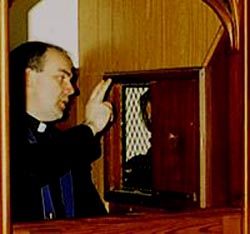
I never took a photo of any of my confessionals but this image from Tradition in Action faithfully represents the level of opaqueness in a number of confessionals where I have heard. Others were like sheets of tin with multiple perforation of small holes that allowed the voice to pass and also, frankly, to be seen through.
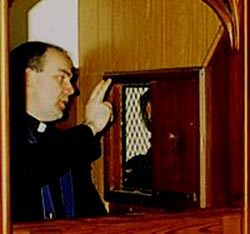


Finally, there is yet another point that needs to be disabused from the perspective of a European priest.

The artist Babochka posted, Roehne, and his painting, should not at all be compared to the painting of the Guardian Angel, which is a fanciful depiction. Roehne was an artist born in the aftermath of the French revolution. What he depicts in this painting is quite accurate to the situation as it was during the French revolution, with priests giving the sacrament of penance, just as being depicted in this scene. Indeed, the young lady could quite easily be one of the myriad of women religious who had to adopt lay garb after being evicted from their convents as they awaited and hoped for both the restoration of their religious life…and not to be executed by the regime.

 
This is an interesting topic and one I’ve also wondered about. There are a number of photos of Padre Pio hearing confessions outside of the confessional. This is my favorite:

https://padrepiodepietrelcina.files.wordpress.com/2008/12/confesando-a-un-nino1.gif

I also wonder how frequently exceptions the law were made, and under what circumstances. Obviously, there were some. For example, hospital confessions or deathbed confession did not take place within a confessional with a screen. What other exceptions were common or accepted?

I have also run into others who seem to think that Confession without a screen is a horrible, modern idea and a complete innovation. You know, all the fault of Vatican II. :rolleyes: While it might not have been common in the Latin Church for centuries, it is certainly not an innovation.
If I had time, I’d research it thoroughly. Since I don’t, I hope others with more knowledge continue to contribute to this thread.
It is a very endearing photo.

The exceptions were made quite frequently, in my lived experience…above all when it concerned the confessions of men.

No, it is indeed far from an innovation and I received the revised Rite of Penance with an enthusiasm that I still remember after all these years.

As the Council Fathers said in Sacrosanctum Concilium, there was so much that needed reform…some things that simply needed to be discarded while other things needed to be restored.
 
Father, first if you are going to speak about the law, you should at least kindly reference the law, please, so that people are not misled. To wit, from the 1917 Pio-Benedictine Code:…
There’s a lot in that post, so I did not re-post it.

I tried to make clear earlier that I was addressing the issue of confessionals, not confession itself. I did scroll through my responses, and I posted earlier that there were other ways of hearing confessions outside a confessional, and that doing so was not always an exception to the law. See my post #11. I think, if anything, I’d need to revise #7 where I said “unusual” but even so, unusual is not that strong a word because it merely means that it wasn’t typical, without actually meaning that it was an exception to the law.

What I am trying to articulate here is that because someone sees a confessional in-use today, that just because the overall structure might be (even centuries) old, that doesn’t mean that they’ve been used in exactly the same way throughout their history. Whether or not someone could see through the grate, it was still there.

Check my response in post #4.

I’m not trying to tell Europeans from the 1950s (let’s just say) what was happening at a time and place when I wasn’t there. What I am trying to say is that a contemporary photograph of a confessional is not an indication that it was used in exactly the same way from the year it was built. (the underlining is because I tend to ramble, so I’m saying “this is the point, the other stuff is my ramblings”, not to try to shout).

Likewise, I’m saying that we cannot rely on artistic representations to answer this question because they don’t always reflect the literal reality. In any case, since the painting by Roehne is set inside a private home, it doesn’t address the topic-at-hand which is about the confessionals themselves. The other paintings (St Anthony, for example) really don’t address the question at all.

I hope you would agree that using art from different centuries depicting events sometimes centuries before they were painted, is really not the way to answer the OPs questions in post #1. That method might be somewhat useful in a different context, but given the question itself, the artwork just doesn’t address the topic.

Re-read my response in #4, please. Is there anything written that you would disagree?

Now, perhaps when I wrote “removed” maybe, just maybe, it might have been better to write that somehow the confessions were modified from their original design. Also, note that I only said grate & screenl, without claiming that it was such that the priest and penitent were completely prevented from seeing each other.

I do regret bringing up the part about the military chaplains, because it likewise doesn’t answer the question, and it only serves to encourage more photos to be posted—photos which still won’t answer the OPs question.

Looking forward to your response…
 
I do regret bringing up the part about the military chaplains, because it likewise doesn’t answer the question, and it only serves to encourage more photos to be posted—photos which still won’t answer the OPs question.
.
I think it is important to remember the original question. The title of the thread was “History of face-to-face confession” and the original question posed was:
So I am wondering, contrary to what many people think, was face-to-face confession always practiced as an option? Or was there a cultural variance between countries before Vatican II with the tradition of screen-only being an American thing?
While we might have gotten off on a tangent regarding confessional design because of the examples given, the original question was not really about confessional design. Showing photos of confessions being heard face-to-face and showing a painting made in the 1900s and depicting a scene from that period certainly does provide valuable information toward answering that question. Written accounts describing the situation would also help. Don Ruggero has provided an excellent answer for the time and places in which he has lived - face-to-face confession was apparently an option that was taken with some frequency and was not restricted to unusual or serious circumstances. Other times and places we would not really know about, without reading (or viewing through photographic or artistic evidence) contemporary accounts.
 
Status
Not open for further replies.
Back
Top