How do Protestants rationalize King Henry VIII, and his selfish non-spiritual motivation?

  • Thread starter Thread starter psychicharvard
  • Start date Start date
Status
Not open for further replies.
Haven’t had time to read all the postings, so forgive duplications. Here are a few random thoughts.

(1) Henry VIII was not a Protestant. He was a schismatic who had denounced Martin Luther and in various other ways remained a Catholic. He wanted a divorce, the reason - of course - for the split.
Code:
(2) There were various Protestant movements in Great Britain before Henry VIII, so it was ripe for the Reformation. I'm sure this has been mentioned by several already.

(3) Elizabeth I was the monarch who advanced Protestantism to its position of supremacy in England. 

(4) There was plenty of persecution and many martyrs on both sides. Bloody Mary wasn't called that for nothing. The religious wars were heinous and a Christian scandal and we all need to be ashamed of them, whatever our church affiliation.

(5) Maybe irrelevant, but as I recall it was the only English Pope - hm! his name slips my mind momentarily - who gave Ireland as a 'papal fief' to England (during the time of William the Conqueror?). One reason given was that Ireland wasn't Catholic enough. I was happy to see the Queen wear green and place a wreath at the monument honoring Irish martyrs. The English record there and in many other places was not good, though it always has amazed me that that tiny kingdom has us all speaking English today!

(6) I come from a mixed heritage. On the Protestant side, they were Belgians who became Huguenots. When the family head was threatened with execution, he fled the next night with his family to England. His grandson came to USA with the Puritans. Both Catholics and Protestants can tell such stories of religious persecution. Shameful! Christ must have shed many tears during those years.

 Everything I wanted to say at the moment. God bless Catholics, Protestants, Orthodox and faithful people of every creed, color, culture and country. We should replace bigotry, arrogance and hostility with love, humility and peace. Christ would encourage that. None of us has that many answers when it comes to understanding this magnificent, mammoth, miraculous and mysterious world, but we do have the same mighty God. Let's rejoice together!
 
Welcome back, Jim! 🙂 As William Shatner said in Airplane II, “irony can be pretty ironic sometimes…”😛
I find all that ironic. Hence, in my post about Tyndale, I said, “ironically”.

GKC
 
From what I understand, most people in Great Britain do not attend any church.

The television broadcast of the Royal Wedding was probably the only church experience that most Englanders have had in their entire lives.

Isn’t “church” and “religion” for most people in Great Britain a “national” thing, something that is part of their culture, like having a monarchy, and eating fish and chips, and Sherlock Holmes and James Bond? If this is the case, then perhaps there is some national pride in the idea that one of their kings broke away from Rome and became free and independent.
I really do notice that in Britain. Aside from the fact that Anglicanism is founded upon by a king’s desire to get rid of his wife, it’s called Anglicanism meaning from England or something like that so it’s really a kind of national thing. I mean, the monarch is the Supreme Governor of the Church of England, how did they even come up with the idea that the monarch should be given that role?

Although I don’t have any knowledge about the background of Henry VIII’s petition to get an annulment for his marriage, I daresay that if the pope had granted it, Britain may still be Catholic now. The thing is when Henry VIII caused the English Church to break from Rome, Protestantism took its place as the basis for the new and independent Church of England.

Funny, I remember asking somewhere on the internet about the Church of England’s stand about divorce and someone replied: most probably…the church was founded because Henry VIII wanted to divorce his wife.
 
A couple points, already made, I’m sure.
Code:
Henry VIII was not a Protestant. He was a fierce foe of Luther, condemned the Reformation, and held on to the main doctrines of Catholicism. Protestantism didn't take hold in England until Elizabeth I. Most Anglicans I know emphasize this point.

 True, the English as a whole rarely go to church, rather like in France, Italy, Spain, and Quebec where attendance at Mass is scant. As is often noted Europe as a whole is in a post-Christian period. Even In Ireland Mass attendance is way down. Poland is about the only country where church attendance apparently remains fairly good, and even there signs point to a rapidly diminishing influence of the church. 

  It is silly to use history to pit Christian against Christian as there is plenty of blame to go around. I read Fr. McBrien's column each weekend and he doesn't beat around the bush when it comes to Catholic misdeeds in the past (and present). Ditto for Protestant misdeeds. But that is in the past.

  What some Catholics and Protestants seem to indulge in - certainly here on CAF - is a loyal and aggressive tribalism. Our tribe is right and yours is wrong. My guess is that we're all off the mark. When I think of a universe that may contain a million solar systems I have a feeling that we on earth are myopic when we size up the world. And we depend too much - in my view - on doctrines etc which were drawn up and declared 'infallible' before we had decent telescopes and did not yet have a microscope. When I read the Church Fathers, for example, I am impressed by their brilliance for their era, but so much of what they write seems patently primitive in light of contemporary knowledge.

 But Gof bless all people of faith who seek to live in love and peace together,
 
A couple points, already made, I’m sure.
Code:
Henry VIII was not a Protestant. He was a fierce foe of Luther, condemned the Reformation, and held on to the main doctrines of Catholicism. Protestantism didn't take hold in England until Elizabeth I. Most Anglicans I know emphasize this point.

 True, the English as a whole rarely go to church, rather like in France, Italy, Spain, and Quebec where attendance at Mass is scant. As is often noted Europe as a whole is in a post-Christian period. Even In Ireland Mass attendance is way down. Poland is about the only country where church attendance apparently remains fairly good, and even there signs point to a rapidly diminishing influence of the church. 

  It is silly to use history to pit Christian against Christian as there is plenty of blame to go around. I read Fr. McBrien's column each weekend and he doesn't beat around the bush when it comes to Catholic misdeeds in the past (and present). Ditto for Protestant misdeeds. But that is in the past.

  What some Catholics and Protestants seem to indulge in - certainly here on CAF - is a loyal and aggressive tribalism. Our tribe is right and yours is wrong. My guess is that we're all off the mark. When I think of a universe that may contain a million solar systems I have a feeling that we on earth are myopic when we size up the world. And we depend too much - in my view - on doctrines etc which were drawn up and declared 'infallible' before we had decent telescopes and did not yet have a microscope. When I read the Church Fathers, for example, I am impressed by their brilliance for their era, but so much of what they write seems patently primitive in light of contemporary knowledge.

 But Gof bless all people of faith who seek to live in love and peace together,
He may not have been a Protestant but he certainly was no longer a Catholic. You cannot start your own church, and be excommunicated by the Pope and still be a member of the church. Obviously, he protested strongly against the authority of the Pope which is what Luther did. Sounds like a Protestant to me.
 
aicirt
Code:
A couple thoughts.

All non-Catholic Christians certainly are not Protestants. Some Anglicans claim that they are not Protestants, except that their 39 articles has some very Protestant declarations. 

And, mainline Protestants in general see themselves as Catholic, but not Roman Catholic. For example, many denominations recite the Apostles Creed - "I believe in the holy Catholic church...."  As you know, Catholic means universal. 

 Millions of Protestants would love to have one church. Certainly a major barrier is that Roman Catholicism declares that it alone teaches the full truth and that everybody else is heretical to one degree or another. So, everyone has to think the same way on major doctrines. Protestants have very different viewpoints, even within the same denomination. There are - as one example - Methodists who believe in a literal Adam and Eve and Methodists who regard Adam and Eve as a myth/fable/legend. They attend the same church and respect the views of each other. Wouldn't it be great if Christianity adopted that attitude? I think so.

 Personally, I believe in a 'big tent' Christianity. In a nutshell, this would mean that people with, say, different views on Mary or celibate clergy or communion would be in the same Christian fellowship. This is true of the World Council of Churches, for example, where you not only have Anglicans, Lutherans, Methodists, Baptists and other Protestants, but you also have Eastern Orthodox churches, the Coptic Church of Egypt, various ancient churches of the Middle East and India, and various other diverse groups.

 We have a lot to learn from one another.
 
aicirt
Code:
A couple thoughts.

All non-Catholic Christians certainly are not Protestants. Some Anglicans claim that they are not Protestants, except that their 39 articles has some very Protestant declarations. 

And, mainline Protestants in general see themselves as Catholic, but not Roman Catholic. For example, many denominations recite the Apostles Creed - "I believe in the holy Catholic church...."  As you know, Catholic means universal. 

 Millions of Protestants would love to have one church. Certainly a major barrier is that Roman Catholicism declares that it alone teaches the full truth and that everybody else is heretical to one degree or another. So, everyone has to think the same way on major doctrines. Protestants have very different viewpoints, even within the same denomination. There are - as one example - Methodists who believe in a literal Adam and Eve and Methodists who regard Adam and Eve as a myth/fable/legend. They attend the same church and respect the views of each other. Wouldn't it be great if Christianity adopted that attitude? I think so.

 Personally, I believe in a 'big tent' Christianity. In a nutshell, this would mean that people with, say, different views on Mary or celibate clergy or communion would be in the same Christian fellowship. This is true of the World Council of Churches, for example, where you not only have Anglicans, Lutherans, Methodists, Baptists and other Protestants, but you also have Eastern Orthodox churches, the Coptic Church of Egypt, various ancient churches of the Middle East and India, and various other diverse groups.

 We have a lot to learn from one another.
True.

And then there is the fact that the 39 Articles are not a binding formulary, or a confession, for Anglicans in general. Ordinands of the Church of England, theoretically, are required to affirm (or, more accurately, not to not affirm) them, but no Anglican, generally, is required to accept them.

For all that, many of them are nothing any Trinitarian Christian would argue with. Not all, sure, but many.

GKC
 
Quote…“Millions of Protestants would love to have one church. Certainly a major barrier is that Roman Catholicism declares that it alone teaches the full truth and that everybody else is heretical to one degree or another. So, everyone has to think the same way on major doctrines. Protestants have very different viewpoints, even within the same denomination. There are - as one example - Methodists who believe in a literal Adam and Eve and Methodists who regard Adam and Eve as a myth/fable/legend. They attend the same church and respect the views of each other. Wouldn’t it be great if Christianity adopted that attitude? I think so”.

RESPONSE:…And when they cease to respect the views of each other, they establish their own Christian churches, hence, the reason why there are 30,000 various Protestant sects. How’s that working out?

Here’s some major issues we all agreed on until the 1930s: abortion, birth control, homosexuality. Not anymore! One church that has not vacillated is the Catholic Church. I’m thinking the Baptists are holding firm but not the other major Protestant churches. How can something be a sin one day and get redefined as a virtue the next?

Henry VIII had the viewpoint that he should be allowed to marry Anne Boylen and he should have an annulment. He obviously had a very different viewpoint from the Pope’s, and Henry would not take “no” for an answer. And because of that, the Anglican Church was established. And about three years after marrying Anne, he had his wife beheaded. This is the head of a Christian Church. He had his wife killed and then he had another killed. How Christ like was this? If he had adhered to his vows, none of this would have happened not to mention the number of Catholics killed who were forced to take the loyalty oath and refused. St. Thomas Moore was one. I’m not seeing Henry as having the full truth about anything here. Henry was about Henry.
 
I really wish if people wanted to comment on the monarch as the head of the CofE they would bother to understand what that was supposed to mean. There is precedent in Christianity for that kind of thing - it’s much closer to Constantine’s role than the Pope’s.

And if we are going to criticize Henry for having individuals executed for personally convenient reasons, or even assassinated, I think we don’t have to look too far in Catholicism to find examples of similar acts by Popes. Who have a much more significant spiritual role than the English monarch ever claimed. How is it that it is ok for the Medicis to be Popes, but Henry was too immoral to be head of the CofE?:confused:
 
I really wish if people wanted to comment on the monarch as the head of the CofE they would bother to understand what that was supposed to mean. There is precedent in Christianity for that kind of thing - it’s much closer to Constantine’s role than the Pope’s.

And if we are going to criticize Henry for having individuals executed for personally convenient reasons, or even assassinated, I think we don’t have to look too far in Catholicism to find examples of similar acts by Popes. Who have a much more significant spiritual role than the English monarch ever claimed. How is it that it is ok for the Medicis to be Popes, but Henry was too immoral to be head of the CofE?:confused:
I’m Catholic but I think a man who allows two of his six wives to be beheaded, should not be the head of any church. There’s some who believe he had his first wife Catherine poisoned. So he married multiple times, fathered out of wedlock kids, and ordered the execution of two wives, the bandishment of two others, bastardized his first born, ordered those who disagreed with his policies imprisoned or killed, and confiscated property.
If you think this is behavior is equal to that of the Popes, then how was Henry a better choice?
I don’t know of any Pope, de Medicis or others, who ordered the execution of anyone. Do you?
 
I really wish if people wanted to comment on the monarch as the head of the CofE they would bother to understand what that was supposed to mean. There is precedent in Christianity for that kind of thing - it’s much closer to Constantine’s role than the Pope’s.

And if we are going to criticize Henry for having individuals executed for personally convenient reasons, or even assassinated, I think we don’t have to look too far in Catholicism to find examples of similar acts by Popes. Who have a much more significant spiritual role than the English monarch ever claimed. How is it that it is ok for the Medicis to be Popes, but Henry was too immoral to be head of the CofE?:confused:
Good point.

In fact, king Henry was a Catholic. So these people excoriate their own co-religionist. What he wanted was the same kind of control over the English church that the king of Spain had over the Spanish church and the king of France had over the French church. For certain historical reasons he did not have this, and he was not the first king of England to demand it.

When he secured control of the church, that church was in schism (since the Pope of that day was unable to compromise with him), but it was still Catholic and the situation could have been repaired.

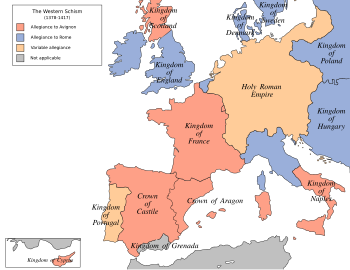
This situation would be analogous to the Chinese Catholic church today, and similar to the great western schism when one Pope was in Rome, one in Avignon and another in Pisa. All still Catholic with the states controlling the Cardinals and bishops from their own lands.


The schism ‘ended’ and Anglicanism as a separate belief system arose during the Elizabethan compromise, I think, so I would say it remained Catholic for about 25 years in that state of schism.
 
When I was 14 I had and aunt who married into the family. She was presbyterian and attempted to pull me and my sister away from Catholicism and into her religion. But one thing she could never answer for me is, How can one justify a religion that was brought about on King Henry VIII selfish desire to divorce his wife? I suppose if King Henry VIII was on a spiritual path it could have some credibility, but he only broke from the Catholic Church because they wouldn’t allow his divorce and so from that he adopted Protestantism as the new religion of England, and then altered the Bible. And so England adopting Protestantism and putting it upon it’s subjects, and England being a strong nation in Europe made Protestantism grow strong. But if King Henry VIII hadn’t wanted a divorce then Protestantism would have either faded or remained small in numbers. So, my question is how can one have such profound faith in a religion that had it’s origins in a selfish King who only used it as a tool to gain a legitimate male heir? I’m not trying to be mean, but it is true. I just want to know if anyone has an answer to this that would make me understand how some Protestants can be so very self-righteous in their religion given it’s dubious origins?:confused::confused: I do want to understand but no as of yet has given me any solid explanation. So please…anyone?
If you’re looking at a “founder” of Protestantism, try Martin Luther. As had been pointed out Henry VIII was most certainly not a Presbyterianism, and considered himself a catholic. England became RC again under Mary Tudor and it was her half sister Elizabeth who founded the CofE as we know it.

Your question reveals considerable ignorance. The great majority of Protestant churches have little or nothing to do with Henry VIII.
 
I’m Catholic but I think a man who allows two of his six wives to be beheaded, should not be the head of any church. There’s some who believe he had his first wife Catherine poisoned. So he married multiple times, fathered out of wedlock kids, and ordered the execution of two wives, the bandishment of two others, bastardized his first born, ordered those who disagreed with his policies imprisoned or killed, and confiscated property.
If you think this is behavior is equal to that of the Popes, then how was Henry a better choice?
I don’t know of any Pope, de Medicis or others, who ordered the execution of anyone. Do you?
I think I’m right in saying that the Pope urged RCs to kill Elizabeth I after her excommunication. I can research this further if you want.
 
Quote…“Millions of Protestants would love to have one church. Certainly a major barrier is that Roman Catholicism declares that it alone teaches the full truth and that everybody else is heretical to one degree or another. So, everyone has to think the same way on major doctrines. Protestants have very different viewpoints, even within the same denomination. There are - as one example - Methodists who believe in a literal Adam and Eve and Methodists who regard Adam and Eve as a myth/fable/legend. They attend the same church and respect the views of each other. Wouldn’t it be great if Christianity adopted that attitude? I think so”.

RESPONSE:…And when they cease to respect the views of each other, they establish their own Christian churches, hence, the reason why there are 30,000 various Protestant sects. How’s that working out?

Here’s some major issues we all agreed on until the 1930s: abortion, birth control, homosexuality. Not anymore! One church that has not vacillated is the Catholic Church. I’m thinking the Baptists are holding firm but not the other major Protestant churches. How can something be a sin one day and get redefined as a virtue the next?

Henry VIII had the viewpoint that he should be allowed to marry Anne Boylen and he should have an annulment. He obviously had a very different viewpoint from the Pope’s, and Henry would not take “no” for an answer. And because of that, the Anglican Church was established. And about three years after marrying Anne, he had his wife beheaded. This is the head of a Christian Church. He had his wife killed and then he had another killed. How Christ like was this? If he had adhered to his vows, none of this would have happened not to mention the number of Catholics killed who were forced to take the loyalty oath and refused. St. Thomas Moore was one. I’m not seeing Henry as having the full truth about anything here. Henry was about Henry.
St Thomas More ordered the burning of various Protestants. He is the patron saint of lawyers and politicians.
 
From what I understand, most people in Great Britain do not attend any church.

The television broadcast of the Royal Wedding was probably the only church experience that most Englanders have had in their entire lives.

Isn’t “church” and “religion” for most people in Great Britain a “national” thing, something that is part of their culture, like having a monarchy, and eating fish and chips, and Sherlock Holmes and James Bond? If this is the case, then perhaps there is some national pride in the idea that one of their kings broke away from Rome and became free and independent.
Unfortunately you are right in your first paragraph. The exception is that part of the “United” Kingdom which currently comprises the six counties of the north of Ireland, where church-going is higher. But that bigotted sectarian province is hardly a good advertisement for Christianity.

Your second paragraph is incorrect. Most English people attend church occasionally, even if only for baptisms, weddings and funerals.

I’m not sure that Sherlock Holmes and James Bond are an important part of English culture. But soccer certainly is. Indian food is now as popular as fish & chips.
 
I think I’m right in saying that the Pope urged RCs to kill Elizabeth I after her excommunication. I can research this further if you want.
Oh yes, and thousands of “heretics” were burnt at the stake in Europe in the sixteenth and seventeenth centuries. You can hardly say that this was not condoned by the Popes.
 
I think I’m right in saying that the Pope urged RCs to kill Elizabeth I after her excommunication. I can research this further if you want.
Regnans in Excelsis, 1570, excommunicated and “deposed” Elizabeth, and released (in theory) her subjects from their oaths and obedience to her.

Didn’t urge her demise, though. Sort of opened the door, OTOH.

GKC
 
A king’s role, who is temporal is not the seat of Peter, which was established by Christ…Peter…the rock…along with the Apostles.

Yes there have been corrupt popes…but what people are failing here over and over again, is that conditions change…look at the history of ancient Christianity to the Mediterranean to Europe and the East…invasions and destruction…the swing between temporal and ecclesial powers…all these require constant redefining of roles…

Since the Reformation, the Council of Trent resolved parameters of the Papacy that needed reform, but the Rock of Peter is in the Church. The Catholic Church has apostolic succession, the Holy Spirit comes at Mass through the ordained priest’s hands to change the bread and wine into the Blood of Christ…

The seat of Peter holds the keys to the Blood of Christ…irregardless of the humanity of those who have occupied it. When that apostolic succession is severed, there is no succession of the Apostles in the laying of hands at ordination.

What Anglicans/Episcopalians are seeking when they return to the Roman Catholic Church is essentially authority.
 
I asked essentially the OP’s question of an intelligent Anglican priest, who responded in this way, best I can remember:

King Henry was no prize, and his motivations were probably as far from spiritual as one can get. However unworthy the triggering motivation may have been, though, what became the Anglican church was largely the creation of reformers such as Cranmer and Latimer, who helped establish an English church freed from overseas corruption and mutated aberrations of doctrine. The rightness of their reforming actions does not stand or fall by the righteousness of the king whose personal sins ironically opened the door for reform. (end paraphrase)

Now, there’s lots that a Catholic might object to in the account above, but I don’t think it’s a weak or silly interpretation of the events, and it doesn’t strike me as a mere rationalization. Hope this helps, OP.
 
Status
Not open for further replies.
Back
Top