G
Gidge
Guest
Significant enough that all Philosophy 101 students are introduced to him via the dialogues of Plato that are usually required reading in these survey classes. 


Good point. I think it’s great that pagan philosophers arrived at the concept of God (e.g. Aristotle’s “Unmoved Mover”)Yet he may not be as significant as Plato made him out to be, since we will never know how much of Socrates is Socrates and how much of him is Plato.
True enough.The people of Athens thought he was significant enough to kill.
Thanks, I’ll reread Phaedro and see what I missed.spock
** However, I was unaware of any criticisms he had of scientists. Please enlighten me. **
sparknotes.com/philosophy/phaedo/section9.rhtml
**Wisdom is knowledge of how to obtain knowledge. **
Sorry for taking so long to respond. Had pressing matters to which I had to attend. What you said sounds wise to me. Please help me consider what you’ve said. Would you say that understanding, counsel, fortitude, knowledge, piety and fear of the Lord are each types of knowledge? If so, do you think wisdom is the knowledge of how to acquire understanding, counsel, fortitude, knowledge, piety and fear of the Lord?Yes, with the caveat that it is not the knowledge of how to obtain itself. That is to say, consistent with what we are taught as Catholics, wisdom is a gift. It is given to some in greater portion than it is given to others. When we receive the Sacrament of Confirmation we seek this as the first of the seven gifts of the Holy Spirit: Wisdom, Understanding, Counsel, Fortitude, Knowledge, Piety, and Fear of the Lord.
Yes, I believe Socrates would agree that wisdom cannot be separated from virtue, for he said at the trial that led to his death:Also, wisdom cannot be separated from virtue. All wisdom is rooted in holiness. We never think it good or admirable or noble to be unwise. Socrates was a holy man constantly in search of Truth. He was loyal to the city state of Athens, and he venerated the gods (Asclepius, anyway, the god of healing). Some would say he was a foolish man who got himself executed for nothing. That would be about as reasonable a thing to say as that Jesus was a foolish man who got himself executed for nothing. There are hardly two men more memorable and admired for their martyrdom than Socrates and Jesus.
I believe Socrates would agree with you, and I agree too.Can’t compare Socrates with Jesus.
You should try reading some of Plato’s Socratic Dialogs. I find them both enlightening and entertaining. Let me know if you would like a link to some you may read online.I didn’t read Socrates and what I know is from other people’s interpretations. I think Socrates operated whitin the natural law. Telling young to question everything might not be such a good ideea, after all they had a hard time to make a living and there is no time to think all in advance; plus not all of them were brilliant. Questioning everything was like playing Socrates’s game by his rules in his backyard. From the point of view of a society that strugles for existence, and keeping together is essential, the "waves’ made by Socrates might have been to much. The most of the people thoght Socrates would go away for a while, recant and come back. I might have voted to “kick his butt out of the town” too
Freedom of speech, as Socrates spoke his mind? Or freedom of religion, as Socrates dared to believe there is only one true God who alone is wise?Ion
I might have voted to “kick his butt out of the town” too.
Do you also object to 1st Amendment rights?
You might be right, Tony, but I wonder if Socrates knew the true reason why he was murdered:If we are to judge by this discussion Socrates must have been quite significant! His impact on his own society led to his death. Scholars argue about whether it was his political or theological ideas that aroused antagonism but it was probably a combination of both. The truth in any aspect of life is not always palatable…
There is a fascinating book - with substantial online extracts - on the subject of Jesus and Socrates which discusses their similarities and differences:You might be right, Tony, but I wonder if Socrates knew the true reason why he was murdered:
I certainly have many enemies, and this is what will be my destruction if I am destroyed; of that I am certain; not Meletus, nor yet Anytus, but the envy and detraction of the world, which has been the death of many good men, and will probably be the death of many more; there is no danger of my being the last of them.
(Apology)
I wonder if the envy of his enemies was his downfall, as it was for Christ. For like Christ, he was liked by many not because of what he knew but because of his righteous character, sincerity and humility. Unlike Christ, he admitted he was not wise but was sincerely seeking truth. (For Christ is the wisdom of God and knows all truth.) I suppose one might say Jesus was the God Socrates worshipped, but did not know.
I thought to myself: I am wiser than this man; neither of us probably knows anything that is really good, but he thinks he has knowledge, when he has not, while I, having no knowledge, do not think I have.
(Apology)
http://www.empowernetwork.com/joranzas/files/2013/05/gold-rush4.gifspock
** If so, do you think wisdom is the knowledge of how to acquire understanding, counsel, fortitude, knowledge, piety and fear of the Lord?**
You raise an interesting question that I really can’t answer. Maybe someone wiser than me could!
The eminence of wisdom certainly is suggested by the fact that it is listed first as a gift.
If I’m not mistaken, it is also the virtue most often identified with the Holy Spirit.

Yes, true wisdom is gold, but isn’t false wisdom is fools gold? What we are looking for is the true meaning of wisdom. We are panning for the truth about wisdom. Any false idea of wisdom is fools gold and should be discarded. Don’t you agree?spock
**
So then, shall we continue to defend the idea that wisdom is knowledge of how to acquire knowledge, or should we drop this idea–as we’d drop a nugget of fool’s gold we’d find in a stream–and keep panning for another? **
Wisdom is gold. It is nor fool’s gold.
Yes, let’s consider that nugget to see if it is the truth about wisdom, or merely a stone that only looks like gold.I’d not try to limit the definition of wisdom to anything too specific, such as that it is “knowledge of how to acquire knowledge.” Yes, that is a form of wisdom that one person can teach other, as when an English teacher explains to his students how to write a research paper. But wisdom can transcend what we are taught. That is, it can be the innate power of discerning truth from falsehood, real gold from fool’s gold. How else do we explain the phenomenon of the student who outperforms his teacher?
There is a fascinating book - with substantial online extracts - on the subject of Jesus and Socrates which discusses their similarities and differences:
books.google.co.uk/books?id=I6Nq9882rXoC&pg=PA57&lpg=PA57&dq=the+similarities+between+socrates+and+jesus&source=bl&ots=LgQaXmrQkn&sig=R2guJGV2M8KzEHSxZqVsFEzABYE&hl=en&sa=X&ei=kAb4UaXvHMevPJ7agJgL&ved=0CD8Q6AEwAzgK#v=onepage&q=the%20similarities%20between%20socrates%20and%20jesus&f=true
Socrates has been likened to a prophet because he stressed the importance of truth, goodness and justice but he also anticipated cross-examination and the development of logical analysis which we now take for granted.
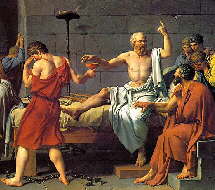
“There is only one good, knowledge, and one evil, ignorance” suggests that Socrates would agree. Moral laws are not arbitrary rules but truths about personal development and fulfilment. It doesn’t pay to be proud, vain, selfish, lazy, greedy, envious, cynical or materialistic because we alienate others and become isolated. The Greek concept of Nemesis and the Indian belief in Karma support this view but on the other hand there is also such a thing as culpable ignorance. Even if we don’t realise our vices will lead to misery for ourselves we know it is wrong to inflict unnecessary misery on others.Tony:
I guess I’m wondering what you think the answer to this broader question might be: Is sinful behavior sometimes a kind of ignorance, or is it something else?
Well, Tony. There seems to be some indication that some are not culpable for sins committed in ignorance. Saint Paul wrote:“There is only one good, knowledge, and one evil, ignorance” suggests that Socrates would agree. Moral laws are not arbitrary rules but truths about personal development and fulfilment. It doesn’t pay to be proud, vain, selfish, lazy, greedy, envious, cynical or materialistic because we alienate others and become isolated. The Greek concept of Nemesis and the Indian belief in Karma support this view but on the other hand there is also such a thing as culpable ignorance. Even if we don’t realise our vices will lead to misery for ourselves we know it is wrong to inflict unnecessary misery on others.
I’ll answer your other post later.
I have not said God holds people accountable for things they do that they do not know are wrong. In this context “culpable ignorance” means we don’t know all the consequences but we know that what we are doing is wrong.Well, Tony. There seems to be some indication that some are not culpable for sins committed in ignorance. Saint Paul wrote:
In the past God overlooked such ignorance, but now he commands all people everywhere to repent.
(Acts 17:30)
And he said of himself:
Even though I was once a blasphemer and a persecutor and a violent man, I was shown mercy because I acted in ignorance and unbelief.
(1 Timothy 1:13)
But please tell me why you believe God holds people accountable for things they do that they do not know are wrong.