I heard someone say Christ was not crucified on a cross but an upright stake

  • Thread starter Thread starter Christine85
  • Start date Start date
Status
Not open for further replies.
C

Christine85

Guest
A person said the Greek word used in the New Testament to describe how Christ was crucified is stauros which means upright stake. He said Christ was not crucified on a cross but on one plank of upright wood…
Can any one who knows anything about this please enlighten me,
Surely all the Churches in the world with crosses cannot be wrong??
 
You were probably talking to a Jehovas Witness.

I believe it is true that many times the Romans would strip a tree into a pole and simply notch it and affix a cross member to turn it into a cross as it was quicker, no carving the wood to a square, no digging a hole so on and so forth.

My understanding has always been that this is the basis for some insisting it wasn’t a cross but was a tree. But even when they used this method it was still a cross just not one sunk in a posthole.
 
Also take into account that the JW’s bible was a translation done by 3 people who were much less than qualified to be translating. Their “Greek scholar” knew only modern Greek, and not the Greek of the Bible. Real Greek and Hebrew scholars consider it an “extraordinarily poor translation”.
 
This is definitely a big Jehovah’s Witness belief. Of course, they don’t believe in the Trinity either.
 
I’m pretty sure the word in koine Greek, which is what the New Testament was written in, could mean both stake or cross. However, there was another word that meant specifically torture stake, skolops, which the Gospel writers could have used, but they didn’t.

Most interesting and convincing to me though, is early Christian art and practices. We have Tertullian in the second century talking about the ‘ancient practice’ going back to the apostles of making the sign of the cross, not torture stake. Also, a couple of decades ago, archaeologists uncovered a house that was buried in the volcano eruption of Vesuvius. It was a Christian home, one of the homes that was used to offer Mass in. How do they know that? Because they found remains of an altar, and imprinted into the stucco wall above it was a cross! An actual cross, with intersecting beams and everything. Vesuvius erupted in 79 AD. That means within less than 50 years of Christs death, his followers were already venerating the Cross. I find it hard to believe that they got it wrong living so close in time to the actual event, but somebody who comes around 2000 years after the fact knows better.

The early Christians venerated the Cross because that’s what Jesus died on and and that was the instrument of our salvation, there’s absolutely no historical evidence of any of them venerating a stake. Or even mentioning one. That idea is brand new, came from the Jehovah’s witnesses in the late nineteenth century. Personally, I’m gonna go with the faith that can trace itself all the way back to Jesus!👍
 
I’m pretty sure the word in koine Greek, which is what the New Testament was written in, could mean both stake or cross. However, there was another word that meant specifically torture stake, skolops, which the Gospel writers could have used, but they didn’t.

Most interesting and convincing to me though, is early Christian art and practices. We have Tertullian in the second century talking about the ‘ancient practice’ going back to the apostles of making the sign of the cross, not torture stake. Also, a couple of decades ago, archaeologists uncovered a house that was buried in the volcano eruption of Vesuvius. It was a Christian home, one of the homes that was used to offer Mass in. How do they know that? Because they found remains of an altar, and imprinted into the stucco wall above it was a cross! An actual cross, with intersecting beams and everything. Vesuvius erupted in 79 AD. That means within less than 50 years of Christs death, his followers were already venerating the Cross. I find it hard to believe that they got it wrong living so close in time to the actual event, but somebody who comes around 2000 years after the fact knows better.

The early Christians venerated the Cross because that’s what Jesus died on and and that was the instrument of our salvation, there’s absolutely no historical evidence of any of them venerating a stake. Or even mentioning one. That idea is brand new, came from the Jehovah’s witnesses in the late nineteenth century. Personally, I’m gonna go with the faith that can trace itself all the way back to Jesus!👍
I agree! If Christ were indeed nailed to a stake instead of a cross, why has all Christian art, literally from the time of Christ’s death, depicted the cross? And the earliest depictions were from people who witnessed the crucifixion!
The JW’s deviation from this is a classic example of not only their leaders ignorance, but of them taking brutal advantage of the historical ignorance of their congregation…just one more example proving they are a cult!
 
I agree! If Christ were indeed nailed to a stake instead of a cross, why has all Christian art, literally from the time of Christ’s death, depicted the cross? And the earliest depictions were from people who witnessed the crucifixion!

…]
I’ve looked online and can’t find any verification for this statement. Even the cross figure referenced by another poster dating to 79 AD at Pompeii is disputed.
 
Yes Jesus was crucified on a cross. I would encourage you to always trust the Magisterium. The Catholic Church is the one true church founded by Jesus Himself, and He protects His Church from error. Don’t be too quick to accept something some random person told you. Trusting in Jesus and His Church brings not only knowledge but deep profound peace. :D:aok:
 
Does it matter? I don’t think it’s in any way an article of faith that He died on a traditional cross as opposed to a wooden stake, any more than that He was born on December 25th.

And depictions in art such as crucifixes are not highly significant either. It was common in the early centuries of Christianity to depict Christ as beardless, now we portray Him as bearded, doesn’t mean diddly squat either way. He has been depicted as African, Ethiopian, Asian, Native American, Aboriginal Australian, when clearly He was none of those things.
 
Yes Jesus was crucified on a cross. I would encourage you to always trust the Magisterium. The Catholic Church is the one true church founded by Jesus Himself, and He protects His Church from error. Don’t be too quick to accept something some random person told you. Trusting in Jesus and His Church brings not only knowledge but deep profound peace. :D:aok:
True!
 
So true. Thanks for that info
Christine,

If Jesus had died on a stake, only one nail would have been used, driven through both hands. Instead, the Gospel of John records…(KJV)
25 The other disciples therefore said unto him, We have seen the Lord. But he said unto them, Except I shall see in his hands the print of the nails, and put my finger into the print of the nails, and thrust my hand into his side, I will not believe.
Nails, plural show that he was crucified, one nail in each hand.
 
Who said that there was only one nail through both feet? 😉
Not the point the point is that one for the hands and none for the feet doesn’t suffice. It could have been 2 for the feet yet it’s still a plural
 
I’ve looked online and can’t find any verification for this statement. Even the cross figure referenced by another poster dating to 79 AD at Pompeii is disputed.
That was in Herculaneum, actually.

This cross was found in 1938 during the excatvations of the Bicentenary House (Casa del Bicentenario; the stems from the fact that the house was excavated 200 years after Herculaneum was discovered), which proved to be the largest house in the Forum district of the city. The room where the cross was discovered was found in a second storey room (a second storey was added or readapted into this house as living quarters for two separate families around AD 50, perhaps under the impulse of the growing commercial life of the Forum).

The family who lived in this apartment would have belonged to the plebs, the lowest class of freeborn, urban citizens. While in antiquity the plebs enjoyed a social advantage over slaves, freedmen and foreigners, they were often at a disadvantage in economic matters. As second-class citizens they lacked capital to compete with foreign traders. As for their religion, it is often argued that the plebs could recognize the benefits of the higher social and economic status which they could rarely attain, which resulted in alienation from the existing social order and, in certain cases, an openness to new religious movements. In Rome we know that the lower classes were attracted to foreign cults. The possibility that the occupier(s) of the upper-floor rooms in the Casa del Bicentenario would be open to such a new religious movement as Christianity cannot be ruled out.

On the wall of one of the smaller upper rooms (3.00 x 2.70 meters), a cross marking was found engraved, at head height, in the recess of a stucco surface (65 x 82 cm). The stucco is opposite a doorway which lighted the room from a window in the outside corridor. Nail markings could be seen in and around this cross. Under the stucco surface a piece of furniture was found resembling a small cabinet, with a flat top surface and containing two rough clay lamps, a dice box and a die. Leaning against this cabinet was a small wooden stool. It is altogether likely that this was the original position of the cross marking, as Herculaneum was engulfed by an immense muddy torrent in AD 79, which submerged the whole town. The houses, with their upper storeys, remained unchanged in form inside a sheath of hardened mud, unlike those in Pompeii, which were flattened by a rain of lapilli and airborne hot cinders. The measurements of the horizontal arms of this cross are slightly unequal, and the top piece is not quite aligned to the base, which suggests that it was not an accurately made liturgical object of some kind. The nail marks however suggest that the cross was originally made of wood and that it had been removed before the eruption of AD 79. These marks may also indicate that a moveable panel had once covered the cross.

.jpg

While it was interpreted as a Christian cross by the excavator who found it (Amedeo Maiuri), the idea was expressed is that this was not so much a cross but a miscellaneous wall marking, perhaps caused by the imprint of a bracket once fitted to the wall. However, if it were a wall bracket it would be odd for it to have a vertical extension above the crossbar and for the “shelf” of the bracket to be smaller than the support underneath.

The case against this Cross being Christian was originally conducted from a consideration of the place of the cross in the Christian cult. It is true that this cross is not a liturgical object and is unlikely to have been used as the focus of a liturgical cult. We would hardly expect this if the apartment was rented to a humble, lower class artisan. Moreover, the dice box found in the cabinet suggests that this furniture was not an altar and so not an early Christian sanctuary or oratory, unless the dice were placed there by a later occupant. However, these observations do not prove that the cross is not Christian.

It would be a mistake to read conditions of later centuries back into the period before 79. Christians in the 1st century kept to themselves and met at each other’s houses. There were apparently no specific Christian monuments or no Church buildings or any fixed liturgical cult until the 3rd century. Is it not possible then that the cross was placed by a Christian as a sacred symbol and as a witness to his/her faith in a room used then (or later) for non-religious purposes? Christianity during Vespasian (AD 69-79) was largely tolerated by the Romans – most likely Christians were (still) regarded as adherents to Judaism and so shared the privileges of the Jews. It is unlikely that a cross on a wall of a modest upstairs room would attract attention.
 
There are meanwhile a possibility that this cross wasn’t Christian, but Jewish. The cross-shape (+) seems to have been known in Judaism, where in its standing or reclining form it represented the sign of the last Hebrew letter, tav (which in the paleo-Hebrew alphabet was indeed shaped like an X or a +). It was used to indicate that a person was God’s property was also used as an eschatological protective sign (cf. Ezekiel 9:4-6).

The position that the Jews had during Vespasian is relevant to this connection. Vespasian celebrated Titus’ capture of Jerusalem and the destruction of the Temple in AD 70 with a triumphal procession through Rome, which was later immortalized on the Arch of Titus. However, Jerusalem’s destruction did not mean that the privileges which the Jews enjoyed in Rome and throughout the Empire (something originally granted by Julius Caesar), were not diminished: the diaspora Jews had no quarrel with Rome and did not wish to jeopardize their favorable position – indeed we have no indication that the Temple’s demise affected their position materially. The only significant change was the transfer of the Temple tax into a poll tax (the fiscus Iudaicus).

By the end of the Jewish War, however, the Jewish population in Rome and other Italian cities probably increased. Puteoli (Pozzuoli) had a Jewish colony, and there seems to be evidence of Jews in Pompeii. There is no certain hard evidence however that there were any Jews in Herculaneum (the name “David” was supposedly found on a graffito in a nearby house in the Insula V region, however). But even if there were Jews in Herculaneum, the argument that this cross is Jewish cannot be sustained. The Jewish cross-marks from the 1st century are only found on tombs and on ossuaries (bone-boxes), never on the walls of rooms. The standing or reclining crosses found on Jewish tombs and slabstones invariably have equilateral arms, unlike the Cross of Herculaneum, which does not fit into the category of Jewish cross markings.
 
I will say here that the Jehovah’s Witnesses do get one thing right: the crux/stauros on which a victim could be hung had no definite shape. The T and the † are just two of the forms that a crux could take; the gibbet could be a tree, it could be a simple upright pole, it could be a T, it could be a †, it could be an X.

The Greek equivalent of crux, stauros, comes from the verb ἵστημι (histēmi ‘straighten up, stand’), which in turn comes from the Indo-European root *stā- ‘to stand, place; upright pole’ (cognate with Icelandic staur ‘a stake, pole’, English stour ‘stake, pole’; cf. staff). It originally meant an upright stake or a piece of paling in earlier Greek (Homeric and classical Greek). However, in Koine Greek, stauros also became synonymous with crux, which refers to the gibbet where a criminal is hanged, anything from a simple stake (a tree) to pieces of timber joined together at an angle. One idea has it (could be wrong though) that the word crux properly refers only to an upright stake, but is used as a metonymy for the gibbet as a whole (kind of like how the horizontal beam - patibulum, literally a ‘spreader’, from patere ‘to be (spread) open’ - was also at times used to refer to the whole device).

One can’t simply argue that stauros/crux only meant ‘upright stake’ any more than one can argue that it only meant ‘T or †-shaped gibbet’, because we do have references where T/†-shaped cruxes are implied.

A Roman citizen of no obscure station, having ordered one of his slaves to be put to death, delivered him to his fellow-slaves to be led away, and in order that his punishment might be witnessed by all, directed them to drag him through the Forum and every other conspicuous part of the city as they whipped him, and that he should go ahead of the procession which the Romans were at that time conducting in honour of the god. The men ordered to lead the slave to his punishment, having stretched out both his arms and fastened them to a piece of wood which extended across his breast and shoulders as far as his wrists, followed him, tearing his naked body with whips.
  • Dionysius of Halicarnassus (ca. 60 BC-after 7 BC), Roman Antiquities, VII, 69:1-2
Such are his verbal offences against man; his offences in deed remain. Men weep, and bewail their lot, and curse Cadmus with many curses for introducing Tau (Τ) into the family of letters; they say it was his body that tyrants took for a model, his shape that they imitated, when they set up the erections on which men are crucified. Σταυρός (stauros) the vile engine is called, and it derives its vile name from him. Now, with all these crimes upon him, does he not deserve death, nay, many deaths? For my part I know none bad enough but that supplied by his own shape–that shape which he gave to the gibbet named σταυρός after him by men.
  • Pseudo-Lucian (ca. 125-after 180), Trial in the Court of Vowels
Since he is a criminal, he will be crucified in his height and in the extension of his hands.
  • Artemidorus (2nd century), Oneirocritica 1:76
Also note the doodle below. This graffito (from around the late 1st-early 2nd century) was found in a taberna located at the vicinity of the Flavian Amphitheater in Pozzuoli (ancient Puteoli). This graffito seems to have been either another representation of the crucified Christ or (more likely) a caricature of a person who was crucified in the nearby ampitheater as part of the brutal entertainment that occurred within its walls.

http://img24.imageshack.us/img24/1272/pozzuolic.jpg

The sketch shows the victim hanging, arms widespread, on a T-shaped cross. The victim’s legs are wide open, with the feet seemingly separate and straddling the vertical beam. Note also the ledge (a sedile?) below the figure’s left leg (viewer’s right). There is some uncertainty as to whether the drawing portrays the figure as being clothed in a rough tunic or naked, or even whether the figure is that of a man or a woman. (The figure is apparently accompanied by an inscription giving the feminine name “Alcimilla.”)
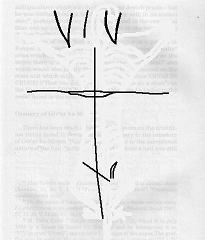


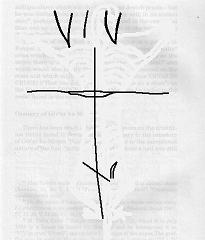
This meanwhile is another graffito, this time found in a house in Pompeii (Insula 13, Regio I). It shows the letters VIV, alongside the drawing of a †-shaped crux, and what looks like a V intersecting with the †. The cross figure could be taken as a rebus for crux. There is some uncertainty as to whether the sketch is a Christian work or not (it could be read as either as the acclamation vivat crux vivat “Long live the cross” or as the insult viva(s in) cruce “may you live on the cross”), or whether the V intersecting with the cross is really a letter or a representation of the sedile.

 
Status
Not open for further replies.
Back
Top