I never get an answer from Protestants as to WHERE the original Church is that Christ founded

Status
Not open for further replies.
Any conception of Almighty God that I am capable of having, tells me that if one of the faithful were to be subjected to this level of duplicity, and were rightly disposed to receive whatever sacrament were at issue here, that same God would not hold it against the penitent, and would confer some kind of grace commensurate with what the sacrament would have been. God's Grace is not limited to the sacraments.
Even if the Church erred as to a sacrament, does not God know the heart of the believer?
It sounds like you love the Church. Consider loving God with your mind, heart, and soul, and reading the First Commandment and then the Most Important Commandment in the Gospel. Perhaps a Bible which was not consecrated to the love of the Church (even if just by the intention of the publisher) should be used? Maybe that's just superstition.

While you sound confident, forgive me for suspecting you may find the notion that the Church could let anyone down to be a little unsettling. If you want to try a little Buddhism, and yes, you are allowed since there are practicing priests who have become Buddhist Lamas and not been excommunicated, consider getting in touch with the fear that the Church could be letting you down without divine rescue, and breathing the fear into your heart as black smoke. Then breathe out the Love of God into its place, even if you use exactly the conception you form of it by reading the Christian Bible.
 
It sounds like you love the Church. Consider loving God with your mind, heart, and soul, and reading the First Commandment and then the Most Important Commandment in the Gospel. Perhaps a Bible which was not consecrated to the love of the Church (even if just by the intention of the publisher) should be used? Maybe that's just superstition.

While you sound confident, forgive me for suspecting you may find the notion that the Church could let anyone down to be a little unsettling. If you want to try a little Buddhism, and yes, you are allowed since there are practicing priests who have become Buddhist Lamas and not been excommunicated, consider getting in touch with the fear that the Church could be letting you down without divine rescue, and breathing the fear into your heart as black smoke. Then breathe out the Love of God into its place, even if you use exactly the conception you form of it by reading the Christian Bible.
The only Bibles to which I pay any attention for spiritual matters, are Bibles that have been approved by the Catholic Church. That said, some Protestant Bible translations are almost entirely unproblematical, such as the King James Version. I would be hard-pressed to think of a Bible translation that is capable of leading people away from the Catholic Church all by itself. They are all far more similar than different.

I don't find it unsettling at all to think that "the Church could let anyone down". Those who teach supposedly in the Church's name, yet allow people (for instance) to dissent from Humanae vitae or speak in favor of women's ordination, same-sex "marriage", and so on, certain do "let people down". They are not always called up on the carpet for such teaching, and that is very wrong. Likewise, bad priests who have practiced sexual abuse certainly "let people down", something with which I think even dissidents can agree. Millstones come to mind.

But to return to the idea of a priest being able (as in not impeded by Almighty God, the only way he could be rendered unable) deliberately to confect an invalid sacrament by withholding intention (or surreptitiously tampering with form or matter with the intent to render the sacrament invalid), if the recipient is beningly disposed in his own heart to receive that sacrament worthily, I cannot believe that Our Lord would withhold the graces that this recipient is seeking. The sacrament might be invalid, but God's grace is not limited to the sacraments. The blame would lie with the priest, not with the penitent. I don't know why it is so important to you, to create such a straw-man scenario, but if this satisfies some kind of intellectual or spiritual need that you have, that is up to your own judgment. To reiterate, this is not something about which Catholics worry or spend time thinking.

It's also worth noting, that if a priest thinks that a penitent is unworthily disposed to receive the sacrament, it is incumbent upon the priest to refuse to confer that sacrament, not to simulate it and withhold intent.
 
But to return to the idea of a priest being able (as in not impeded by Almighty God, the only way he could be rendered unable) deliberately to confect an invalid sacrament by withholding intention (or surreptitiously tampering with form or matter with the intent to render the sacrament invalid), if the recipient is beningly disposed in his own heart to receive that sacrament worthily, I cannot believe that Our Lord would withhold the graces that this recipient is seeking. The sacrament might be invalid, but God's grace is not limited to the sacraments.
Why is this divine protection which you suppose limited to those who have accepted the faith? Why doesn't God save Protestants, or Satanists for that matter? Why not Atheists? Have you thought about why God would draw the line at the Church but not the sacraments?

I believe God is not limited by the Church's sacraments but only if you pray for salvation.
I don't know why it is so important to you, to create such a straw-man scenario, but if this satisfies some kind of intellectual or spiritual need that you have, that is up to your own judgment. To reiterate, this is not something about which Catholics worry or spend time thinking.
 
Why is this divine protection which you suppose limited to those who have accepted the faith? Why doesn't God save Protestants, or Satanists for that matter? Why not Atheists? Have you thought about why God would draw the line at the Church but not the sacraments?

I don't understand the second question. Almighty God has established the Church as the sole ark of salvation (extra ecclesiam nulla salus). However, to what extent someone outside the visible framework of the Church is nonetheless united to the Church in some way, and thus not truly "outside" it, is known to God alone. Only God can know hearts.

I believe God is not limited by the Church's sacraments but only if you pray for salvation.
I don't really disagree with you here.
 
Are you saying that this hypothetical wants salvation apart from God's church?
Can it be they want salvation? Would you not pick up a Protestant bible and read it and love God, if you weren't being saved because some other individual who is as weak and corruptible as you had decided it was the lesser of two evils?

Can it be the leaders of this world were not at all interested in the power a faithful Christian has to help or to withhold help?

That's why it's not necessary to find a different church which the Lord actually started. Your own catechisms proclaim the fact that they don't have to give you their help if they choose not to. They have the power not to grant it, even though rules and oversight are promised.
 
Can it be they want salvation? Would you not pick up a Protestant bible and read it and love God, if you weren't being saved because some other individual who is as weak and corruptible as you had decided it was the lesser of two evils?

Can it be the leaders of this world were not at all interested in the power a faithful Christian has to help or to withhold help?

That's why it's not necessary to find a different church which the Lord actually started. Your own catechisms proclaim the fact that they don't have to give you their help if they choose not to. They have the power not to grant it, even though rules and oversight are promised.

Our Lord "started" only one Church, the Catholic Church.

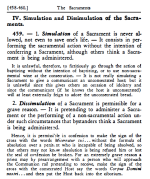
Simulating a sacrament, which is the scenario to which you keep referring, is gravely sinful (not sure if catechisms typically get into this, some catechisms are more detailed than others), this per Jone in Moral Theology:

1765807850799.png

Again, if a penitent seeks to receive a sacrament in good faith, but for some malevolent (and gravely sinful) reason the priest "tricks" him and tampers with the form, matter, or intention of the sacrament, making him think that he has received the sacrament when in fact he has not, surely Almighty God is able to supply graces commensurate with the intent of the recipient. While they might not be sacramental graces per se, they are nonetheless graces. Surely Our Lord would not leave the penitent bereft of His Grace, and woe to the priest who would abuse his orders in this way.
 
The Church clearly created some rules surrounding conditional salvation. You have posted some of them.

They were probably only looking to define and regulate the reality of the fact that a priest can intend what he will and it was so before the first catechism was written down by some scribe. It is simply the case that intentions can come with conditions. It was so before the Church made rules around it.

If you have a priest serve as your connection to the holy sacrifice of Calvary, or if you pray while intending to share in the Church's intentions, you risk not having your interests prayed for. I can't believe God makes it good unless the priest or the Church pray that their intention be so only if it's the will of God, or if the faithful person in question prays for it.

Can it be they choose to pray for and save you from serious physical harm and spiritual interference from demons or preternatural powers or unhealthy sinful spiritual rapports, but do not choose to save your good sense from the notion that so much blind faith is not warranted? Suppose they may do so thinking it is for your own good or the greater good.


Suppose Luther knew his priest had intended that the saving power of his masses did not extend to a reasonable number of eligible priestly candidates in things which would not ruin them but which would force a choice between priesthood and death, such as a lightning storm?

If you were hastening across the same field and a lightning storm blew up, and you knew in your conscience that you were on some mission which God approved of, would it not encourage you to continue, assuming there was no good way to avoid or delay the trip?

Now, what if your conscience told you that you weren't protected and stood a good chance of dying, and it was merely because the local hierarchy in your area found it prudent by their fallible human judgment that it be so?

Last, oversight and rules don't always prevent abuse.


All of this has a point relevant to the OP. There need not be some other church which the Lord started in order for the protestant reformers to have validly believed there was a need to find a different way to obtain salvation.
 
The Church clearly created some rules surrounding conditional salvation. You have posted some of them.

They were probably only looking to define and regulate the reality of the fact that a priest can intend what he will and it was so before the first catechism was written down by some scribe. It is simply the case that intentions can come with conditions. It was so before the Church made rules around it.

If you have a priest serve as your connection to the holy sacrifice of Calvary, or if you pray while intending to share in the Church's intentions, you risk not having your interests prayed for. I can't believe God makes it good unless the priest or the Church pray that their intention be so only if it's the will of God, or if the faithful person in question prays for it.

Can it be they choose to pray for and save you from serious physical harm and spiritual interference from demons or preternatural powers or unhealthy sinful spiritual rapports, but do not choose to save your good sense from the notion that so much blind faith is not warranted? Suppose they may do so thinking it is for your own good or the greater good.


Suppose Luther knew his priest had intended that the saving power of his masses did not extend to a reasonable number of eligible priestly candidates in things which would not ruin them but which would force a choice between priesthood and death, such as a lightning storm?

If you were hastening across the same field and a lightning storm blew up, and you knew in your conscience that you were on some mission which God approved of, would it not encourage you to continue, assuming there was no good way to avoid or delay the trip?

Now, what if your conscience told you that you weren't protected and stood a good chance of dying, and it was merely because the local hierarchy in your area found it prudent by their fallible human judgment that it be so?

Last, oversight and rules don't always prevent abuse.


All of this has a point relevant to the OP. There need not be some other church which the Lord started in order for the protestant reformers to have validly believed there was a need to find a different way to obtain salvation.
A prayer that is not offered subject to the will of God is no prayer at all. You may not be able to believe that God can "make it good", but I do. Almighty God is not limited to His sacraments nor to His priests. If you are seeking some kind of admission that this is so, here you have it. I don't think the Church has ever denied that.

And to repeat for the umpteenth time, the reference to conditional conferral of the sacraments, in various catechisms and moral theology texts, refers not to the priest having any reservation in his mind or intent as to whether this penitent or that deserves the sacrament, but whether it is possible to confect that sacrament. A person cannot be baptized (or confirmed, or ordained, or what have you) more than once, and a priest cannot confer absolution or extreme unction against the will of the penitent. Where that will cannot be known (as in the case of an unconscious or possibly dead penitent who is given absolution or unction), or when there is some doubt that the original sacrament was ever validly administered (as in the case of baptism, confirmation, or holy orders), the priest adminsters that sacrament conditionally. That's all it means.

This whole matter has been ground down into the finest point possible, and I have never heard of anyone seeking to assert that a priest can trick his penitent into having received a sacrament when in fact he has not. As I said, if a priest deems a penitent unworthy of receiving a sacrament, it is his duty to refuse the sacrament and to advise the penitent thusly, not to simulate it and fool the penitent into thinking he has received a sacrament when he has not.

If it is important to you to think that a priest could surreptitiously tamper with intention, matter, or form, in order to simulate the sacrament and trick the penitent into thinking he has received that sacrament, I will grant that he does indeed have that ability, arguendo --- the alternative would be to say that no, a priest cannot do that, and if he tried, he would be paralyzed or struck dead on the spot before having had that chance (just as one would die instantly if he touched the Ark of the Covenant in the OT) --- so there you have your answer (you actually had it somewhere upthread, I'm just reiterating it). Again, also as noted, this is not something with which Catholics concern themselves. If you do, that's your call.

This discussion has run its course.

 
Last edited:
Status
Not open for further replies.
Back
Top