There are also two sides to the “respect” coin, but both are covered in vanity.
Exposure of skin to sun is the normal means by which the body makes vitamin D. God intends for both women and men to at least have their bare arms exposed to the sun some of the time. Our health suffers if we don’t:
ncbi.nlm.nih.gov/pubmed/11804019
Besides, I don’t think one would find that men are more respectful of women in cold climates than in island cultures. It isn’t just how much one covers. It is how it is done and what men are taught concerning what particular clothing is meant to convey.
I don’t find it problematic that women have this part of their skin or that part of their skin covered. I find it problematic that both women and men in our culture are taught to select their clothing so as to be “sexy”.
Consider these dresses, from 1892:
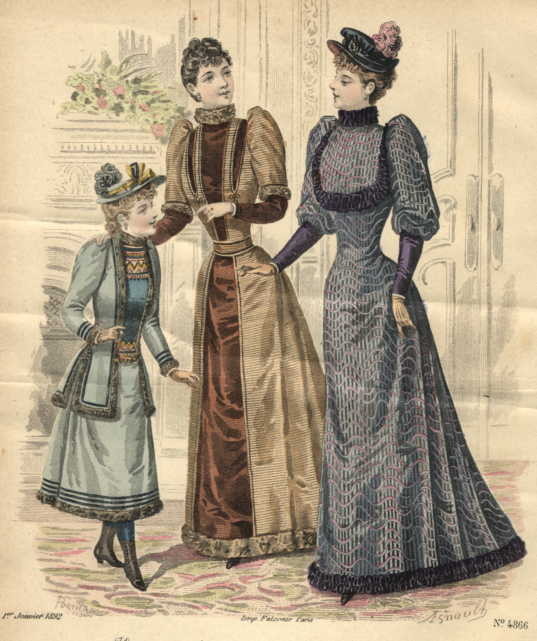
Notice that while very little skin is left showing, the feminine features are exaggerated by the use of corsets (which, if faithfully worn, were often harmful to the women’s internal organs) and padding on the backside. Obviously, what one covers isn’t the whole story.
And yes, in the evening the necklines plunged. Don’t forget that high necks and gloves were as often meant not so much to be modest for the “public”, but also to keep skin snowy, luscious-looking, and wealthy for evening events…when one’s pastor would be nowhere to be seen. Showing skin during the day came about when wealthy women took on outdoor leisure and tans were seen as “healthy-looking”, rather than a sign that a woman’s family couldn’t afford enough farm hands to get the work done. "
Do not stare at me because I am swarthy, because the sun has burned me. My brothers have been angry with me; they charged me with the care of the vineyards: my own vineyard I have not cared for. Song 1:6There have even been periods when women took arsenic in order to make their skin particularly pallid.
There is a huge middle ground between making a woman’s body indistinguishable under a billowing pile of clothing and making choices in fabric, cut, and drape which are precisely defined to inflame desire or coveteousness of other people in one’s own culture. How much money is spent every year with the goal that we, male and female, will feel good about ourselves on account of our ability to tempt others to covet either our bodies, our spouses’ bodies, or our bank accounts? We look in the mirror and want to see an object of desire, and usually we don’t want that desire to “only” be in our spouses. We want the whole world to either want to have us or else want to be us. If we don’t, that is good…but someone in the advertising world will see that as a failure.
This is what I mean by the coin having two sides: We are always told that modesty is about protecting men from lust, but modesty is not only about women keeping men from impure thoughts. It is about rejection of all sorts of vanity and vain competitions. If you dress not in a way that a man would notice but in a way that you calculate will make your friends green with envy or even that will make Heaven hold you up as a good example to them, do not think you are practicing modesty!
I think the rule is this, then: If your clothing would be
reasonably likely to make another person think a thought that starts with “I want”, then dial it down at least a notch. Modesty, by definition, does not aim to provoke envy, lust or coveteousness. Pride, or vanity, aims for those things. Rather, our grooming and dress should give the impression that we care about others and value them, not that we’re trying to impress them, compete with them, or seduce them. Slovenly dressing may not be seductive, but it is not necessarily virtuous, either. It just says, “You aren’t worth the effort.” That is not modesty, either.
I think that defines the line between being provocative and merely being well-groomed. Having said that, there is always going to be some prudence required in deciding to what degree a) exposure of skin, b) falsification or vulgar suggestion of what is left unexposed, and c) the combination of exposure and falsification that is made possible with make-up crosses that line.



 When watching TV - hey, I’ve got a real good remote control!

 If someone comes and sits right in front of me, dressed in a way that’s distracting to me, I will stand up and move somewhere else.
  I’m only sorry for the priest. He can’t run out of his own church.


