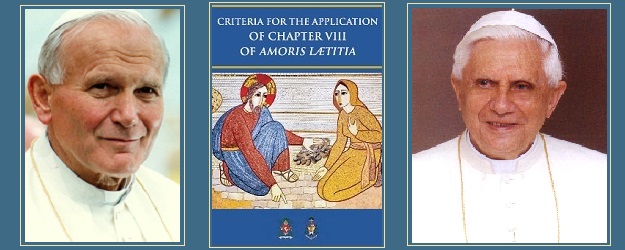
there has to be a “reasonable” application - that should by a council of cardinals to do this. Teaching cannot conflict with doctrine in any way but I guess its all in the understanding of it.
Any way, I follow a theologian of facebook and just saw this post he made - a piece of it here -
In summary, if Pope Francis were to answer the first question as “yes,” then it follows that Familiaris Consortio, 84—and subsequently reaffirmed by Reconciliatio et Paenitentia, 34—and Sacramentum Caritatis, 29, is in error and, therefore AL, would be the real truth. Furthermore, FC would then not have been a definitive and authentic act of the magisterium of the previous Pope, St. John Paul, who taught precisely the opposite. Living in an invalid marriage, one need not make a voluntary commitment, not merely a simple velleity or wish, to live as brother and sister (continence) before one can be absolved of sin, and receive holy communion. If this teaching was erroneous in practice, why? Impossible to practice?
If the answer to questions two through five is “no,” then VS 79, 81, and 56, are either erroneous, or could AL’s teaching in this area be erroneous? Further, Matthew 19:3-9, forbidding divorce and remarriage, is to be treated as an ideal of Jesus to strive for, and not a real precept of the Lord. Is this true? Furthermore, while a Pope may answer “no” by force of his office, he cannot yet appeal to an evolution of doctrine because this teaching, on the surface, contradicts previous, settled and definitive doctrine, and does not deepen the teaching, but undermines it. If previous teachings were based on Sacred Scripture and Tradition, then could this new teaching be in serious error? Since Pope St. John Paul taught these doctrines as definitive, not as opinions, and therefore fell under canon 752, #2, how can the Holy Spirit, as it were, “speak out of both sides of his mouth?” In VS 105, the “attitude of the Pharisee” is “expressed particularly in the attempt to adapt the moral norm to one’s own capacities and personal interests.” Or do the new pastoral relaxations, based on discernment, mean that the old moral norms were pharisaical ones? Did Pope St. John Paul objectively deceive the Church as Al suggests? the article continues