Is a "Flat Tax" compatible with Social Justice teaching?

  • Thread starter Thread starter Roman_Army
  • Start date Start date
Status
Not open for further replies.
You keep believing that. Meanwhile, any increased taxes on the wealthy will disappear into the same D.C.-centered black hole that our own taxes are disappearing into, without creating a single job.
I don’t have to believe it. The proof is in plain view, clear as glass.

I’m not a fan of solving everything federally, I do believe to a great degree in subsidiarity, but if it’s black holes you want, DC pales in comparison to the current abyss of unchecked private black holes.
 
i’m not at all. I’m very explicitly saying that the current structure of things benefits the cut-throat and thus forces everyone else to either match or lose.

i’m not trying to ever make a case that every CEO is a bad person. That would be foolish.

On Michael Moore: not at all, although I don’t think he’s that far off base on a lot of things. I rather like him. But his work would improve greatly if he cut back on all the personal ad hominem attack stuff.
Do you desire a state-controlled economy?
 
I think the answer to the question is that a flat tax can be compatible with social justice teaching. After all, sales tax is the same across the board for all. There is nothing inherent in Catholic social teaching that dictates percentages of tax. Even under a flat tax, those who make more will pay more.
 
Do you desire a state-controlled economy?
no, but i do desire a citizenry-controlled state, which we barely have anymore, which would make for a much more responsive and useful and effective civic vessel. In other words, government wouldn’t be this scary out of control monster. It would be us.

and i do believe such a state has an important role in the economy.

but i do not believe in pure socialism or pure capitalism. both extremes lead to tyranny.

a healthy economy must have a strong and free private sector and at the same time have a useful, efficient, and vigilant public sector.

for years the NFL has achieved far more widespread competition and winning opportunity across its 32 teams (and thus a far more vibrant and thriving “economy”) than the MLB thanks to things like salary caps which don’t hand out equal talent and records, but do make sure a small handful of advantaged teams can’t buy up all the best players for themselves.

I lean towards a distributist ideal in many ways:
Work towards ensuring that control/ownership/participation of a society’s resources, productive property, opportunities, institutions, government, etc is distributed as widely as possible, while taking real serious steps to strengthen the local levels of community & civic life, making for more effective & human problem solving.
 
I think the answer to the question is that a flat tax can be compatible with social justice teaching. After all, sales tax is the same across the board for all. There is nothing inherent in Catholic social teaching that dictates percentages of tax. Even under a flat tax, those who make more will pay more.
apples and oranges though (especially depending on the type of sales tax)

A well planned and nuanced sales tax can in theory be avoided/softened for the struggling via frugality, while the rich can still (in theory) pay a lot more taxes should they choose to enjoy the finer things in life. Whether this really fully works in the real world is another debate, but at least that’s the x’s and o’s.

Meanwhile, a flat tax forces struggling people above the poverty line to cough up a critical hole in their life budget while barely brushing the huge surpluses in forgotten pockets of those who have most benefited from a given society. It puts far more of the actual quality-of-life burden on those who are already hurting.
 
apples and oranges though (especially depending on the type of sales tax).
They have the one thing in common that is key to this topic. Neither is a part of, or excluded by, Catholic teaching. The Church only teaches principles, not specifics. Whether we pay a consumption tax or an income tax is likewise not a Catholic question.

BTW- Income tax can also be softened with similare exclusions, like dependent deductions.
 
They have the one thing in common that is key to this topic. Neither is a part of, or excluded by, Catholic teaching. The Church only teaches principles, not specifics. Whether we pay a consumption tax or an income tax is likewise not a Catholic question.

BTW- Income tax can also be softened with similare exclusions, like dependent deductions.
I agree, neither is officially referenced by name (that i know of), but its pretty clear that a flat tax exacts a palpably larger living burden on those with less, while asking negligibly little of those who’ve benefited the most, thus allowing wealth and power to amass and concentrate into fewer bigger hands, all of which is pretty clearly against Catholic social teaching.
 
Actually, the opposite is often true - for example, private hospitals cost a lot more per patient than government-run hospitals - because for-profit hospitals have to make a profit, whereas government-run hospitals only have to cover wages and expenses.

And slower response times, because you have to get people out of bed to come to the fire and put it out - they aren’t waiting at the ready in the fire station for the call to come.

And many people wouldn’t send their children to school at all, if there were no public schools to send them to. Not everyone has $20,000.00 a year of disposable income per child. For some people, that’s their whole take-home packet for the year.
Actually, it depends on how well (or poorly) the function is carried out.

Which is a reason why people home school.

Which is a reason why communities prefer volunteer fire companies.

It also depends on how effectively the money is used.

With government-run functions, often effective use of money is not an issue.

Which is the reason why functions are often contracted out by government.
 
Your question is misleading. At the same percentage, the rich still pay more in dollars than those who are not rich.

20 percent of $2,000,000 is $400,000.

“Social Justice” is a nice warm & fuzzy term that is all too often a euphemism for socialism, which is not supported by doctrine. Charity cannot be legislated via fear and punishment of incarceration. Stealing from someone to give to another in the guise of charity is a distortion of what true charity is.
The idea behind different tax rates for different income brackets is that those with higher incomes can afford to pay higher rates. A flat tax discriminates against the poor because a borderline-poverty family has a harder time giving up, say, 17% of its income than a billionaire.
 
The idea behind different tax rates for different income brackets is that those with higher incomes can afford to pay higher rates. A flat tax discriminates against the poor because a borderline-poverty family has a harder time giving up, say, 17% of its income than a billionaire.
exactly.

Every economy is fundamentally really about meeting human needs and living standards. Quality of life is the true human currency of every economy, we’ll call them QOLs.

Dollars don’t convert to QOLs at an even rate. The rate slows down to a point when the power of Dollars can no longer buy anymore QOLs and according to some studies, it actually begins to go backward.

So Dollars are money and QOLs are the meeting of human need and desire.

With a fair tax, people are taxed more QOLs the poorer they are.

it’s Catholic social values in reverse
 
The idea behind different tax rates for different income brackets is that those with higher incomes can afford to pay higher rates. A flat tax discriminates against the poor because a borderline-poverty family has a harder time giving up, say, 17% of its income than a billionaire.
On the other hand, there are few billionaires. If payment of taxes has no difficulty, or one pays no tax, then a person has no reason to show any fiscal responsibility in their voting. Voting for someone who wishes to increase spending needs to hurt everyone at least a little. If not, then representation without taxation will result in the collapse of democracy.
 
On the other hand, there are few billionaires. If payment of taxes has no difficulty, or one pays no tax, then a person has no reason to show any fiscal responsibility in their voting. Voting for someone who wishes to increase spending needs to hurt everyone at least a little. If not, then representation without taxation will result in the collapse of democracy.
that makes no sense

with a well thought-out progressive tax, everyone has the potential to be taxed if they become successful enough for it to not cripple their quality of life.

and if funding the government is made more painless to people’s quality of life, then fiscal responsibility is already being put into practice.

why should increased spending hurt people who already struggle? this is only logical if you want everyone to be against increased spending out of some fundamental religious anti-spending zeal. If funding is painless and spending is helpful (as there’e no other reason to spend but to be helpful/useful) then why force more pain?
 
why should increased spending hurt people who already struggle?
Because human nature is fallen. If I got to spend on myself out of someone else’s checking account, I spend more freely than I do if the money comes out of my checking account. You say it makes no sense. I say we will see the collapse of democracy because we have too many voters that pay nothing but get to vote themselves more benefits.

I would be accepting of increased in governement spending to the extent it is supported by the majority of those who contribute to that fund. I have no respect for the vote of the man who pays nothing.
 
Because human nature is fallen. If I got to spend on myself out of someone else’s checking account, I spend more freely than I do if the money comes out of my checking account. You say it makes no sense. I say we will see the collapse of democracy because we have too many voters that pay nothing but get to vote themselves more benefits.

I would be accepting of increased in governement spending to the extent it is supported by the majority of those who contribute to that fund. I have no respect for the vote of the man who pays nothing.
this is just so backwards (and elitist) – not calling you an elitist, but this suggestion is.

if hypothetically a taxation system came about which harms nobody’s quality of life, doesn’t impoverish the rich (allows for people to be quite wealthy) and the government (through that funding) was able to accomplish things important to society (such as infrastructure, libraries, safety nets, fire fighters, etc) and the citizenry (who are all aware they’ll face more painless taxes to their surpluss the better off they become) continue to vote and determine how the government shall behave, then society has a civic vessel that listens and responds to us all.

To say you have no respect for the vote of the man who pays nothing is to imply 4 things
A: today’s poor who pay no taxes shouldn’t have a voice
B: the only people who contribute to society are the tax payers.
C: i’m more important than you if i pay more taxes.
D: you have disdain for democracy and prefer plutocracy
 
this is just so backwards (and elitist) – not calling you an elitist, …
You called me enough, thank you. Whether you agree or disagree is your business. However, I believe it is more important to live in charity in our daily dealings than give lip service to political charity and treat other uncharitably. I do not disdain democracy because, like Thomas Jefferson, I see its demise in certain political directions, and hypocrisy in promoting government charity without being willing to extend charity one on one.

Personally, I believe quite strongly in society helping the poor and needy and everyone being able to vote. I also think *everyone *should pay some income tax as part of the privilege of living in a democracy. I never said those who pay more are of more value. The widows mite is of great value both in its cumulative effect and in helping her know she too is part of society.
 
The current system doesn’t appear to work very well. Though we say we have a progressive tax rate, in practice that is not what happens. The very rich have tax lawyers who find ways to reduce their clients’ tax burdens. And on the other end we have an underground economy where illegal aliens and criminals pay no income tax.

Almost anything would be better than the current system, which many people (maybe most people) recognize as bloated, broken and unfair.
 
Milton Friedman’s single-postcard flat tax idea has finally started catching on (ten Eastern European countries, with four more in Europe close to adoption). 2004 GDP growth rates there averaged a staggering 8%, well over twice the industrialized nations’ average of 3.4%. Of course these flat tax rates vary widely, from 12-33%. Among the six lowest-taxed countries, growth rates are the highest: 8.6%. The lowest-taxed three have 9.5% growth.

Georgia (12% tax rate, 9.5% growth-est.)
Russia (13% tax rate, 7.1% growth)
Ukraine (13% tax rate, 12% growth-est.)
Serbia (14% tax rate, 7% growth)
Hong Kong (16% tax rate, 8.1% growth)
Romania (16% tax rate, 8.1% growth-est.)
Slovakia (19% tax rate, 5.3% growth-est.)
Estonia (24% tax rate, 6% growth-est.)
Latvia (25% tax rate, 7.6% growth-est.)
Lithuania (33% tax rate, 6.6% growth-est.)

These countries needed to start out with a fresh idea.

So they adopted the flat tax.

They did not start out saddled with a 75,000 page tax code.

The flat tax idea certainly has the potential to be similarly successful if democracies can summon the moral courage to resist the natural inclination to legally confiscate their wealthy neighbors’ money through the coercive power of government. Note that this extraordinary success was achieved through adopting one element of economic freedom.

Adopting many of these components would unleash economic energy of unprecedented proportions.
 
Milton Friedman’s single-postcard flat tax idea has finally started catching on (ten Eastern European countries, with four more in Europe close to adoption). 2004 GDP growth rates there averaged a staggering 8%, well over twice the industrialized nations’ average of 3.4%. Of course these flat tax rates vary widely, from 12-33%. Among the six lowest-taxed countries, growth rates are the highest: 8.6%. The lowest-taxed three have 9.5% growth.

Georgia (12% tax rate, 9.5% growth-est.)
Russia (13% tax rate, 7.1% growth)
Ukraine (13% tax rate, 12% growth-est.)
Serbia (14% tax rate, 7% growth)
Hong Kong (16% tax rate, 8.1% growth)
Romania (16% tax rate, 8.1% growth-est.)
Slovakia (19% tax rate, 5.3% growth-est.)
Estonia (24% tax rate, 6% growth-est.)
Latvia (25% tax rate, 7.6% growth-est.)
Lithuania (33% tax rate, 6.6% growth-est.)

These countries needed to start out with a fresh idea.

So they adopted the flat tax.

They did not start out saddled with a 75,000 page tax code.

The flat tax idea certainly has the potential to be similarly successful if democracies can summon the moral courage to resist the natural inclination to legally confiscate their wealthy neighbors’ money through the coercive power of government. Note that this extraordinary success was achieved through adopting one element of economic freedom.

Adopting many of these components would unleash economic energy of unprecedented proportions.
this is all based on GDP which is an infamously poor indicator of quality
 
Hilarious!!

:rotfl:

[could you suggest some other metric?]
lol, sure.

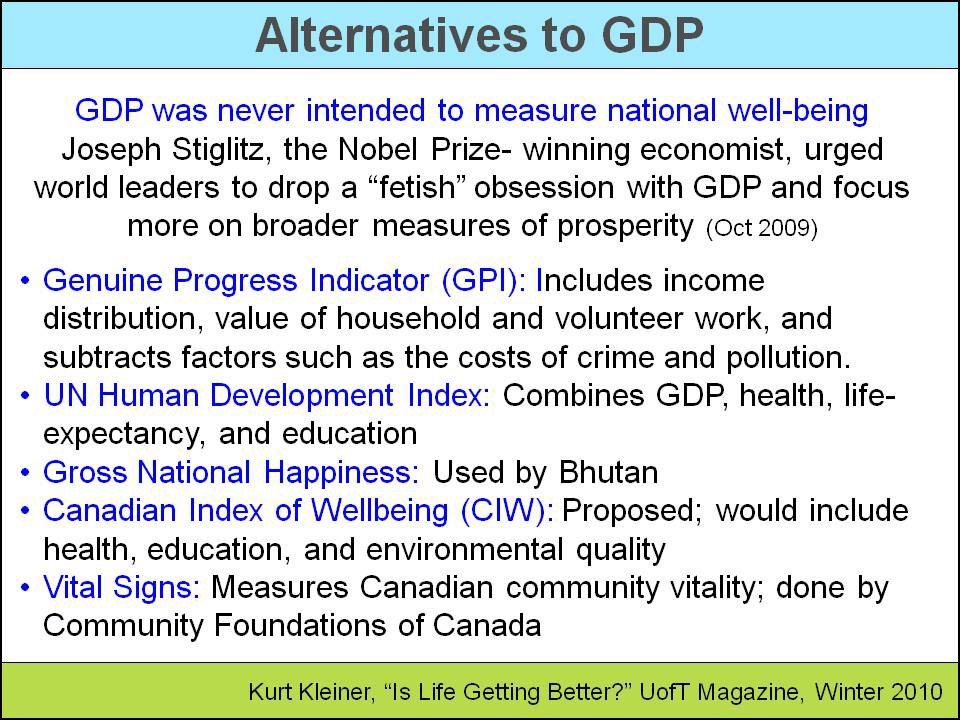
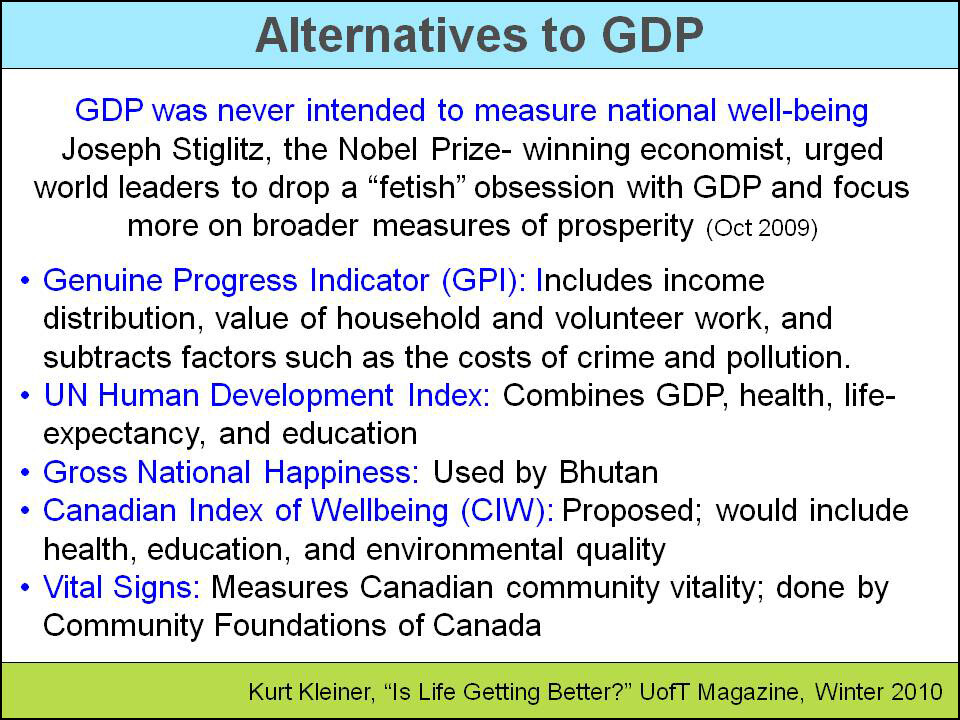
for starters, how about GPI

sustainabilityadvantage.com/2011/03/08/5-reasons-why-a-gpi-should-replace-the-gdp/

article text:

Economists deny that Gross Domestic Product (GDP) was ever intended as a metric of overall country progress or well-being. However, that’s how it is being used. Leaders express alarm if the GDP—the value of all goods and services produced within a nation in a given year—falls. Countries are ranked by GPD or GDP per citizen, implying that countries with higher rankings are doing better overall than countries with lower rankings.

What nonsense. We need a better metric for improved quality of life and progress. We need a Genuine Progress Indicator (GPI) that accounts for not only monetized economic wealth but, more importantly, includes vital environmental and social factors. Here are five reasons why it’s time we replaced the GDP with a GPI.
  1. The GDP only counts spending
As progressive economist Mark Anielski says in “The Economics of Happiness,” the GDP measures what is produced, but ignores what is required to create that production. That’s why it is called a “gross” domestic product, not a “net” domestic product. It only celebrates one side of the ledger. If we ran our household budgets that way, the person who is the most bankrupt wins. The more a nation depletes or degrades its natural resources used to produce goods and services, the more the GDP goes up. The more we over-consume and drown ourselves in debt, the more the GDP rises. This is progress?
  1. The GDP encourages layoffs
National economists warn of “productivity gaps” between their countries and others. They alert us to lack of adequate “productivity growth.” They measure productivity as GDP per hour worked. They encourage automation and more R&D so that we can produce more goods with fewer people. That means fewer jobs and higher unemployment. This is progress?
  1. The GDP celebrates disasters
As the “What’s Wrong with the GDP” ( dieoff.org/page11.htm ) web page says: “Since the GDP records every monetary transaction as positive, the costs of social decay and natural disasters are tallied as economic advance. Crime adds billions of dollars to the GDP due to the need for locks and other security measures, increased police protection, property damage, and medical costs. Divorce adds billions of dollars more through lawyer’s fees, the need to establish second households and so forth.” This is progress?
  1. The GDP omits what matters most
As Mark Anielski outlines in his above book, the GDP minimizes the value of expenditures on health care, education, social services, and environmental protection. It ignores democratic progress. It excludes the value of natural capital and the vital services provided by nature. It excludes the value of unpaid housework, child care, volunteer work and leisure. These are all good things that matter to us. If the GDP doesn’t count them, does the GDP count?
  1. The GDP sets a bad example for businesses
Governments send signals of what’s important. They influence companies to track and do well on what they consider important enough to measure. The GDP is myopically focused on the economic aspect of the triple bottom line and ignores the environmental and social bottom lines. If the GDP doesn’t track all legs of the 3-legged stool of sustainability, why should companies?

The GPI, and other similar metrics listed in the adjacent slide, is a more complete, accurate, and holistic assessment of what we care about. It assesses the well-being / happiness / quality of life of citizens. Isn’t that what matters most? It’s time we had an adult conversation about what we track and celebrate. It’s time we tracked progress toward genuine social wealth, natural wealth, and economic wealth. It’s time for a GPI.

Bob

http://dieoff.org/Gpi.gif
 
Status
Not open for further replies.
Back
Top