Is Darwin's Theory of Evolution True? Part Three

  • Thread starter Thread starter Techno2000
  • Start date Start date
Status
Not open for further replies.
Very true, but often ignored. We know a creature survived because it’s still around? Then we get a guess at to its previous versions.

 
Very true, but often ignored. We know a creature survived because it’s still around? Then we get a guess at to its previous versions.
And…I’ve learned here that some previous versions die out, and some don’t . 🤔
 
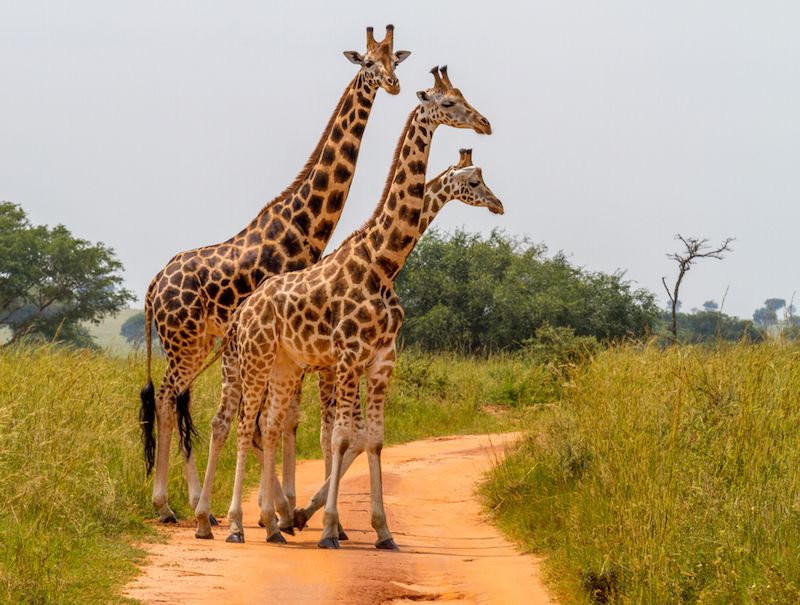
And the ones that do survive, the ones in between them and the later model somehow died. Did they leave bones behind? There should be all sorts of different bones half giraffe, half okapi. If they were unfit, how’d the later model make it?
 
Last edited:
And the ones that do survive, the ones in between them and the later model somehow died. Did they leave bones behind? There should be all sorts of different bones half giraffe, half okapi. If they were unfit, how’d the later model make it?
The half okapi-half giraffe got confused and die out, because it didn’t know if it should live in the forest or the savanna.
 
From the article: "The researchers also noted that S. major is not a direct ancestor of the giraffe. “It’s near the direct ancestor,” Solounias said. “But the direct ancestor has not been found yet.”

It doesn’t show what it claims. It shows a creature which “is not a direct ancestor of the giraffe.” Not convincing.
 
Hey. We don’t know. Anything could be and usually is an “answer.” Not “the” answer but an answer that supposedly supports the theory.
 
I’m not seeing it.
  1. The question about the origins … of man has been the object of many scientific studies which have splendidly enriched our knowledge of … the development of life-forms and the appearance of man.
  2. The great interest accorded to these studies is strongly stimulated by a question of another order, which goes beyond the proper domain of the natural sciences. It is not only a question of … when man appeared, but rather of discovering the meaning of such an origin …"
What are these paragraphs referring to if not evolution?
The CCC has other things to say.

295 "We believe that God created the world according to his wisdom.141 It is not the product of any necessity whatever, nor of blind fate or chance. We believe that it proceeds from God’s free will; he wanted to make his creatures share in his being, wisdom and goodness: "For you created all things, and by your will they existed and were created."142 Therefore the Psalmist exclaims: “O LORD, how manifold are your works! In wisdom you have made them all”; and "The LORD is good to all, and his compassion is over all that he has made."143
This paragraph doesn’t oppose theistic evolution.

The CCC is clearly biased towards evolution and bends over backwards to accomodate it, but as far as I know, it doesn’t mention anywhere that the faithful are free to believe in a literal “six days” of creation. This is an amazing omission, considering the fact that a literal interpretation of Genesis 1 was the standard for about 99% of the Church’s history.
 
Last edited:
I understand what you are saying. Catholic Answers offers the following:

"It would be fair to say that the Catechism’s statement makes the symbolic view the official interpretation of the Catholic Church on the six days. But this does not mean that the Holy See would regard those who take a literal view as sinning (committing the sins of dissent or incredulity).

"As noted above, the authority of a teaching “becomes clear from the nature of the documents, the insistence with which a teaching is repeated, and the very way in which it is expressed.” The fact it is mentioned in the Catechism indicates that the view is to be taken seriously. But the fact that it is introduced in a magisterial text for the first time here, that it has not been oft-repeated, and that it is not expressed in a forceful way (i.e., “the faithful are obliged to hold”) suggest that the Holy See would not have a problem with individual Catholics maintaining a literal interpretation.

"Indeed, the recent history of this question has strongly emphasized liberty of interpretation. To introduce the symbolist view in such a casual manner suggests that Rome is wanting to establish more of an official position than it has to this point, yet still not disturb individuals who are attached to the literal view, which heretofore has been both permitted and even historically dominant.

“The question of how the six days are to be interpreted should remain an active one in Catholic circles for some time to come.”

I was taught a literal six days in Catholic school.
 
If it’s “open to interpretation,” then that means the truth is not known. If the truth is not known, then we need to continue looking for the truth. We look for things with our eyes, and analyze what we see with our minds.
 
Is evolutionary science due for a major overhaul – or is talk of ‘revolution’ misguided?

If evolution is not to be explained solely in terms of changes in gene frequencies; if previously rejected mechanisms such as the inheritance of acquired characteristics turn out to be important after all; and if organisms are acknowledged to bias evolution through development, learning and other forms of plasticity – does all this mean a radically different and profoundly richer account of evolution is emerging? No one knows: but from the perspective of our adapting dog-walker, evolution is looking less like a gentle genetic stroll, and more like a frantic struggle by genes to keep up with strident developmental processes.

If you are not a biologist, you’d be forgiven for being confused about the state of evolutionary science. Modern evolutionary biology dates back to a synthesis that emerged around the 1940s-60s, which married Charles Darwin’s mechanism of natural selection with Gregor Mendel’s discoveries of how genes are inherited. The traditional, and still dominant, view is that adaptations – from the human brain to the peacock’s tail – are fully and satisfactorily explained by the natural selection (and subsequent inheritance). Yet as novel ideas flood in from genomics, epigenetics and developmental biology, most evolutionists agree that their field is in flux. Much of the data implies that evolution is more complex than we once assumed.

Some evolutionary biologists, myself included, are calling for a broader characterisation of evolutionary theory, known as the extended evolutionary synthesis (EES). A central issue is whether what happens to organisms during their lifetime – their development – can play important and previously unanticipated roles in evolution. The orthodox view has been that developmental processes are largely irrelevant to evolution, but the EES views them as pivotal. Protagonists with authoritative credentials square up on both sides of this debate, with big-shot professors at Ivy League universities and members of national academies going head-to-head over the mechanisms of evolution. Some people are even starting to wonder if a revolution is on the cards.

 
Last edited:
Catholics do that and much more. There are truths known only by Divine revelation as given by the Church. Science is limited.
 
Of course science is limited. It’s limited to physical observation. That’s why, for example, I do not think that there can be a good science of the mind-- we cannot observe ideas or interact with them physically. What we DO have is a science of the brain, and some understanding of the relationship between that and our experiences.

The same for evolution. I don’t really think evolution is a thing. Personally, I wouldn’t even call it a process, since it doesn’t “happen” to anything. I don’t agree with the view that a species evolves, exactly, because a species is really an idea that humans impose on a group of individuals-- these animals all have this and that feature. But there’s no “cat” mothership, or “giraffe.”

That being said, it’s very easy to see from fossil records that the kinds of individuals we find at different ages are. . . different. But they aren’t completely different-- they are related in very specific and interesting ways. You can see that dinosaurs no longer exist, exactly, but that birds have so many of the features of dinosaurs that it would be surprising indeed if they were just made from scratch that way.

Here’s my view: as we gain more, those things we say, “Don’t ask, just understand that God did it” reduce in number. We know now, for sure, why people die of certain viruses or bacterial infections. We don’t say, “My grandfather died of God,” we say he died of severe pneumonia caused by an antibiotic bacterial infection.

But you can never, EVER, get to the start of the causal chain. There will always be room for the idea of God, and no amount of science will eliminate that philosophical fact. Treating science with suspicion isn’t an act of faith-- it is, in my opinion, evidence of a LACK of faith-- that the word of God can’t hold up if you honestly assess the environment and the actors in it.
 
40.png
rossum:
Remember that “often” is not “always”. Beneficial mutations are rare, but they do happen.
It can happen therefore it did.

Do you really not see the logical problems in that line of thought?
That isn’t the logic being used. It can happen because it did happen.
 
Atheism is the applied concept. To science, God does not exist. Science is a human endeavor and it involves making money. No funding, no research. Evolution has no practical scientific application or other application, except as a pillar of support for atheism. That appears to be the primary function of the theory. This conversation has been about certain things filled with assumptions and guesswork.

When scientists ‘discovered’ a second code in DNA, the odds of chance doing this or that dropped by an order of magnitude, functional ‘Junk’ DNA drops it another order of magnitude, and molecular switches with some known functions but others with unknown function or functions drops the probability again. Millions or even billions of years are no longer enough.

This debate between science and faith will continue indefinitely. So be it.
 
Last edited:
Atheism isn’t an applied concept of anything, except that someone doesn’t have a belief in God.

God’s existence to science is irrelevant. Unless there are tests you can do to confirm, disprove God’s existence, or there is evidence for which the idea of God’s existence is the best match, science has no business with religion one way or the other.

Evolution clearly has a practical application-- it allows us to understand why animals are what they are, and it also allows us to develop new antibiotics and other treatments of bacteria which evolve very quickly.

There’s no real debate between science and faith, because they are not diametrically opposed. There are plenty of non-religious people who don’t hold much credence with science, and there are plenty of religious people who are perfectly comfortable with the idea of evolution.

If you want to stick your head in the sand that’s find. The world will move on without you, and comfortably so. But if you want the Catholic religion to remain relevant, making yourself an enemy of science is probably not a good way to achieve that goal.
 
“enemy of science”? The use of emotion words does not apply. The science I follow is easily demonstrated and repeatable. I’ve been studying science for a long time. I’ve also studied the use of propaganda and psychological warfare. Science and faith are not at odds except in this case.

The Catholic Church will continue. But this debate will also continue until full compliance is achieved. There is reasonable doubt here.
 
Status
Not open for further replies.
Back
Top