
Is it a sin to call Yahweh "God"?

  • Thread starter Thread starter minichibi
  • Start date Start date
Status
Not open for further replies.
There is that idea, yes, that Yəhûḏāh is a combination of the Name and the verb yādāh ‘to praise’. (Genesis 29:35)
I think you may be referring to the Masoretic text, or one which Jerome had access to. The Greek LXX does not appear to say precisely that.
The etymology as given in Greek indicates that the name is “yet/again”, referring back (I suppose) to her third son – whose name included the idea of 3 by the etymology given.

I need to look at the word more closely, but the word rendered “praise” is εξ-ομο-λογη-σομαι; which (if I have broken it down right) has a possible etymology suggesting same-ness (exs - homo / ex-omo ); “out of-same” – perhaps, likely meaning out of the same word/logic.

It can be translated Praise, but Thanks is often more appropriate; I am going to look for a connotation issue – for the word is somewhat unusual; It is never used in the new testament, and in Jerimiah 12:1 you can see the idea of “word” in the same declension meaning “plead” or “argue/reason”.
However, some think that Genesis provides a folk etymology for the origin of the name: William F. Albright proposed that originally, Yəhûḏāh was the passive verbal form of yādāh, and was originally followed by 'Ēl (represented by the final -āh), giving us something like Jehudael or Jehudeel “Let 'Ēl be praised.” A.R. Millard proposes something similar, although he thinks that the original name would have been something like Jehudjah.
What you are doing, is listing out a large number of vague relationships to the spelling of the word; and that seems common among scholars of Hebrew, regardless of the word; In one way, it shows a good answer to Angel’s question about how the pronunciation can get lost…

I’m thinking most of these studies aren’t really rooted deep in history; The people in Genesis, with the church, I don’t take as fictional characters; and they lived at a time where Hebrew writing was still in the idea-gram stage; eg: their association with Egypt was very close in Palo-Hebrew, for these languages were both essentially hieroglyphic in nature.
 
I think you may be referring to the Masoretic text, or one which Jerome had access to. The Greek LXX does not appear to say precisely that.
The etymology as given in Greek indicates that the name is “yet/again”, referring back (I suppose) to her third son – whose name included the idea of 3 by the etymology given.

I need to look at the word more closely, but the word rendered “praise” is εξ-ομο-λογη-σομαι; which (if I have broken it down right) has a possible etymology suggesting same-ness (exs - homo / ex-omo ); “out of-same” – perhaps, likely meaning out of the same word/logic.

It can be translated Praise, but Thanks is often more appropriate; I am going to look for a connotation issue – for the word is somewhat unusual; It is never used in the new testament, and in Jerimiah 12:1 you can see the idea of “word” in the same declension meaning “plead” or “argue/reason”.

What you are doing, is listing out a large number of vague relationships to the spelling of the word; and that seems common among scholars of Hebrew, regardless of the word; In one way, it shows a good answer to Angel’s question about how the pronunciation can get lost…

I’m thinking most of these studies aren’t really rooted deep in history; The people in Genesis, with the church, I don’t take as fictional characters; and they lived at a time where Hebrew writing was still in the idea-gram stage; eg: their association with Egypt was very close in Palo-Hebrew, for these languages were both essentially hieroglyphic in nature.
You mean Proto-Sinaitic, from which the Canaanite alphabet (Phoenician, Paleo-Hebrew, Moabite, etc. they’re all the same really) developed. And no, while Proto-Sinaitic may have developed out of Egyptian writing (specifically Hieratic), the system wasn’t the same. Only the graphic form of the Proto-Sinaitic characters derive from Egyptian hieroglyphs; these characters were in turn given the sound value of the first consonant of the Semitic translation of the hieroglyph. Granted the Wadi el-Hol inscriptions show a greater hieroglyphic influence, but the system is the same.

And did someone say here that the characters in Genesis are fictional? I didn’t.
 
You mean Proto-Sinaitic, from which the Canaanite alphabet (Phoenician, Paleo-Hebrew, Moabite, etc. they’re all the same really) developed. And no, while Proto-Sinaitic may have developed out of Egyptian writing (specifically Hieratic), the system wasn’t the same.
I didn’t mean they were the same, my apology.
In the Heiroglyphic system, there appear to be many more glyphs; and when phonetics are used, only a small subset are used – put in some kind of surrounding shape to indicate that sounds are meant, and not the ideas.
Of course, there are sure to be many other variations.

I’m neither a Hebrew nor Egyptian expert; I merely have general knowledge from wide reading interests.

However, in the Palo Hebrew – as far as I know – the words themselves are still copies of the earlier idea-graphics. Palo Hebrew preserves the original characters; and when I read about the language – the concatenation of ideas was demonstrated from a Palo-Hebrew inscription;

Although there was a linguistic development, if I understand you correctly, one can still find the foundational method of the language (partially) preserved in the later system. It wasn’t a complete re-invention of language, but an incremental one with legacy methods preserved, even if the original reasons were forgotten.

Not until the Babylonian exile, and the introduction of the block script – did the original picto-graphs loose their obvious non-phonetic origin, paralleling that of heiroglyphics.
Only the graphic form of the Proto-Sinaitic characters derive from Egyptian hieroglyphs; these characters were in turn given the sound value of the first consonant of the Semitic translation of the hieroglyph. Granted the Wadi el-Hol inscriptions show a greater hieroglyphic influence, but the system is the same.
And did someone say here that the characters in Genesis are fictional? I didn’t.
No, I didn’t claim anyone said they were fictional; however, looking at the scholars cited – I fairly certain that in that general circle of scholars – they cite other scholars (approvingly) who hold ideas that equate pseudo authorship with pseudo historical figures…

The historical nature of the bible, however, is not completely fluid – although rabbinic interpretation became very fanciful by the time of Jesus, eg: contrast halacha (midrash) w/ haggadic. The accounts in Genesis do use mythological elements, but it is (none the less) conveying a true history sometimes obscured by later ignorance.

I am merely affirming that the figures are real, and although a “folk” etymology may be suspected; it is in no way on par with something like the “American tall tale.” – such an etymology as found in Genesis ought not be discarded outright as totally false or invented without solid reason for doing so.

The Hebrews absorbed many elements from the people they were with throughout history both in their writing characters; and in the texts themselves. Some of the old testament writings (for example, Song of Songs) show direct inheritance from Egyptian writing (for example, the Wasif (sp?) ). The wisdom tradition, and proverbs, are also inherited from Egyptian literary styles/genres. I might also cite the later block script itself, which came into existence during the Babylonian captivity copying Babylonian character style – and perhaps in babylon, they found a synergistic recapturing of Abraham’s roots/people in the Genesis flood story. (Compare w/ enuma elish).

I prefer to check what a scholar says with a comparison to primary sources before just accepting their conclusions. I’m not, of course, saying they are all wrong – but very often, they are excessively speculative.
 
I didn’t mean they were the same, my apology.
In the Heiroglyphic system, there appear to be many more glyphs; and when phonetics are used, only a small subset are used – put in some kind of surrounding shape to indicate that sounds are meant, and not the ideas.
Of course, there are sure to be many other variations.

I’m neither a Hebrew nor Egyptian expert; I merely have general knowledge from wide reading interests.

However, in the Palo Hebrew – as far as I know – the words themselves are still copies of the earlier idea-graphics. Palo Hebrew preserves the original characters; and when I read about the language – the concatenation of ideas was demonstrated from a Palo-Hebrew inscription;

Although there was a linguistic development, if I understand you correctly, one can still find the foundational method of the language (partially) preserved in the later system. It wasn’t a complete re-invention of language, but an incremental one with legacy methods preserved, even if the original reasons were forgotten.
I’m getting confused here. What I meant is this: according to the alphabet theory, Proto-Sinaitic only inherited the forms of Egyptian hieroglyphs. The sound values, meanwhile, were that of the first consonant of the Semitic translation of the hieroglyph. In other words, the hieroglyph for pr ‘house’ was adopted to write the sound /b/, after the first consonant of baytu ‘house’ (acrophony). That doesn’t mean that the letter itself is read as or automatically means baytu.
Not until the Babylonian exile, and the introduction of the block script – did the original picto-graphs loose their obvious non-phonetic origin, paralleling that of heiroglyphics.
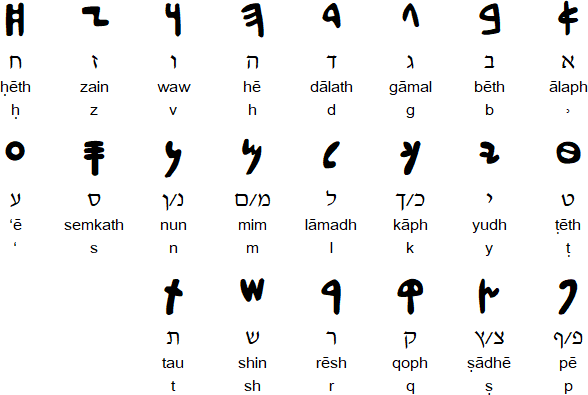
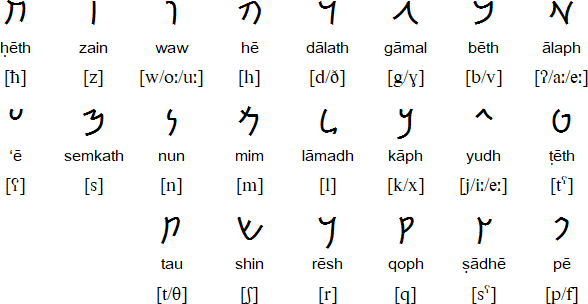
Fun fact: the ‘block script’ is itself a descendant of Phoenician. In other words, the Jews in exile dropped one script in favor of its relative.

(Please Note: This uploaded content is no longer available.)
Phoenician


Early Aramaic (10th-9th century BC)

http://home.earthlink.net/~walterk12/HIB/HIB_Pics/paleoletters.gif
Paleo-Hebrew


Imperial Aramaic (5th century BC)
I prefer to check what a scholar says with a comparison to primary sources before just accepting their conclusions. I’m not, of course, saying they are all wrong – but very often, they are excessively speculative.
Why don’t you read Albright says and judge for yourself rather than just me - a second-hand source - telling you? and Todah**Torah
 
I’m getting confused here. What I meant is this: according to the alphabet theory, Proto-Sinaitic only inherited the forms of Egyptian hieroglyphs. The sound values, meanwhile, were that of the first consonant of the Semitic translation of the hieroglyph. In other words, the hieroglyph for pr ‘house’ was adopted to write the sound /b/, after the first consonant of baytu ‘house’ (acrophony). That doesn’t mean that the letter itself is read as or automatically means baytu.
Sure.
Thanks for the link, Patrick. 🙂
 
That’s my understanding, although I haven’t exhaustively studied the Hebrew for examples of it.
I don’t recall ever seeing it used when it didn’t mean God’s name – but don’t quote me on that.

🙂

I have some speculation on this;
First, think about the “Glory Be” prayer.
It talks about God’s perfection & power in three ways.

Past, Present, Future.

The name of God is also spoken in three ways to Moses.

Likewise – In English: We don’t use the same word to represent past, present, and future – “is” ness. We also break the word’s forms out in the Glory prayer.

But, other languages do have forms that combine the three basic tense ideas.

Look at Luke 23:46 – and recognize “Father” is Jesus’ very last word/idea upon dying.

Then look at John 19:30;

The two passages (in English translation) do not agree on what his last word was – !or even if it were the same topic!.

But, from studying Greek – I know that the translation “it is finished” is about as lame as one can get. The word is in the perfect tense – meaning whatever happened was complete in the past, is now, and will continue on for as long as the one causing it exists. (Eternal in this case.)

Now recall the glory be – again – and recognize Jesus’ last word in it’s etymology means “being”; and by it’s spelling/form in John – it means “perfect being”.

When understood in this way, Jesus last word in John’s Gospel really is his Father’s personal name – but rendered in Greek by it’s meaning. (Not pronunciation).

For the first time, the Greek speaking Gentiles had access to the Father through Jesus – his sacrifice being consummated; and they would repeat his name as often as they recalled Jesus’ last words.

– Just so –

I don’t know Hebrew well enough to know exactly how all three variations of being are to be pronounced; and I get the idea from reading history and anecdotes from Hebrew scholars – that over most the previous millenia (recall we’re only 200+ years old in the USA) before Jesus’ time; the language and pronunciation changed. (I suppose it’s like Slang with a vengeance – and vowel drift; eg: compare how baby is said in the USA “Bayb(EE)” vs. Europe ( “Bayb(ih)”. )

So, When I ask about the pronunciation of God’s name – I’m really talking about, how many changes has vocalization gone through over the last 2800+ years? eg: Both translational, and pronunciation / accenting changes from the original language and time.

I do wonder, with you, why it is that the original pronunciation isn’t just easily found when doing a web-search, or in basic Hebrew learning texts – but it isn’t.

I don’t know if the problem is that the original Hebrews had a way to combine all three variations of “being” into a single name spoken differently than the constituent words; Or whether it’s just taboo to say “I am”; or if more than one vowel is acceptable to use in certain words without changing their meaning – and simultaneously that God’s name requires one to use a particular vowel; etc. for it isn’t revealed in more than one way.

But I DO know that there are a plethora of ways that Jews came up with to almost say his name, in order to avoid the risk of using it in vain – but to “legalistically” have not said it! So, I do know there are many ways that it is “wrong” to say God’s personal name; and considering the history of Israel – there are many ways his name was almost said, that I don’t want to repeat.
🙂
Thank you for your informative post… the highlighted portion reflects my thoughts… since there’s no Scriptural Command not to pronounce/use God’s Name, it is only reasonably logical that well-meaning legalism went into play… what baffles me is how people get so caught up in “not offending” the “sensibilities” by not pronouncing God’s Name when it is God Himself that Commands Moses to Bless Israel (and consequenty the rest of the world) in His Name!

Maran atha!

Angel
 
אֶֽהְיֶ֖ה אֲשֶׁ֣ר אֶֽהְיֶ֑ה ’ehyeh ’ăšer ’ehyeh (“I-be that I-be”), you mean? Yep, Yhwh is, as per the consensus theory, thought to be related to ’ehyeh (1st person singular imperfect), both coming from the Semitic root היה h-y-h (hāyah) ‘to be, to become’.
Thanks… I just wasn’t sure the of the term!

Maran atha!

Angel
 
I didn’t mean they were the same, my apology.
In the Heiroglyphic system, there appear to be many more glyphs; and when phonetics are used, only a small subset are used – put in some kind of surrounding shape to indicate that sounds are meant, and not the ideas.
Of course, there are sure to be many other variations.

I’m neither a Hebrew nor Egyptian expert; I merely have general knowledge from wide reading interests.

However, in the Palo Hebrew – as far as I know – the words themselves are still copies of the earlier idea-graphics. Palo Hebrew preserves the original characters; and when I read about the language – the concatenation of ideas was demonstrated from a Palo-Hebrew inscription;

Although there was a linguistic development, if I understand you correctly, one can still find the foundational method of the language (partially) preserved in the later system. It wasn’t a complete re-invention of language, but an incremental one with legacy methods preserved, even if the original reasons were forgotten.

Not until the Babylonian exile, and the introduction of the block script – did the original picto-graphs loose their obvious non-phonetic origin, paralleling that of heiroglyphics.

No, I didn’t claim anyone said they were fictional; however, looking at the scholars cited – I fairly certain that in that general circle of scholars – they cite other scholars (approvingly) who hold ideas that equate pseudo authorship with pseudo historical figures…

The historical nature of the bible, however, is not completely fluid – although rabbinic interpretation became very fanciful by the time of Jesus, eg: contrast halacha (midrash) w/ haggadic. The accounts in Genesis do use mythological elements, but it is (none the less) conveying a true history sometimes obscured by later ignorance.

I am merely affirming that the figures are real, and although a “folk” etymology may be suspected; it is in no way on par with something like the “American tall tale.” – such an etymology as found in Genesis ought not be discarded outright as totally false or invented without solid reason for doing so.

The Hebrews absorbed many elements from the people they were with throughout history both in their writing characters; and in the texts themselves. Some of the old testament writings (for example, Song of Songs) show direct inheritance from Egyptian writing (for example, the Wasif (sp?) ). The wisdom tradition, and proverbs, are also inherited from Egyptian literary styles/genres. I might also cite the later block script itself, which came into existence during the Babylonian captivity copying Babylonian character style – and perhaps in babylon, they found a synergistic recapturing of Abraham’s roots/people in the Genesis flood story. (Compare w/ enuma elish).

I prefer to check what a scholar says with a comparison to primary sources before just accepting their conclusions. I’m not, of course, saying they are all wrong – but very often, they are excessively speculative.
…I would say so and would even dare: unapologetically biased!

Maran atha!

Angel
 
I’m getting confused here. What I meant is this: according to the alphabet theory, Proto-Sinaitic only inherited the forms of Egyptian hieroglyphs. The sound values, meanwhile, were that of the first consonant of the Semitic translation of the hieroglyph. In other words, the hieroglyph for pr ‘house’ was adopted to write the sound /b/, after the first consonant of baytu ‘house’ (acrophony). That doesn’t mean that the letter itself is read as or automatically means baytu.
That’s a good point; and one of which I was not aware. I have not read that deeply into the topic. It also suggests that the connections made in the papers I read previously, are wrong; but that also brings up troubling issues.

I was not aware that the Hebrew aleph-bet was directly inherited from Egyptian hieroglyphics alone. My impression was that there was some parallelism, and that Hebrew writing was later influenced by their sojourn in Egypt. This is something I need to spend some time on, first, but am very limited in funds in order to get all these kinds of documents; and the library at my alma-mater is presently unavailable due to being rebuilt… 😦

However, your thesis indicates that they were already fully oral and phonetic in speech/grammar before adopting a script. That doesn’t entirely make sense to me. What structure I have seen in the early language does appear to make a connection between the glyphs and the ideas they represented.
I could easily look up a Hebrew word of a certain pattern – and compare the meaning of the word with what the shapes were understood to mean as ideas (and not phonemes). The two related quite well in many cases.

Since the entire writing system of the Egyptians was picture idea oriented; it is strange that the Hebrew language (which was formed in contact with Egypt) would be exclusively based on a different system.

Again, the Egyptians had a subset of hieroglyphs that were exclusively used for phonetic spellings. If the Hebrews were truly borrowing, then I would have expected the Hebrews to borrow the phonetic glyphs alone;

I need to verify that is true and can’t.

What I am getting at, is that there may be a far more basic reason those glyphs were chosen (by Egyptians, and Hebrews) than mere sound association; or perhaps – the sounds were more intimately tied to a common predecessor language than we are aware of. (Speculation, of course.)
Fun fact: the ‘block script’ is itself a descendant of Phoenician. In other words, the Jews in exile dropped one script in favor of its relative.
Assuredly so; but that doesn’t change the fact that the stylistic block script is far more like an impressionists blurry painting of the original shape, than an accurate depiction of a “thing” recognizable from everyday life.

Your early Aramaic listing is very good, as is the Phonecian, at showing these shapes I am thinking of; Heth, for example, resembles the triple gate popular in David’s day; suggesting it is a wall, fence, or entry.

No such resemblance is found in the block script found in the Masoretic texts; etc. Babylonian block script, even if a cousin script – none the less, hides the essential pictographic idea.
Why don’t you read Albright says and judge for yourself rather than just me - a second-hand source - telling you? The Names ‘Israel’ and ‘Judah’ with an Excursus on the Etymology of Todah and Torah
🙂 I can’t read as much as I would like at the moment; but it does appear Albrecht is not among the scholars I assumed he was. When I am able, soon, I’ll see if I can buy the article – or find it in Google (It is out of copyright!!!)
 
Status
Not open for further replies.
Back
Top