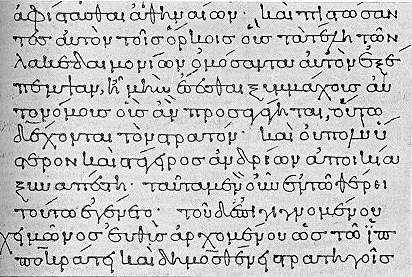
Somewhere along the line, some Englishman decided to transliterate the Greek letter kappa with the English “c” rather than “k”. I don’t know why; maybe at that time “c” was pronounced like “k” wherever it appeared. In any case, if I could borrow someone’s time machine, I’d like to go back and wring his scrawny little neck.
To be correct, “c” should be pronounced as “k” in all Bible proper names: Cephas = Kephas, Candace = Kan-da-ke, etc.
DaveBj
From
Wikipedia:
When the Roman alphabet was introduced into Britain, C represented only /k/ and this value of the letter has been retained in loanwords to all the insular Celtic languages: in Welsh, Irish, Gaelic, C, c, is still only /k/. The Old English or “Anglo-Saxon” writing was learned from the Celts, apparently of Ireland; hence C, c, in Old English, also originally represented /k/: the words kin, break, broken, thick, seek, were in Old English written cyn, brecan, brocen, Þicc, séoc. But during the course of the Old English period, /k/ before front vowels (/e/ and /i/) was palatalized, having, by the 10th century, advanced nearly or quite to the sound of /tʃ/, though still written c, as in cir(i)ce, wrecc(e)a. On the continent, meanwhile, a similar phonetic change had also been going on (for example, in Italian).
Original Latin /k/ before front vowels had palatalized in Italy to the sound of /tʃ/, and in France and the Iberian peninsula to that of /ts/. Yet for these new sounds the old character C, c, was still retained before e and i, the letter thus represented two distinct values. Moreover the Latin phoneme /kʷ/ (represented by QV, or qu) de-labialized to /k/ meaning that the various Romance languages had /k/ before front vowels. In addition, Norman used the Greek letter K, so that the sound /k/ could be represented by either k or c, the latter of which could represent either /k/ or /ts/. These French inconsistencies as to C and K were, after the Norman Conquest, applied to the writing of English, which caused a considerable re-spelling of the Old English words.
Thus while Old English candel, clif, corn, crop, cú, remained unchanged, Cent, cæ´ (cé´), cyng, brece, séoce, were now (without any change of sound) spelt Kent, keȝ, kyng, breke, seoke; even cniht was subsequently spelt kniht, knight, and þic, þicc, became thik, thikk, thick. The Old English cw- was also at length displaced by the French qw, qu, so that the Old English cwén, cwic, became Middle English qwen, quen, qwik, quik, now queen, quick. The sound /tʃ/ to which Old English palatalized c had advanced, also occurred in French, chiefly (in Central French) from Latin c before a. In French it was represented by ch, as in champ, cher:–Latin camp-um, caōr-um; and this spelling was now introduced into English: the Hatton Gospels, written about 1160, have in Matt. i-iii, child, chyld, riche, mychel, for the cild, rice, mycel, of the Old English version whence they were copied. In these cases, the Old English c gave place to k, qu, ch; but, on the other hand, c in its new value of /ts/ came in largely in French words like processiun, emperice, grace, and was also substituted for ts in a few Old English words, as miltse, bletsien, in early Middle English milce, blecien. By the end of the 13th century both in France and England, this sound /ts/ de-affricated to /s/; and from that date c before front vowels has been, phonetically, a duplicate or subsidiary letter to s; used either for etymological reasons, as in lance, cent, or (in defiance of etymology) to avoid the ambiguity due to the “etymological” use of s for /z/, as in ace, mice, once, pence, defence.
And:
When Greek words were taken into Latin, the Kappa was converted to C, with a few exceptions such as the praenomen Kaeso.[2] Some words from other alphabets were also transliterated into C. Therefore, the Romance languages have K only in words from still other language groups. The Celtic languages also chose C over K, and this influence carried over into Old English. Today, English is the only Germanic language to productively use hard C in addition to K (although Dutch uses it in learned words of Latin origin and follows the same “hard / soft” distinction in such words as does French and English – but not in native words).
So, if there is one to blame for the evolution of C, blame the Italians, the Celts, and the French.