Is it Cephas (soft c), or Kepha (hard k)?

  • Thread starter Thread starter catechizeme
  • Start date Start date
Status
Not open for further replies.
C

catechizeme

Guest
I’ve heard that the Aramaic word Jesus would had used in Matthew 16 is either Cephas/Cephus (soft c, follwed by long e sound) or Kepha/Kephas (hard k, followed by long a sound).

Which is it, and what is the difference between these two words. Are they both Aramaic?

Thank you!
 
Kepha is the Aramaic.

Cephas is the Greek rendering of the Aramaic Kepha.

Think John (English), Juan (Spanish) and even Sean (Irish).
 
I’ve heard that the Aramaic word Jesus would had used in Matthew 16 is either Cephas/Cephus (soft c, follwed by long e sound) or Kepha/Kephas (hard k, followed by long a sound).

Which is it, and what is the difference between these two words. Are they both Aramaic?

Thank you!
Cephas is merely the Latinized form of the Greek transliteration Kēphas (Κηφας), which in turn comes from the Aramaic Kêfâ (כיפא).

For the record, it might be only in English where Cephas is pronounced with a soft C, very much like SEE-fuhs. Kēphas and Kêfâ are pronounced with a K sound in both Greek and Aramaic. Meanwhile, Classical Latin would yield KE-fas, while Ecclesiastical Latin would give its pronunciation as CHE-fas I think.
 
Cephas is merely the Latinized form of the Greek transliteration Kēphas (Κηφας), which in turn comes from the Aramaic Kêfâ (כיפא).

For the record, it might be only in English where Cephas is pronounced with a soft C, very much like SEE-fuhs. Kēphas and Kêfâ are pronounced with a K sound in both Greek and Aramaic. Meanwhile, Classical Latin would yield KE-fas, while Ecclesiastical Latin would give its pronunciation as CHE-fas I think.
Is there a difference between Kepha and Kephas -is one more correct than the other?

Thank you!! (How do you know all this? I’m impressed.)
 
Cephas is merely the Latinized form of the Greek transliteration Kēphas (Κηφας), which in turn comes from the Aramaic Kêfâ (כיפא).
The key word in this sentence is transliteration. As a general rule, we can actually know with a high degree of certainty how an unfamiliar word would have been pronounced in one language, by seeing how it was transliterated into other languages.

There is no Greek letter for ‘c’ (soft or hard), so a ‘soft c sound’ in Aramaic would have been transliterated to the Greek letter for ‘s’ (i.e. sigma). As it is, the transliteration was to the Greek letter for ‘k’ (i.e. kappa) so it must have been a ‘hard c sound’ in Aramaic.
 
Is there a difference between Kepha and Kephas -is one more correct than the other?

Thank you!! (How do you know all this? I’m impressed.)
Well, Kēpha would be the actual transliteration of kêfâ while Kēphas is an Hellenization - the final sigma (s) is added in Greek to make the name masculine rather than feminine (a similar instance to this would be how the Aramaic tômâ “twin” is transliterated in Greek as Thōmas - with a sigma). But if you’ll ask me, I don’t think one is more correct than the other.
 
Somewhere along the line, some Englishman decided to transliterate the Greek letter kappa with the English “c” rather than “k”. I don’t know why; maybe at that time “c” was pronounced like “k” wherever it appeared. In any case, if I could borrow someone’s time machine, I’d like to go back and wring his scrawny little neck.

To be correct, “c” should be pronounced as “k” in all Bible proper names: Cephas = Kephas, Candace = Kan-da-ke, etc.

DaveBj
 
It’s actually Latin that transliterated Aramaic Kepha, Greek Kephas into Cephas. Latin doesn’t have a K; it has a C. The C used to be a hard sound (in classical Latin), but gradually changed to a soft c sound or even a ch, as in the Italian pronunciation of Latin today.

Most European languages used the Roman alphabet, so most of them spelled their version of Kephas with a C.

So don’t blame the English. This time. 🙂
 
Somewhere along the line, some Englishman decided to transliterate the Greek letter kappa with the English “c” rather than “k”. I don’t know why; maybe at that time “c” was pronounced like “k” wherever it appeared. In any case, if I could borrow someone’s time machine, I’d like to go back and wring his scrawny little neck.

To be correct, “c” should be pronounced as “k” in all Bible proper names: Cephas = Kephas, Candace = Kan-da-ke, etc.

DaveBj
From Wikipedia:

When the Roman alphabet was introduced into Britain, C represented only /k/ and this value of the letter has been retained in loanwords to all the insular Celtic languages: in Welsh, Irish, Gaelic, C, c, is still only /k/. The Old English or “Anglo-Saxon” writing was learned from the Celts, apparently of Ireland; hence C, c, in Old English, also originally represented /k/: the words kin, break, broken, thick, seek, were in Old English written cyn, brecan, brocen, Þicc, séoc. But during the course of the Old English period, /k/ before front vowels (/e/ and /i/) was palatalized, having, by the 10th century, advanced nearly or quite to the sound of /tʃ/, though still written c, as in cir(i)ce, wrecc(e)a. On the continent, meanwhile, a similar phonetic change had also been going on (for example, in Italian).

Original Latin /k/ before front vowels had palatalized in Italy to the sound of /tʃ/, and in France and the Iberian peninsula to that of /ts/. Yet for these new sounds the old character C, c, was still retained before e and i, the letter thus represented two distinct values. Moreover the Latin phoneme /kʷ/ (represented by QV, or qu) de-labialized to /k/ meaning that the various Romance languages had /k/ before front vowels. In addition, Norman used the Greek letter K, so that the sound /k/ could be represented by either k or c, the latter of which could represent either /k/ or /ts/. These French inconsistencies as to C and K were, after the Norman Conquest, applied to the writing of English, which caused a considerable re-spelling of the Old English words. Thus while Old English candel, clif, corn, crop, , remained unchanged, Cent, cæ´ (cé´), cyng, brece, séoce, were now (without any change of sound) spelt Kent, keȝ, kyng, breke, seoke; even cniht was subsequently spelt kniht, knight, and þic, þicc, became thik, thikk, thick. The Old English cw- was also at length displaced by the French qw, qu, so that the Old English cwén, cwic, became Middle English qwen, quen, qwik, quik, now queen, quick. The sound /tʃ/ to which Old English palatalized c had advanced, also occurred in French, chiefly (in Central French) from Latin c before a. In French it was represented by ch, as in champ, cher:–Latin camp-um, caōr-um; and this spelling was now introduced into English: the Hatton Gospels, written about 1160, have in Matt. i-iii, child, chyld, riche, mychel, for the cild, rice, mycel, of the Old English version whence they were copied. In these cases, the Old English c gave place to k, qu, ch; but, on the other hand, c in its new value of /ts/ came in largely in French words like processiun, emperice, grace, and was also substituted for ts in a few Old English words, as miltse, bletsien, in early Middle English milce, blecien. By the end of the 13th century both in France and England, this sound /ts/ de-affricated to /s/; and from that date c before front vowels has been, phonetically, a duplicate or subsidiary letter to s; used either for etymological reasons, as in lance, cent, or (in defiance of etymology) to avoid the ambiguity due to the “etymological” use of s for /z/, as in ace, mice, once, pence, defence.

And:

When Greek words were taken into Latin, the Kappa was converted to C, with a few exceptions such as the praenomen Kaeso.[2] Some words from other alphabets were also transliterated into C. Therefore, the Romance languages have K only in words from still other language groups. The Celtic languages also chose C over K, and this influence carried over into Old English. Today, English is the only Germanic language to productively use hard C in addition to K (although Dutch uses it in learned words of Latin origin and follows the same “hard / soft” distinction in such words as does French and English – but not in native words).

So, if there is one to blame for the evolution of C, blame the Italians, the Celts, and the French. :rolleyes:
 
An interesting read, Patrick. I didn’t have time to do any research myself; I’m in my hometown for my HS reunion. So we get to blame everyone BUT the English. Pity 😛

DaveBj
 
I’ve heard that the Aramaic word Jesus would had used in Matthew 16 is either Cephas/Cephus (soft c, follwed by long e sound) or Kepha/Kephas (hard k, followed by long a sound).

Which is it, and what is the difference between these two words. Are they both Aramaic?

Thank you!
JL: Hard as a ROCK.
 
There certainly was the letter K in the Latin, or Roman, alphabet. In fact, it was used for Greek loan words or names.
Interesting: You can see the letter C used in Greek icons and church paintings. I’ve been told it’s actually a form of S. Could it have come from the Latin alphabet after Christianization?
 
There certainly was the letter K in the Latin, or Roman, alphabet. In fact, it was used for Greek loan words or names.
Interesting: You can see the letter C used in Greek icons and church paintings. I’ve been told it’s actually a form of S. Could it have come from the Latin alphabet after Christianization?
Yes, there was originally a ‘K’ in Latin, but as you can infer it soon dropped out of common use, surviving only in a few words (like kalendae/calendae or the praenonen Kaeso/Caeso). And the ‘C’ you see in icons is what’s called a lunate sigma, because it’s shaped like a crescent moon. As the name implies, it is a simplified variant of the letter sigma (Σ). And no, it was in use for quite some time before Christianity even existed.
 
There certainly was the letter K in the Latin, or Roman, alphabet. In fact, it was used for Greek loan words or names.
Interesting: You can see the letter C used in Greek icons and church paintings. I’ve been told it’s actually a form of S. Could it have come from the Latin alphabet after Christianization?
That lunate sigma, Ϲ, becomes very common after about 300 BC, but (I have read), does occasionally show up earlier. It is especially used in manuscripts, and I wonder whether that might be because it would have been hard to tell Σ from Є, the epsilon of the cursive style of the period.
 
I’ve heard that the Aramaic word Jesus would had used in Matthew 16 is either Cephas/Cephus (soft c, follwed by long e sound) or Kepha/Kephas (hard k, followed by long a sound).

Which is it, and what is the difference between these two words. Are they both Aramaic?

Thank you!
The /k/ is more original, the /s/ quite common in modern English, but I find it interesting that I do hear quite a few people saying “Cephas” with a /k/ initial, but almost no one doing that for “Caesar”, or “Caesarea”.
 
Because one sees in icons, etc., what appear to be mixed majuscule and minuscule letters, my speculation was that C might have evolved from the terminal sigma, ς, where sometimes the lower portion is very small. Kind of like ç in French.
 
Because one sees in icons, etc., what appear to be mixed majuscule and minuscule letters, my speculation was that C might have evolved from the terminal sigma, ς, where sometimes the lower portion is very small. Kind of like ç in French.
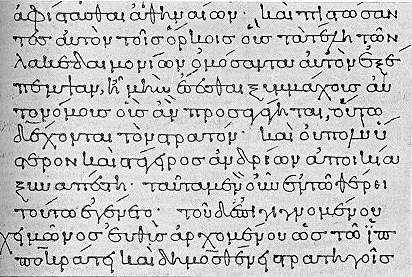
Actually, it’s the reverse: lower-case terminal sigma (ς) developed out of cursive/minuscule sigma (σ), which in turn came from the lunate sigma (Ϲ). You have to remember that the minuscule script was invented only around the 9th-10th century as a book hand, replacing the earlier uncial (majuscule) style.


10th-century manuscript of Thucydides showing earlier minuscule form


15th-century manuscript of Aristotle, showing later minuscule
 
Interesting. Why is remembering when it happened relevant?
It’s a history geek thing: we get all excited about when things occur, as well as how and (if we can figure it out) why. 🤓
 
Interesting. Why is remembering when it happened relevant?
Professionals need to remember because that’s part of their job. Us geeky/nerdy amateurs like to remember for the fun of it. 😃
 
Status
Not open for further replies.
Back
Top