Jesus distinct from God

  • Thread starter Thread starter paarsurrey
  • Start date Start date
Status
Not open for further replies.
P

paarsurrey

Guest
Hi

The distinction between Jesus and God was well understood among the disciples and the early Christians, as would be appreciated from the following:

For we are the circumcision, which worship God in the spirit, and rejoice in Christ, Jesus, an d have no confidence in the flesh. (Philippians 3:3)

But to us there is but one God, the Father of whom are all things, and we in Him; and one Lord Jesus Christ by whom are all things, and we by him. ( 1 Cor. 8:6)

Jesus himself brought out the distinction clearly in attributing divinity to God alone, who was also his God, as for instance:

Go to my brethren, and say unto them, I ascend unto my Father, and your Father; and to my God, and your God. (John 20:17)

-Muhammad Zafrullah Khan

Thanks
 
Hi

But to us there is but one God, the Father of whom are all things, and we in Him; and one** Lord Jesus Christ by whom are all things, and we by him**. ( 1 Cor. 8:6)
and what does this mean according to you?

and yes Jesus made a distinction, not a seperation, as the Word of God is God in essence that is why there is the Father, and His Word, and “whatever the Father does, the Word/Son does likewise” because “the Father and His Word are One”.
 
The distinction between Jesus and God was well understood among the disciples and the early Christians, as would be appreciated from the following:
Peace Muhammad,

If the Bible was composed of only the quotes you mentioned then we might be in trouble! We have to consider the Bible as a whole though. The quotes you mention do suggest a distinction between Jesus and Whom He called God. I will point out an interesting thing though, you’ll notice Jesus never said, “Our Father/God” He would always make a distinction between His relationship with God and our relationship with God by saying, “My God and your God…”

As a Muslim you take these select few quotes to mean that Jesus and God are distinct in the sense that Jesus is a creature and God His Creator, however that’s not what we believe. We base our belief on what God revealed and not just select quotes but everything. So keeping your quotes in mind, consider these quotes as well:

You quote from Philippians, in the very chapter before your quote St Paul affirms the divinity of Jesus:

“Have this mind among yourselves, which is yours in Christ Jesus, who, though he was in the form of God, did not count equality with God a thing to be grasped, but made himself nothing, taking the form of a servant, being born in the likeness of men. And being found in human form, he humbled himself by becoming obedient to the point of death, even death on a cross.”
Philippians 2: 5-8

Comment: This passage reveals the Divinity of Jesus as well as His humanity and role as a servant.

“In the beginning was the Word, and the Word was with God, and the Word was God… And the Word became flesh and dwelt among us, and we have seen his glory, glory as of the only Son from the Father, full of grace and truth.”
**John 1: 1,14
**

Comment: This reveals the true distinction between the Son and Father. Both are in fact God but they are distinct by procession, in that the Father is the Font of Divinity while the Son proceeds from the Font and shares in the procession of the Holy Ghost. This also reveals the nature of Jesus’ “Sonship” and the Incarnation.

“He is the image of the invisible God, the firstborn of all creation. For by him all things were created, in heaven and on earth, visible and invisible, whether thrones or dominions or rulers or authorities—all things were created through him and for him… For in him all the fullness of God was pleased to dwell, and through him to reconcile to himself all things, whether on earth or in heaven, making peace by the blood of his cross.”
Colossians 1:15-20

Comments: Other than revealing the Divinity of Jesus it also explicitly associates Him with the creation of the Heavens, material world, and even angels and men! It also says that these things exist FOR Him!

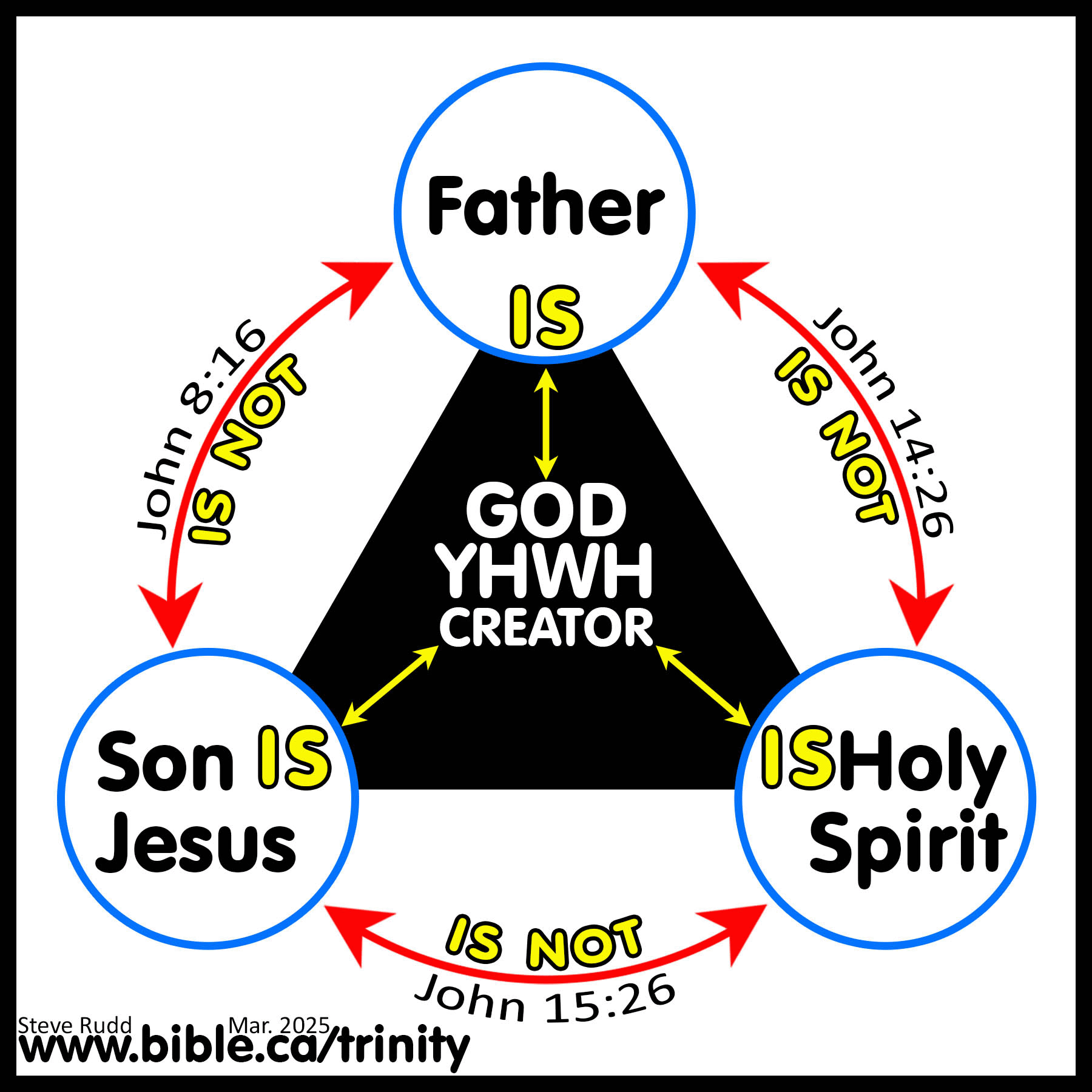
Now Muhammad, you don’t have to accept what these quotes reveal right now, but I’m going to ask you to make an honest judgment. Based on what the Bible says, is Jesus God? Even though you may personally disagree, I think you have to admit that the Bible ascribes Divinity to Jesus. Now here is the interesting thing: Jesus is God, the Father is God, and the Holy Spirit is God, yet there is only one God. The only way to accept the whole of scripture is to accept the Trinity, which explains for the distinction between Jesus and the Father, and yet still affirms their Divinity while holding on to monotheism.

 
Hi

The distinction between Jesus and God was well understood among the disciples and the early Christians, as would be appreciated from the following:

For we are the circumcision, which worship God in the spirit, and rejoice in Christ, Jesus, an d have no confidence in the flesh. (Philippians 3:3)

But to us there is but one God, the Father of whom are all things, and we in Him; and one Lord Jesus Christ by whom are all things, and we by him. ( 1 Cor. 8:6)

Jesus himself brought out the distinction clearly in attributing divinity to God alone, who was also his God, as for instance:

Go to my brethren, and say unto them, I ascend unto my Father, and your Father; and to my God, and your God. (John 20:17)

-Muhammad Zafrullah Khan

Thanks
what about John 8:58?
“I tell you the truth, before Abraham was, I AM!”
Jesus is definitly saying that he is the eternal God here.
 
(Please Note: This uploaded content is no longer available.)

Salaam/peace
… and to my God, and your God. (John 20:17)
yap , We all have a God , Jesus (p) also had a God. Jesus (p) can’t be his own God.
 
We declare with St Thomas regarding Jesus: “My Lord and my God!”
 
The Secon Quote:
But to us there is but one God, the Father of whom are all things, and we in Him; and one Lord Jesus Christ by whom are all things, and we by him. ( 1 Cor. 8:6)
Hi

Do you mean Jesus was himself his own father and his own son? I don’t think you believe that. It would not be logical, as that would mean he was husband of Mary. The only solution would be that Bible usage means two separate and distinct entities; father only in metaphoric sense is GodAllahParmesherYHWH; and son in metaphoric sense is Jacob,King of Salem, Jesus and many more. There is no literal or physical father in the above quote and there is no physical and literal son; all is metaphoric.

Please see meaning by taking the Bible (OT and NT) as a whole* as one of our Catholic friends (TomaszA) has suggested in a later post here.

*We have to consider the Bible as a whole- TomaszA

This is what I believe with rational and logical reasons; one may belive otherwise, no compusion whatsoever.

Thanks
 
Hope you don’t mind me jumping in!
Do you mean Jesus was himself his own father and his own son?
Such a statement would be a denial of distinction between the Three Persons, this is exactly what we don’t believe! We do not believe there is One God in One Person who acts in three modes or ways, one act as a Father, the other as Son, and the other as Spirit. This is the heresy of modalism.

What we believe is that there are Three Persons in God. That there are Three Subjects of the same Divine Consciousness and Will.
The only solution would be that Bible usage means two separate and distinct entities;
This is actually pretty close! Yes, the Three Persons are distinct but they are not separate in the sense that they are three different deities, that would contradict the fact that there is only one God.
father only in metaphoric sense is GodAllahParmesherYHWH; and son in metaphoric sense is Jacob,King of Salem, Jesus and many more. There is no literal or physical father in the above quote and there is no physical and literal son; all is metaphoric.
The Divine names of the Persons reflect their distinction. Keep in mind that the Persons are alike in all things except their relation to one another. Without knowing the relationship between each other the Persons are indistinguishable.

So “Father” and “Son” reflect the distinction in procession. God the Father is the font of Divinity, from which the other Persons proceed. God the Son proceeds from the Father and also shares in the outpouring of Divinity. The Holy Spirit is purely receptive, proceeding from the Father and the Son.
Please see meaning by taking the Bible (OT and NT) as a whole* as one of our Catholic friends (TomaszA) has suggested in a later post here.
Elements of the Trinity are revealed in the Old Testament. Consider this passage which reveals a distinction in God:

“Then the LORD rained down burning sulfur on Sodom and Gomorrah—from the LORD out of the heavens.”
Genesis 19:24

Here is another example:

In Genesis 16:7 a Messenger of the Lord appears to Hagar. However in verse 13 this Messenger is identified as God Himself! So if God’s Messenger is God this implies a distinction in God’s Being!

Hope this helps,

God bless,
Tomasz
 
Hope you don’t mind me jumping in!
Tomasz
Hi

You are welcome. This is a discussion board and we should not turn it, in my opinion, into a formal debate between two opposing persons. Many people should join in, for a peaceful and free understanding.

Thanks friend.
 
Aha… my dear brother, Paarsurrey,

Long time I miss you from this forum. Welcome back, and I hope you were allright, and continue to be allright. It seems i have nothing for you for your posting as of now, since all my brothers and sisters are answering you.
 
what about John 8:58?
“I tell you the truth, before Abraham was, I AM!”
Jesus is definitly saying that he is the eternal God here.
Hi

Please don’t mind. I don’t think the word “definitly” has been properly used in the above sentence.

I don’t want to much discuss it here as then we will be off-the-topic. May be it has been discussed in this Forum so many times already, but it could be discussed again in a separate thread as it is not direclt linked with the topic of the thread, I think.

I however quote some passages from the wikipedia in this connection:

Hebrew grammatical tense and purported implication

Theologians **have many different explanations **for the meaning behind this phrase. Many theologians explain that I am that I am is better translated I be that I be. The ancient Hebrew language does not have a past, present, or future tense. Instead, it has an imperfective aspect and perfective aspect as indicators of time, with no actual determined time. In Hebrew, time elements rather than verb conjugations are used to denote time.

[edit] New Testament Biblical references where Jesus uses the word

**Some claim **that according to traditional Christian interpretation, the New Testament testifies that Jesus Christ declared He is the great “I Am” of the Old Testament (Hebrew Bible). In the book of John verse 8:58 Jesus says: “before Abraham was, I am” (KJV). In the use of “I Am” Jesus was implying he is the God of Judaism, made evident in verse 59 by the Scribes and Pharisees’ reaction: “Then took they up stones to cast at him” (KJV). Nevertheless, Christ himself also said:

“Ye heard how I said to you, I go away, and I come unto you. If ye loved me, ye would have rejoiced, because I go unto the Father: for the Father is greater than I” (John 14:28, ASV), as well as: “My Father, who hath given them unto me, is greater than all; and no one is able to snatch them out of the Father’s hand.” (John 10:29, ASV).

It has also been argued that few scholars today would say that there is a connection between the “I am” in this context and the divine name. Edwin Freed explains, “the meaning of the sentence in the mind of the writer was: 'Before Abraham was, I, the Christ, the Son of God, existed.”

William Loader notes that the “text need mean no more than I am and was in existence before Abraham, still a majestic unique claim but not an allusion to the divine name.” The Simple English Bible paraphrases it as, “I am the Messiah.” K.L. McKay notes, “The emphatic words used by Jesus in the passages referred to above [including John 8:58] are perfectly natural in their contexts, and they do not echo the words of Exodus 3:14 in the normally quoted Greek version.” [1]

This argument, however, only negates a direct link between Jesus’ utterance of “I Am” and the divine name of the tetragrammaton. The phrase itself, “I am,” is stated by Yahweh independently of the tetragrammaton, and is literally repeated by Jesus.

en.wikipedia.org/wiki/I_am_that_I_am

I don’t think that using the word definitely for a controversial issue is appropiate.

However, you may think otherwise, no compulsion.

Thanks
 
Aha… my dear brother, Paarsurrey,

Long time I miss you from this forum. Welcome back, and I hope you were allright, and continue to be allright. It seems i have nothing for you for your posting as of now, since all my brothers and sisters are answering you.
Hi dear swariffin!

I love all Catholics here, such a good and loving people; and I have special regards for you.

It is you who had suggested that I should have my own website and or a blog; so I got started it. With the little computer knowledge I had, it was difficult to do; but I have some blogs now, and one is mentioned in my signatures.

You, and of course other members also, may visit my blog and add comments on the topics there, if you like. You, and other members are welcome; even if you have a different opinion.

Thank you for remembering me
 
The whole of scripture forums.catholic-questions.org/showpost.php?p=4431756&postcount=4

Please ascertain true meaning by taking the Bible (OT and NT) as a whole* as one of our Catholic friends (TomaszA) has suggested in a later post here.

*We have to consider the Bible as a whole- TomaszA.

Please excuse me for a little editing of my above post.

I do agree that one should always take meanings that are deducible from the whole Revealed Books; be it Vedas, or Bible (Jews don’t believe the NT; but for Christian, I would be a little or more lenient to include OTBible and NTBible to make a whole) or Quran or any other revealed Book for that matter.

But for the NTBible one should always have following points in mind:

The ultimate truth about Jesus is that:
  1. JesusYeshuaIssa did not leave the Word of God or anything in writing revealed on him from GodAllahYHWH in the form of stone tablets as was in the case of Moses.
  2. Or anything written by JesusYeshuaIssa himself as a biography when he left from Galilee, after the incident of Crucifixion, along with his mother Mary in search of the lost ten tribes of the house of Israel, he died natural and peaceful death in Kashmir, India.
  3. Jesus left nothing behind authenticated by him, in possession of the Church, as there was none in existence.
  4. We do respect the NTGospels which have a little account of Jesus life, but it does not have much utility for a non-Catholic except that we may treat it as a book of history subject to scrutiny, internal as well as external, for each bit of event for finding truth in it on merit.
120+ writers

There are about 120+ writers who wrote a sort of history books about the time of Jesus, that could be logically accepted as a historical source and truth could be searched/extracted out of it like we do from other sources of history on merit of each bit of event unbiased.

All these 120+ books must be treated at par but unfortunately some have been selected by the clergy arbitrarily and are known as NTBible while others have been discarded. This shows their bias, in my opinion.

I don’t want to be off-topic.

But I must conclude here that Jesus was a Jew and one of their most intelligent one, apart form his being a Messenger of GodAllahParmesherYHWH.

His duty was only to confirm the OTBible and to enforce its teachings. So logically anything mentioned in the NTBible must be in principle truly deducible from OTBible in unequivocal and straight forward terms. The words/texts/meanings (in NTBible) which do not conform to the usage in the OTBible should therefore be not paid, in my opinion, any worthwhile attention.

This would be against Jesus’ mission set for him by GodAllahParmesherYHWH.

This is my sincere opinion; others are not bound by it, and they may believe freely what they think is the truth with reasonable, logical and rational arguments.

Thanks
 
**(Isaiah 7:14):
"Therefore the Lord himself shall give you a sign; Behold, a virgin shall conceive, and bear a son, and shall call his name Immanuel."
**
(Isaiah 48:16-17):

"Come near me and listen to this: “From the first announcement I have not spoken in secret; at the time it happens, I am there.” And now the Sovereign LORD has sent me, with his Spirit.This is what the LORD says—your Redeemer, the Holy One of Israel:“I am the LORD your God, who teaches you what is best for you, who directs you in the way you should go.”

(John 10:30):
“I and the Father are one.”

(John 10:33):
We are not stoning you for any of these," replied the Jews, "but for blasphemy, because you, a mere man, claim to be God.

(John 1:14):
“The Word became flesh and made his dwelling among us. We have seen his glory, the glory of the One and Only,who came from the Father, full of grace and truth.”

(Luke 7:16):
*"They were all filled with awe and praised God. “A great prophet has appeared among us,” they said. “God has come to help his people.”
*
(John 14:10):
“Don’t you believe that I am in the Father, and that the Father is in me? The words I say to you are not just my own. Rather, it is the Father, living in me, who is doing his work.”

(Revelation 22:13):
“I am the Alpha and the Omega, the First and the Last, the Beginning and the End.”

 
Hi

I would like to give here some passages from wikipedia about John:

John

Authorship

Most modern experts conclude the author to be an unknown non-eyewitness.

The tradition that John the Apostle, son of Zebedee, was the author goes back at least to the end of the 2nd century.[2]

[edit] Contemporary scholarship

Starting in the 19th century, critical scholarship has further questioned the apostle John’s authorship, arguing that the work was written decades after the events it describes. The critical scholarship argues that there are differences in the composition of the Greek within the Gospel, such as breaks and inconsistencies in sequence, repetitions in the discourse, as well as passages that clearly do not belong to their context, and these suggest redaction.[21]

Raymond E. Brown, a biblical scholar who specialized in studying the Johannine community, summarizes a prevalent theory regarding the development of this gospel.[22] He identifies three layers of text in the Fourth Gospel (a situation that is paralleled by the synoptic gospels): 1) an initial version Brown considers based on personal experience of Jesus; 2) a structured literary creation by the evangelist which draws upon additional sources; and 3) the edited version that readers know today (Brown 1979).

Among scholars, Ephesus in Asia Minor is a popular suggestion for the gospel’s origin.[3]

There are critical scholars who are of the opinion that John was composed in stages (probably two or three), beginning at an unknown time (50–70?) and culminating in a final text around 95–100. This date is assumed in large part because John 21, the so-called “appendix” to John, is largely concerned with explaining the death of the “beloved disciple”, supposedly the leader of the Johannine community that would have produced the text. If this leader had been a follower of Jesus, or a disciple of one of Jesus’ followers, then a death around 90–100 is reasonable.

History

John was written somewhere near the end of the first century, probably in Ephesus, in Anatolia. The tradition of John the Apostle was strong in Anatolia, and Polycarp of Smyrna reportedly knew him. Like the previous gospels, it circulated separately until Irenaeus proclaimed all four gospels to be scripture.
In the early church, John’s reference to Jesus as the eternal Logos was a popular definition of Jesus, defeating the rival view that Jesus had been born a man but had been adopted as God’s Son. The gospel’s description of Jesus’ divinity was fundamental to the developing doctrine of the Trinity.

When Bible criticism developed in the 19th century, John came under increasing criticism as less historically reliable than the synoptics.

en.wikipedia.org/wiki/Gospel_of_John

“it circulated separately until Irenaeus proclaimed all four gospels to be scripture.”

One can note, in my opinion, that it was not Jesus who gave the gospels; it was Irenaeus, perhaps.

Thanks
 
I was reading the secular opinion you provided above. There is no explanation why these scholars reject the traditional belief that John wrote the Gospel. Everything within the Gospel and the history surrounding it points to John’s authorship.

Authorship of John

You also underline the statement of St Ireneus, as if he is the source of the bible canon when in fact he was only reporting what was a common belief at the time.

As a side note, is there a textual investigation of the Quran like the one you have provided of John?
 
People forget that although Jesus was truly God Almighty he was also truly human like the rest of us.
usually it is Muslim who confuse the Trinity with Jesus’ second nature. when they want they quote the verses emphasizing His humanity, and at other times they forget them and discuss as if He is only God.
 
HI

For those who desired that verses of Revealed Books should be interpreted not from a few quotations but from their usage in the whole of the scripture as stated in the post: forums.catholic-questions.org/showpost….56&postcount=4

I have started a new thread, so that the discussion in this thread is not turned off-topic.
The new thread is <Defining “the whole of scripture”>
forums.catholic-questions.org/showthread.php?p=4434416#post4434416

One may like to comment in the new thread.

Thanks
 
Muhammad,

Just clarify, what I meant by whole of scripture is that you can’t reject the divinity of Jesus by selectively quoting the Bible. I provided three quotes in response to yours in my first post on this thread, what do you make of those quotes?

I hope you’ll see that taking your quotes and my quotes together will show that Jesus is distinct from the Father but also Divine. The only explanation for this that fits with monotheism is the Trinity.
 
Status
Not open for further replies.
Back
Top