
P
patrick457
Guest
Going on:
The Greatest Story Ever Told (1965) is basically the last Jesus epic that Hollywood will ever produce for years. Despite its all-star cast and a huge budget, it was a commercial flop: the public was simply getting tired of the opulent sword and sandal epics directors in Hollywood were churning out for a decade or so.
The role of Jesus was given, as per the director’s intentions, to the then-unknown - at least to most of the American public - Max von Sydow, who had been making a name for himself amongst film critics for his performances in Ingmar Bergman’s films but had never appeared in an English-language film before. Most of the cast, however, is populated by familiar faces - a technique which many critics would later complain distracted from the solemnity of the film. Charlton Heston for instance played John the Baptist, Martin Landau had a role as Caiaphas, Joseph Schildkraut (son of the guy who played Caiaphas in DeMille’s The King of Kings and Judas in that film; he died before completing his performance here) played Nicodemus, Sidney Poitier cameos briefly as Simon of Cyrene, David McCallum (The Man from U.N.C.L.E.) acted as Judas. In addition, two guys who would eventually play Ernst Stavro Blofield in the James Bond films - Telly Savalas and Donald Pleasence - played Pontius Pilate and “the Dark Hermit” (this film’s version of Satan) respectively. (Pleasence would act in a few more Jesus films afterwards so you gotta note him carefully.) Finally, there’s John Wayne, who most infamously had a single scene as the centurion at Golgotha.
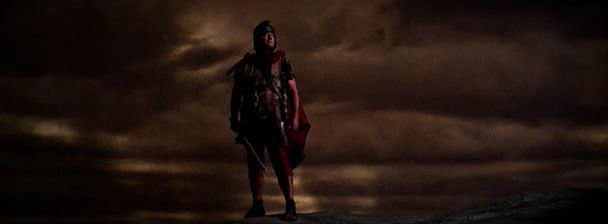
“Truly this man was the son of Gahd.”
Instead of opening with an historical prologue like the 1961 King of Kings, Greatest Story opens in a much more lofty, spiritual way by depicting a fresco of Christ with arms outstretched while a narrator (Orson Welles) intones John’s prologue: In the beginning was the Word… This painting literally bookends the film: at the end we see Von Sydow’s Jesus adopting the same pose as the fresco as He ascends to heaven amid a rendition of Handel’s Hallelujah Chorus. As Stephen Greydanus notes in his review of the film:
Specifically, Greatest Story is closest to the transcendent, luminous spirit of the Gospel of John, the prologue of which is borrowed for the opening shot depicting a church fresco of Christ with arms outstretched, invoking a context of 2,000 years of tradition and faith. Much like the Fourth Gospel, dialogue is often pregnant with second meanings and Old Testament (or Christian history) resonances. Von Sydow’s impassive performance is best seen as an interpretation of John’s overtly divine and sovereign Lord, in contrast to the generally clearer indications of humanity in the Synoptics. He isn’t warm or approachable, but he’s persuasively authoritative and all-knowing.
That being said, it’s not that Greatest Story is not interested in the history. It does attempt to give a sense of the historical context like King of Kings, but where the two films differ is that whereas King of Kings simply drops Jesus into a world populated with Romans and Zealots fighting each other, Greatest Story does the opposite in that it reconfigures history as such that it revolves around Jesus and His coming. In effect, the scenes at the beginning of the film follow traditional Christian thinking by emphasizing the need of 1st century Jews for a Messiah, by stressing what a rotten world this was before Jesus came.
In fact, there is a huge emphasis on the fulfillment of prophecy in this film. The film opens with the visit of the wise men to Herod and his learning of the prophecy about the newborn King of the Jews in Bethlehem (Matthew 2:1-8); Herod in response tries to fulfill another prophecy on purpose by instigating the killing of the Bethlehemite children (Jeremiah 13:15; cf. Matthew 2:18). Meanwhile, in Egypt, we glimpse at Joseph reading to his wife and Child from Isaiah 9:6-7 (“For unto us a child is born…”) just before a messenger arrives bringing the news of Herod’s death. This stress on prophecy goes on until the end of the film, where the disciples at first complain about having enough of prophecy before Mary Magdalene is inspired by Jesus’ prophetic words that He will rise again after three days to go to the tomb.
Greatest Story is one of the few films which include Josephus’ story about the golden eagle erected by Herod the Great over the gate of the temple being torn down at the instigation of two Jewish teachers when a rumor that Herod had died begun to spread (War 1.648-655). The difference between Josephus and the film, however, is that by this point in the movie, Herod is dead. Unlike in Josephus, where Herod (who was ill but not yet dead) has the culprits arrested and put to death, here it is the Romans who agressively quell the riot.
The Greatest Story Ever Told (1965) is basically the last Jesus epic that Hollywood will ever produce for years. Despite its all-star cast and a huge budget, it was a commercial flop: the public was simply getting tired of the opulent sword and sandal epics directors in Hollywood were churning out for a decade or so.
The role of Jesus was given, as per the director’s intentions, to the then-unknown - at least to most of the American public - Max von Sydow, who had been making a name for himself amongst film critics for his performances in Ingmar Bergman’s films but had never appeared in an English-language film before. Most of the cast, however, is populated by familiar faces - a technique which many critics would later complain distracted from the solemnity of the film. Charlton Heston for instance played John the Baptist, Martin Landau had a role as Caiaphas, Joseph Schildkraut (son of the guy who played Caiaphas in DeMille’s The King of Kings and Judas in that film; he died before completing his performance here) played Nicodemus, Sidney Poitier cameos briefly as Simon of Cyrene, David McCallum (The Man from U.N.C.L.E.) acted as Judas. In addition, two guys who would eventually play Ernst Stavro Blofield in the James Bond films - Telly Savalas and Donald Pleasence - played Pontius Pilate and “the Dark Hermit” (this film’s version of Satan) respectively. (Pleasence would act in a few more Jesus films afterwards so you gotta note him carefully.) Finally, there’s John Wayne, who most infamously had a single scene as the centurion at Golgotha.

“Truly this man was the son of Gahd.”
Instead of opening with an historical prologue like the 1961 King of Kings, Greatest Story opens in a much more lofty, spiritual way by depicting a fresco of Christ with arms outstretched while a narrator (Orson Welles) intones John’s prologue: In the beginning was the Word… This painting literally bookends the film: at the end we see Von Sydow’s Jesus adopting the same pose as the fresco as He ascends to heaven amid a rendition of Handel’s Hallelujah Chorus. As Stephen Greydanus notes in his review of the film:
Specifically, Greatest Story is closest to the transcendent, luminous spirit of the Gospel of John, the prologue of which is borrowed for the opening shot depicting a church fresco of Christ with arms outstretched, invoking a context of 2,000 years of tradition and faith. Much like the Fourth Gospel, dialogue is often pregnant with second meanings and Old Testament (or Christian history) resonances. Von Sydow’s impassive performance is best seen as an interpretation of John’s overtly divine and sovereign Lord, in contrast to the generally clearer indications of humanity in the Synoptics. He isn’t warm or approachable, but he’s persuasively authoritative and all-knowing.
That being said, it’s not that Greatest Story is not interested in the history. It does attempt to give a sense of the historical context like King of Kings, but where the two films differ is that whereas King of Kings simply drops Jesus into a world populated with Romans and Zealots fighting each other, Greatest Story does the opposite in that it reconfigures history as such that it revolves around Jesus and His coming. In effect, the scenes at the beginning of the film follow traditional Christian thinking by emphasizing the need of 1st century Jews for a Messiah, by stressing what a rotten world this was before Jesus came.
In fact, there is a huge emphasis on the fulfillment of prophecy in this film. The film opens with the visit of the wise men to Herod and his learning of the prophecy about the newborn King of the Jews in Bethlehem (Matthew 2:1-8); Herod in response tries to fulfill another prophecy on purpose by instigating the killing of the Bethlehemite children (Jeremiah 13:15; cf. Matthew 2:18). Meanwhile, in Egypt, we glimpse at Joseph reading to his wife and Child from Isaiah 9:6-7 (“For unto us a child is born…”) just before a messenger arrives bringing the news of Herod’s death. This stress on prophecy goes on until the end of the film, where the disciples at first complain about having enough of prophecy before Mary Magdalene is inspired by Jesus’ prophetic words that He will rise again after three days to go to the tomb.
Greatest Story is one of the few films which include Josephus’ story about the golden eagle erected by Herod the Great over the gate of the temple being torn down at the instigation of two Jewish teachers when a rumor that Herod had died begun to spread (War 1.648-655). The difference between Josephus and the film, however, is that by this point in the movie, Herod is dead. Unlike in Josephus, where Herod (who was ill but not yet dead) has the culprits arrested and put to death, here it is the Romans who agressively quell the riot.

 - voice echoes across the desert, quoting a combination of Isaiah 29:19, Psalm 9:18 and Isaiah 60:1 (there it is - Scripture again!): “Arise, shine; for thy light is come, and the glory of the Lord is risen upon thee.” Triumphant music blares as Jesus, seemingly inspired by these words, rock-climbs up the cliff; we get a good view of the Californian Death Valley (doubling as the Judaean desert) as Jesus proclaims via voiceover: “All the tribes of the earth shall see the Son of man coming in the clouds of heaven with power and great glory.” (cf. Matthew 24:30)
 After Pilate declares “Behold the man,” the Satan character wades through the crowd and is the first person to shout “Crucify Him.” Only after he does this do we see others in the crowd start to follow suit and ask for Jesus to be killed - effectively drowning out the shouts for Jesus to be released. The line “We have no king but Caesar,” which in John’s gospel is spoken by the chief priests (19:15), is in this film also spoken by the Dark Hermit - as a contrast to Jesus’ declaration that “[His] kingdom is not of this world.” So again we see the film taking things up to a new level: it is the Devil himself who instigates the crowd to ask for Jesus’ death. This portrayal could be seen positively as an attempt to remove any insinuation of Jews as God-killers, but at the same time, I think it could also be open to an interpretation which aligns the Jewish crowds with Satan. The trial ultimately ends with Pilate sentencing Jesus to death and the obligatory hand-washing scene. The film however does not include Pilate’s declaration of innocence and the crowd’s controversial reply (Matthew 27:25); instead, the words of the Apostles’ Creed come to Pilate’s mind: “…suffered under Pontius Pilate, was crucified, dead, and buried.”