(Continued)
There are two main ways that early Christians dealt with ‘pagan’ stuff: they either rejected them or appropriated them. On the one hand, Tertullian, Origen, Eusebius of Caesarea, and later, St. Epiphanius of Salamis opposed image-making, usually because of its close association with idolatry (apparently taking a page from Plato’s objections to art, which saw it as being removed from the ‘truth’ and appealing more to the lower, sensuous part of our nature and the passions); on the other hand, the Cappadocian fathers of the 4th century, such St. Gregory of Nyssa or St. John Chrysostom, mention Christian images in terms other than those of their educational value, acknowledging that images have the power to evoke a strong sense of emotion to the viewer.
The scathing tone of Tertullian’s attack against Christian artists in his
On Idolatry seems to imply that he wrote against well-established habits and that by 200, the Church was already accustomed to tolerate images as well as their makers. The treatise does not so much deal with idolatry but with a more limited question: can an artist, a maker of images and likenesses, be a Christian? Tertullian denies this passionately. But at the same time, he must acknowledge that artists are not only admitted into the Church but into the priesthood as well. Tertullian did not bother to make a difference between an idol and an image: since every likeness, even that of an animal, might become the object of idolatry, it was mere sophistry to introduce a distinction between the two. His advice for an image-making Christian: give up art entirely and be a simple workman instead. In fact, Tertullian was actually stricter than Jewish rabbis of the time: the rabbis, for commercial reasons, accepted that Jewish artist-merchants could make images of pagan gods for their pagan clients. For the rigorist Tertullian, for any Christian to engage in image-making is out of the question. An image becomes an idol by its very making; the only way to make it non-idolatrous is to destroy it.
In the anti-image camp, there’s also Clement of Alexandria, who formulated a rigorist interpretation of the ban against images and a certain disdain for the material world. (Again, all in true Platonist fashion.) In certain passages (
Exhortation to the Heathen 4;
Stromata 5.5), Clement seems to have excluded the making of all images, even quoting the Sibyl alongside Scripture to prove his point. He alludes to Pythagoras’ injunction to not wear a ring or have the figure of a deity on it and links it to the command against graven images, using it as prooftext for his idea that Christianity is superior to pagan religion, because it is older, by virtue of the philosophers actually learning from Moses (Clement counts Israelite Yahwism as a part of Christianity here).
How then does he deal with God’s seeming inconsistency in the Old Testament, banning images at one point and commanding them in another? He does so by doing what the Alexandrian school of theology does best, by transforming the cherubim on the Ark of the Covenant into allegory (
Stromata 5.6):
And those golden figures, each of them with six wings, signify either the two bears, as some will have it, or rather the two hemispheres. And the name cherubim meant much knowledge. But both together have twelve wings, and by the zodiac and time, which moves on it, point out the world of sense. It is of them, I think, that Tragedy, discoursing of Nature, says:—
Unwearied Time circles full in perennial flow,
Producing itself. And the twin-bears
On the swift wandering motions of their wings,
Keep the Atlantean pole.
And Atlas, the unsuffering pole, may mean the fixed sphere, or better perhaps, motionless eternity. But I think it better to regard the ark, so called from the Hebrew word Thebotha, as signifying something else. It is interpreted, one instead of one in all places. Whether, then, it is the eighth region and the world of thought, or God, all-embracing, and without shape, and invisible, that is indicated, we may for the present defer saying. But it signifies the repose which dwells with the adoring spirits, which are meant by the cherubim.
For He who prohibited the making of a graven image, would never Himself have made an image in the likeness of holy things. Nor is there at all any composite thing, and creature endowed with sensation, of the sort in heaven. But the face is a symbol of the rational soul, and the wings are the lofty ministers and energies of powers right and left; and the voice is delightsome glory in ceaseless contemplation. Let it suffice that the mystic interpretation has advanced so far.
In
The Instructor (3.11), Clement seems to have softened his stance somewhat, if he did not simply recognize, as Tertullian did, a special category of images (yes, Tertullian’s stance on images was also quite inconsistent):
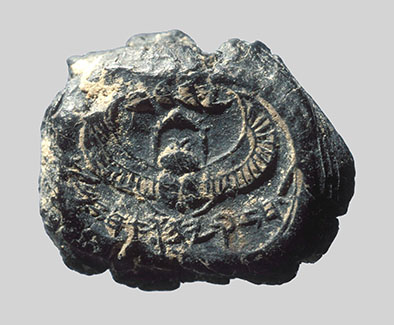
And let our seals be either a dove, or a fish, or a ship scudding before the wind, or a musical lyre, which Polycrates used, or a ship’s anchor, which Seleucus got engraved as a device; and if there be one fishing, he will remember the apostle, and the children drawn out of the water. For we are not to delineate the faces of idols, we who are prohibited to cleave to them; nor a sword, nor a bow, following as we do, peace; nor drinking-cups, being temperate.
Many of the licentious have their lovers engraved, or their mistresses, as if they wished to make it impossible ever to forget their amatory indulgences, by being perpetually put in mind of their licentiousness.



 )
)
