Jesus Films and the 'Jews'

  • Thread starter Thread starter patrick457
  • Start date Start date
Status
Not open for further replies.
I don’t wanna be a pain or anything, but had to come back to this as Gd said it again in the bible. He actually says it over and over and over again. And since Jesus didn’t teach anything else but the same scriptures, how comes images and statues were allowed all of a sudden after he had deceased? If you were so nice to give me just one or two answers I’d apreciate it a lot.
Hey Katrin. I made this thread and decided to go back to it in order to get some information. You’ll find some links to OT passages, nothing really in the NT about statues or pictures:

forums.catholic-questions.org/showthread.php?p=11093899#post11093899
 
I don’t wanna be a pain or anything, but had to come back to this as Gd said it again in the bible. He actually says it over and over and over again. And since Jesus didn’t teach anything else but the same scriptures, how comes images and statues were allowed all of a sudden after he had deceased? If you were so nice to give me just one or two answers I’d apreciate it a lot.
You asked for it. 😉

The earliest images which we could definitively identify as Christian appeared somewhere about AD 200. We don’t know for sure where the genesis of Christian art lies: according to the older view, it originated in Rome, but the predominant view today favors the East. At least, recent archaeological discoveries at Dura-Europos in Syria during the 1920s (specifically, the house church dating ca. AD 235) have lent support to the view that Christian art originated there. The earliest surviving specimens of Christian art, however, do derive predominantly from the catacombs of Rome.

Other exceptions to the Roman-Italian dominance of extant pre-Constantinian Christian art, aside from the Dura-Europos house church, include the Cleveland marble sculptures (ca. 3rd century), which are assumed to have come from a family tomb in Asia Minor. Possible 3rd century frescoes have also been found in catacombs in North Africa and Thessalonica. Additionally, many surviving examples of early Christian relief sculpture on sarcophagi (coffins) may have been produced by ateliers in Gaul, although the influence of Roman workshops is apparent in their technique and style.

It seems that the lack of Christian images during the first two and a half centuries can be traced not so much to the ban in the Old Testament against graven images per se, but to a natural association in the early Christian mind of images and image-making with pagan religion and the whole pagan way of life. Already by the mid-3rd century, however, we have evidence in Christian literature of changing attitudes and by the next century, religiously meaningful paintings began to occur in Christian contexts.

http://img822.imageshack.us/img822/9039/hart311.png
The house church at Dura-Europos

One thing noticeable about most of these artworks is their funereal nature. Almost all existing pre-mid-4th century artwork was specifically created to decorate tombs or coffins. In fact, most surviving specimens can be grouped into two basic types: catacomb frescoes and the relief sculpture on sarcophagi. These, however, are by no means the only pieces of art that would have existed back then: documentary sources from the period reveal that Christians built or converted buildings or parts of buildings for their assemblies, and that they owned liturgical implements as well as scripture books. Unfortunately, these examples of material culture have been lost or destroyed over the centuries, perhaps even during the persecutions of the 3rd and early 4th centuries.

Another distinctive element of early Christian art is how ambiguous they are and open to different layers of interpretation. In fact, they don’t even seem to be ‘Christian’ at all: they could very well be depictions of pagan or Jewish motifs. (For example, note the Christ-as-Sol Invictus mosaic from a mausoleum in the necropolis underneath the Vatican.) They are so simplified, almost schematic, indicating only the minimum necessary to call to the viewer’s mind the Biblical themes illustrated. Often they are no more than ciphers or pictographs. And the biblical texts also were abridged so that only essentials had to be represented.

The early Christians did not set out to produce an original or magnificent kind of art, but merely an art which would satisfy the needs of religious worship. Poverty, persecution, the need to remain in hiding, as well as religious and moral requirements outweighed aesthetic considerations and put magnificence out of the question. The earliest works were designed to meet practical needs and thus became symbolical and illustrative. It was an art in which beauty and harmony were not pursued for their sake, but reflected the preoccupations of people chiefly interested in religious and moral matters.
 
(Continued)

Let’s go back to the Israelite/Jewish context first.

Early in their history, the Israelites seem to have had a pretty lax interpretation of the commandment against images. It seems that what is really forbidden is more the depiction of the Deity Himself, although this rule is not always followed. Aniconism (the use of an abstract symbol or an empty space to symbolically represent a given deity) was a common feature of West Semitic religions in general and was by no means unique to the Israelites.

There are two types of aniconism, both related to one another: material aniconism, which refrains from using effigies, but rather makes use of abstract images or symbols - like poles ('asherah) or standing stones (maṣṣeboth) to symbolize the divine (cf. Greek xoanon and the Hindu lingam), and empty space aniconism, which makes use of an empty space as a symbol for the deity’s presence. Genuine West Semitic (Canaanite) religion in general was aniconic: for most West Semitic religions, a sacred place meant an open-air temenos with stelae. (There were exceptions to this, particularly in areas like cities, where we have evidence of iconic cults.) Now there are some cultures, like the Phoenicians who favored the ‘sacred emptiness’-type of aniconism: very often what was chosen was the image of an empty throne or animals like bulls, where the deity is envisioned to sit or ride upon.

West Semitic aniconism wasn’t of the “thou shalt not make any graven image” type, as the Israelite version was. While the norm amongst the majority was to use abstract symbols, there was nothing which prevented the use of actual effigies or figurines to represent gods. It was not a question of prohibition, but of preference and mentality.

The early Hebrews originally held the former, although they would also eventually adopt the latter. Within the Old Testament we often hear of maṣṣeboth being set up in commemoration of some event (usually a divine revelation) or in memory of someone (Genesis 28:18; 31:45-54; 35:14-15; 35:20; Exodus 34:4; Joshua 4:20-24; 24:25-27). It was not a huge step from the idea of the standing-stone as a sign of the presence of the divine or the manifestation of a god to accepting the stone itself as a representation of the deity, and there was not need for it to be hewn in the shape of a statue: even in its crude, natural shape, the maṣṣebah is a symbol of the god. In latter days, the connection between maṣṣeboth and worship of false gods seems to have strengthened to the point that even making one was eventually frowned upon altogether.

The cherubim in the Ark of the Covenant and in Solomon’s Temple, as well as the golden calf (and Jeroboam’s calves) all seem to be representatives of the latter category of empty space aniconism: the cherubim (we shouldn’t imagine here the cute babies of the Renaissance, but rather the winged men or human-animal hybrids of Ancient Near Eastern and Egyptian iconography) and the ‘calves’ are envisioned to be the steeds and/or the throne of the invisible Yhwh, the “Rider of the cherubim.”

Orthodox Israelite Yahwism seems to have been an aniconic religion (i.e. they did not directly portray their God but used symbols to mark His presence, for example the cherubs on the Ark), which by itself is not unique (a few of their neighbors seem to have aniconic tendencies as well). What set the Israelites apart was the active ban against direct portrayal of the divine.

The Israelites did not develop a unique art-style of their own or contribute anything of great importance or originality in the realm of arts and crafts, being content to borrow and adapt from their Levantine neighbors. The proscription in Exodus against making “carved idols” (pesel, traditionally “graven images”; also cf. Deuteronomy 5:8), may have discouraged creativity in this area. Nonetheless, images did exist throughout the history of Israel until the postexilic period: for instance, Gideon fashions an ephod of gold (Judges 8:27) and Micah’s mother contributed silver for the making of an idol (pesel) in Judges 17:3. The Tabernacle and the Temple of Solomon themselves were, on the face of it, a direct contravention of the literal understanding of the commandment, yet the bblical authors did not denounce them.
 
(Continued)

The prohibition in Exodus was not so much against the act of making of images themselves but against idolatry (i.e. making an image in the purpose of worshipping it) to which the art could lead. The Israelites did, in fact, fashion images, which the prophets regarded, in a concept unique to Israel, as “idols” (cf. Isaiah 30:22; Hosea 13:2).

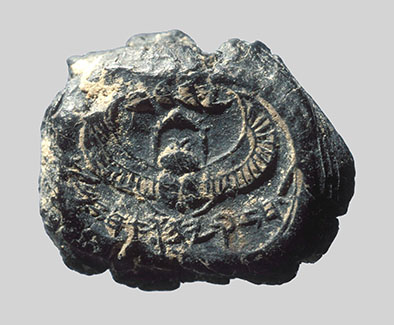
We now need to qualify this prohibition against images. Obviously, cherubim, serpents, lions, oxen, humans, and other images of ‘nature’ and ‘mythology’ were at times exempt from the ban - and it would seem that the prohibition of representations was less rigid in the preexilic period compared to later periods. What seems to be forbidden is more often than not the depiction of the Deity Himself - but again, this rule is not always followed, especially in the popular level. We have as possible extant examples of such both the winged sun-disc symbol above the bull-calf on the top tier of the Ta’anach cult stand and the Egypto-Phoenician winged disc/beetle symbol on the seal impressionslmlk on the handles of royal Judahite storage jars and even some personal seals.


http://biblical-studies.ca/blog/wp-content/uploads/2006/04/Hezekiah_bulla.jpg

Two of Hezekiah’s seals, featuring the winged solar disc/winged scarab symbol and the inscription: “Of Hezekiah, (son of) Ahaz, King of Judah”
Between the foreign pagan practices and the pure monotheism of orthodox Yahwism there existed a cult that may be called pagan Yahwism or perhaps more accurately, Yahwistic paganism, which represents a sort of fusion between the two. Of course in the background was the central monotheistic cult practiced in the Jerusalem Temple by its priests and preached by the Biblical prophets. While some of the kings of Judah (such as Hezekiah and Josiah) made efforts to centralize the monotheistic cult in Jerusalem, we must conclude by looking at the archaeological evidence that they were less than 100 percent successful. Indeed, until the Babylonian destruction of Judah and the end of the Israelite monarchy in 586 BC, pagan Yahwism was common even in Jerusalem, to say nothing of the rest of Judah.

The Old Testament implies that there were many shrines both in Israel and in Judah, coexisting with the Temple in Jerusalem, something which archaeology also attests to. Aside from the state-sponsored cultic centers at Dan and Bethel, there were probably also religious activity in places like Gilgal, Beersheba, Lachish, Shiloh, Shechem, Samaria, Hazor, Gezer, Nebo, Arad, Hebron, and Beersheba.

The thing about ancient religion is that there are different levels of cult (a particular group’s enactment of their beliefs and customs), and to some extent this is also true of Israelite religion. First off you have the domestic cult. Although there aren’t too many of them in the archaeological record, some homes had a modest household shrine, perhaps one equipped with simple paraphernalia like miniature altars, lamps, clay figurines or a ‘standing-stone’ (maṣṣebah) which the family members tended with care and regularity to ensure the family’s well-being. Family and clan tombs (for the Israelites, burial - “to be gathered to one’s fathers” - like most anything was a family affair) could also serve as places of ritual and reverence.

A local cult, meanwhile, is one that is maintained by a community - say, a village or several villages, or neighborhoods in urban areas. Worship sites for local cults seem to have been the bamoth (“high places”): open-air shrines located upon a natural or an artificial raised area (for example, a hill or a man-made mound or platform) outside a village, where villagers gathered for religious and communal festivals and other events (there was no clear distinction between the two in those days), perhaps equipped with nothing more than an altar (some may have a number of maṣṣeboth standing erect). A regional cult served an area larger than just a few villages, perhaps a tribal territory; we do not know much about them just as less is known materially about tribes than about villages in ancient Israel.

At the top stands the central cult, in particular the state cult. The Temple of Jerusalem and the sanctuaries of Dan and Bethel are two examples of this official, centralized form of religion. The central cult provides us an example of the interweaving of religion and politics (again, there was no “separation of Church and State” in the ancient world): Jeroboam sets up official sanctuaries in Bethel and Dan, two sites hallowed since ancient times, because he feared that his subjects would switch their allegiance to Judah if they were to go to Jerusalem. Hezekiah and Josiah both enact their religious reforms (centralizing - ‘restoring’ - Yahwistic orthodoxy by removing all unauthorized worship centers) as part of political actions: one can say that both kings ruled in rather politically-troubled times.
 
(Continued)

The close tie between the command against pesalim and the prior ban against worshipping other gods in the Decalogue suggests that the veto of images was directed toward any image that may be construed as an idol or cult artifact of another deity. The elaboration of this command in Deuteronomy 4:16-19 confirms that the commandment had in mind the ‘other gods’ of the previous one as at least the eventual understanding of this prohibition. Indeed the comprehensiveness of these formulations tended to make any kind of image, whether for purposes of worship or not, questionable.

We now need to distinguish between aniconism and iconoclasm, which might help clarify the issue of graven images. Aniconic cults are usually defined as those where there are no iconic representations of the deity (anthropomorphic or theriomorphic) serving as the dominant central or cultic symbol, while iconoclasm is the active, religiously motivated hatred of images, that is, the injunction against making or venerating images within a given religion, as well as the damaging and demolition of images of another religion. We can divide aniconism itself into two categories: (1) de facto aniconism, a more fairly tolerant form, and (2) programmatic aniconism, which moves toward a rigorous iconoclasm but which developed out of the aniconic tendency of an earlier time.

We do not know exactly when the Israelites, which eventually rejected even standing stones in its cult, moved from West Semitic de facto aniconism to a programmatic one (which is close to iconoclasm but developing out of the aniconic tendency of an earlier time). We can already see its signs however by the 7th century BC, when the Judahite name seals show a clear tendency towards aniconicity, a tendency that is not exclusive but begins even further back and then becomes quite pronounced. (There are two other Semitic peoples which moved from de facto standing-stone aniconism to iconoclasm: the Nabataeans and the Arabs.)

The strict view (avoidance of any figural depictions whatsoever) became the norm starting from the late Hellenistic to the Hasmonean period, just as Jewish monotheism finally becomes consolidated, although the trend was already slowly moving towards it for quite some time. The reason for this change of views is unclear; some suggestions include (1) as a reaction against the forced eradication of Jewish customs by the Seleucids and the desecration of the Temple by Antiochus Epiphanes; (2) a more stringent position reflecting the Sadducean position, who were generally in control of affairs in Jewish Palestine in the late Second Temple period (except for the era of Salome in 76-67 BC, when their rivals the Pharisees dominated); (3) as a part of the Hasmonean campaign to cultivate and assert a unique Jewish identity; and (4) a general reaction against Hellenization and the threat of foreign influences.

It is at this time direct portrayals of living things were now frowned upon by the devout: abstract designs were often preferred. To this end, most locally-minted Jewish currency at the time did not feature images of gods, men or animals as was common, but images of plants or suchlike as a concession. (The exceptions to this ‘no-images’ rule were Roman coins and, rather curiously, the Tyrian shekel in use at the Temple.) Take for example these coins of Herod the Great, Herod Antipas, and Pontius Pilate, respectively.

The Herods followed the Law when it suited them; they apparently were wise enough to not offend their Jewish subjects too much. Antipas did have his palace decorated with figures of animals, which would have been regarded as a transgression of the commandment, but he minted coins which bore only abstract symbols for his Jewish subjects and did not try to force Greco-Roman culture on them. (Contrast this with Philip, who ruled in gentile cities and thus was could be quite conventional in his choice of imagery.)

Even the houses of priestly and aristocratic families in Jerusalem, while built and decorated in the Greco-Roman style, restrained themselves from portraying human or animal figures. Instead, the walls of these houses were mainly decorated with geometric patterns, imitations of architectural elements, or floral motifs. In fact, while Solomon’s Temple was replete with imagery derived from common Levantine religious iconography, Herod’s Temple was by contrast apparently mostly devoid of such representations, although Josephus does say that the Temple curtain portrayed “a panorama of the heavens except the signs of the Zodiac,” and that vines wrought of gold hung over the doors of the sanctuary (War 5.5.4 (210); Antiquities 15.9.2 (394); cf. m. Middoth 3.8; Tacitus, History 5.5).
 
(Continued)

Martin Goodman (Rome and Jerusalem: The Clash of Ancient Civilizations) writes:

Jewish culture was more oral than visual: when Jews referred to themselves in Hebrew as understanding a truth or a command, they would say that they had heard it; by contrast, in Latin, as in Greek and in English, the metaphor for comprehension is to “see” the truth. The aural metaphor, however, cannot have been overwhelming in the Jewish mentality, for Philo, writing in Greek, refers repeatedly to a false etymology of the name “Israel” as derived from the Hebrew ish-ra’ah-el, taken to mean “he who sees God.” At any rate, Jews in Jerusalem certainly demonstrated an appreciation of visual aesthetics both in the Temple and in the interior decoration of their houses. Excavated houses from the time of the war against Rome in 66-70 are decorated with patterned mosaic floors and wall plaster painted in the Pompeian Second Style. These provincials imitated Italy as others did elsewhere in the empire, even if they were behind the times in the fashions they followed. The major difference, clearly deliberate, was that the paintings in Jerusalem were wholly devoid of images of humans and only rarely included images of animals. The architectural frames of the pictures painted direct onto the plaster, and the deep reds and blacks, are all in the Italian style, but the central interest in each picture in Roman as in Hellenistic art, the depiction of the interplay of living bodies, is wholly lacking. The taboo which precluded such depictions was by no means static or universal among Jews, since later in antiquity Jews in the land of Israel were to commission fine synagogue mosaics with detailed images of humans and animals, and in the mid-third century CE the Jews of Dura-Europus depicted in detail on the walls of their synagogue a series of biblical scenes. Even in the first century, when Herod completed his rebuilding of the Temple by erecting an image of an eagle over its entrance, he must have believed this to be permitted in Jewish law, since he had just spent years, and huge amounts of money, in ensuring that the building be seen by his subjects as both magnificent and kosher. However, the riots that greeted the eagle image suggest that other first-century Jews disagreed with Herod’s interpretation. The “two sophists,” as Josephus describes the ringleaders of the crowd who tried to tear the eagle down, evidently saw the image as an affront, presumably in light of the commandment in Exodus, “You shall not make for yourself any graven image, or any likeness of any thing that is in heaven above, or that is in the earth beneath, or that is in the water under the earth:,” although the symbolism of the eagle as an image of Rome may also have aggravated their anger. Later Jews were to interpret the commandment in Exodus in the light of the following verse (“You shall not bow down yourself to them [the images], nor serve them”), thus permitting images of all kinds providing that they are not worshipped, but most first-century Jews seem to have taken a hard line: the iconography on Jewish coins minted during the revolt against Rome reveals a willingness to depict objects such as palm branches, pomegranates and a chalice, but neither people not animals. Jewish homes thus lacked the riot of statues, reliefs and other images that enlivened the houses of their Roman contemporaries, and the public spaces of Jerusalem had no commemorative statues to link the citizens to the historic figures of the past.

However, after the Bar Kochba revolt of AD 132-135, Jews began to embrace art once more, as evidenced by the 2nd century synagogue in Dura-Europos, as well as later Byzantine-era synagogues in Palestine. Again, there are a number explanations for the reintroduction of figural representation (which are not necessarily mutually exclusive), such as increasing Hellenization, increasing minority status which made the need the accomodation to the outside world more pressing, the slow decline of paganism and the perception that images are not really a threat to Jews and Judaism after all.

http://img805.imageshack.us/img805/4856/q8545955.png
Interior of Dura-Europos synagogue
 
(Continued)

Now to go back to those early Christians. They, living in a Hellenistic Roman culture, drew on the artistic techniques and motifs of that culture, and only introduced such changes as worship and conditions of life demanded. Not all the achievements of Greece and Rome were emulated, however: sculpture, which had so prominent a place in ancient civilization, declined and almost disappeared. The most important early Christian art forms were instead painting and mosaic.

Constantine’s legalization of Christianity in 313 and its declaration as the state religion of the Empire by Theodosius in 380, of course, brought with it huge changes to popular culture, including art. Until then Christian art was more of a folk art which derived its style and much of its iconography from popular Roman art (although usually executed more crudely), but from this point grand Christian buildings built under imperial patronage (the basilicas) brought a need for Christian versions of Roman elite and official art to accomodate the wealthy newcomers to the faith, of which mosaics in churches in Rome are the most prominent surviving examples. While in earlier times, art was more the preserve of the laity - with some of the authorities even clamoring against their use for fear of idolatry - now it was ‘officially’ appropriated and sanctioned. Christians are now more free than in earlier centuries to express themselves via art.

Large-scale sculpture was not popular, but relief sculpture on sarcophagi and ivory carvings and book covers continued to be produced. The walls of churches were decorated with paintings or mosaics expressing Christian themes to instruct the faithful. Painting also illustrated liturgical books and other manuscripts. In fact, it seems to have been a Christian innovation to put mosaics on the wall and use them for sacred subjects; previously the technique had essentially been used for floors and walls in gardens.

Christian art was caught up in, but did not originate, the shift in style away from the classical tradition inherited from Ancient Greek art to a less realist and otherworldly hieratic style, the start of medieval art. Christian art by this time had developed into a more abstract, simplified artistic expression, the ideal of which was not so much physical beauty as spiritual feeling. The human figures thus became types rather than individuals and often had large, staring eyes, “the windows of the soul.” Symbols were frequently used, and compositions were flat in order to concentrate and clearly visualize the main idea. (We can see here the origin of the Eastern icon.)
 
(Continued)

We shift here to focus on the veneration of sacred images, the origins of which is quite unclear. Eusebius, writing in the 4th century, speaks about portraits of Jesus, Peter and Paul being made during their lifetimes and venerated by their contemporaries (Church History 7.18).

Since I have mentioned this city I do not think it proper to omit an account which is worthy of record for posterity. For they say that the woman with an issue of blood, who, as we learn from the sacred Gospel, received from our Saviour deliverance from her affliction, came from this place, and that her house is shown in the city, and that remarkable memorials of the kindness of the Saviour to her remain there. For there stands upon an elevated stone, by the gates of her house, a brazen image of a woman kneeling, with her hands stretched out, as if she were praying. Opposite this is another upright image of a man, made of the same material, clothed decently in a double cloak, and extending his hand toward the woman. At his feet, beside the statue itself, is a certain strange plant, which climbs up to the hem of the brazen cloak, and is a remedy for all kinds of diseases. They say that this statue is an image of Jesus. It has remained to our day, so that we ourselves also saw it when we were staying in the city. Nor is it strange that those of the Gentiles who, of old, were benefited by our Saviour, should have done such things, since we have learned also that the likenesses of his apostles Paul and Peter, and of Christ himself, are preserved in paintings, the ancients being accustomed, as it is likely, according to a habit of the Gentiles, to pay this kind of honor indiscriminately to those regarded by them as deliverers.

It is of course possible to dismiss this as a late anachronism, but it is equally possible that there may be a grain of truth behind this story. A negative attitude would seem to be out of place since, as far as we know, portraits of Christ and the apostles were neither common nor particularly venerated in Eusebius’ time. (The cult of the veneration of images, starting with that of Christ, would only become increasingly common and widespread from the second half of the 6th century onwards.) It would be wrong to see in his text a reflection of the state of affairs that he himself knew from what he observed around him and all the more so since Eusebius himself was no image-lover.

We are more likely to interpret correctly the passage of Eusebius if we consider it in connection with the story from the apocryphal Acts of John (ca. mid-to-late 2nd-3rd century) about John’s newly-converted disciple Lycomedes having a portrait painted of the apostle for private veneration. It should be added that the veneration shown it took the usual forms of the time: the portrait was placed on a table covered with a cloth, it was crowned with flowers, and two candles and altar were placed before it. John, upon knowing what Lycomedes had done, gives a discourse disapproving of portraiture and forbids the veneration of portraits and of a representation of himself. In spite of this, the fact remains that Lycomedes saw nothing wrong in possessing a portrait of his spiritual father, the apostle, or even in devoting to it a certain cult of veneration.

There is also the ambiguity of John not rejecting Lycomedes’ explanation that the painting helps keep his presence and teachings constantly before him. Instead, John focuses on another point: he convinces Lycomedes to forget about his physical appearance and instead paint a picture based on his words and on the palette of virtues that Jesus painted on the human soul: the art of preaching and restoring souls replaces painting. He calls his disciple’s eagerness and attachment for art “childish and imperfect,” but it is by no means a total condemnation of painting. His strongest remark is his criticism of Lycomedes’ possession of “a dead likeness of the dead,” but it apparently does not sway Lycomedes: the icon is a powerful substitute for the real man.


One of the Fayum mummy portraits from Egypt
The apocryphon and Eusebius are unanimous in attributing this use to the portrait and its veneration to the first generation of Christians, who were accustomed to reverence their benefactors by a cult devoted to their portraits. It is probable that the first generations of Christians, if they did possess representations of Christ, the apostles, or martyrs, saw no wrong in surrounding them with material symbols of respect in memory of the person portrayed. In doing so, they were conforming to the usages of the social milieu to which they belonged (where for example, funerary portraits and masks were used mainly for commemorative, but also for cultic functions). More especially, it was customary at the time for the disciples of a great man, the founder of a religious sect or of a school of philosophy, to possess and also venerate his portrait. St. Irenaeus (Adversus haereses 1.23.4), and Eusebius (Letter to Constantia) purports that the disciples of Simon Magus did so; and we learn it also for Mani, the founder of Manichaeism (from the same text of Eusebius and from other testimony). It was probably later that clergy, fearing a tendency to idolatry, opposed the practice and forbade not only the cult of veneration but funerary portraits themselves.
 
(Continued)

There are two main ways that early Christians dealt with ‘pagan’ stuff: they either rejected them or appropriated them. On the one hand, Tertullian, Origen, Eusebius of Caesarea, and later, St. Epiphanius of Salamis opposed image-making, usually because of its close association with idolatry (apparently taking a page from Plato’s objections to art, which saw it as being removed from the ‘truth’ and appealing more to the lower, sensuous part of our nature and the passions); on the other hand, the Cappadocian fathers of the 4th century, such St. Gregory of Nyssa or St. John Chrysostom, mention Christian images in terms other than those of their educational value, acknowledging that images have the power to evoke a strong sense of emotion to the viewer.

The scathing tone of Tertullian’s attack against Christian artists in his On Idolatry seems to imply that he wrote against well-established habits and that by 200, the Church was already accustomed to tolerate images as well as their makers. The treatise does not so much deal with idolatry but with a more limited question: can an artist, a maker of images and likenesses, be a Christian? Tertullian denies this passionately. But at the same time, he must acknowledge that artists are not only admitted into the Church but into the priesthood as well. Tertullian did not bother to make a difference between an idol and an image: since every likeness, even that of an animal, might become the object of idolatry, it was mere sophistry to introduce a distinction between the two. His advice for an image-making Christian: give up art entirely and be a simple workman instead. In fact, Tertullian was actually stricter than Jewish rabbis of the time: the rabbis, for commercial reasons, accepted that Jewish artist-merchants could make images of pagan gods for their pagan clients. For the rigorist Tertullian, for any Christian to engage in image-making is out of the question. An image becomes an idol by its very making; the only way to make it non-idolatrous is to destroy it.

In the anti-image camp, there’s also Clement of Alexandria, who formulated a rigorist interpretation of the ban against images and a certain disdain for the material world. (Again, all in true Platonist fashion.) In certain passages (Exhortation to the Heathen 4; Stromata 5.5), Clement seems to have excluded the making of all images, even quoting the Sibyl alongside Scripture to prove his point. He alludes to Pythagoras’ injunction to not wear a ring or have the figure of a deity on it and links it to the command against graven images, using it as prooftext for his idea that Christianity is superior to pagan religion, because it is older, by virtue of the philosophers actually learning from Moses (Clement counts Israelite Yahwism as a part of Christianity here).

How then does he deal with God’s seeming inconsistency in the Old Testament, banning images at one point and commanding them in another? He does so by doing what the Alexandrian school of theology does best, by transforming the cherubim on the Ark of the Covenant into allegory (Stromata 5.6):

And those golden figures, each of them with six wings, signify either the two bears, as some will have it, or rather the two hemispheres. And the name cherubim meant much knowledge. But both together have twelve wings, and by the zodiac and time, which moves on it, point out the world of sense. It is of them, I think, that Tragedy, discoursing of Nature, says:—

Unwearied Time circles full in perennial flow,
Producing itself. And the twin-bears
On the swift wandering motions of their wings,
Keep the Atlantean pole.

And Atlas, the unsuffering pole, may mean the fixed sphere, or better perhaps, motionless eternity. But I think it better to regard the ark, so called from the Hebrew word Thebotha, as signifying something else. It is interpreted, one instead of one in all places. Whether, then, it is the eighth region and the world of thought, or God, all-embracing, and without shape, and invisible, that is indicated, we may for the present defer saying. But it signifies the repose which dwells with the adoring spirits, which are meant by the cherubim.

For He who prohibited the making of a graven image, would never Himself have made an image in the likeness of holy things. Nor is there at all any composite thing, and creature endowed with sensation, of the sort in heaven. But the face is a symbol of the rational soul, and the wings are the lofty ministers and energies of powers right and left; and the voice is delightsome glory in ceaseless contemplation. Let it suffice that the mystic interpretation has advanced so far.

In The Instructor (3.11), Clement seems to have softened his stance somewhat, if he did not simply recognize, as Tertullian did, a special category of images (yes, Tertullian’s stance on images was also quite inconsistent):

And let our seals be either a dove, or a fish, or a ship scudding before the wind, or a musical lyre, which Polycrates used, or a ship’s anchor, which Seleucus got engraved as a device; and if there be one fishing, he will remember the apostle, and the children drawn out of the water. For we are not to delineate the faces of idols, we who are prohibited to cleave to them; nor a sword, nor a bow, following as we do, peace; nor drinking-cups, being temperate.

Many of the licentious have their lovers engraved, or their mistresses, as if they wished to make it impossible ever to forget their amatory indulgences, by being perpetually put in mind of their licentiousness.

 
(Continued)

Around AD 400, at the time that Christian figurative art burst into vigorous bloom and borrowed so many of the artistic usages of the past, this interdiction - if it was ever systematic - was definitely raised. Christian portraits and miniatures of these portraits became more and more frequent and were tolerated by Church authorities. This happened at the very same time that Theodosius II forbade the pagan ancestor cult, in a prohibition which ought to have been fatal to the art of the funerary portrait. But one branch of funerary art was saved by the Church, that of the portraits of the blessed dead, who were, by virtue of this, the legitimate objects of an authorized cult.

As a result of the prohibition, the funerary portrait of the simple mortal disappears at the end of the 4th century, while the iconographic formulas of funerary portraiture are retained exclusively for images of the saints. Something similar must have occurred with respect to the veneration which originally was devoted to any portrait of the deceased and which after about 400 was reserved for the images of saints. It goes without saying that at this period the veneration of saints had a commemorative character and involved only the forms that the early Christians reserved for the cult of commemorative portraits of any kind.

Here we see a difference in emphasis between the East and the West on the function and nature of images. The West has traditionally emphasized more the didactic, commemorative, and aesthetic aspects of the image. St. Augustine was a huge influence: on the hand, he was somewhat indifferent to art, arguing that images were unhistorical, juxtaposing elements which did not belong together and thus misleading the looker, and accused artist of over-literalism and anthromorphism, yet on the other hand, he had also praised beauty and the work of artisans as creations of God, and considered pictures to have at least an important illustrative value for the uneducated. More superior than pictures, however, is the word: images are viewed more as substitutes for the written text for those who cannot read.

The traditional Western view is summarized adequately by Pope St. Gregory the Great’s letter to Bishop Serenus of Marseille (ca. AD 600).

Word has since reached us that you, gripped by blind fury, have broken the images of the saints with the excuse that they should not be adored. And indeed we heartily applaud you for keeping them from being adored, but for breaking them we reproach you. Tell us, brother, have you ever heard of any bishop anywhere who did the like? This, if nothing else, should have given you pause. Do you despise your brothers and think that you alone are holy and wise? To adore images is one thing; to teach with their help what should be adored is another. What Scripture is to the educated, images are to the ignorant, who see through them what they must accept; they read in them what they cannot read in books. This is especially true of the pagans. And it particularly behooves you, who live among pagans, not to allow yourself to be carried away by just zeal and so give scandal to savage minds. Therefore you ought not to have broken that which was placed in the church not in order to be adored but solely in order to instruct the minds of the ignorant. It is not without reason that tradition permits the deeds of the saints to be depicted in holy places. If you had tempered your zeal with discretion, you could certainly have better achieved what you wanted, and rather than scatter the flock that was scattered, and so have enhanced the glory of your name of pastor rather than acquired the guilty name of a disperser. But by following your own rash impulse you, as I hear, have so scandalized your flock that the larger part of it is no longer in communion with you. How will you lead wandering sheep to the Lord’s fold if you are not able to keep in it those you already have? Therefore we exhort you to lay aside false pride, and immediately to do all you can to call back, with paternal love, those disaffected souls that you know to be outside the unity of your communion.

For these dispersed children of the church must be called back, and those passages of Holy Scripture should be shown to them that prohibit the adoration of man’s handiwork, for it is written, “Thou shalt adore the Lord thy God, and Him only shalt thou serve.” But then you should add that because you saw that those painted likenesses, made for the instruction of the ignorant, so that they might understand the stories and so learn what occurred, were being adored, you were so enraged that you ordered them to be broken. And you should also tell them: “If you wish to have images in church in order to gain from them the instruction for which they were formerly made, I freely permit them to be made and placed there.” And explain that it was not the sight of the story there related in a painted text that angered you, but the worship which had been paid to them illicitly.
 
(Continued)

The venerable Bede, writing in the 8th century, repeats Gregory’s line of reasoning:

There are some who believe that God’s law forbids us to sculpture or to paint, whether in a church or any other place, the figures of men or animals or the likeness of any other object … [They would not think thus] if they considered the works of Moses, who, at the Lord’s command, first made the cherubim in the propitiatory, and later on the brazen serpent in the desert, at whose sight the people were saved from the wild serpents’ poison. Now if it was permissible to lift up a brazen serpent on a piece of wood so that the Israelites who behold it might live, why should it not be allowable to recall to the memory of the faithful, by a painting, that exaltation of our Lord Saviour on the cross through which he conquered death, and also his other miracles and healings through which he wonderfully triumphed over the same author of death, and especially since their sight is wont also to produce a feeling of great compunction in the beholder, and since they open up, as it were, a living reading of the Lord’s story for those who cannot read? The Greek word for pictura is indeed zoographia, that is, “living writing.”

This is partly the reason why the art of manuscript copying and illumination became a fully-developed art form in the West: the image is married to and pressed to the service of the text. It is particularly telling that by 5th century, manuscript illuminations are clearly subordinate to the written text in striking contrast to earlier images, which are largely or completely independent of text. The pictures illustrate or comment upon the written word. (Cf. the Vatican Virgil or the Vienna Genesis). The West took this one step further: the text is art (cf. historiated initials, Hiberno-Saxon manuscript art, or Carolingian carmina [.jpg"]figurata]("http://www.public.asu.edu/~cschleif/2 [640x480)).

The East, meanwhile, in the second half of the 6th century and at the beginning of the 7th, a closer relationship had been established between imperial portraits and the images of Christ. The imperial portrait overlapped the divide between icons and idols: they were not icons, but honor was still shown to them. (In fact, the importance of the imperial image and its veneration seems to have grown under Christian emperors.) The Byzantine emperor, because he was thought to be chosen by God, was the object of a highly-complex ritual veneration; he was crowned in elaborate sacred ceremonies, at public receptions he sat on his throne receiving prostrations (proskynesis) from his subjects, and in a fixed ritual would be revealed and hidden by curtains. In the same vein, imperial portraits were usually accorded the same gestures of respect as the live emperor. The idea is that since the emperor, being human, cannot be everywhere all at once, it is necessary to set up an image of him in public areas - in every place, in fact, in which an official acts, there needs to be an imperial portrait present so the emperor may ‘confirm’ what takes place.
 
(Continued)

The venerable Bede, writing in the 8th century, repeats Gregory’s line of reasoning:

There are some who believe that God’s law forbids us to sculpture or to paint, whether in a church or any other place, the figures of men or animals or the likeness of any other object … [They would not think thus] if they considered the works of Moses, who, at the Lord’s command, first made the cherubim in the propitiatory, and later on the brazen serpent in the desert, at whose sight the people were saved from the wild serpents’ poison. Now if it was permissible to lift up a brazen serpent on a piece of wood so that the Israelites who behold it might live, why should it not be allowable to recall to the memory of the faithful, by a painting, that exaltation of our Lord Saviour on the cross through which he conquered death, and also his other miracles and healings through which he wonderfully triumphed over the same author of death, and especially since their sight is wont also to produce a feeling of great compunction in the beholder, and since they open up, as it were, a living reading of the Lord’s story for those who cannot read? The Greek word for pictura is indeed zoographia, that is, “living writing.”

This is partly the reason why the art of manuscript copying and illumination became a fully-developed art form in the West: the image is married to and pressed to the service of the text. It is particularly telling that by 5th century, manuscript illuminations are clearly subordinate to the written text in striking contrast to earlier images, which are largely or completely independent of text. The pictures illustrate or comment upon the written word. (Cf. the Vatican Virgil or the Vienna Genesis). The West took this one step further: the text is art (cf. historiated initials, Hiberno-Saxon manuscript art, or Carolingian carmina [.jpg"]figurata]("http://www.public.asu.edu/~cschleif/2 [640x480)).

The East, meanwhile, in the second half of the 6th century and at the beginning of the 7th, a closer relationship had been established between imperial portraits and the images of Christ. The imperial portrait overlapped the divide between icons and idols: they were not icons, but honor was still shown to them. (In fact, the importance of the imperial image and its veneration seems to have grown under Christian emperors.) The Byzantine emperor, because he was thought to be chosen by God, was the object of a highly-complex ritual veneration; he was crowned in elaborate sacred ceremonies, at public receptions he sat on his throne receiving prostrations (proskynesis) from his subjects, and in a fixed ritual would be revealed and hidden by curtains. In the same vein, imperial portraits were usually accorded the same gestures of respect as the live emperor. The idea is that since the emperor, being human, cannot be everywhere all at once, it is necessary to set up an image of him in public areas - in every place, in fact, in which an official acts, there needs to be an imperial portrait present so the emperor may be a witness and ‘confirm’ what takes place.

The symbolic and moral function of imperial art was accepted by early Christians, despite their attacks on pagan adolatry. The Church Fathers argued that pagan rulers had placed their statues in public places in order to turn their subjects from crime and delinquency through the awesome sight of the kingly likeness.
 
(Continued)

St. Athanasius in the 4th century once said this in the context of discussing the Son’s relation to the Father:

And on hearing the attributes of the Father spoken of a Son, we shall thereby see the Father in the Son; and we shall contemplate the Son in the Father, when what is said of the Son is said of the Father also. And why are the attributes of the Father ascribed to the Son, except that the Son is an Offspring from Him? And why are the Son’s attributes proper to the Father, except again because the Son is the proper Offspring of His Essence? And the Son, being the proper Offspring of the Father’s Essence, reasonably says that the Father’s attributes are His own also; whence suitably and consistently with saying, ‘I and the Father are One,’ He adds, 'that you may know that I am in the Father and the Father in Me. ’ Moreover, He has added this again, ‘He that has seen Me, has seen the Father ;’ and there is one and the same sense in these three passages. For he who in this sense understands that the Son and the Father are one, knows that He is in the Father and the Father in the Son; for the Godhead of the Son is the Father’s, and it is in the Son; and whoso enters into this, is convinced that ‘He that has seen the Son, has seen the Father.’ for in the Son is contemplated the Father’s Godhead. And we may perceive this at once from the illustration of the Emperor’s image. For in the image is the shape and form of the Emperor, and in the Emperor is that shape which is in the image. For the likeness of the Emperor in the image is exact; so that a person who looks at the image, sees in it the Emperor; and he again who sees the Emperor, recognises that it is he who is in the image. And from the likeness not differing, to one who after the image wished to view the Emperor, the image might say, 'I and the Emperor are one; for I am in him, and he in me; and what you see in me, that you behold in him, and what you have seen in him, that you hold in me. ’ Accordingly he who worships the image, in it worships the Emperor also; for the image is his form and appearance. Since then the Son too is the Father’s Image, it must necessarily be understood that the Godhead and propriety of the Father is the Being of the Son.

Under a similar dictum by the Cappadocian St. Basil the Great that “the honor paid to the image passes to its prototype, and he who pays homage to (proskynon) the image, pays homage to the person whom it represents,” a legitimacy was given to the veneration of the Imperial portrait (which itself was not an uncontroversial practice). Due to fears of possible excesses, however, measures were made beginning with Theodosius II (reigned 408-450) to curb the excess of this practice. Finally, after Justinian (reigned 527-565), efforts were made to substitute the icons of Christ and of the saints for the imperial image. It is suggested that the the forms of obeisance traditionally enjoyed by official portraits of the monarch was transferred to images of Christ as sovereign and, by way of these images, to all portraits of saints. (After all, “the honor paid to the image passes to its prototype.”) What is new is not the appearance or the increase of Christian portraits, but the development of a religious, rather than purely commemorative, veneration of Christian portraits and perhaps especially of the portrait of Christ.

The East had also developed a complex theology surrounding images, which is closely tied in with the Eastern-Western debate about divine essence and divine energies.

In the East, the icon does not only represent the prototype but actually makes it present by participation in its uncreated energies or grace. The aim of the iconographer is thus to induce that presence in the icon, with divine assistance. The image achieves its full meaning by the principle of identity between the image and the prototype; identity achieved through likeness or hypostatic relation and “familiarity” wth the prototype are constitutive principles of the image.

In the midst of the Iconoclast controversy of the 8th and 9th centuries, St. Theodore the Studite (759-826) once pointed out how the icon and its prototype are identical in likeness and name, but are distinct from each other in essence. It is because of this relational connection that one can offer veneration to an icon, and the honor thus given to the image passes on to its prototype. The Iconodule Fathers ensured the realization of the principle of identity between image and prototype; there is a clear distinction between icon and idol.
 
(Continued)

The Iconoclast controversy was centered around the idea of theosis, the assimilation of the divine likeness through cooperation with God’s uncreated energies. (As Athanasius and Augustine once put it, “God became man so that man might become God.”) So what Christ is by nature, the icon and the saints are by grace. According to the theorists, the icons represented not just the humanity of Christ, but His deified humanity. The Iconoclasts (those who rejected icons) rejected the view of the icon as a bearer of divine energies or grace (charis), which was confused with the divine essence or substance (ousia); in so doing they restricted the possibility of participation in the divine energies by means of icon veneration. The Icondules (those who supported Christian use of images), on the other hand, had a more charismatic approach, not recognizing a division of God’s creation into sacred and profane parts. The icon, the relic, the holy man and the monk are all channels through the world was permeated by the holy, so that man himself could “[become] by grace what God is by nature.” (So St. Athanasius.)

There are also the ideas of oikonomia and enigma, as per St. Nicephorus. ‘Economy’ signifies the servitude and humiliation of God through the Son of Man. In taking on flesh, the holy countenance is made visible and salvation is brought to humanity. If the flesh of the Son is the carrier of salvation, then this salvation is likewise carried through the image, through the visible. The concept of enigma, meanwhile, goes deeper into the definition of “visibility.” It brings the system of referral into the visual medium. The iconoclast considered the icon to be the same as what is represented and must therefore refuse it on the basis of conflict between the sacred and the profane. With the concept of enigma, Nicephorus had introduced a “semiotic” dimension into the ontology of the image. This means that the image of Christ is a “visible invisibility;” in other words it makes visible in this life what will be visible hereafter: God the Father. The image is a veil, the affirmation of the hidden, and likewise the only possibility to see “what no eye has seen.” In Byzantine thinking, looking and honoring are always coupled with anagogy toward the divine being. This essence is guarded by a strictly regulated artistic canon.

Veneration of images was somewhat of a sensitive topic during that time; some people apparently feared that it might lead to idolatry (again, the correspondence between bishop Serenus and Pope Gregory). In fact, some pagans had also charged Christians with what looked like hypocrisy: attacking pagan idolatry only to pay homage to images. (cf. The anonymous Consultations of Zacchaeus and Apollonius, where the pagan character Apollonius chides the Christian Zacchaeus for the honor Christians pay to the Imperial portrait.) There was also the fact that pictures are indeterminate. Physically depicting angels could be misleading (an issue Epiphanius of Salamis in the 4th century took issue with), artists do not agree on how to portray a particular saint or subject, leading to general confusion, and literal representations of symbolic things are sometimes frowned upon.
 
(Continued)

Veneration of images was somewhat of a sensitive topic during that time; some people apparently feared that it might lead to idolatry (again, the correspondence between bishop Serenus and Pope Gregory). In fact, some pagans had also charged Christians with what looked like hypocrisy: attacking pagan idolatry only to pay homage to images. (cf. The anonymous Consultations of Zacchaeus and Apollonius, where the pagan character Apollonius chides the Christian Zacchaeus for the honor Christians pay to the Imperial portrait.) There was also the fact that pictures are indeterminate. Physically depicting angel could be misleading, artists do not agree on how to portray a particular saint or subject, leading to general confusion, and literal representations of symbolic things are sometimes frowned upon.

As we’ve seen earlier, there was a difference between the Western and Eastern view of religious art, with the West accepting it as a means of religious education, and with the East taking a sacramental view, which integrated the veneration of images into the liturgical life of the Church. Some decades before Gregory wrote to Serenus (around the 530s), bishop Hypatius of Ephesus also wrote a letter in response to certain concerns about images raised by his suffragan, Julian of Atramytion. Julian was alarmed about the veneration of images in his diocese and wrote to his metropolitan for counsel. Julian was concerned that “those who set up in the sanctuaries what is revered and worshiped, in the form of paintings and carvings like, are once again disturbing divine traditions.” He apparently cited biblical prohibitions against such representations (“not only does [the Scripture] forbid the making [of representations], but even bids us to destroy them when they are being made or are already in existence”), but added that he permitted the veneration of paintings but not statues. In response, Hypatius wrote:

It is necessary to examine the reason why Scripture says such things, and to understand at the same time why it is that the moulding of sacred objects is allowed. Inasmuch as some people believed (as Holy Writ says) that “the Godhead is like unto gold and silver and stones and the tracing made by man’s device;” (Acts 17:29) inasmuch as they invented to themselves material gods according to their fancy and “worshipped the creature more than the creator;” (Romans 1:25) [for this reason] it says: “Destroy and cut down their altars and burn with fire their graven images, (Deuteronomy 7:5,25) and take good heed of your souls, for ye saw no similitude on the day that the Lord spake unto you on the mount of Horeb out of the midst of the fire, lest ye corrupt yourselves and make you a graven similitude.” (Deuteronomy 4:15-16) For no existing thing is similar or equal or identical to the Trinity that is good and divine above all beings, and is the creator and cause of all beings. For “who is like unto thee, who shall be likened to thee?” (Psalm 70:19; 82:2 LXX) as we hear the divines sing.

This being so, you say, “We allow venerable paintings in sanctuaries, but in forbidding, as we often do, carving in wood and stone, we do not regard the latter as being free from sin, except on doors.” But, O my revered friend, we neither confess nor set down in writing that the Divine essence (whatever it may be) is similar or identical or equal to any existing thing. And as for the inexpressible and incomprehensible love of God towards us men, and the holy patterns set by the saints, we ordain that these should be celebrated in sacred writings, since, for our part, we take no pleasure whatever in any sculpture or painting. However, we permit simple folk, inasmuch as they are less perfect, to learn such things in an introductory manner by means of sight, which is appropriate to their natural development, having found that on many occasions that even the old and new ordinances of God may be brought down to the level of the weaker for the sake of their spiritual salvation. Indeed, even the holy prophet Moses, who made the above legislation at God’s prompting, set up in the Holy of Holies golden images of the cherubim of beaten work. And in other cases we see the divine wisdom through its salutary love of men sometimes relaxing its strictness for the sake of souls that are as yet in need of guidance. …

For these reasons, we, too, permit material adornment in the sanctuaries, not because God considers gold and silver, silken vestments and vessels encrusted with gems to be precious and holy, but because we allow every order of the faithful to be guided in a suitable manner and to be led up to the Godhead, inasmuch as some men are guided even by such things towards the intelligible beauty, and from the abundant light of the sanctuaries to the intelligible and immaterial light….

We can compare to Gregory’s letter to Serenus. Hypatius himself does not like art much and prefers the word over the image, but admits a definite, though subordinate, place for them in Church life, arguing that they are useful for “simple folk [who] are less perfect” and that God Himself had relaxed His laws for the weak - why should we do any less?
 
(Still following me? :D)

Crucial to the development of Eastern icon theology is an anonymous 5th-6th theologian who wrote under the name of Dionysius the Areopagite (Pseudo-Dionysius). Pseudo-Dionysus’ writings aimed at a synthesis between traditional Christian dogma and Neoplatonist thought. The intimate union between God and the soul and the progressive deification (theosis) of man is, he felt, to be obtained in a process of unknowing in which sense perception and intellectual reasoning are abandoned.

Pseudo-Dionysius’ theory contributed to the veneration of images, since he regarded the sensuous world as an emanation (idea courtesy of Plotinus) of the divine. According to him, God created the visible universe to act as His own, immense icon. A vast “code” of visible symbols, deliberately placed by God in the world, linked humanity to an invisible God. The physical, visual aspects of human worship were part of that great code - hence, he great emphasis on the liturgy and the sacraments. God was far above human imagination, but God drew the human race toward Him through a proliferation of visible symbols.

We can compare bishop Hypatius with pseudo-Dionysius. While both of them seem to use the same language and ideas (suggesting that Hypatius was himself influenced by Neoplatonism), their outlook is actually fundamentally different. Pseudo-Dionysius envisions ascent for all believers through the earthly and heavenly ‘hierarchies’; his ‘sacramental’ view of the cosmos sees material helps as lower but still indispensible stages in the ascent. Hypatius, meanwhile, believed that material adornment are provisionally granted for the “imperfect”; the strong, the spiritually-perfect - among whom Hypatius naturally counts himself - do not need these, and there is no indication that he thought that the “perfect” ever passed through a stage where they needed such helps.

Hypatius’ idea of God granting concessions for “the weak” - for example, the command to make cherubim on the Ark, animal sacrifice, the use of pagan names for constellations within Scripture, or the leading the wise men through a star as temporary accomodation for their astrological errors - is rooted apparently in an ancient patristic exegesis of Deuteronomy 4:19 (“And beware lest you raise your eyes to heaven, and when you see the sun and the moon and the stars, all the host of heaven, you be drawn away and bow down to them and serve them, things that the LORD your God has allotted to all the peoples under the whole heaven”). In St. Justin Martyr’s Dialogue with Trypho (chapter 121), Justin’s Jewish character Trypho claims that God allotted the sun, moon and stars to the heathen; Justin does not comment on this, but himself later claims that God gave the sun for the heathen to worship (chapter 121).

Both Clement of Alexandria and Origen elaborated on this idea, arguing that God “apportioned” in some way the heavenly bodies to pagans as revealing a divine pedagogic method. They both declared that God assigned them the heavenly bodies so that they may not fall away to atheism and gross idolatry of material objects, but rather to provide them to rise up to true religion. Origen in particular declares that the worship of heavenly bodies, while of course being inferior to the worship of the true God and the Logos, is much better than devotion to material idols. St. Athanasius in the 4th century also emphasizes the pedagogical role of the heavenly lights in leading men to knowledge of their Creator. They all agree in one thing: the imperfect were apportioned the “material light” in order to rise eventually to the immaterial light of the divinity. The true Israel of course needed no such preparation.

…That’s it. I’m taking a break here and go back to topic. I’m sure I didn’t answer your question straight up, Katrin. Told you I’d ramble on about pointless drivel. 😊
 
Patrick, thanks so much. I really didn’t expect you would write so much. Good thing is that others that are interested in that topic will also have a source and can read it as well 🙂
I oppose some of it, but will refer to the other thread in order to not hijack this one. Again, thank you for your time and effort.
 
I often watch, “The Gospel of John” movie because it was done so well imo. The Pharisees look pretty stereotypical in it, but wow what an accurate word for word movie on John. The acting is incredible, I absolutely love it.

It would be interesting to see your in depth analysis on this movie as well.
 
I often watch, “The Gospel of John” movie because it was done so well imo. The Pharisees look pretty stereotypical in it, but wow what an accurate word for word movie on John. The acting is incredible, I absolutely love it.

It would be interesting to see your in depth analysis on this movie as well.
I’ll go try to go to that, yeah. I agree with you, “the chief priests and the Pharisees” (“the Jews”) are two-dimensional in that movie, but then again, we could argue that that’s not the filmmakers’ fault, but the gospel’s. The film simply followed the literal text.
 
Status
Not open for further replies.
Back
Top