
Jesus Films and the 'Jews'

  • Thread starter Thread starter patrick457
  • Start date Start date
Status
Not open for further replies.
Going on:

The Greatest Story Ever Told (1965) is basically the last Jesus epic that Hollywood will ever produce for years. Despite its all-star cast and a huge budget, it was a commercial flop: the public was simply getting tired of the opulent sword and sandal epics directors in Hollywood were churning out for a decade or so.

The role of Jesus was given, as per the director’s intentions, to the then-unknown - at least to most of the American public - Max von Sydow, who had been making a name for himself amongst film critics for his performances in Ingmar Bergman’s films but had never appeared in an English-language film before. Most of the cast, however, is populated by familiar faces - a technique which many critics would later complain distracted from the solemnity of the film. Charlton Heston for instance played John the Baptist, Martin Landau had a role as Caiaphas, Joseph Schildkraut (son of the guy who played Caiaphas in DeMille’s The King of Kings and Judas in that film; he died before completing his performance here) played Nicodemus, Sidney Poitier cameos briefly as Simon of Cyrene, David McCallum (The Man from U.N.C.L.E.) acted as Judas. In addition, two guys who would eventually play Ernst Stavro Blofield in the James Bond films - Telly Savalas and Donald Pleasence - played Pontius Pilate and “the Dark Hermit” (this film’s version of Satan) respectively. (Pleasence would act in a few more Jesus films afterwards so you gotta note him carefully.) Finally, there’s John Wayne, who most infamously had a single scene as the centurion at Golgotha.
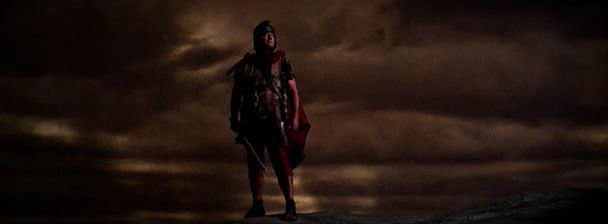

“Truly this man was the son of Gahd.”

Instead of opening with an historical prologue like the 1961 King of Kings, Greatest Story opens in a much more lofty, spiritual way by depicting a fresco of Christ with arms outstretched while a narrator (Orson Welles) intones John’s prologue: In the beginning was the Word… This painting literally bookends the film: at the end we see Von Sydow’s Jesus adopting the same pose as the fresco as He ascends to heaven amid a rendition of Handel’s Hallelujah Chorus. As Stephen Greydanus notes in his review of the film:

Specifically, Greatest Story is closest to the transcendent, luminous spirit of the Gospel of John, the prologue of which is borrowed for the opening shot depicting a church fresco of Christ with arms outstretched, invoking a context of 2,000 years of tradition and faith. Much like the Fourth Gospel, dialogue is often pregnant with second meanings and Old Testament (or Christian history) resonances. Von Sydow’s impassive performance is best seen as an interpretation of John’s overtly divine and sovereign Lord, in contrast to the generally clearer indications of humanity in the Synoptics. He isn’t warm or approachable, but he’s persuasively authoritative and all-knowing.

That being said, it’s not that Greatest Story is not interested in the history. It does attempt to give a sense of the historical context like King of Kings, but where the two films differ is that whereas King of Kings simply drops Jesus into a world populated with Romans and Zealots fighting each other, Greatest Story does the opposite in that it reconfigures history as such that it revolves around Jesus and His coming. In effect, the scenes at the beginning of the film follow traditional Christian thinking by emphasizing the need of 1st century Jews for a Messiah, by stressing what a rotten world this was before Jesus came.

In fact, there is a huge emphasis on the fulfillment of prophecy in this film. The film opens with the visit of the wise men to Herod and his learning of the prophecy about the newborn King of the Jews in Bethlehem (Matthew 2:1-8); Herod in response tries to fulfill another prophecy on purpose by instigating the killing of the Bethlehemite children (Jeremiah 13:15; cf. Matthew 2:18). Meanwhile, in Egypt, we glimpse at Joseph reading to his wife and Child from Isaiah 9:6-7 (“For unto us a child is born…”) just before a messenger arrives bringing the news of Herod’s death. This stress on prophecy goes on until the end of the film, where the disciples at first complain about having enough of prophecy before Mary Magdalene is inspired by Jesus’ prophetic words that He will rise again after three days to go to the tomb.

Greatest Story is one of the few films which include Josephus’ story about the golden eagle erected by Herod the Great over the gate of the temple being torn down at the instigation of two Jewish teachers when a rumor that Herod had died begun to spread (War 1.648-655). The difference between Josephus and the film, however, is that by this point in the movie, Herod is dead. Unlike in Josephus, where Herod (who was ill but not yet dead) has the culprits arrested and put to death, here it is the Romans who agressively quell the riot.
 
(Continued)

At the same time, the movie oversimplifies historical fact by showing Herod Antipas as the sole successor of his father.

In fact, Greatest Story’s Antipas seems to be more of a conflation of the historical Antipas and Archelaus, two of the three brothers (the third being Philip) who inherited a part of their father’s kingdom as ‘independent’ tetrarchs (‘rulers of a fourth’ - yeah, it’s a mystery even to scholars why three brothers each got a fourth of the kingdom) under Rome. Antipas got the lion’s share - Samaria, Judaea, and Idumaea - but due to his incompetency he was kicked out during AD 6 and his tetrarchy converted into a Roman province (Judaea Province) governed by a prefect.

The film gets around this oversimplification by showing Antipas ruling first as ‘king’ as Herod the Great did (note that while Mark and - in a single passage - Matthew does use ‘king’ for Antipas, he never really held the title; Luke - and Matthew save for that one passage - accurately refer to him as “tetrarch”), but due to the eagle incident - which in this film was of such scale that it required the action of the nearest Rome legion available (in Syria) - Antipas is demoted into the position of tetrarch and kicked out of Jerusalem into Machaerus: “from now on a Roman legion directed by a Roman governor will govern Judaea.”

It was also at this time that in the film Rome secures control of the high priest’s vestments, whereas in Josephus Herod already has supervision of them. (To explain: the vestments of the high priest were at this time intimately connected with the political and social fabric of Palestinian society that Herod, and later the Romans, held them in custody for most of the year, only allowing the high priest to wear them during festivals and holy days; cf. Antiquities 15.403-406.)

Now on the north side [of the temple] was built a citadel, whose walls were square, and strong, and of extraordinary firmness. This citadel was built by the kings of the Asamonean =Hasmonean] race, who were also high priests before Herod, and they called it the Tower, in which were reposited the vestments of the high priest, which the high priest only put on at the time when he was to offer sacrifice. These vestments king Herod kept in that place; and after his death they were under the power of the Romans, until the time of Tiberius Caesar; under whose reign Vitellius, the president of Syria, when he once came to Jerusalem, and had been most magnificently received by the multitude, he had a mind to make them some requital for the kindness they had shewn him; so, upon their petition to have those holy vestments in their own power, he wrote about them to Tiberius Caesar, who granted his request: and this their power over the sacerdotal vestments continued with the Jews till the death of king Agrippa (reigned AD 41-44); but after that, Cassius Longinus, who was president of Syria (AD 41-49), and Cuspius Fadus, who was procurator of Judea (AD 44-46), enjoined the Jews to reposit those vestments in the tower of Antonia, for that they ought to have them in their power, as they formerly had.

However, the Jews sent ambassadors to Claudius Caesar (reign AD 41-54), to intercede with him for them; upon whose coming, king Agrippa, junior, being then at Rome, asked for and obtained the power over them from the emperor, who gave command to Vitellius, who was then commander in Syria, to give it them accordingly. Before that time they were kept under the seal of the high priest, and of the treasurers of the temple; which treasurers, the day before a festival, went up to the Roman captain of the temple guards, and viewed their own seal, and received the vestments; and again, when the festival was over, they brought it to the same place, and showed the captain of the temple guards their seal, which corresponded with his seal, and reposited them there. And that these things were so, the afflictions that happened to us afterwards [about them] are sufficient evidence. But for the tower itself, when Herod the king of the Jews had fortified it more firmly than before, in order to secure and guard the temple, he gratified Antonius, who was his friend, and the Roman ruler, and then gave it the name of the Tower of Antonia.

Like King of Kings before it, Greatest Story is at pains to at least visually show how crucifixion was not a special punishment reserved for Jesus and the two criminals executed with Him but is a part of the sea of civilization. As the Holy Family returns from Egypt they walk along a road lined with crosses with mourners reciting psalms - one of which is Psalm 22. As perhaps noted earlier, Scripture - in the form of prophecy and prayer - is a main element of this film. In this case, this scene also serves to foreshadow Jesus’ eventual fate and one of His last words. (Greatest Story however does commit the same ‘gaffe’ as King of Kings does by showing the crosses Jesus and the two robbers were crucified in as being visibly more in line with the smooth planks of traditional Christian art compared with the more roughly-hewn gibbets which feature in this scene.)

http://godwillbegod.com/blog/wp-con...greatest-story-ever-told-movie-still-hill.jpg
 
We are then treated to scenes which drive home the point of the Jews’ need for a messiah (in the Christian sense): slaves being branded and forced to carry a Roman statue, a woman who is forced into a brothel, beggars lining up a road, a man assaulting another. These scenes of suffering and corrupt morals then culminate with a scene of priests performing sacrifice in the temple as John the Baptist (via voiceover) proclaims the words of Hosea (6:6): “I desire steadfast love and not sacrifice, the knowledge of God and not burnt offerings.”

This juxtaposition of the temple sacrifice with scenes of moral decline and Hosea 6 leads to a question: does the film imply that such sacrifices are in a way, ‘wrong’? As other scenes in the film suggest, Greatest Story does seem to adopt a popular perception of Judaism among Christians as this empty religion that has been superseded by Christianity. Taking a page from the author of Hebrews, the animal sacrifices of the old covenant are deemed insufficient and useless, ultimately being fulfilled and replaced by the sacrifice of Christ.

We can sense this mentality in two other scenes. When Von Sydow’s Jesus drives out the moneychangers out of the Temple in this film, He, like Heston’s John, also quotes from Hosea 6:6, but He does not stop there; instead He goes on to quote from Isaiah 1:11: “I do not delight in the blood of bulls, or of lambs, or of goats.” This is then followed by Jesus explaining to the people that He had not come to destroy the Law, but to fulfill it (Matthew 5:17). However in light the context this saying is transplanted in it seems to acquire a different connotation: Jesus ‘fulfills’ the old Law by doing away with it by His future sacrifice (the whole idea of ‘legalistic, works-based Judaism vs. moral, faith-based Christianity’ common in some Christian circles).

Most telling, however, is the way Judas dies in this film: he does not hang himself (as in Matthew and in most other films) nor does he so he so much fall (as in Acts), but flings himself into the fires of the altar of sacrifice at the exact moment the nails are pounded into Jesus’ hands. In effect, Judas - who had betrayed Jesus - symbolically becomes the final sacrifice of a temple that no longer worships God. Judas’ betrayal and death then becomes symbolic of Judaism’s rejection of the Messiah; subsequent to Judas’ suicide, Jesus dies “outside the camp” as the first and only sacrifice of the New Covenant. Upon Jesus’ death, the temple curtain tears apart, a wind blowing it outward. As the priests in the 1935 Golgotha film would say, “God has left the temple.”

Now, director George Stevens did comment on how he so wanted to avoid the ‘anti-Semitism’ of earlier Jesus films and at other places took steps which to him would help mitigate it, to varying effect. First of all, somewhat uniquely for a Jesus movie, the Pharisees are nowhere to be seen at all. Jesus does condemn “these scribes and these Pharisees” in the temple after driving out the vendors (using a very abbreviated form of Matthew 23:1-12), but about half of this speech occurs sotto voce, and there are no actual Pharisees on-screen, but only the crowd of Jesus’ supporters, the temple guards, and the temple priests.
 
Now, director George Stevens did comment on how he so wanted to avoid the ‘anti-Semitism’ of earlier Jesus films and at other places took steps which to him would help mitigate it, to varying effect. First of all, somewhat uniquely for a Jesus movie, the Pharisees are nowhere to be seen at all. Jesus does condemn “these scribes and these Pharisees” in the temple after driving out the vendors (using a very abbreviated form of Matthew 23:1-12), but about half of this speech occurs sotto voce, and there are no actual Pharisees on-screen, but only the crowd of Jesus’ supporters, the temple guards, and the temple priests.
In Greatest Story, it is not so much humans who prove to be Jesus’ opponents, but in keeping with the highly-spiritual tone of the film, Satan himself in the form of an elderly, ragged “Dark Hermit” (Donald Pleasence). He appears in the temptation scene, of course (where he isn’t the threateningly spooky Devil of popular culture, but is genial and quietly reasonable whose temptations come off more like seductive - and more persuasive - suggestions), but he also appears in at least two more scenes. More on this later.
 
In Greatest Story, it is not so much humans who prove to be Jesus’ opponents, but in keeping with the highly-spiritual tone of the film, Satan himself in the form of an elderly, ragged “Dark Hermit” (Donald Pleasence). He appears in the temptation scene, of course (where he isn’t the threateningly spooky Devil of popular culture, but is genial and quietly reasonable whose temptations come off more like seductive - and more persuasive - suggestions), but he also appears in at least two more scenes. More on this later.
Has there ever been a movie that disguises Satan as an “Angel of light”? I can’t grasp that all these movie makers try and make him look evil. Doesn’t the devil want to show himself off as a beautiful being?
 
Has there ever been a movie that disguises Satan as an “Angel of light”? I can’t grasp that all these movie makers try and make him look evil. Doesn’t the devil want to show himself off as a beautiful being?
That’s another good topic there. Really, Satan in Jesus films has been portrayed as things ranging from an ambiguous voice inside Jesus’ head (King of Kings, The Miracle Maker) to a snake (1979 Jesus, The Last Temptation of Christ) to a dark-robed human figure (The King of Kings, Il Vangelo secondo Matteo, The Greatest Story Ever Told, The Passion of the Christ, The Bible) to a beautiful woman in red and a man in a suit (1999 Jesus) to a man dressed like a Greco-Roman statue (The Miracle Maker once more) to a Caucasian girl and a pillar of fire* (again The Last Temptation of Christ) to a stereotypical horned devil (Daya Sagar).
  • Which is a simplification/reversal of the original novel, where Satan appears both as a black servant boy (!) and a green-winged angel with the morning star (= Lucifer, get it?) on his brow. More when we actually get to that film.
When it comes to horror films, the ‘ugly/spooky Devil’ is a standard cliche - thanks in part to The Exorcist with its unnaturally-contorting body parts and the pea soup vomit. (Constantine’s devil in a white suit is one exception I could name - I don’t know, I don’t watch horror films much.) The two most recent Exorcist films (Exorcist: The Beginning and Dominion: Prequel to The Exorcist - really just the same story filmed by different directors) provide a good contrast.

Dominion shows the devil controlling a severely physically-deformed boy (a literal outcast), who ironically becomes healed of his injuries due to this, ultimately transforming into this physically-perfect androgynous being when the evil spirit fully possesses the kid. (I mean, he says it all: “I am perfection.”) So the exorcism scene is kind of bittersweet: driving the demon away would mean that the boy will again be physically infirm. The other film, Exorcist: The Beginning (which was made when the backers rejected the original version - Dominion - as not being too ‘horror’ enough and fired director Paul Schrader; Dominion was only released when ETB proved to be a flop, not that it helped), on the other hand, simply repeats the formula of the first film, showing the possessed woman (yes, it’s a woman in this version - again) turning ugly and vulgar - of course with lots of icky stuff and physical acrobatics. I mean, the dumb public wouldn’t be able to handle the more sophisticated, intellectual demon of Dominion; you gotta show the evil spirit causing the possessed to vomit green stuff at people and use profanity every other sentence, don’tcha? 🤷
 
That’s another good topic there. Really, Satan in Jesus films has been portrayed as things ranging from an ambiguous voice inside Jesus’ head (King of Kings, The Miracle Maker) to a snake (1979 Jesus, The Last Temptation of Christ) to a dark-robed human figure (The King of Kings, Il Vangelo secondo Matteo, The Greatest Story Ever Told, The Passion of the Christ, The Bible) to a beautiful woman in red and a man in a suit (1999 Jesus) to a man dressed like a Greco-Roman statue (The Miracle Maker once more) to a Caucasian girl and a pillar of fire* (again The Last Temptation of Christ) to a stereotypical horned devil (Daya Sagar).
  • Which is a simplification/reversal of the original novel, where Satan appears both as a black servant boy (!) and a green-winged angel with the morning star (= Lucifer, get it?) on his brow. More when we actually get to that film.
When it comes to horror films, the ‘ugly/spooky Devil’ is a standard cliche - thanks in part to The Exorcist with its unnaturally-contorting body parts and the pea soup vomit. (Constantine’s devil in a white suit is one exception I could name - I don’t know, I don’t watch horror films much.) The two most recent Exorcist films (Exorcist: The Beginning and Dominion: Prequel to The Exorcist - really just the same story filmed by different directors) provide a good contrast.

Dominion shows the devil controlling a severely physically-deformed boy (a literal outcast), who ironically becomes healed of his injuries due to this, ultimately transforming into this physically-perfect androgynous being when the evil spirit fully possesses the kid. (I mean, he says it all: “I am perfection.”) So the exorcism scene is kind of bittersweet: driving the demon away would mean that the boy will again be physically infirm. The other film, Exorcist: The Beginning (which was made when the backers rejected the original version - Dominion - as not being too ‘horror’ enough and fired director Paul Schrader; Dominion was only released when ETB proved to be a flop, not that it helped), on the other hand, simply repeats the formula of the first film, showing the possessed woman (yes, it’s a woman in this version - again) turning ugly and vulgar - of course with lots of icky stuff and physical acrobatics. I mean, the dumb public wouldn’t be able to handle the more sophisticated, intellectual demon of Dominion; you gotta show the evil spirit causing the possessed to vomit green stuff at people and use profanity every other sentence, don’tcha? 🤷
Good stuff, Patrick.

Though outside of Jesus films – the role Al Pacino played in Devil’s advocate I found quite interesting. Satan played by Pacino had alluring qualities (through most of the film at least). Offering worldly powers. The traits of a seducer, liar and accuser were demonstrated well enough. In this portrayal, Satan never forced anyone’s hand. Yet, always manipulating and applying pressure to choose evil. Attempting to make evil appear the most appealing choice. Of course, the horned devil and flames at the end of the film appeared (the appeasement of pop culture) yet still found the role well done.
 
Who would have the courage to make a movie where Pilate, Caiaphas, and Satan were Hollywood handsome men, and Jesus was short, bald, and average-looking?!
 
Who would have the courage to make a movie where Pilate, Caiaphas, and Satan were Hollywood handsome men, and Jesus was short, bald, and average-looking?!
One of the few ‘unattractive’ on-screen Jesuses I know of is Colin Blakely’s ragged, out-of-shape middle-aged bloke with a slightly receding hairline from English playwright Dennis Potter’s production Son of Man (televised on the BBC in 1969), but even then Blakely’s Jesus is also unconventional in many ways (sometimes torn by self-doubt, other times enthusiastically ‘on fire’) that many considered it offensive and even blasphemous.

http://img43.imageshack.us/img43/5576/colinblakely.jpg

That, and the fact that the film ends with Jesus’ death (with the words “My God, why have you forsaken me” no less) - which for quite a number of people out there is a no-no. That’s one of the reasons why films like From the Manger to the Cross, Jesus Christ Superstar, Godspell, and The Last Temptation of Christ - all of which wrap up with Jesus’ death - got attacked. (There was that recent black Jesus film, The Color of the Cross, which also technically ended at the crucifixion, but at least the director did make a sequel.)
 
Who would have the courage to make a movie where Pilate, Caiaphas, and Satan were Hollywood handsome men, and Jesus was short, bald, and average-looking?!
This would be more in line with Isaiah’s Prophecy:

Isaiah 53:2 For he grew up before him like a young plant, and like a root out of dry ground; he had no form or majesty that we should look at him, and no beauty that we should desire him.

And of course, 1 corin 11: 14 And no wonder, for even Satan disguises himself as an angel of light
 
This would be more in line with Isaiah’s Prophecy:

Isaiah 53:2 For he grew up before him like a young plant, and like a root out of dry ground; he had no form or majesty that we should look at him, and no beauty that we should desire him.
In early Christianity, there were two opposing opinions on what Jesus looked like - each of which used Scripture as a basis. One opinion held by writers like Gregory of Nyssa, Ambrose, Augustine and Jerome that Jesus must have been very handsome - in fact the archetype of manly beauty - based on the description of the bridegroom in Song of Songs 5:10-16 (“My beloved is radiant and ruddy, chief among ten thousand,” etc.) and the king in Psalm 45:2 (“You are fairer than the sons of men; grace is poured upon your lips; therefore God has blessed you forever”), both held to be types of Christ. The other camp, represented by writers like Justin Martyr, Irenaeus, Clement of Alexandria and Tertullian on the other hand, argued on the basis of Isaiah 53:2-3 and Psalm 22:6 (“I am a worm, and no man”) that no, Jesus was actually physically ‘inglorious’ and deformed, repulsive even. This camp argued that the passages mentioned above do not so much refer to the bodily beauty of Christ but to His spiritual perfection. Tertullian writes:

Let us compare with Scripture the rest of His dispensation. Whatever that poor despised body may be, because it was an object of touch and sight, it shall be my Christ, be He inglorious, be He ignoble, be He dishonoured; for such was it announced that He should be, both in bodily condition and aspect. Isaiah comes to our help again: “We have announced (His way) before Him,” says he; “He is like a servant, like a root in a dry ground; He has no form nor comeliness; we saw Him, and He had neither form nor beauty; but His form was despised, marred above all men.” Similarly the Father addressed the Son just before: “Inasmuch as many will be astonished at You, so also will Your beauty be without glory from men.” (Isaiah 52:14) For although, in David’s words, He is fairer than the children of men (Psalm 45:2), yet it is in that figurative state of spiritual grace, when He is girded with the sword of the Spirit, which is verily His form, and beauty, and glory. According to the same prophet, however, He is in bodily condition “a very worm, and no man; a reproach of men, and an outcast of the people.” (Psalm 22:6) But no internal quality of such a kind does He announce as belonging to Him. In Him dwelt the fullness of the Spirit; therefore I acknowledge Him to be “the rod of the stem of Jesse.” His blooming flower shall be my Christ, upon whom has rested, according to Isaiah, “the spirit of wisdom and understanding, the spirit of counsel and might, the spirit of knowledge and of piety, and of the fear of the Lord.” (Isaiah 11:1-2) Now to no man, except Christ, would the diversity of spiritual proofs suitably apply. He is indeed like a flower for the Spirit’s grace, reckoned indeed of the stem of Jesse, but thence to derive His descent through Mary.

Of course that latter opinion didn’t last; people simply took for granted that Jesus was a pretty boy. After all, He’s God, ain’t He? And the Devil is a frightening monster because he’s evil.
And of course, 1 corin 11: 14 And no wonder, for even Satan disguises himself as an angel of light
Oh yeah, I forgot to mention Bedazzled and its female Satan. But speaking within Jesus films, the only movies where Satan takes the form of a woman (or at least is played by a female actor) is The Last Temptation of Christ, Jesus (1999), and The Passion of the Christ.
 
In Greatest Story, it is not so much humans who prove to be Jesus’ opponents, but in keeping with the highly-spiritual tone of the film, Satan himself in the form of an elderly, ragged “Dark Hermit” (Donald Pleasence). He appears in the temptation scene, of course (where he isn’t the threateningly spooky Devil of popular culture, but is genial and quietly reasonable whose temptations come off more like seductive - and more persuasive - suggestions), but he also appears in at least two more scenes. More on this later.
The “Dark Hermit” appears at least four times throughout Greatest Story. The very first instance is of course the temptation in the wilderness (clip here): when Jesus retreats into a cave on a steep, high cliff at night, he meets a scraggly old man inside having a meal, who invites Him in. His very first words to Jesus are:

Some think that all of life should be hard like that; an easy life is a sinful life. That’s what they think. Not so - life should be easy as man could make it. It can be easy, friend, if a man knows the way to power and glory in this world.

He tries to give Jesus some of his food, which He refuses. As Jesus goes outside the cave, the Hermit then offers Jesus “the power and the glory of all these kingdoms” in exchange for “doing [him] homage,” which He refutes. Jeffrey Lloyd Staley and Richard G. Walsh in Jesus, the Gospels, and Cinematic Imagination write:

Stevens’s Jesus rejects the “easy life” for an almost ascetic trust in God, and it is notable that Stevens does not show Jesus at the wedding at Cana or eating with “tax collectors and sinnders.” Perhaps not coincidentally, the Dark Hermit tells Jesus that he can rule “all this” if he simply does “homage” to him—this on a night with a huge full moon dominating the sky. Is this scene an allusion to President John F. Kennedy’s promise to “put a man on the moon by the end of this decade?” It was a promise that, couple with Kennedy’s nomination speech (July 15, 1960) and his inaugural address (January 20, 1961), spoke of both the hard work and the sacrifice required of all Americans who should be asking “not what your country can do for you [but] … what you can do for your country.” If Stevens’s Jesus represents the ideal American, then like Jesus, America should shoulder the heavy load, climb the hard path, take the moon; and be the empire that “saves the world.”

The order of the temptations in this film follow neither Matthew (stones to bread-throw yourself down-kingdoms of the world) nor Luke (stones to bread-kingdoms of the world-throw yourself down), but instead seems to be a reverse of the Matthaean order, with the offer to turn stones to bread coming last. Instead of the threatening demeanor other film Satans take, here the tests are played out more as an intellectual conversation between the Devil and Jesus. The final test is played out in an interesting way: Jesus leaves the scene just as the Hermit demands Him to turn stones to bread, and so we only hear His voice thunder: “Man shall not live by bread alone, but by every word that proceedeth out of the mouth of God.” I wonder - is there a connection here between the ‘word’ and the ‘Word’?

A new day dawns as John’s - well, Charlton Heston’s 😃 - voice echoes across the desert, quoting a combination of Isaiah 29:19, Psalm 9:18 and Isaiah 60:1 (there it is - Scripture again!): “Arise, shine; for thy light is come, and the glory of the Lord is risen upon thee.” Triumphant music blares as Jesus, seemingly inspired by these words, rock-climbs up the cliff; we get a good view of the Californian Death Valley (doubling as the Judaean desert) as Jesus proclaims via voiceover: “All the tribes of the earth shall see the Son of man coming in the clouds of heaven with power and great glory.” (cf. Matthew 24:30)

The approach taken by Greatest Story is similar to King of Kings in that they both deliberately eschew any overt, lavish depiction of the supernatural in favor of naturalism (something which would characterize most later Jesus films): hence, there is no dove and no voice from heaven in the baptism scene, and here in the temptation sequence, there is no change in scenery (as in the gospels): the offer of all earthly kingdoms simply occur just outside the cave where the Hermit was, with the desert as the backdrop; the demand to Jesus to throw Himself down simply happens at the cliff immediately in front. As in King of Kings, most of the more spectacular miracles are only briefly referenced in second-hand reports; the darkness at the crucifixion is simply a thunderstorm.

The depiction of Satan as an wizened elderly man may also be part of this more naturalistic approach, but at least it can be read as acknowledging the physical presence of the Evil One, compared to King of Kings, where the temptations are carried out by a bodiless, impersonal voice inside Jesus’ head. The latter approach leaves it ambiguous as to whether it was really the Devil talking or simply Jesus imagining things.

I forgot to note: I’m wondering if Stevens is here drawing from a popular medieval belief that the Devil did adopt the form of an elderly hermit when he tested Jesus in the desert.
 
The second time the Dark Hermit appears is during Jesus’ ministry. He briefly filters through the crowd surrounding Jesus and proclaims: “Hail, Son of David.” Jesus only stares at him icily until he looks left off-screen and motions to leave, whence Mary Magdalene (here identified as the woman caught in adultery) enters the scene. That the title “Son of David” is placed here in the mouth of Satan establishes that the title as a reference to the earthly throne of David is an incorrect understanding. Later, when Judas says that Jesus is a king, we know that he aligns himself with this wrong and evil view. This film’s Jesus is not a political threat, His kingdom is not “of this world;” He is rather the Logos, the Word.

After Jesus forgives the adulterous woman/Mary Magdalene and a woman touches His clothes (cf. Mark 5:25-29 and parallels), the people begin to proclaim Jesus as Messiah. One even calls Him a king (!), prompting nearby Roman soldiers to beat the poor guy. As Jesus heads to the pier on the shore the crowd swells in size, trying to reach out to Him - all the while having His back turned to them. Disturbingly, it is revealed that the Hermit is among the crowd. Again, we get a whiff of John here:

When the people saw the sign that he had done, they said, “This is indeed the Prophet who is to come into the world!” Perceiving then that they were about to come and take him by force to make him king, Jesus withdrew again to the mountain by himself. (6:14-15)

The presence of Satan among the crowd and their proclamation of Him as “king” gives a negative connotation to the scene: the people have misunderstood who Jesus is.

http://img547.imageshack.us/img547/561/3obl.jpg

Let me correct myself: there are actually five scenes where this Satan character appears. I’ve already talked about two. The three other scenes where the Dark Hermit appears is (1) when Judas leaves the upper room, (2) when Jesus is being crowned with thorns, and (3) at the trial of Jesus before Pilate.

The first one is brief. As Judas heads to where the chief priests are, he almost bumps into the Dark Hermit, who is standing on a poorly-lit corner; the Hermit only stares as Judas goes on his way to the Temple. This is probably the film’s visual attempt at representing/evoking Luke’s and John’s brief description about Judas being instigated into betraying Jesus by the devil: “Satan entered into him” (Luke 22:3; John 13:27).

The second one is also quite brief. The crowning with thorns occurs here after Jesus is led away from Herod’s presence (Luke 23:6-12). Note that Luke - the only one to speak of Jesus being brought before Herod - does not mention the crowning with thorns, but does mention Jesus being mocked by “Herod and his soldiers,” which might be his analogue to the mockery by the Roman soldiers in the other gospels. The film attempts to harmonize these accounts by directly placing the mockery by the Roman soldiers (here accompanied by a gathering of Jewish hecklers) immediately after the trial before Herod and just before Jesus is brought back to Pilate. As the camera pans to the people laughing derisively at Jesus, the Dark Hermit via voiceover recites the words of John 3:16* either as a sort of (mocking) commentary or in recollection: “For God so loved the world, that he gave his only begotten Son, that whosoever believeth in him should not perish, but should have everlasting life.” The next shot is then of Jesus, already with the crown of thorns on His head.
  • No Jesus film to my knowledge places these words into Jesus’ mouth, not even the 2003 word-for-word film The Gospel of John (where the narrator recites it).
 
Picking this up:

The final time the Dark Hermit appears is during Jesus’ trial before Pilate. Yeah, Mel Gibson wasn’t the first filmmaker to visibly insert Satan during the Passion. 😉 After Pilate declares “Behold the man,” the Satan character wades through the crowd and is the first person to shout “Crucify Him.” Only after he does this do we see others in the crowd start to follow suit and ask for Jesus to be killed - effectively drowning out the shouts for Jesus to be released. The line “We have no king but Caesar,” which in John’s gospel is spoken by the chief priests (19:15), is in this film also spoken by the Dark Hermit - as a contrast to Jesus’ declaration that “[His] kingdom is not of this world.” So again we see the film taking things up to a new level: it is the Devil himself who instigates the crowd to ask for Jesus’ death. This portrayal could be seen positively as an attempt to remove any insinuation of Jews as God-killers, but at the same time, I think it could also be open to an interpretation which aligns the Jewish crowds with Satan. The trial ultimately ends with Pilate sentencing Jesus to death and the obligatory hand-washing scene. The film however does not include Pilate’s declaration of innocence and the crowd’s controversial reply (Matthew 27:25); instead, the words of the Apostles’ Creed come to Pilate’s mind: “…suffered under Pontius Pilate, was crucified, dead, and buried.”

Of note is the fact that the Temple priests are nowhere to be seen in this sequence. In fact, the temple priests play only a relatively minor role in the film as a whole: much of the screentime is taken up by Jesus and associates, Herod Antipas (mostly interacting with John the Baptist), and Pilate. The very first scene in Jesus’ adulthood where Jewish leaders of any sort are referenced is when messengers from “the Grand Sanhedrin” come to John the Baptist ordering him to cease his preaching. Caiaphas and the temple priests are only introduced later when said messengers return to Jerusalem to report: Caiaphas does not seem to know who John is until the messengers tell him. They purport that John is blaspheming and preaches “against all authority.”

Caiaphas is then summoned before Pilate, who reprimands him for his lack of action concerning John. When Caiaphas gives the excuse that since John is in Antipas’ territory they could not do anything about him, Pilate asks them if they tried asking the latter’s permission. After granting Caiaphas and the priests to ask Herod, he tells them that he does not care about their “superstitions” and is only concerned with keeping order. So messengers are sent to Antipas in the Galilee, and this dialogue occurs:

Servant: Sire, these emissaries have come from Jerusalem with disturbing reports of a fanatic preacher, the so-called Baptist who incites great crowds on the Jordan River.
Antipas: Why do you come to me?
Messenger: He stands day after day in the water, spreading sedition.
Antipas: Did it ever occur to you that as the ruler here I have more to do than chase an eccentric, screaming hell of a damnation out of the Jordan River?
Messenger: I humbly suggest that your majesty has not grasped the inflammatory possibilities of this man’s teaching.
Antipas: Impostor. All prophets are impostors.
Messenger: He’s attracting great crowds all over Judaea and Galilee, promising a better world to come.
Antipas: Good for him. We can use a better world. Preferably one without Romans.
Messenger: He speaks of the Christ that is to come.
Antipas: …What did you say?
Messenger: The Christ, your majesty. The Messiah.
Antipas: (To a soldier) Bring that Baptist to me.

These scenes tries to establish at least (at the cost of committing heavy artistic license) that the temple priests are subservient to Rome and could not act by themselves. Again, there is also a historical blunder here on the portrayal of Antipas, portrayed as a modern-day cynic who is still brooding over the fact that Rome has taken his kingdom away. (See post number 81.)
 
Patrick, when did you become a Forum Master?

Congratulations!

Re JB…of course, the only reason Antipas arrested John was because he was preaching so close to where his armies were massing to invade Nabotea- Antipas didn’t want John disrupting his war effort (such as it was). So John was arrested and trundled off to nearby Macherus, Antipas’ base of operations.

Then Herodias and Salome came to visit to celebrate Antipas’ birthday party…
 
Patrick, when did you become a Forum Master?

Congratulations!
Thanks! I’m not so sure - I wasn’t paying attention myself.
Re JB…of course, the only reason Antipas arrested John was because he was preaching so close to where his armies were massing to invade Nabotea- Antipas didn’t want John disrupting his war effort (such as it was). So John was arrested and trundled off to nearby Macherus, Antipas’ base of operations.
The only thing Josephus says about John is this:

Now some of the Jews thought that the destruction of Herod’s army came from God, and was a very just punishment for what he did against John called the baptist. For Herod had him killed, although he was a good man and had urged the Jews to exert themselves to virtue, both as to justice toward one another and reverence towards God, and having done so join together in washing. For immersion in water, it was clear to him, could not be used for the forgiveness of sins, but as a sanctification of the body, and only if the soul was already thoroughly purified by right actions. And when others massed about him, for they were very greatly moved by his words, Herod, who feared that such strong influence over the people might carry to a revolt – for they seemed ready to do any thing he should advise – believed it much better to move now than later have it raise a rebellion and engage him in actions he would regret.
And so John, out of Herod’s suspiciousness, was sent in chains to Machaerus, the fort previously mentioned, and there put to death; but it was the opinion of the Jews that out of retribution for John God willed the destruction of the army so as to afflict Herod.
Then Herodias and Salome came to visit to celebrate Antipas’ birthday party…
Ah, about that. Matthew and Mark are the only two gospels who record John’s beheading, and they don’t name the daughter. (Surprise surprise!) In fact, it’s quite unclear - just going by those gospels - whose daughter the girl is. The 27th edition of the Nestle-Aland Greek New Testament (NA27) has “the daughter of Herodias” (ἡ θυγάτηρ τῆς Ἡρῳδιάδος) in Matthew 14:6, but has “his [Herod’s] daughter Herodias” (τῆς θυγατρὸς αὐτοῦ Ἡρῳδιάδος) in Mark 6:22, which would suggest that ‘Herodias’ is supposed to be the name of the daughter or that Herod had a daughter named Herodias.

The reading “his daughter Herodias” only appears in a few manuscripts like Codex Vaticanus, Sinaiticus, or Bezae but in support of the reading is the fact that some of these are the earliest witnesses to the complete text of Mark. Plus, there’s also the fact that this is the harder reading, which, under the principle of lectio difficilior (the difficult reading is more likely to be original), takes it under consideration. Well, to put it simply, since “his daughter Herodias” can be read as contradicting Matthew 14:6, most other manuscripts have the harmonized reading “the daughter of Herodias herself” (τῆς θυγατρὸς αὐτῆς τῆς Ἡρῳδιάδος) or “the daughter of Herodias” (τῆς θυγατρὸς τῆς Ἡρῳδιάδος). Most translations to my knowledge also follow suit and simply gloss over the textual variant by adopting a similar reading.

And since we’re talking about this issue, I’ll let you in on something. The whole “dance of the seven veils” thing comes from Oscar Wilde. The text doesn’t suggest anything about the daughter’s dance being a sort of ancient striptease or some such. Showing ‘Salome’ as a seductive young woman is popular in Hollywood epics (King of Kings and Greatest Story) because it allows filmmakers to insert some sex appeal into a ‘holy’ story. Now Pasolini’s film Il Vangelo secondo Matteo is I think the only one which intentionally avoids portraying the dance in such a way - in fact, Herodias’ daughter in that film is a non-sexualized teenage girl. The irony is that this sort of portrayal is perhaps more accurate to the gospel text.
 
You won’t find Salome in the NT.
You have to go to Josephus to flesh out what occurs in the Gospels.
There are some sources who do this quite nicely, IMO.
 
Status
Not open for further replies.
Back
Top