Jesus's tomb

  • Thread starter Thread starter jcupach
  • Start date Start date
Status
Not open for further replies.
J

jcupach

Guest
Not sure where this would go…

When the Marys go to the tomb to cleanse Jesus on Easter morning would they have been able to move the stone blocking the tomb? I would think that these rocks would be larger and that you would need more than the two women to move it. Or are the rocks small enough that it wouldn’t be a problem for the two of them?
 
Not sure where this would go…

When the Marys go to the tomb to cleanse Jesus on Easter morning would they have been able to move the stone blocking the tomb? I would think that these rocks would be larger and that you would need more than the two women to move it. Or are the rocks small enough that it wouldn’t be a problem for the two of them?
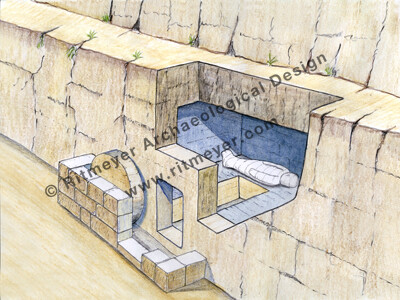
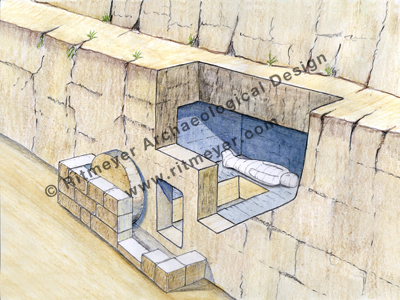
In those days, it was common for the entrances of some tombs to be fitted with heavy blocking stones or golal/golel that were either square/rectangular or less commonly, round (other cave burial-type tombs could be simply sealed by piling small stones, bricks and/or plaster over the door). These served to prevent possible desecration
of the tomb and its contents by both wild animals and men. In the case of disc-shaped blocking stones, you would have this slot cut just in front of the door to hold the stone; the stone was rolled into the entrances.

http://www.bibleplaces.com/blog/upl...Midras rolling stone tomb, 45-17tb-782156.jpg

As for the rectangular/square stones, they could either be flat or have a protuberant ‘stopper’, which could be ‘plugged’ snugly into the entrance.

http://rsc.byu.edu/sites/default/files/image/Religious Educator/4 1/image019.gif

http://rsc.byu.edu/sites/default/files/image/Religious Educator/4 1/image021.gif

Many of these blocking stones aren’t too big in size since the entrances are tiny anyway (in most instances, measuring less than 3 feet in height), that there is only barely enough space for a single person to stoop or crawl into. But needless to say, removing a blocking stone would be a difficult task (especially if you’re using the plug type IMHO). By necessity it needs to be EXTREMELY heavy and secure - various estimates put the average weight of a blocking stone at around one to two tons at the greatest. To gain access to the tomb you would need to push or pry out the stone from its position first.
 
No they wouldn’t. That’s why the Gospels record that as they were going there they discussed who they would get to move the stone for them. Perhaps they wouldn’t have dared to ask the soldiers guarding the tomb to move the stone. I guess they were going to check things out first and then see if they could get some able bodied men to move it who were hanging around or passing nearby, as the Gospels tell us the place was not far outside the city walls. At that time Jerusalem had a large population and was also chock full of visitors for the Passover.
 
No they wouldn’t. That’s why the Gospels record that as they were going there they discussed who they would get to move the stone for them. Perhaps they wouldn’t have dared to ask the soldiers guarding the tomb to move the stone. I guess they were going to check things out first and then see if they could get some able bodied men to move it who were hanging around or passing nearby, as the Gospels tell us the place was not far outside the city walls. At that time Jerusalem had a large population and was also chock full of visitors for the Passover.
Yes! 🙂

Romans usually preferred to execute criminals in two places: the place where the condemned perpetrated his crime and was ‘caught in the act’, or in generally prominent and public areas such as on roadsides and city gates. The Roman rhetorician Quintilian (ca. AD 35-100) explains the reason for latter thus: “Whenever we crucify the guilty, the most crowded roads are chosen, where most people can see and be moved by this fear. For penalties relate not so much to retribution as to their exemplary effect.” This explains the reason why the 6,000 slaves who followed Spartacus in the Third Servile War and survived Crassus’ onslaught were all crucified alongside the Via Appia, which connected Capua and Rome.

The area where Jesus was crucified, Golgotha, is an example of the latter. John writes about how the people were able to read the sign posted on Jesus’ cross “for the place was near the city where Jesus was crucified,” and Matthew and Mark both speak of “those who passed by” taunting Jesus. This suggests that His cross stood just outside the city walls somewhere near the roadside, where people can pass by and view the victim at close range. And because John later in the narrative notes that “in the place where He was crucified there was a garden,” the general area where both execution area and garden was located was close enough to the city proper. So, yeah.
 
Pardon me for running wild here, but a little something about Jewish modes of burial in those days. Somebody correct me here if I got details wrong:

At that time, there were at least two popular modes of burial: one was burying the body of the deceased in a trench grave, not unlike modern day grave cuts. After the pit was filled in, the grave was marked either by erecting a headstone or a pile of rocks at one end, or simply pouring a mixture of lime/chalk and water over the backfill, so that people would recognize the presence of a burial - and thus avoid accidentally passing through it and becoming ritually impure as a result (there is one idea that Jesus’ reference to “whitewashed tombs” in His woes against the Pharisees refers to this). This was apparently the preferred mode of burial among the poorer classes, which of course in those days meant the majority of the population. Some scholars even think it likely that had Jesus - who was by no means wealthy - died a ‘normal’ death, He probably would have been buried in one. Given the inconspicuous and highly flimsy nature of this type of grave compared to the burial cave-type below, relatively few examples of this type of burial is in the archaeological record.

For those who could afford to make and/or own one meanwhile, the other option was a burial cave, either natural or man-made, which were, unlike the individual trench graves, family affairs: the bones of generations upon generations could all be interred in a single cave.

The basic design of these rock-cut tombs consists of a square or rectangular room with benches on three sides of the chamber, leaving a pit in the middle, and a narrow doorway which could be closed with a blocking stone. Some tombs could be more elaborate: for instance, having multiple chambers and whatnot. Around the time of Jesus you also had tombs with shelves cut into the walls of the interior: one variant is the arcosolia, which has a bench-like aperture (known as an arcosolium) with an arched ceiling hewn into the length of the wall. Another is the loculi, aka kokhim type: a loculus or a kokh refers to a narrow shaft running perpendicularly back from the chamber wall.

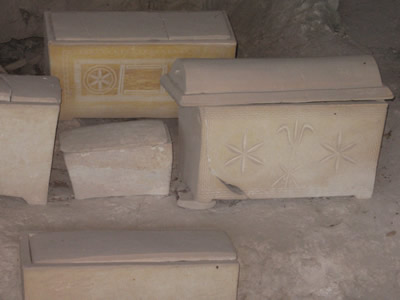
In this scenario, the body of the deceased would usually first be laid on the bench or on a shelf (arcosolium) or on a niche (kokh) inside the burial chamber and left there, allowing the flesh to rot (the Jews did not practice embalming) until it has totally decomposed - something which is usually considered to occur within the space of a year. Sometimes the body could even be placed on a sort of coffin when it is placed on the shelf. This is what is known as primary burial. At the following year, once the flesh had decomposed, family members would return to the tomb and practice the continuation of the funerary rite: secondary burial, which involves taking the bones and reinterring it in some way, either by depositing it in a specially-designated area somewhere inside the tomb or - more common at the time of Jesus - in stone boxes called ossuaries, which would then be also placed on a certain spot inside the burial chamber, in the loculi or on the benches.
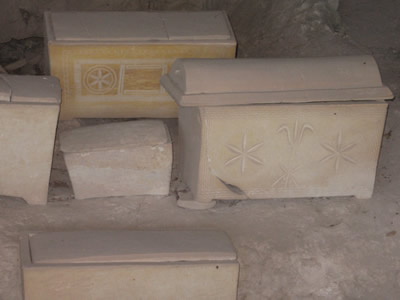

Ossuaries

http://rsc.byu.edu/sites/default/files/i4.jpg
Tomb with the corpse in an arcosolium and ossuaries on shelf and loculi
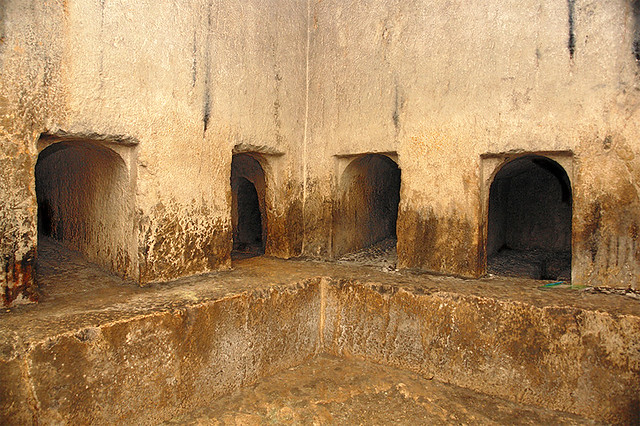

Kokhim atop benches


The tomb of Joseph of Arimathea where Jesus was buried, a newly-hewn tomb (Matthew 27:60; Luke 23:53; John 19:41), would have probably looked like this. You can notice that only the benches are present: the first stage in tomb construction is the cutting out of the chamber with the benches on three sides. Other chambers and niches and shelves could then be added.

 
Pardon me for running wild here, but a little something about Jewish modes of burial in those days. Somebody correct me here if I got details wrong:

At that time, there were at least two popular modes of burial: one was burying the body of the deceased in a trench grave, not unlike modern day grave cuts. After the pit was filled in, the grave was marked either by erecting a headstone or a pile of rocks at one end, or simply pouring a mixture of lime/chalk and water over the backfill, so that people would recognize the presence of a burial - and thus avoid accidentally passing through it and becoming ritually impure as a result (there is one idea that Jesus’ reference to “whitewashed tombs” in His woes against the Pharisees refers to this). This was apparently the preferred mode of burial among the poorer classes, which of course in those days meant the majority of the population. Some scholars even think it likely that had Jesus - who was by no means wealthy - died a ‘normal’ death, He probably would have been buried in one.
I don’t know why they would think that. Yes as Jesus had no worldly wealth to speak of, normally He would have been buried in a poor man’s grave. However the Gospels tell us that the wealthy politician Joseph of Arimethea provided Him the rock-cut tomb of the type you describe, which he had prepared for himself. The Resurrection accounts seem to indicate that Jesus’ body had lain on a rock ledge or shelf inside the tomb.
 
Not sure where this would go…

When the Marys go to the tomb to cleanse Jesus on Easter morning** would they have been able to move the stone blocking the tomb?** I would think that these rocks would be larger and that you would need more than the two women to move it. Or are the rocks small enough that it wouldn’t be a problem for the two of them?
No and they knew that.

Mark 16:1-3

1 When the sabbath was over, Mary Magdalene, Mary, the mother of James, and Salome bought spices so that they might go and anoint him.

2 Very early when the sun had risen, on the first day of the week, they came to the tomb.

3 They were saying to one another,** “Who will roll back the stone for us from the entrance to the tomb?”**
 
Tonight I am watching the Shroud of Turin from Ignatius Press. It has three movies in it.

The Silent Witness 1978 which I have never seen. The Shroud of Turin from 2008 and Shroud from 2010.

I am looking forward to this DVD and this particular thread seems to fit right in. Thanks jcupach.
 
Believe me, nothing really fits in with the Shroud of Turin.

Maybe the Carpocretian Christian sect. Possibly.
 
The Shroud of Turin has nothing to do with this thread topic. Anyone wishing to discuss it can open a new thread or go into the many existing threads about it. You should not derail this thread with something off topic.
 
Pardon me for running wild here,
No Patrick. On the contrary, it took some time and effort to write that and paste the URL’s for those pictures. The information, for me, is wonderful.

I love this stuff. Thank you.

-Tim-
 
The Shroud of Turin has nothing to do with this thread topic. Anyone wishing to discuss it can open a new thread or go into the many existing threads about it. You should not derail this thread with something off topic.
Oh I am so sorry I upset you by talking about a movie that deals with a burial cloth. Wait, wouldn’t a burial cloth be in a tomb? I certainly was not trying to derail this thread.

Having a bad day are you?
 
Oh I am so sorry I upset you by talking about a movie that deals with a burial cloth. Wait, wouldn’t a burial cloth be in a tomb? I certainly was not trying to derail this thread.

Having a bad day are you?
No bad day. Just stick to the topic. The OP was not asking about what was in the tomb?
 
No Patrick. On the contrary, it took some time and effort to write that and paste the URL’s for those pictures. The information, for me, is wonderful.

I love this stuff. Thank you.

-Tim-
Something tells me that Patrick is “locked and loaded” on a multitude of Christian subjects, ready to fire.
 
Something tells me that Patrick is “locked and loaded” on a multitude of Christian subjects, ready to fire.
I don’t know anything about locked and loaded. It he knows biblical history, that’s for sure.

-Tim-
 
I believe one account has the angel sitting on the stone. Another account has one angel sitting at the head and a second angel sitting at the foot where Jesus was laid inside of the tomb. So it may well be that the angels moved the head stone back from the opening.
 
I believe one account has the angel sitting on the stone. Another account has one angel sitting at the head and a second angel sitting at the foot where Jesus was laid inside of the tomb. So it may well be that the angels moved the head stone back from the opening.
We can infer what type of tomb Jesus was buried in from the Gospels:
  • It was ‘new’, i.e. yet unused (Matthew 27:60; Luke 23:53; John 19:41)
  • It was hewn out of rock (Matthew 27:60; Mark 15:46; Luke 23:53)
  • It apparently had a low entrance - at least people had to stoop to look or go inside (Luke 24:12; John 20:5, 11) - which was sealed by a heavy blocking stone (Matthew 27:60, 28:2; Mark 15:46, 16:2-3; Luke 24:2; John 20:1)
  • It had a place inside where the corpse would be laid in, where one could apparently sit (Mark 16:5; John 20:12)
These descriptions would fit the cave tomb type. Jesus died in a place far away from His native hometown: any ancestral tomb, supposing that His family had one, would have probably been up north in the Galilee. (But then again, you do have folks who’ll make it a priority to be buried near the holy city.) Not to mention that with such little time available before Sabbath begins they wouldn’t have been able to dig a proper trench grave for Him. So the next option available was: to use somebody else’s tomb, even if only temporarily.
 
Status
Not open for further replies.
Back
Top