Pardon me for running wild here, but a little something about Jewish modes of burial in those days. Somebody correct me here if I got details wrong:
At that time, there were at least two popular modes of burial: one was burying the body of the deceased in a trench grave, not unlike modern day
grave cuts. After the pit was filled in, the grave was marked either by erecting a headstone or a pile of rocks at one end, or simply pouring a mixture of lime/chalk and water over the backfill, so that people would recognize the presence of a burial - and thus avoid accidentally passing through it and becoming ritually impure as a result (there is one idea that Jesus’ reference to “
whitewashed tombs” in His woes against the Pharisees refers to this). This was apparently the preferred mode of burial among the poorer classes, which of course in those days meant the majority of the population. Some scholars even think it likely that had Jesus - who was by no means wealthy - died a ‘normal’ death, He probably would have been buried in one. Given the inconspicuous and highly flimsy nature of this type of grave compared to the burial cave-type below, relatively few examples of this type of burial is in the archaeological record.
For those who could afford to make and/or own one meanwhile, the other option was a burial cave, either natural or man-made, which were, unlike the individual trench graves, family affairs: the bones of generations upon generations could all be interred in a single cave.
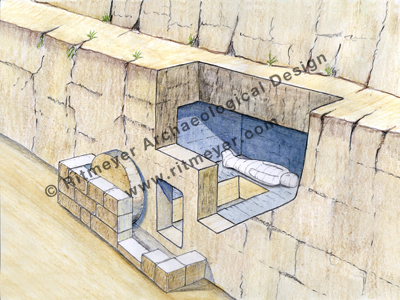
The basic design of these rock-cut tombs consists of a square or rectangular room with benches on three sides of the chamber, leaving a pit in the middle, and a narrow doorway which could be closed with a blocking stone. Some tombs could be more elaborate: for instance, having multiple chambers and whatnot. Around the time of Jesus you also had tombs with shelves cut into the walls of the interior: one variant is the
arcosolia, which has a bench-like aperture (known as an
arcosolium) with an arched ceiling hewn into the length of the wall. Another is the
loculi, aka
kokhim type: a
loculus or a
kokh refers to a narrow shaft running perpendicularly back from the chamber wall.
In this scenario, the body of the deceased would usually first be laid on the bench or on a shelf (
arcosolium) or on a niche (
kokh) inside the burial chamber and left there, allowing the flesh to rot (the Jews did not practice embalming) until it has totally decomposed - something which is usually considered to occur within the space of a year. Sometimes the body could even be placed on a sort of coffin when it is placed on the shelf. This is what is known as
primary burial. At the following year, once the flesh had decomposed, family members would return to the tomb and practice the continuation of the funerary rite:
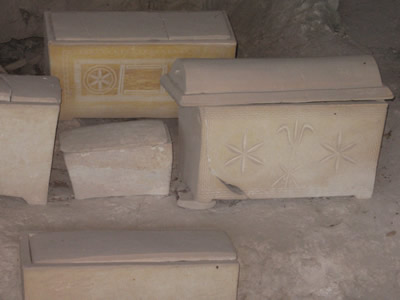
secondary burial, which involves taking the bones and reinterring it in some way, either by depositing it in a specially-designated area somewhere inside the tomb or - more common at the time of Jesus - in stone boxes called
ossuaries, which would then be also placed on a certain spot inside the burial chamber, in the
loculi or on the benches.
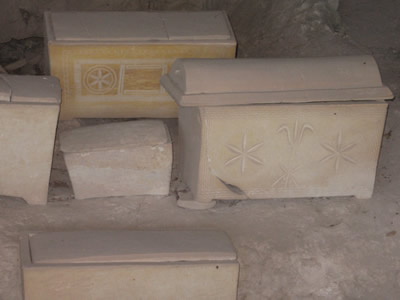
Ossuaries
http://rsc.byu.edu/sites/default/files/i4.jpg
Tomb with the corpse in an
arcosolium and ossuaries on shelf and
loculi
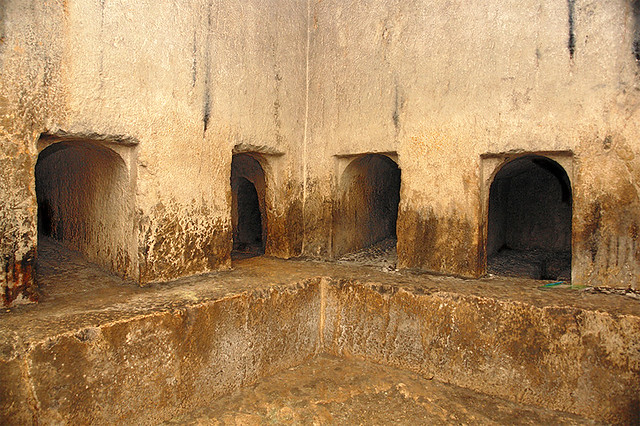 Kokhim
 atop benches
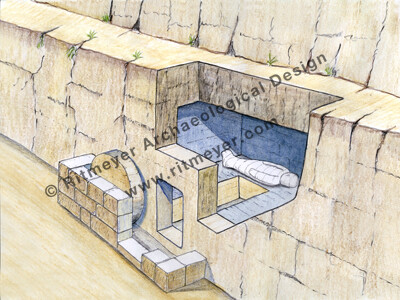
The tomb of Joseph of Arimathea where Jesus was buried, a newly-hewn tomb (Matthew 27:60; Luke 23:53; John 19:41), would have probably looked like this. You can notice that only the benches are present: the first stage in tomb construction is the cutting out of the chamber with the benches on three sides. Other chambers and niches and shelves could then be added.