Okay, as promised, let me introduce the data.
Triple tradition: Refers to the material shared by Matthew, Mark and Luke. It broadly has the same order across all three gospels, in fact this order tends to be identical with Mark’s, to the point that if you were to isolate triple tradition material in Matthew and Luke you’d end up with a complete gospel generally similar to Mark in structure. Now there are times when Matthew or Luke may occasionally place individual incidents differently, but striking thing about it is that it is rare for both Matthew and Luke to place the same incident differently. Even where Matthew and Luke apparently depart from Mark’s narrative order, they very often both of them end up reverting into agreement with Mark.
Double Tradition: Material found in Matthew and Luke but
not in Mark, what adherents of the two-source hypothesis would call ‘Q material’. It is not as numerous as triple tradition material (it’s roughly half the length of triple tradition), but is still substantial to some extent. Double tradition is mainly sayings material (i.e. the Our Father, the Beatitudes) but includes some narratives such as the centurion’s boy/servant (Matthew 8:5-13; Luke 7:1-10) and the testing of Jesus in the desert (Matt. 4:1-11; Lk. 4:1-13) as well. The interesting thing about this material is that you don’t have much of it in a closely parallel order; there is some kind of parallel order, but not the same one you get with triple tradition. The order tends to vary between the two gospels.
Special Matthew (M): Material found only in Matthew. Like double tradition, much of it is sayings material (for instance, the parables in Matthew 25:1-13 and 25:31-46), with a few exceptions (i.e. the temple tax in Matthew 17:24-27). Some of it can also be found embedded within triple tradition material; for instance, Judas’ death (27:3-10) and the brief reference to Pilate’s wife (27:19).
Special Luke (L): Material found only in Luke, usually narrative material like the announcement to Zechariah and John the Baptist’s birth, the Annunciation and Visitation, the boy Jesus in the Temple and the Road to Emmaus, and also saying materials like the parables of the Good Samaritan and the Prodigal Son. Interestingly, Special Luke is notable for containing a greater concentration of Semitisms than any other gospel material.
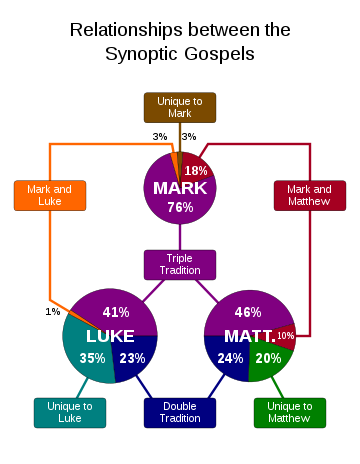
Most of the materials in the three gospels usually fit one of these four categories (triple tradition, double tradition, M, L). But there are four complications, if you will:
M Material in Triple Tradition: Material unique to Matthew embedded in triple tradition material and would make no sense outside of context; for example, Jesus’ conversation with John the Baptist just before His baptism in 3:14-15.
Lukan Triple Tradition: Three pericopes or passages which have parallels in Matthew and Mark and might be described as Lukan versions of triple tradition material (the rejection at Nazareth at 4:16-30; the call of the first disciples at 5:1-11; the anointing of Jesus at 7:36-50).
Not-quite Triple Tradition: Material found in Matthew and Mark but
not in Luke (cf. Matthew 14:34-3; Mark 6:53-56), or in Mark and Luke but
not in Matthew (for example, the woman at the treasury; Mark 12:41-44; Luke 21:1-4). These are not, strictly speaking, triple tradition material since they occur in only two out of the three gospels, but they are akin to triple tradition because they appear in the Markan order.
When Mark is not the middle term: Some material halfway between triple and double tradition. Appears in all three synoptics but unlike triple tradition, features substantial agreement between Matthew and Luke against Mark. Major examples of these are the story of John the Baptist (Matt. 3:11-12; Lk. 3:15-17; cf. Mk. 1:7-8); the temptation (Matthew 4:1-11; Luke 4:1-13; cf. Mark 1:12-13); the Beelzebul controversy (Matt. 12:22-37; Lk. 11:14-23; cf. Mk. 3:22-30); the parable of the mustard seed (Matt. 13:31-32; Lk. 13:18-19; cf. Mk. 4:30-32) and the mission of the disciples (Matt. 10:1-15; Lk. 9:1-6, 10:1-12; cf. Mk. 6:6b-13).
I need to stress again that Mark is often, but not always, the ‘middle term’. Reason for this is, in triple tradition, there are usually substantial agreements between Matthew, Mark and Luke, between Matthew and Mark, and between Mark and Luke. There are only minor agreements between Matthew and Luke against Mark. The order of triple tradition passages and those which are not quite it is usually similar to the Markan order. Matthew and Luke less often agree together in order against Mark.
http://img580.imageshack.us/img580/3347/63594641.png
 )
) ) and Q instead.