Lecture: Mark comes third and last in time among the synoptic Gospels

  • Thread starter Thread starter thomasjj70
  • Start date Start date
Status
Not open for further replies.
You are missing the point here. There are multiple passages in the triple tradition where if Mark condensed or edited Matthew than he would be changing phrasing that would reduce the power of God.
All of these proofs you provide are just failures of the imagination. They are not proof of one gospel coming before the other. We are talking about two different authors with two different audiences. They account for these differences.

Let me explain this one more time:

*MK “Why do you call me good?” no one is good but God alone." *
Mark explains to the Gentiles that “no one is good but God alone” because the Gentiles would have no idea given their understanding of pagan gods. That is why it is there. The same reason Mark has to explain to his audience that rabbi means teacher. It was **not ** a “hard” saying. It was the right saying for the audience.

MT “What do you ask me about what is good? One there is who is good”
As we can see above, since Matthew is writing to the Jews, they already knew about the “One” who is good, because they knew the OT.

DRB Psalms 118:68 “Thou art good; and in thy goodness teach me thy justifications.”

The same explanation resolves this portion:
Matthew: Why do you ask what is good.
Mark: Why do you call me good.

The Jew should already know the “one” who is good, so Jesus says “why do you ask?”\

The Gentile has no idea of God as good, so Jesus says “Why do you call me good” and follows up with the teaching on divine nature “no one is good but God alone”.
 
I’m not breaking down that argument about the Fathers. What is evident is that there was no agreement about the order of the Gospels among the fathers. There may be a lot saying Matthew comes first but there are still fathers who disagree.
  1. Augustine actually didn’t even hold the same theory through his whole life. He first said Matthew Mark Luke than Matthew Luke Mark. If there is such a consensus about the order why would Augustine, the 2nd biggest Catholic Superstar in history, change his mind?
  2. We see at-least two differing opinions before Augustine on this.
  3. When it comes down to it, the Church has not commented on this matter so we are free to believe what we want.
  4. Even if there was a consensus which really isn’t there, it doesn’t solve the major problems Matthean priority presents, I presented one.
  1. Your quote on Augustine just proves my point. He was consistent that Matthew was first. Secondly, Augustine is nearly 200 years after the fathers I am talking about who all agree. Irenaeus, Papias, Origen, Clement, Eusebius etc, etc
2+4) There was unanimous agreement amongst the early Church that Matthew was first. EAST AND WEST. Fathers geographically dispersed all agree. Not a single one says Mark came first.
  1. True, but all of the doctors who have commented on it agree. Matthew first.
  2. I already showed how your so called problem, was not a problem, but rather intentional.
 
You must look at it this way.

You find two copies in the trash of a story, almost word for word with a few minor changes. You assume oh this is two drafts of the same story.

One says all loved Jane for she was very kind to everyone.

the other says many loved Jane because she was very kind to many people.

If the first was the original and second the edit than the edit implies that Jane wasn’t as nice as they made it out to be.

If the second was the original and the first the edit, than it confirms that she was kind to many people.

If we find out that Jane really is loved by everyone, it makes sense that the 2nd is the original and 1st is the edit.
??? I would assume it was an “edit” only if both were both written by the same author. (same handwriting 🙂 )

If they were written by 2 separate people, I would just think they were each expressing true information about Jane in their own way. The main point being the same in both: Jane was kind and loved because of it.
 
Lets think about this question in another way. Why would the first gospel be to the Gentiles when there was obvious confusion in the early church as to their candidacy as Christians to begin with? As St Paul says, “To the Jew first, then to the Greek”. The Gospels would have been no different. Considering the time and expense, would the first Gospel have been written far away in Italy(Mark) rather than near the heart of the mother Church in Judea(Matthew)? Everything we know about scripture and history points to Matthew first. I would also add that if Mark came first, why does the ancient Didache (AD 40-60) reference only Matthew and not Mark?
 
All of these proofs you provide are just failures of the imagination. They are not proof of one gospel coming before the other. We are talking about two different authors with two different audiences. They account for these differences.

Let me explain this one more time:

MK “Why do you call me good?” no one is good but God alone."
Mark explains to the Gentiles that “no one is good but God alone” because the Gentiles would have no idea given their understanding of pagan gods. That is why it is there. The same reason Mark has to explain to his audience that rabbi means teacher. It was **not ** a “hard” saying. It was the right saying for the audience.

MT “What do you ask me about what is good? One there is who is good”
As we can see above, since Matthew is writing to the Jews, they already knew about the “One” who is good, because they knew the OT.

DRB Psalms 118:68 “Thou art good; and in thy goodness teach me thy justifications.”

The same explanation resolves this portion:
Matthew: Why do you ask what is good.
Mark: Why do you call me good.

The Jew should already know the “one” who is good, so Jesus says “why do you ask?”\

The Gentile has no idea of God as good, so Jesus says “Why do you call me good” and follows up with the teaching on divine nature “no one is good but God alone”.
Exactly. And not only were they writing to different audiences (Matthew to Jews, Mark to the Romans, and Luke to the Greeks - and John to catechumens and already baptized Christians), their audiences determine how the authors wanted to show Jesus. Matthew shows Jesus as (a) Son of David (shown primarily in the infancy narrative), but also as (b) the Second Moses (five discourses = five books of the Torah). Mark shows Jesus as having divine power that no one else has (Mark focuses on the miracles of Jesus, leaving out most of His teachings - and Jesus is in quite the hurry in Mark’s gospel, too). Luke was concerned with the universality of the gospel. For every man healed in Luke’s gospel, a woman was healed. For every Jew healed, a Gentile was healed. For Luke, Jesus (and salvation) belong to everyone.

As for John? Well, John’s gospel was (and is) primarily used to (a) teach catechumens (which is why the year A readings for the 3rd, 4th, and 5th Sundays of Lent are used in all years at Masses where the scrutinies are performed), and (b) fight heresy. It is in John’s gospel - and ONLY in John’s gospel - that Jesus is explicitly shown as being God the Son from all eternity. And it is only in John’s gospel that Jesus explicitly uses the divine name “I AM” in reference to Himself. Before John’s gospel was written, adoptionism was a very common heresy. And it’s John’s gospel that has been used to fight gnosticism, Arianism, and a whole host of other heresies. With only the synoptic gospels, actuaully, these heresies could make a whole lot of sense. But it is John’s gospel that emphatically states - Jesus is God the Son made Perfect Man. And that is why the Church Councils have always included the Gospel of John in the canon (and why JW’s have altered the gospel to try to fit their own teachings - which are pretty much renewed Arianism).
 
More than you might suspect.

Matthew’s Gospel is the only one in which Christ bestows on Peter the Keys of the Kingdom. Marcan primacy clearly offers support for discounting the claims for a papal authority which rests on the Peter passage in Matthew absent in Mark.

From this link:

I fail to see how the order in which the gospels were written could have any bearing on the truth/s contained in them. What is said in Matthew is just as true whether he wrote his gospel 1st, 2nd, 3rd, or 4th.

I read the link so I realize that Germany pushed Marcan primacy for the purpose of undermining the authority of the pope. Don’t recall the link giving their actual reasoning as to why and how it would make a difference, but whatever it was it’s amazing that someone would accept it (unless it served their selfish purposes). Why should anyone bother reading anything in the NT except Mark if his are the only words that can be trusted to be true.
 
I fail to see how the order in which the gospels were written could have any bearing on the truth/s contained in them. What is said in Matthew is just as true whether he wrote his gospel 1st, 2nd, 3rd, or 4th.

I read the link so I realize that Germany pushed Marcan primacy for the purpose of undermining the authority of the pope. Don’t recall the link giving their actual reasoning as to why and how it would make a difference, but whatever it was it’s amazing that someone would accept it (unless it served their selfish purposes). Why should anyone bother reading anything in the NT except Mark if his are the only words that can be trusted to be true.
Some people really throw the baby with the bathwater. It’s true that the Kulturkampf (1871-8) made propagandistic use of the Markan priority-Q theory against the Church (since it ostensibly helped negate one of the well-known Catholic proof-texts: Matthew 16:18), but both theories existed even before the Kulturkampf and are originally neutral. It wasn’t invented by Bismarck.

In fact, Markan priority was actually formulated because it was felt that Matthean priority (as represented by Griesbach’s theory) jeopardized the historicity of the gospels. That might sound odd, but during the 18th century, scholars basically had this idea that Matthew was written after the period of the eyewitnesses; so for the people at that time, assuming that Matthew was written first and that the other gospels were based on it was felt to make the historicity of the gospels suspect.

Griesbach’s theory was adopted by the prominent members of the Tübingen school (such as David Strauss and his teacher Ferdinand Christian Baur) to develop their theories which resulted in radical skepticism about the gospels’ historical reliability. That’s why Griesbach’s theory disappeared when the Tübingen school collapsed (until William Farmer resurrected it in the 1960s): it was (unjustly) connected by critics with the hyper-skepticism of the Tübingen school and was summarily dismissed without a fair hearing. Now the reason why Markan priority and the two-source hypothesis came to the fore, Farmer says, was because it satisfied a theological need: over against the Matthean priority proposed by Griesbach’s theory championed by the radical Tübingen school, those who wished to lay claim to the reliability of the gospels championed Mark (because we all know Matthew was late 🤷) and Q instead.
 
Okay, as promised, let me introduce the data.

Triple tradition: Refers to the material shared by Matthew, Mark and Luke. It broadly has the same order across all three gospels, in fact this order tends to be identical with Mark’s, to the point that if you were to isolate triple tradition material in Matthew and Luke you’d end up with a complete gospel generally similar to Mark in structure. Now there are times when Matthew or Luke may occasionally place individual incidents differently, but striking thing about it is that it is rare for both Matthew and Luke to place the same incident differently. Even where Matthew and Luke apparently depart from Mark’s narrative order, they very often both of them end up reverting into agreement with Mark.

Double Tradition: Material found in Matthew and Luke but not in Mark, what adherents of the two-source hypothesis would call ‘Q material’. It is not as numerous as triple tradition material (it’s roughly half the length of triple tradition), but is still substantial to some extent. Double tradition is mainly sayings material (i.e. the Our Father, the Beatitudes) but includes some narratives such as the centurion’s boy/servant (Matthew 8:5-13; Luke 7:1-10) and the testing of Jesus in the desert (Matt. 4:1-11; Lk. 4:1-13) as well. The interesting thing about this material is that you don’t have much of it in a closely parallel order; there is some kind of parallel order, but not the same one you get with triple tradition. The order tends to vary between the two gospels.

Special Matthew (M): Material found only in Matthew. Like double tradition, much of it is sayings material (for instance, the parables in Matthew 25:1-13 and 25:31-46), with a few exceptions (i.e. the temple tax in Matthew 17:24-27). Some of it can also be found embedded within triple tradition material; for instance, Judas’ death (27:3-10) and the brief reference to Pilate’s wife (27:19).

Special Luke (L): Material found only in Luke, usually narrative material like the announcement to Zechariah and John the Baptist’s birth, the Annunciation and Visitation, the boy Jesus in the Temple and the Road to Emmaus, and also saying materials like the parables of the Good Samaritan and the Prodigal Son. Interestingly, Special Luke is notable for containing a greater concentration of Semitisms than any other gospel material.
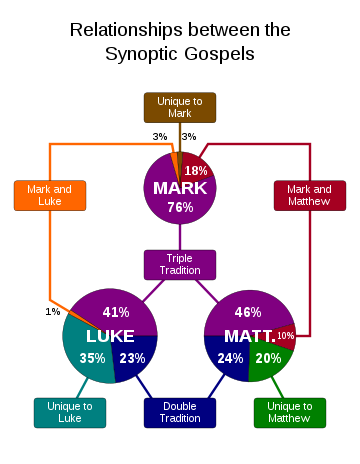


Most of the materials in the three gospels usually fit one of these four categories (triple tradition, double tradition, M, L). But there are four complications, if you will:

M Material in Triple Tradition: Material unique to Matthew embedded in triple tradition material and would make no sense outside of context; for example, Jesus’ conversation with John the Baptist just before His baptism in 3:14-15.

Lukan Triple Tradition: Three pericopes or passages which have parallels in Matthew and Mark and might be described as Lukan versions of triple tradition material (the rejection at Nazareth at 4:16-30; the call of the first disciples at 5:1-11; the anointing of Jesus at 7:36-50).

Not-quite Triple Tradition: Material found in Matthew and Mark but not in Luke (cf. Matthew 14:34-3; Mark 6:53-56), or in Mark and Luke but not in Matthew (for example, the woman at the treasury; Mark 12:41-44; Luke 21:1-4). These are not, strictly speaking, triple tradition material since they occur in only two out of the three gospels, but they are akin to triple tradition because they appear in the Markan order.

When Mark is not the middle term: Some material halfway between triple and double tradition. Appears in all three synoptics but unlike triple tradition, features substantial agreement between Matthew and Luke against Mark. Major examples of these are the story of John the Baptist (Matt. 3:11-12; Lk. 3:15-17; cf. Mk. 1:7-8); the temptation (Matthew 4:1-11; Luke 4:1-13; cf. Mark 1:12-13); the Beelzebul controversy (Matt. 12:22-37; Lk. 11:14-23; cf. Mk. 3:22-30); the parable of the mustard seed (Matt. 13:31-32; Lk. 13:18-19; cf. Mk. 4:30-32) and the mission of the disciples (Matt. 10:1-15; Lk. 9:1-6, 10:1-12; cf. Mk. 6:6b-13).

I need to stress again that Mark is often, but not always, the ‘middle term’. Reason for this is, in triple tradition, there are usually substantial agreements between Matthew, Mark and Luke, between Matthew and Mark, and between Mark and Luke. There are only minor agreements between Matthew and Luke against Mark. The order of triple tradition passages and those which are not quite it is usually similar to the Markan order. Matthew and Luke less often agree together in order against Mark.

http://img580.imageshack.us/img580/3347/63594641.png

 
Note Papias’ statements: “Mark …] wrote down accurately as many things as he recalled from memory—though not in an ordered form—of the things either said or done by the Lord. …] Peter …] used to give his teachings in the form of chreiai, but had no intention of providing an ordered arrangement of the sayings of the Lord.” Which is then followed by: “therefore Matthew put the sayings in an ordered arrangement in the Hebrew language.” As per Watson’s reading, according to Papias, Mark, Peter’s “interpreter,” recorded the latter’s recollections of Jesus, which became our canonical gospel of Mark. )
Thanks Patrick. I read that a bit differently. Mark was writing second hand from memory(“as he recalled from memory”), whereas Matthew was first hand. Therefore, Matthew had the right order, and while Mark was merely episodic.
 
This fact is really the keystone of modern theories about the synoptic gospels: the theories that postulate Markan priority (the two-source/Q hypothesis and the Q-less Farrer-Goulder hypothesis) explains Mark’s being the middle term by thinking that Matthew and Luke drew from Mark, while the theory that postulates Markan posteriority (the Griesbach-Farmer-Orchard/two-gospel hypothesis) explains it by thinking that it was Mark who drew from both Matthew and Luke.

While they both agree in one thing (Markan priority), where the two-source hypothesis and the Farrer-Goulder hypothesis disagree with each other is how to explain double tradition. The reason why two-source hypothesis postulates the existence of Q (or to use its full name, the Logienquelle the ‘logia source’ - it actually gets its name from Papias’ reference to Matthew’s logia) is essentially because it thinks that neither Matthew nor Luke knew of or used each other’s work. The Farrer-Goulder theory renders Q unnecessary by proposing a simpler hypothesis: Luke knew of and relied on Matthew’s work. (A variant has the opposite: Matthew used Luke.) Despite disagreeing whether Mark came first or last, the idea of Luke using Matthew I think this is one of the elements common between Farrer’s theory and Griesbach’s.
 
Thanks Patrick. I read that a bit differently. Mark was writing second hand from memory, whereas Matthew was first hand. Therefore, Matthew had the right order, and while Mark was merely episodic.
You know what? Mark was the least popular gospel among Early Christians.

Going by the numbers of manuscripts we’ve found, we can infer that the most popular early Christian work was John’s gospel (we currently have fifteen manuscripts predating the 4th century). After that comes Matthew (twelve copies), then after the Shepherd of Hermas, Luke-Acts. John and Matthew from early on were the most frequently-used gospels liturgically and in private devotion, not to mention that they were the most frequently-cited gospels by early Christian authors.

By contrast, Mark wasn’t very popular. It wasn’t quoted very much (in fact, it was overall the least-quoted gospel), and whereas Matthew and John were popular candidates for commentaries from early on, you had to wait until the time of St. Bede (8th century) and Theophylact (11th century) for full-length commentaries on the gospel. In fact, we only have a single manuscript of Mark that predates the 4th century: Papyrus 45, from the mid-3rd century. (Now some people from time to time keep claiming to have found a 1st century fragment of Mark, be it from the Dead Sea Scrolls or some mummy cartonnage, but you really have to take these claims with a grain of salt: as the fact that we’ve so far only found one pre-4th century copy of the gospel implies, Mark seems not to have been copied nearly as often as the other NT gospels, so as Larry Hurtado would say: “the statistical chances of any copy surviving are slim, and the chance of fragments of a first-century copy surviving very, very, very slim.”)

Part of its unpopularity was partly because it is overall too similar to Matthew: in fact, it kinda reads like a shorter Matthew, albeit in a more colloquial, ‘bad’ Greek. (No wonder Papias thought Mark was deficient - ‘not in order’.) And partly because the gospels attributed to the apostles are the ones that get all the attention: I think it’s no coincidence that Matthew and John was the most popular of the four gospels. You might say that an apostle trumps a disciple of an apostle. This would explain why St. Augustine simply chalked up Mark as Matthew’s breviator.

And this is where I go back to Watson’s theory for a moment. Of course, even if Watson’s reading is right and that Papias (or John the Elder, who told the story to Papias) actually implied Mark wrote first, that isn’t necessarily an indicator that that was what really happened. For all we know, Papias or rather, the Elder just put out his personal hunch on why the two gospels were very similar, and why one was ‘disorderly’. (But then again, the same could potentially be said for Irenaeus: assuming he made use of Papias, his belief in Matthew writing first may possibly be chalked up to the ‘a disciple cannot trump an apostle’ rule and may not necessarily reflect what really happened.)
 
  1. Your quote on Augustine just proves my point. He was consistent that Matthew was first. Secondly, Augustine is nearly 200 years after the fathers I am talking about who all agree. Irenaeus, Papias, Origen, Clement, Eusebius etc, etc
2+4) There was unanimous agreement amongst the early Church that Matthew was first. EAST AND WEST. Fathers geographically dispersed all agree. Not a single one says Mark came first.
  1. True, but all of the doctors who have commented on it agree. Matthew first.
  2. I already showed how your so called problem, was not a problem, but rather intentional.
You have delt with this issue much more than I have.

Few things here.

There were at-least some differing opinions in the fathers. BTW when there is unanimous agreement among the fathers it is usually doctrine. I’m not saying that is every thing but usually it’s that way.

The Church has no definitively talked about this.

Most Scholars hold Mark came first

Most internal evidence points to Mark writing first than Greek Matthew comes second. I know there is the issue of Hebrew Matthew but the inspired Matthew it appears from my own understanding came after inspired Mark.
 
All of these proofs you provide are just failures of the imagination. They are not proof of one gospel coming before the other. We are talking about two different authors with two different audiences. They account for these differences.
not really

There are two passages that are almost word for word, you have to pay attention to why there are differences.

Let me explain this one more time:
MK “Why do you call me good?” no one is good but God alone."
Mark explains to the Gentiles that “no one is good but God alone” because the Gentiles would have no idea given their understanding of pagan gods. That is why it is there. The same reason Mark has to explain to his audience that rabbi means teacher. It was **not ** a “hard” saying. It was the right saying for the audience.
Mark doesn’t necessarily write to the gentiles, and that doesn’t remove the problem of other passages I brought up.
MT “What do you ask me about what is good? One there is who is good”
As we can see above, since Matthew is writing to the Jews, they already knew about the “One” who is good, because they knew the OT.
DRB Psalms 118:68 “Thou art good; and in thy goodness teach me thy justifications.”
The same explanation resolves this portion:
Matthew: Why do you ask what is good.
Mark: Why do you call me good.
The Jew should already know the “one” who is good, so Jesus says “why do you ask?”\
The Gentile has no idea of God as good, so Jesus says “Why do you call me good” and follows up with the teaching on divine nature “no one is good but God alone”.
This is a possible explanation but this is one in many.

Why does Mark change it from All to Many?

Now I think this evidence is much much more convincing than this who came first in editing. Simply editorial fatigue. Which I believe simply shows that Matthew copied many things from Mark. If Mark doesn’t come first than this is just bad writting.

Let’s compare Mark 1:40-45 and Matthew 8 1-4.

Matthew begins “when he came down from the mountain great crowds followed him.” This is directly after the sermon on the mount.

Mark gives no context

Story goes on Matthew says some things that Mark doesn’t and visa versa. Pay attention to v 44 in Mark and v 5 in Matthew

It is identical (In greek too) See that you say nothing to anyone; but go show yourself to the priest.

Now Mark this fits perfectly Jesus isn’t with the crowds he could say don’t tell anyone.

But why would Jesus say don’t tell anyone when crowds were following him down the mountain?

There is one other one that isn’t as convincing as that story but still proves the point. Mark calls herod a king, Matthew calls Herod a tetrarch, but later in the passage, Matthew falls back into calling him king.

I’ve done the best job I’ve could trying to argue this. You aren’t bound to hold either side, I’m just trying to present why I believe that Mark came first Matthew Second. I don’t see any point in trying to create division among good faithful Catholics on a small point like priority of Gospels.

God Bless.
 
One last thing, The Gospel writers didn’t only write to certain audiences. They were very mobile they preached and wrote in many different places around that area. Maybe Mark more often wrote to gentiles, but don’t put him in a box that we have to read Mark as if he was reading to the gentiles.

Also dates are very wide ranged. We don’t assume Mark wrote the Gospel of Mark, we believe his name is attributed to it and it is very reasonable that Mark had a large impact on it. But just because Mark was further away doesn’t mean he must write second.

Look at Paul he traveled a lot. Keep in mind we know very little about the Gospel writers themselves, they don’t really even mention themselves that much, well maybe other than John who is the beloved disciple. But don’t think that Mark necessarily wrote in one place. Same goes with Matthew and Luke.

What is most important is to look at what we have and that is the internal evidence present in the bible. There is far from anything conclusive about the history of these men to say based on this historical fact Matthew must have come first.

I don’t think there is consensus in the fathers, at-least not enough to ignore interior evidence. Papius our earliest source from the 2nd century holds Mark first.
 
Papius our earliest source from the 2nd century holds Mark first.
No. Actually, he affirms Matthew like all the others. Papias makes excuses for Mark being accepted, but he doesnt for Matthew… because it already was.
 
I need to introduce a three things to keep in mind first. (I’ll follow up later.)

Markan priority does NOT equal two-source (Q) hypothesis. It’s a common mistake perpetrated even by Q adherents to use ‘two-source hypothesis’ interchangeably with ‘Markan priority’, but in reality the theory of Markan priority is actually just only a side element of the Q theory. These are two independent, different theories developed at different times that were only joined together later. The two-source hypothesis relies on Markan priority, that’s true, but disproving the existence of the phantom Q or Logienquelle does not necessarily disprove Markan priority. (cf. the Farrer-Goulder hypothesis)

(I know nobody has directly invoked this yet, but in the event that it comes up) The ‘Kulturkampf’ argument against Markan priority and the two-source hypothesis should really be laid to rest. It’s bad argumentation and is throwing the baby with the bathwater. “The two-source hypothesis and Markan priority are bad because the Kulturkampf promoted (note: not invented, as some people claim; both hypotheses were ‘already there’ when Bismarck appropriated them for his own purposes) them to target Catholicism and cast doubt on the Petrine passages on Matthew’s gospel” is really like saying “Guns are bad because they are used by criminals to threaten and kill people.” But it’s not a gun’s fault that it was used to kill somebody; we don’t sentence guns to jail. The blame lies on the criminal who used it.

Just saying “most current scholars hold Mark came first” or “early Christians held Matthew came first” doesn’t really prove anything. One needs to learn and take into account first why early Christians claimed Matthew was first, and why many modern scholars find Markan priority convincing. This is where I admit I find both sides to be just engaging in arguments from authority: ‘Mark is first because modern scholar A said so.’ ‘Matthew is first because early Christian author B said so.’ It really gets you nowhere.
 
Why does Mark change it from All to Many?
Its a distinction without a difference. Did you notice that our liturgy went form “for many” to “for all” to “for many” in the last generation.
Let’s compare Mark 1:40-45 and Matthew 8 1-4.
Matthew begins “when he came down from the mountain great crowds followed him.” This is directly after the sermon on the mount.
Mark gives no context
Story goes on Matthew says some things that Mark doesn’t and visa versa. Pay attention to v 44 in Mark and v 5 in Matthew
It is identical (In greek too) See that you say nothing to anyone; but go show yourself to the priest.
Now Mark this fits perfectly Jesus isn’t with the crowds he could say don’t tell anyone.
But why would Jesus say don’t tell anyone when crowds were following him down the mountain?
It was a leper colony. Do you think the crowd was crazy enough to follow him right into a leper colony? No, he could have a private conversation with the leper while the crowd was at a safe distance. It fits perfectly.
There is one other one that isn’t as convincing as that story but still proves the point. Mark calls herod a king, Matthew calls Herod a tetrarch, but later in the passage, Matthew falls back into calling him king.
And I could ask, why Mark does not use both? That is not evidence of fatigue. Unless you also say the different titles given to Jesus in those Gospels were editorial fatigue too. they were intentional.
 
I need to introduce a three things to keep in mind first. (I’ll follow up later.)

Markan priority does NOT equal two-source (Q) hypothesis. It’s a common mistake perpetrated even by Q adherents to use ‘two-source hypothesis’ interchangeably with ‘Markan priority’, but in reality the theory of Markan priority is actually just only a side element of the Q theory. These are two independent, different theories developed at different times that were only joined together later. The two-source hypothesis relies on Markan priority, that’s true, but disproving the existence of the phantom Q or Logienquelle does not necessarily disprove Markan priority. (cf. the Farrer-Goulder hypothesis)
I disagree with Q FYI
Just saying “most current scholars hold Mark came first” or “early Christians held Matthew came first” doesn’t really prove anything. One needs to learn and take into account first why early Christians claimed Matthew was first, and why many modern scholars find Markan priority convincing. This is where I admit I find both sides to be just engaging in arguments from authority: ‘Mark is first because modern scholar A said so.’ ‘Matthew is first because early Christian author B said so.’ It really gets you nowhere.
I know I’ve dropped this line but I have also used textual evidence to back up what I’m saying.

I’ve listed multiple
  1. Mark adds no tradition if he simply copies Matthew and Luke, every Gospel writer did that in their Gospel.
  2. Mark is longest of Triple Tradition, which would appear to point to, Mark wrote first and Matthew and Luke condensed. Not necessarily though.
  3. For the most part, differences in the triple tradition make more sense when mark write first.
  4. Editorial Fatigue only happens in Matthew and Luke, which very strongly points to Mark writing first.
I’ll leave it for the night at this.

I’m just repeating what I have heard and have been taught. The only way you can really speak definitively on this is if you take the time to actually color code a synopsis. This is an overly complex issue and isn’t something even graduate students in theology can fully grasp. I’m doing my best to present my understanding, which comes from a scholar I know who is pretty knowledgeable on this subject. He could be wrong, but from the little I’ve done on this, it appears to be Markan priority not Matthean.
 
Just saying “most current scholars hold Mark came first” or “early Christians held Matthew came first” doesn’t really prove anything. One needs to learn and take into account first why early Christians claimed Matthew was first, and why many modern scholars find Markan priority convincing.
Yeah, you are right.
 
Its a distinction without a difference. Did you notice that our liturgy went form “for many” to “for all” to “for many” in the last generation.

It was a leper colony. Do you think the crowd was crazy enough to follow him right into a leper colony? No, he could have a private conversation with the leper while the crowd was at a safe distance. It fits perfectly.
.
quickly on the Many thing. We didn’t change for all to for many. We changed how we translated the same word. In the Gospel account mentioned, one said All one said Many.

You are misreading the story, the leper came to Christ, not the other way around. You are reading something into the story that isn’t there in order to defend your position.

This is how Matthew portrays the story. Jesus is walking down the mountain after teaching on the beatitudes, a large crowd is following him. While he is walking a leper comes up and asks Christ to heal him. The Crowd will clearly see what is going on, sure they may back away but they see what is going on. Why would Christ tell the leper, tell no-one when thousands of people just witnessed him healing a leper. Keep in mind lepers are visible ill, and if he was healed it is almost certain that his appearance would change.

Your attempt is putting something into the story that isn’t there. Jesus goes into a leper colony and the crowd doesn’t see it happen.

Editorial fatigue makes more sense. Matthew takes a story from Mark, and puts it after the sermon on the mount. So a crowd is following him and he does this miracle. Than suddenly he says don’t tell anyone when thousands of people just saw him do it.
 
Status
Not open for further replies.
Back
Top