
Mary Is Sinless: 5 Biblical Reasons (New Apologetics Video)

  • Thread starter Thread starter jas84173
  • Start date Start date
Status
Not open for further replies.
Mary Thought Jesus Was Insane!
(Mark 3:20-35)

Falling short of the glory of God in being a sinner, even includes Mary. A sinner meaning a spiritually lost person. In fact, a little-known and shocking truth about Mary, the Mother of Jesus, is what you are about to be shown from the Scriptures (Mark 3:20-35). Please consider the evidence. It is indeed the message of the word of God. This is what happened, even though Mary is presented much differently, even sinless:
Mark 3:20,21Then Jesus entered a house, and again a crowd gathered, so that he and his disciples were not even able to eat. When his family heard about this, they went to take charge of him, for they said, “He is out of his mind.” (Mark 3:20, 21)
Those are extremely important verses to focus in upon for they shockingly declare that Jesus’ natural family thought he was out of his mind, that is, insane! (Who is included in the family will be revealed in verse 31.)
Mark 3:22-31And the teachers of the law who came down from Jerusalem said, “He is possessed by Beelzebub! By the prince of demons he is driving out demons.” So Jesus called them and spoke to them in parables: “How can Satan drive out Satan? If a kingdom is divided against itself, that kingdom cannot stand. If a house is divided against itself, that house cannot stand. And if Satan opposes himself and is divided, he cannot stand; his end has come. In fact, no one can enter a strong man’s house and carry off his possessions unless he first ties up the strong man. Then he can rob his house. I tell you the truth, all the sins and blasphemies of men will be forgiven them. But whoever blasphemes against the Holy Spirit will never be forgiven; he is guilty of an eternal sin.” He said this because they were saying, “He has an evil spirit.” Then Jesus’ mother and brothers arrived. Standing outside, they sent someone in to call him. (Mark 3:22-31)
Just curious, dreath: have you ever called Mary “blessed”, in fulfillment of her prophecy in Luke 1?

All generations are going to call her blessed.
 
Mary Thought Jesus Was Insane!
(Mark 3:20-35)

Falling short of the glory of God in being a sinner, even includes Mary. A sinner meaning a spiritually lost person. In fact, a little-known and shocking truth about Mary, the Mother of Jesus, is what you are about to be shown from the Scriptures (Mark 3:20-35). Please consider the evidence. It is indeed the message of the word of God. This is what happened, even though Mary is presented much differently, even sinless:
Mark 3:20,21Then Jesus entered a house, and again a crowd gathered, so that he and his disciples were not even able to eat. When his family heard about this, they went to take charge of him, for they said, “He is out of his mind.” (Mark 3:20, 21)
Those are extremely important verses to focus in upon for they shockingly declare that Jesus’ natural family thought he was out of his mind, that is, insane! (Who is included in the family will be revealed in verse 31.)
Mark 3:22-31And the teachers of the law who came down from Jerusalem said, “He is possessed by Beelzebub! By the prince of demons he is driving out demons.” So Jesus called them and spoke to them in parables: “How can Satan drive out Satan? If a kingdom is divided against itself, that kingdom cannot stand. If a house is divided against itself, that house cannot stand. And if Satan opposes himself and is divided, he cannot stand; his end has come. In fact, no one can enter a strong man’s house and carry off his possessions unless he first ties up the strong man. Then he can rob his house. I tell you the truth, all the sins and blasphemies of men will be forgiven them. But whoever blasphemes against the Holy Spirit will never be forgiven; he is guilty of an eternal sin.” He said this because they were saying, “He has an evil spirit.” Then Jesus’ mother and brothers arrived. Standing outside, they sent someone in to call him. (Mark 3:22-31)
I’m confused by your “proof” that Mary called Jesus insane. Because it says that His “family” called him possessed.
“Who is included in the family will be revealed in verse 31”
…Yeah, it IS revealed. To be everyone EXCEPT His mother and His brothers. Because in verse 31, they’re only just arriving at the house - “Then Jesus’ mother and brothers arrived.”

So…yeah, I don’t know what your argument is.
 
The translation that I read is “The child will not share the guilt of the parent.”
In my private interpretation and from looking at the context, it seems that the word guilt is used to indicate that if the parent sins, then the child will not be judged guilty of that sin.
“20 The one who sins is the one who will die. The child will not share the guilt of the parent, nor will the parent share the guilt of the child. The righteousness of the righteous will be credited to them, and the wickedness of the wicked will be charged against them.”
The meaning of this passage is that the guilt of the parents shall not be imputed to their children. But that doesn’t mean the children might not be implicated in their parents’ guilt. There is a difference between being guilty and being implicated in the guilt of another because of sin. Recall the Babylonian captivity and exile of the Jews because of the sins of the people as a whole. The deportation included innocent children and the faithful remnant who unfortunately had to suffer because of the sins of the unfaithful. God permitted many young children to be slaughtered during the siege of Jerusalem that was meant to serve as a judgment against their parents for their sins. We find ourselves in a similar situation by being born in a state of exile, viz., original sin, because of the sins of our primordial parents Adam and Eve. Although their personal guilt isn’t imputed to us, we still must suffer and die on account of their sins inasmuch as we are their biological descendants.

Therefore, just as through one person sin entered the world, and through sin, death, and thus death came to all, inasmuch as all sinned. For if, by the transgression of one person, death came to reign through that one, how much more will those who receive the abundance of grace and of the gift of justification come to reign in life through the one person Jesus Christ. In conclusion, just as through one transgression condemnation came upon all, so through one righteous act acquittal and life came to all. For just as through the disobedience of one person the many were made sinners, so through the obedience of one the many will be made righteous.
Romans 5, 12, 17-19

Original sin is a sin contracted, not a sin committed. As descendants of Adam, we, too, are inclined to sin, though we don’t have a “sin nature”. And because we do have the potential to sin, and do in fact sin, death has entered the world on account of this human condition of ours. We are no different from our universal father Adam. This natural state of ours, original sin, deprives us of our justification and sanctity when we are conceived. And in this state of spiritual deprivation, we are born, regardless of whether we have actually committed any personal sins. Even infants suffer and die because of their implication in Adam’s guilt, though they haven’t committed any personal sins. But they do have the potential to sin. This potential or inclination to sin renders us having “fallen short of the glory of God”. We are baptized so that we can retrieve the original justice and sanctity which our father Adam first forfeited and which was originally a part of our inheritance. Thus, God exempted Mary from having to lose her share of the original inheritance when He sanctified her soul upon conception and preserved her free from the effects of original sin: concupiscence of the eyes, concupiscence of the flesh, and the pride of life.

PAX
:heaven:
 
no child bears the iniquity of his or her parents (Ezekiel 18:20). If it were necessary for Mary to have been sinless, in the absolute sense of the word, in order to have a sinless child, then sinlessness also would be required of Mary’s parents, in order to conceive a “sinless” Mary. In turn, all Mary’s ancestors logically would have had to meet the same requirement.
Agreed. It’s a silly argument for the Immaculate Conception.
 
Agreed. It’s a silly argument for the Immaculate Conception.
Did you mean to include agreeing to the part about “no child bearing the iniquities of his parents”?

For that certainly can’t be true.

All we have to do is look at Fetal Alcohol Syndrome to know that many children do indeed bear the iniquites of their parents.
 
The meaning of this passage is that the guilt of the parents shall not be imputed to their children. But that doesn’t mean the children might not be implicated in their parents’ guilt. There is a difference between being guilty and being implicated in the guilt of another because of sin. Recall the Babylonian captivity and exile of the Jews because of the sins of the people as a whole. The deportation included innocent children and the faithful remnant who unfortunately had to suffer because of the sins of the unfaithful. God permitted many young children to be slaughtered during the siege of Jerusalem that was meant to serve as a judgment against their parents for their sins. We find ourselves in a similar situation by being born in a state of exile, viz., original sin, because of the sins of our primordial parents Adam and Eve. Although their personal guilt isn’t imputed to us, we still must suffer and die on account of their sins inasmuch as we are their biological descendants.

Therefore, just as through one person sin entered the world, and through sin, death, and thus death came to all, inasmuch as all sinned. For if, by the transgression of one person, death came to reign through that one, how much more will those who receive the abundance of grace and of the gift of justification come to reign in life through the one person Jesus Christ. In conclusion, just as through one transgression condemnation came upon all, so through one righteous act acquittal and life came to all. For just as through the disobedience of one person the many were made sinners, so through the obedience of one the many will be made righteous.
Romans 5, 12, 17-19

Original sin is a sin contracted, not a sin committed. As descendants of Adam, we, too, are inclined to sin, though we don’t have a “sin nature”. And because we do have the potential to sin, and do in fact sin, death has entered the world on account of this human condition of ours. We are no different from our universal father Adam. This natural state of ours, original sin, deprives us of our justification and sanctity when we are conceived. And in this state of spiritual deprivation, we are born, regardless of whether we have actually committed any personal sins. Even infants suffer and die because of their implication in Adam’s guilt, though they haven’t committed any personal sins. But they do have the potential to sin. This potential or inclination to sin renders us having “fallen short of the glory of God”. We are baptized so that we can retrieve the original justice and sanctity which our father Adam first forfeited and which was originally a part of our inheritance. Thus, God exempted Mary from having to lose her share of the original inheritance when He sanctified her soul upon conception and preserved her free from the effects of original sin: concupiscence of the eyes, concupiscence of the flesh, and the pride of life.

PAX
:heaven:
Did Mary suffer at all in life, especially when she was at the Crucifixion? Was she ever ill or have a cold?
 
Did you mean to include agreeing to the part about “no child bearing the iniquities of his parents”?

For that certainly can’t be true.

All we have to do is look at Fetal Alcohol Syndrome to know that many children do indeed bear the iniquites of their parents.
I only intended to comment on saying Mary needed to be sinless for Jesus to be sinless to be a silly argument for the IC.
 
Did Mary suffer at all in life, especially when she was at the Crucifixion? Was she ever ill or have a cold?
Mary suffered and died as much as Jesus had, though he was without sin. Suffering and death have redemptive value in and through the merits of Christ, who suffered and died for our sins by his love for us. Although suffering and death have entered the world inasmuch as we sin, these evils now serve as temporal means of reparation for our sins for the attainment of our salvation. Without suffering, and, of course dying, no soul can get to heaven. We must pick up our cross after Jesus if we hope to follow him. If we truly love Jesus, we will bear our crosses joyfully in patience and fortitude, and with moral courage.

He was wounded for our transgressions, He was bruised for our iniquities; The chastisement for our peace was upon Him, And by His stripes we are healed.
Isaiah 53, 5


Although Jesus and Mary suffered, they weren’t punished because of sin. Their sufferings were all part of God’s plan of redemption. They were required to suffer to reciprocally undo the sin of Adam and Eve. Only by their suffering could the Father be propitiated for the sins of the world. With respect to Mary, she suffered interiorly for her love of God, whom sin offended, her love of the Son, who died because of sin, and her love of humanity, which sin had ravaged. Mary’s sorrow, therefore, made temporal satisfaction to God for our sins. She didn’t suffer as a result of being selfish (the essence of original sin), but because of her love. Her charity in grace merited temporal satisfaction for our sins. Our Lady wasn’t chosen to be the mother of our Lord simply to provide his humanity, but also, and more importantly, to experience a mother’s anguish because of sin. To make temporal satisfaction to God for our sins, we must offer Him something back that pleases Him more than any sin of ours displeases him. And this must involve pain or loss to counteract vain pleasure and selfish gain. The equity of justice cannot be restored any other way. Mary’s suffering in charity and grace outweighed the offenses against God because of sin and thereby appeased His wrath. Suffice it to say, neither Jesus nor Mary were subjected to the moral ill-effects of original sin, while the physical temporal punishments of ours which they had to bear served a moral and spiritual purpose.

Now, why art thou drawn together with grief? Hast thou no king in thee, or is thy counsellor perished, because sorrow hath taken thee as a woman in labour?
Micah 4, 9


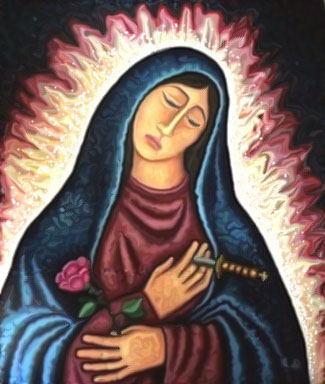
And Simeon blessed them, and said to Mary his mother: Behold this child is set for the fall, and for the resurrection of many in Israel, and for a sign which shall be contradicted: And thy own soul (heart) a sword shall pierce, that, out of many hearts, thoughts may be revealed.
Luke 2, 35

The Greek translation for “and a sword shall pierce your own soul” is ψυχὴν διελεύσεται ῥομφαία. The nominative noun ῥομφαία (a sharp blade) can be taken both literally and figuratively. Thus we have a play on words in this verse. Just as the Son’s body was pierced by a sharp blade when the soldier struck his side with his spear, so also should the Mother’s soul or heart be pierced by a sharp blade. Luke’s message is clear: God desired Mary to participate in her Son’s suffering to complete His plan, though Christ’s suffering alone was more than sufficient to make reparation for the sins of the world. The nominative noun is a metaphor for the shared anguish of the Son and the Mother which was required for our redemption. What Jesus merited in strict justice, Mary merited by her maternal right and friendship with God. Unless the Mother would make temporal satisfaction for the world’s sins against God, the Son would not make eternal satisfaction. So that the hearts of many shall be revealed, a sword should pierce Mary’s heart. Mary’s participation cannot be excluded. The new Adam did not wish to hang on the cross without the new Eve standing beneath it. This truth is emphasized by the juxta-positioning of the Son’s external suffering and the Mother’s internal suffering within verses 34-35.

The curse Eve brought upon herself and all women by her sin, that she give birth to children in pain, did not apply to Mary only because she was exempted from contracting original sin (Isaiah 66:9), but also because the pain she had to suffer for the redemption of the world should be because of her Son’s death. Mary gave birth to the one who is the ultimate remedy for all sin, so he couldn’t have caused the punishment his mother may have had to endure because of sin. Not if she is the new Eve. From the cross, Jesus called his mother “Woman” when giving her to the disciple to be his mother from then on. Adam referred to his wife as woman before she fell from grace. From that point on, he called her Eve, which means “mother of all the living.” Jesus referred to his mother as the mother of all who are regenerated unto God - our spiritual mother who never fell from God’s grace.


I pray therefore that you may not lose heart over my sufferings for you; they are your glory.
Ephesians 3, 13


:heaven:
 
I heard Catholic apologist Tim Staples once explain on Catholic Answers Live that Jesus was fully God and also fully man. He inherited his divine nature from God. He inherited his human nature from Mary. Since Jesus is sinless and he inherited his human nature from Mary, Mary could not have been tainted by sin or else Jesus would have inherited his mother’s sinful human nature from her, which would not have made him divine.

That’s how I understood it, anyway. In other words, I think Catholics believe that Mary was born sinless because of who Christ is, not because Catholics are trying to turn Mary into a goddess or anything like that.
Bingo–in fact all of the things that we say about Mary that seem to bother non-Catholics are not as much about Mary, but rather a statement about who Jesus Christ is (e.g. “Mother of God” is about refuting the Nestorian heresy).

Basically, the Immaculate Conception is possible because God is not bound by time, so He can treat something “future” as “past” or “present” and the effect can therefore come before the cause (from a merely human perspective).
 
The rest of us are made “immaculate” not in the same way as Mary, but by the sacraments of Baptism and Reconciliation. But, sadly, we regress by our sins and need that regular reconciliation.
 
in a previous post, I referred to the encyclopedia entry on this website for information.

Then, I read it myself.

The IC is a theological concept, not based on scripture.

But, an interesting insight about her sinlessness in her life is given there, as follows, based on the verse that says there will be enmity between her and her seed, and satan:

Only the continuous union of Mary with God by grace explains sufficiently the enmity between her and Satan.

The Proto-evangelium [Gen 3:15] , therefore, in the original text contains a direct promise of the Redeemer, and in conjunction therewith the manifestation of the masterpiece of His Redemption, the perfect preservation of His virginal Mother from original sin
 
Paul was very emphatic about this subject: “For all have sinned and fall short of the glory of God” (Romans 3:23, emp. added). Paul allowed no exceptions. He wrote that all have sinned. There is no doubt that the word “all” includes Mary. Paul agreed with the psalmist’s inspired assessment of humanity: “There is none righteous, no, not one” (Romans 3:10; cf. Psalms 14:3; 53:1-3). But if Mary never committed sin, the text should read: “There is none righteous, except Mary.
This poster, now banned, misunderstands Romans 3:23.

I don’t want anyone to be mislead by this post, so here is the response:

For All Have Sinned
A Refutation of the Attack on the Immaculate Conception of Mary from Romans 3:23

(Based on a talk by Karlo Broussard on Catholic Answers Live on 2/11/08)

Many people reject the Catholic doctrine of the Immaculate Conception and argue that Mary was not born sinless and that she did not remain sinless all of her life. In support of their position, they often quote a passage from Paul’s Letter to the Romans which declares, “for all have sinned and fall short of the glory of God.” (Romans 3:23)

However, does this passage really prove that Mary could not have been without sin? And is this really what Paul intended to teach in this passage? Let’s take a closer look.

The primary question to be asked concerning Romans 3:23 is this: When the Bible uses the word “all”, does it necessarily exclude exceptions? The answer is “no” as several scripture passages suggest.

For example, Matthew 3:5 tells us, “People went out to him from Jerusalem and all Judea and the whole region of the Jordan.” Does this mean that there were no places from which people did not go out to see Jesus? This is not likely. The author attempted to convey an idea that a large number of people went out to see Jesus by using hyperbole.

Similarly, 1 Corinthians 15:22 says, “For as in Adam all die, so in Christ all will be made alive.” Does this mean that every single person ever born will die? Well, the Bible tells us that Enoch and Elijah were taken up into heaven without dying, so we know that obviously not all die because these two exceptions exist. From this, we know that the Bible does not necessarily exclude exceptions when it uses the word, “all”.

Returning to Romans 3:23, we should ask further whether Paul intended to exclude exceptions when he used the word, “all”, or is he using it in a non-absolute way? To understand the context of Paul’s thought, we should look at Romans 3:10-12 wherein he quotes Psalm 14:2-3: “As it is written: “There is no one righteous, not even one; there is no one who understands, no one who seeks God. All have turned away; they have together become worthless; there is no one who does good, not even one.”

Does Paul really believe that there no righteous people? Of course not! The Bible tells us that Joseph was a just man (Mt 1:19), John the Baptist’s parents, Zechariah and Elizabeth, were declared righteous (Luke 1:19), and Psalm 14 goes on to speak of “the company of the righteous” in verse 5 while Psalm 15 references those who walk blamelessly and do what is right. So, if Paul is using the word “all” to mean “absolutely no exceptions”, then he is using the word very differently from the verses he quoted from Psalm 14 and from other passages of scripture.

Finally, it is also reasonable for us to assume that Paul would agree that infants and those who are mentally deficient cannot sin personally—two additional exceptions to the concept of “all” having sinned.

Therefore, when Paul uses the word, “all”, it is obvious that he is not attempting to declare that every single individual who ever lives will be guilty of committing personal sin; rather, he is attempting to communicate with clarity the universality of sin and the idea that both Jews and Gentiles alike are sinners before God. He is not attempting to exclude the possibility of exceptions.

Thus, the word “all” in Romans 3:23 cannot be used to disprove the doctrine of sinlessness of Mary.
 
Like every other person ever born, Mary was born without any kind of original sin; (2) like every other person ever born (apart from Jesus Christ), Mary was not exempt from sin and its consequences; and (3) like every other person ever born (apart from Jesus Christ), Mary was in need of a Savior. These biblical facts do not minimize the importance of Mary’s role in fulfilling God’s divine plan to save man. Because of her godly life, God chose this particular young Jewish virgin to bring forth the Messiah. However, she was not sinless. Throughout history, God has used ordinary, imperfect men and women to accomplish extraordinary things, bringing them closer to “perfection” through His Son, Jesus Christ.
Again, although this person has been banned, I do not wish to leave these errors hanging for others to stumble over.

I posted the correct understanding of Mary’s need for a savior in post #17 above. 👍
 
Mary suffered and died
This is an objection that some Eastern Orthodox and others have with regard to the Immaculate Conception. Suffering and death are a result of original sin. If Mary did not have any stain of original sin, why did She experience the effects of that sin?
 
Some Orthodox traditions (not all) explain that mortality is the only consequence of original sin. Thus, hunger, suffering, and other things that come from being mortal are what so easily drive us to sin today. For these Orthodox, I imagine the Immaculate Conception makes little sense.

The CC’s teaching on original sin is different. Immortality was a preternatural gift we had prior to original sin. However, the primary consequence is instead the loss of the original holiness and justness in which God created us, which left us susceptible to concupiscence. Sin created a spiritual deadness and disunion from God as the primary consequence. Mary was not deprived of the original holiness and justness man was created with, and she was in union with God all her life. Still, she was not necessarily given immortality.
 
This is an objection that some Eastern Orthodox and others have with regard to the Immaculate Conception. Suffering and death are a result of original sin. If Mary did not have any stain of original sin, why did She experience the effects of that sin?
I thought I had already answered your question. Jesus suffered and died as well, but he was exempted from contracting original sin. Jesus suffered and died to redeem the world, and Mary was associated with him in his redemptive work. Suffering and death are conditions that have resulted from original sin, but these evils didn’t apply as forms of punishment to Jesus and Mary. Moreover, Jesus had to first die to be the first-fruit of the resurrection, and Mary died, too, to have a share in it with him. But she didn’t have to die because of sin no more than Jesus had to. In private revelations to saints and mystics, Mary said she chose to die to perfectly emulate her Son. She wasn’t assumed body and soul into heaven while still alive. She humbly owned that she wasn’t greater than her Son. Apparently, Jesus had given her options to choose between.

PAX
:heaven:
 
Status
Not open for further replies.
Back
Top