New Metropolitan for Ruthenians

  • Thread starter Thread starter ciero
  • Start date Start date
Status
Not open for further replies.
Since the pattern has been to install an existing bishop as Metropolitan, it will most likely be William who outranks his two peers in order of installation as a bishop. Liturgical experience seems to count very little in mattters regarding selection of bishops. It will be interesting to see who is elevated as the next bishop of Passaic if that is the case.

It is almost impossible that a non seated bishop or priest would be elevated to Metropolitan.
 
If the next Metropolitan is to come from the other three bishops, my personal choice would be Bishop John. However, not my will but the Lord’s be done.
 
My first thought was Father Jack Custer, but I can’t say I really know.
Many years ago, before my ordination, I had the pleasure of sitting at a Thanksgiving dinner one year with Msgr. Alan and Rev. Richard, both of Blessed Memory, of the Eparchy of Passic. At that dinner Fr. Richard said, when we were discussing who was going to be named as a new bishop for another eparchy, “Do you honestly expect a bunch of loosers to finally pick a winner?” I think in Father Jack’s case, those words still ring true. I know Fr Jack and he would be an excellent choice…so we could probably count him out.
 
OB: I am not sure who it is, precisely, that you are implying to be “losers”, and really don’t want to know. But what a lovely first post.:rolleyes:
 
Am I correct in assuming that RDL means “Revised Divine Liturgy”? I haven’t had the chance to visit the local Ruthenian mission here in St. Louis, but I plan to as soon as possible. Could anyone tell me what to expect? This is their website:

stlouis.byzcath.org/
 
Am I correct in assuming that RDL means “Revised Divine Liturgy”?
Yes, around the net in Byzantine Catholic circles ‘RDL’ is readily taken as an acronym for the Revised Divine Liturgy.

I left before it was implemented, so I have no real experience with it except that we started to implement the music early. I have met professor J. Michael Thompson a couple of times because he would regularly come to Chicago and visited the parish to give us a seminar. He also attended Orthodox events where I have run into him.

I had always thought that it (RDL) was going to be a positive thing, and when the hoopla started I could only observe from outside with comments from acquaintances in town and over the internet. It seems to have grown from aggravation over implementing the chant to a serious objection over the translation of the text (some gender neutral phrasing, I guess), coupled with some changes (minor or major, I will not be able to say) to the rubrics.

One interesting introduction, was the ‘Vesperal Divine Liturgy’, which seems to be something designed to accommodate the ‘Saturday night Mass’. Essentially the night before a holy day should have a Vespers (and in fact, attendance at vespers satisfies one’s Sunday obligation if an Eastern Catholic, but not an Orthodox) but the Divine Liturgy is normally the next day as a separate event.

There were some abbreviations, particularly of the litanies which most people really love. I think the Prayer of the Catechumans was deleted and the priests ‘silent prayers’ are now taken aloud. *

Some netizens have complained that this is a Novus Ordo for the Divine Liturgy of St John Chrysostom.

My position (having already left for theological reasons) was that something like this by itself could not possibly be a valid reason to quit the Catholic church. But it apparently was enough reason for some to begin considering it, there was a lot of noise over it.

One of the more serious alleged repercussions with the RDL seems to be that the new translation does more to unnecessarily differentiate the Ruthenian Metropolia from other Eastern Catholic and Orthodox churches. In a way, designed to make sure it is too unique to disappear into a larger more successful church (the threat of being swallowed up by the UGCC seems all too real). Perhaps that is just internet inspired urban legend.
Could anyone tell me what to expect?
I think that if you have already attended an Orthodox parish, don’t hold your expectations too high.

It should be pleasant.*

 
Am I correct in assuming that RDL means “Revised Divine Liturgy”?
Yes, around the net in Byzantine Catholic circles ‘RDL’ is readily taken as an acronym for the Revised Divine Liturgy.

I left before it was implemented, so I have no real experience with it except that we started to implement the music early. I have met professor J. Michael Thompson a couple of times because he would regularly come to Chicago and visited the parish to give us a seminar. He also attended Orthodox events where I have run into him.

I had always thought that it (RDL) was going to be a positive thing, and when the hoopla started I could only observe from outside with comments from acquaintances in town and over the internet. It seems to have grown from aggravation over implementing the chant to a serious objection over the translation of the text (some gender neutral phrasing, I guess), coupled with some changes (minor or major, I will not be able to say) to the rubrics.

One interesting introduction, was the ‘Vesperal Divine Liturgy’, which seems to be something designed to accommodate the ‘Saturday night Mass’. Essentially the night before a holy day should have a Vespers (and in fact, attendance at vespers satisfies one’s Sunday obligation if an Eastern Catholic, but not an Orthodox) but the Divine Liturgy is normally the next day as a separate event.

There were some abbreviations, particularly of the litanies which most people really love. I think the Prayer of the Catechumans was deleted and the priests ‘silent prayers’ are now taken aloud. *

Some netizens have complained that this is a Novus Ordo for the Divine Liturgy of St John Chrysostom.

My position (having already left for theological reasons) was that something like this by itself could not possibly be a valid reason to quit the Catholic church. But it apparently was enough reason for some to begin considering it, there was a lot of noise over it.

One of the more serious alleged repercussions with the RDL seems to be that the new translation does more to unnecessarily differentiate the Ruthenian Metropolia from other Eastern Catholic and Orthodox churches. In a way, designed to make sure it is too unique to disappear into a larger more successful church (the threat of being swallowed up by the UGCC seems all too real to some people, including apparently bishops). Perhaps that is just internet inspired urban legend.
Could anyone tell me what to expect?
I think that if you have already attended an Orthodox parish, don’t hold your expectations too high.

It should be pleasant.*
 
Since the pattern has been to install an existing bishop as Metropolitan, it will most likely be William who outranks his two peers in order of installation as a bishop. Liturgical experience seems to count very little in mattters regarding selection of bishops. It will be interesting to see who is elevated as the next bishop of Passaic if that is the case.

It is almost impossible that a non seated bishop or priest would be elevated to Metropolitan.
In 1995, Msgr. Judson Procyk, the rector of the Munhall Cathedral was selected and raised to Metropolitan-Archbishop. So it can and does happen.

U-C


One interesting introduction, was the ‘Vesperal Divine Liturgy’, which seems to be something designed to accommodate the ‘Saturday night Mass’. Essentially the night before a holy day should have a Vespers (and in fact, attendance at vespers satisfies one’s Sunday obligation if an Eastern Catholic, but not an Orthodox) but the Divine Liturgy is normally the next day as a separate event.

There were some abbreviations, particularly of the litanies which most people really love. I think the Prayer of the Catechumans was deleted and the priests ‘silent prayers’ are now taken aloud. *

…*

There is a “Vigil Divine Liturgy”, which is in the (Byzantine-Ruthenian) green book (p. 104) promulgated June 29, 2007. The only time I have assisted with the Vigil Divine Liturgy is at the Annunciation March 25, 2009 on Wednesday during the Great Fast which replaced the Presanctified.

Not every Eastern Catholic church sui iurus allows divine praises (vespers) to fulfill the obligation.

CCEO Canon 881
  1. The Christian faithful are bound by the obligation to participate on Sundays and feast days in the Divine Liturgy, or according to the prescriptions or legitimate customs of their own Church sui iuris, in the celebration of the divine praises.
  2. In order for the Christian faithful to fulfill this obligation more easily, the available time runs from the evening of the vigil until the end of the Sunday or feast day.
 
In 1995, Msgr. Judson Procyk, the rector of the Munhall Cathedral was selected and raised to Metropolitan-Archbishop. So it can and does happen.

U-C
True.

Not a likely scenario to be repeated with the current state of affairs in the Metropolia though.
 
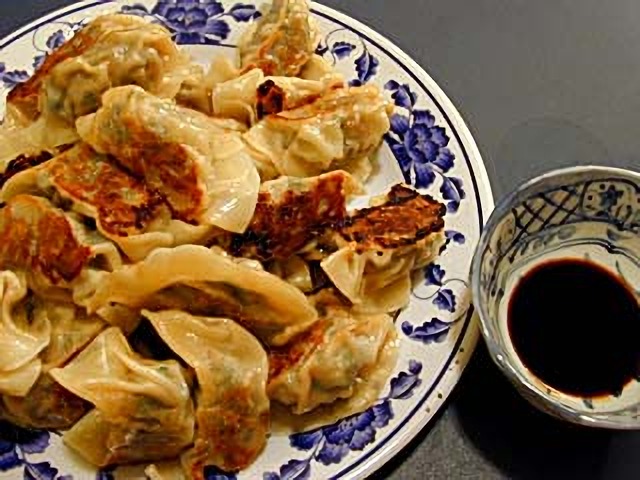
Brother Michael, China ? Do they have perogies…?

james
James my brother! :extrahappy:

It is so great to see your name here.

Yes, in fact they do have pierogis! I just had some for lunch.

I am in Shandong Province, and they have been making pierogies here for thousands of years, everyone makes them in this province. Shandong (the ancient home of Confucius) is known for them all over China. I have a theory that the Mongols brought them to Europe with the cabbages.


My family (as I recall) always fried them, but here they are more often served just boiled and dipped in vinegar and soy sauce with perhaps crushed garlic or a clove of fresh garlic (as I enjoyed today 😃 ).
 
The Chinese-Americans call them “Pot Stickers”…
That must be a colloquialism, I have seen that term in Chinese buffets, but it seems to usually refer to the fried ones. Even boiled they may stick though.

Here in China they are always just called ‘dumplings’. When I was in Chicago I met a teacher from Taiwan and I told her my wife was Chinese, she asked “what part of China is she from?” and after I told her she said “you must eat a lot of dumplings then …” which was true! I ate jiaozi (stuffed dumplings) two or three times a week 😃 even then.
 
Different versions were being used in different eparchies, so now one version is to be used in all the eparchies in the USA.
Just as a base (without going into the details and pros/cons of the changes), this should theoretically be a good thing going forward.

I had thought that Passaic had different books than Parma, although I wouldn’t know why that should be.

It would have been nice if they had worked with the UGCC or even ACROD in developing the new texts, but no one can say they must do something like that.
 
Just as a base (without going into the details and pros/cons of the changes), this should theoretically be a good thing going forward.

I had thought that Passaic had different books than Parma, although I wouldn’t know why that should be.

It would have been nice if they had worked with the UGCC or even ACROD in developing the new texts, but no one can say they must do something like that.
I believe that the Vatican approved 1942 version in Slavonic may be used. But since English is used, the desire of many, is to translate the 1942 version faithfully into English.

Slavonic - Ruthenian Recension, Rome 1942
Greek - Rome, 1950

The English version of the Divine Liturgy from the 1965 Liturgikon is based on the Slavonic, some think this is closer to the 1942 Slavonic than the current 2006 English version. I think the problem now is mutany.

There is also a revised Liturgy of the Presanctified Gifts that was promulgated 2010, but not required for use till 2011 Great Fast.

The Divine Liturgy of Saint Basil, celebrants version, was not revised in 2006 when the Divine Liturgy of St. John Chrysotsom was.

I have no idea who was consulted to make the current revisions, except that the Holy See had to approve it.
 
I looked in the Byzantine DL green book, and found that for the Byzantine Catholic Church USA, only the 2006 version is to be used. It was translated into English from the Greek with reference to the Slavonic, and uses fresh translation of the Old and New Testaments with reference to the LXX, and the Grail Psalms 1963.

metropolitancantorinstitute.org/Publications2.html

Perhaps the next Metropolitan will address the remaining texts.

Also the Melkites have a revised version of the Divine Liturgy:
melkite.org/Dliturgy.htm
 
…I think the problem now is mutany.
:eek:
The Divine Liturgy of Saint Basil, celebrants version, was not revised in 2006 when the Divine Liturgy of St. John Chrysotsom was.
Is there anything formally preventing a priest from taking the Liturgy of Saint Basil every day? :hmmm:
I have no idea who was consulted to make the current revisions, except that the Holy See had to approve it.
That was my understanding. The new work is approved, either formally or because the Holy See has decided to let the decision of the local synod stand.
 
Status
Not open for further replies.
Back
Top