Check
this out

My wiki summary follows

Until a successor Pope can be elected, the Camerlengo serves as acting head of State of the Vatican City. He is not, however, currently responsible for the government of the Catholic Church during a sede vacante…in fact, all of the heads of the Roman Curia resign their offices (the administrative apparatus of the Holy See and the central governing body of the entire Church). That task is in the hands of the College of Cardinals (although this power of government is extremely limited, being merely enough to allow Church institutions to continue to operate and perform some basic functions without making any definitive decisions or appointments that are normally reserved to other powers delegated by the Pope).
Cardinal Tarcisio Bertone S.D.B. is currently the Camerlengo - previously Secretary of State.
http://bluenred.files.wordpress.com/2009/11/2483053814_800a92210e.jpg?w=165&h=171
The Coat of Arms of the Holy See* sede vacante* is for the time being the one of the Camerlengo:
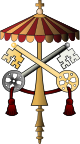
This is not the
episcopal Coat of Arms of Card. Bertone. The Umbraculum (Italian: Ombrellino, “little umbrella”) is a historic piece of the papal regalia and insignia, once used on a daily basis to provide shade for the pope. In modern usage the umbraculum is a symbol of the Roman Catholic Church and the authority of a pope over it.
St. Peter’s Basilica, in fact, is not a cathedral since it is not the seat of a bishop; the *cathedra *of the Bishop of Rome is located in the Archbasilica of St. John Lateran. Thus the “vacant seat” is the *cathedra *of Saint John Lateran, the cathedral church of the bishop of Rome.
This time is also called
interregnum. Cardinals present in Rome are required to wait at least fifteen days after the start of the vacancy for the rest of the college before they can hold the conclave to elect the new Pope. However, after twenty days have elapsed, they must hold the conclave even if cardinals are missing. Between the 15 to 20 days, by means of two instruments, the General and the Particular Congregation, the College of Cardinals governs the Holy See. They can discuss the state of the Church and exchange views concerning the election, but are bound to “abstain from any form of pact, agreement, promise or other commitment of any kind which could oblige them to give or deny their vote to a person or persons”, or to “enter into any stipulations, committing themselves of common accord to a certain course of action should one of them be elevated to the Pontificate”.
Then the
conclave begins. But that is another topic

P.s.: I guess I could have picked another photo of Card. Bertone, but I like that one because it portrays the idea of stability




 )
)