Old Earth vs. Young Earth

  • Thread starter Thread starter Banff9
  • Start date Start date
Status
Not open for further replies.
And this balloon exists where? If it is expanding, what is it expanding into? Nothing?

Peace,
Ed
Yes. If the universe has boundaries, there is nothing outside the boundaries. What would be the point of positing an expanding space–i.e., the universe–expanding into more space? No, it is the space itself that is expanding.

One could also theoretically envision an essentially “flat” universe, with space extending infinitely in every direction. But the evidence does not support it; it supports the Big Bang.

(Astronomer Fred Hoyle, way back in the 1950’s theorized such a flat universe: he called it the steady state universe. But in order to account for the fact that galaxies are receding indefinitely he proposed that matter had to be continuously created in order to maintain the ‘steady state.’ That theory did not last, and all the evidence now points to a 13 billion year old “spherical” universe.
 
I am thinking the same way some say Luther opened up things negatively to many denominations, so to did Darwin open up things to much downslide scientifically and spiritually. There are many evidences for a young Earth. Further one can ask how old was Adam and Eve when created? Did Jesus make em to look like 30 years old, as mature adults ? Why could not He have created an “old”, mature Earth from day one?
 
I am thinking the same way some say Luther opened up things negatively to many denominations, so to did Darwin open up things to much downslide scientifically and spiritually. There are many evidences for a young Earth. Further one can ask how old was Adam and Eve when created? Did Jesus make em to look like 30 years old, as mature adults ? Why could not He have created an “old”, mature Earth from day one?
How young, and name your evidences.
 
I am thinking the same way some say Luther opened up things negatively to many denominations, so to did Darwin open up things to much downslide scientifically and spiritually. There are many evidences for a young Earth. Further one can ask how old was Adam and Eve when created? Did Jesus make em to look like 30 years old, as mature adults ? Why could not He have created an “old”, mature Earth from day one?
Your analogy doesn’t work. A better analogy would be that God created Adam and Eve to be 30 years old, and then planted baby pictures, childhood videos, birth certificates, birthday cards and mementos, bronzed baby shoes, etc, etc.
 
Yes. If the universe has boundaries, there is nothing outside the boundaries. What would be the point of positing an expanding space–i.e., the universe–expanding into more space? No, it is the space itself that is expanding.

One could also theoretically envision an essentially “flat” universe, with space extending infinitely in every direction. But the evidence does not support it; it supports the Big Bang.

(Astronomer Fred Hoyle, way back in the 1950’s theorized such a flat universe: he called it the steady state universe. But in order to account for the fact that galaxies are receding indefinitely he proposed that matter had to be continuously created in order to maintain the ‘steady state.’ That theory did not last, and all the evidence now points to a 13 billion year old “spherical” universe.
Back to the balloon. A balloon starts out small and becomes larger, right? And if objects are traveling away from us at high speeds, where is the acceleration energy coming from? If I want to accelerate any object, I need to add energy. So where is it coming from?

Spherical? Says who? If I could stand in the emptiness of nothing, I would see the universe as a round balloon in the distance?

Sounds far-fetched.

Peace,
Ed 🙂
 
Your analogy doesn’t work. A better analogy would be that God created Adam and Eve to be 30 years old, and then planted baby pictures, childhood videos, birth certificates, birthday cards and mementos, bronzed baby shoes, etc, etc.
:rotfl: Great analogy.
 
Your analogy doesn’t work. A better analogy would be that God created Adam and Eve to be 30 years old, and then planted baby pictures, childhood videos, birth certificates, birthday cards and mementos, bronzed baby shoes, etc, etc.
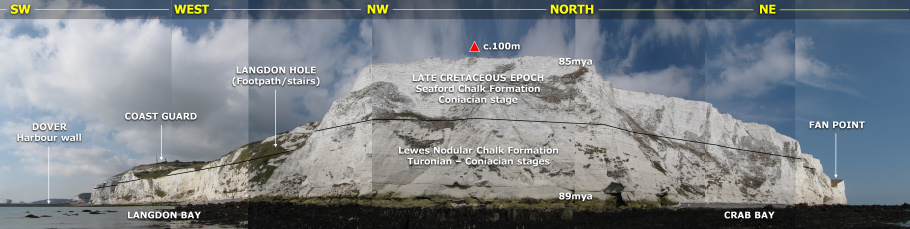
ah, the old baby shoes argument. see if the story below makes sense of the data, or, if conventional science/geology/paleozoology whatever, makes more sense of the data.
you be the judge.

discoveringfossils.co.uk/dover_kent_fossils.htm


see the second photo, you can just make out tiny layers in the chalk.

now for some experimental calculations.

the cliff face in the top photo is 330 feet high.
the micraster fossil, in the second photo, is about 3 inches in height, its resting on its side.
i can just make out tiny layers in the chalk around the micraster fossil. counting the layers and estimating that there are 200 layers per 3 inches of chalk in the dover cliffs.

this means that, conventionally, each tiny layer would have taken 15 years to deposit.
so to cover the micraster fossil with chalk layers in that second photo it would take 3,030 years.
yet there is no evidence on the top of the fossil of 3,030 years of erosion or decomposition or covering with precipitants of other life-forms growths, etc.

also, how, and why, would there be a visible layer every 15 years of chalk deposition. i cannot think of any reason for a layer to appear every 15 years.

anyway, so i got thinking.
if the layers were in fact a days worth of chalk deposits. the chalk is made of cocolithophores. so if cocolithophores lived for a short time, which they do. they live for a few days or weeks. so if there was a significant death of cocolithophores each day, lets say at night when the sun goes down and the older cocolithophores which are losing the power to photosynthesize have a mini mass die-out and create a layer of descending cocolithophore shells. they are so tiny they take time to settle out of the water.

so if the layers were created each day, or represent a days worth of sediment then that would make the cliffs in the top photo which are 330 feet high, not 4 million years worth of sediment but 722 years worth of sediment.
and the timespan from the top to the bottom of the cliffs is not 4 million years but 722 years.


so, a silly idea, i thought. but can i find anything else interesting in the cliff.
so i see that every 5 feet or so there is a layer of flint nodules representing the mortal remains of sponges.
so counting the tiny layers again i find that there is a period of 59,940 years, apparently, between each layer of sponges.

now, this is unaccountable. i already know that sponges mostly live for just a few years, but to live for and to die every 59,940 years is just strange.

so again, i applied my little idea that a tiny layer represents a day and now i find that the layers of sponges every 5 feet represent not 59,940 years but 10.9 years.
and what happens cyclically every 11 years, yup, the 11 year solar cycle.

so its possible that the slight dimming of the sun every 11 years was just enough to kill off a few of those deep living sponges which were living at the very maximum of their tolerance.

and so, in a few deft moves, we have explained why the micraster fossil did not erode; why there are tiny perfectly regular layers in the chalk deposits; why there are sponges deposited in perfect layers; and why the sponges are deposited regularly every 11 year solar cycle.
we also now have a true age for that 330 foot cliff. its 722 years old. or rather it took 722 years to deposit all that chalk, not 4,000,000 years.

 
ah, the old baby shoes argument. see if the story below makes sense of the data, or, if conventional science/geology/paleozoology whatever, makes more sense of the data.
you be the judge.

discoveringfossils.co.uk/dover_kent_fossils.htm

http://www.discoveringfossils.co.uk/dover_geological_panoramic.jpg
http://www.discoveringfossils.co.uk/dover_fossil_10.jpg

see the second photo, you can just make out tiny layers in the chalk.

now for some experimental calculations.

the cliff face in the top photo is 330 feet high.
the micraster fossil, in the second photo, is about 3 inches in height, its resting on its side.
i can just make out tiny layers in the chalk around the micraster fossil. counting the layers and estimating that there are 200 layers per 3 inches of chalk in the dover cliffs.

this means that, conventionally, each tiny layer would have taken 15 years to deposit.
so to cover the micraster fossil with chalk layers in that second photo it would take 3,030 years.
yet there is no evidence on the top of the fossil of 3,030 years of erosion or decomposition or covering with precipitants of other life-forms growths, etc.

also, how, and why, would there be a visible layer every 15 years of chalk deposition. i cannot think of any reason for a layer to appear every 15 years.

anyway, so i got thinking.
if the layers were in fact a days worth of chalk deposits. the chalk is made of cocolithophores. so if cocolithophores lived for a short time, which they do. they live for a few days or weeks. so if there was a significant death of cocolithophores each day, lets say at night when the sun goes down and the older cocolithophores which are losing the power to photosynthesize have a mini mass die-out and create a layer of descending cocolithophore shells. they are so tiny they take time to settle out of the water.

so if the layers were created each day, or represent a days worth of sediment then that would make the cliffs in the top photo which are 330 feet high, not 4 million years worth of sediment but 722 years worth of sediment.
and the timespan from the top to the bottom of the cliffs is not 4 million years but 722 years.

http://www.discoveringfossils.co.uk/dover_flint.jpg

so, a silly idea, i thought. but can i find anything else interesting in the cliff.
so i see that every 5 feet or so there is a layer of flint nodules representing the mortal remains of sponges.
so counting the tiny layers again i find that there is a period of 59,940 years, apparently, between each layer of sponges.

now, this is unaccountable. i already know that sponges mostly live for just a few years, but to live for and to die every 59,940 years is just strange.

so again, i applied my little idea that a tiny layer represents a day and now i find that the layers of sponges every 5 feet represent not 59,940 years but 10.9 years.
and what happens cyclically every 11 years, yup, the 11 year solar cycle.

so its possible that the slight dimming of the sun every 11 years was just enough to kill off a few of those deep living sponges which were living at the very maximum of their tolerance.

and so, in a few deft moves, we have explained why the micraster fossil did not erode; why there are tiny perfectly regular layers in the chalk deposits; why there are sponges deposited in perfect layers; and why the sponges are deposited regularly every 11 year solar cycle.
we also now have a true age for that 330 foot cliff. its 722 years old. or rather it took 722 years to deposit all that chalk, not 4,000,000 years.
I vote for the conventional explanation made by people who didn’t just look at pictures, and who actually know what they’re talking about.
 
I have heard some say about this topic, “Does it really matter?” Well, it’s not that important to Faith as to whether the Earth is Old or Young. That God created the Earth, Heavens and Man is important to Faith. But, whether or not we believe Moses’s creation story, including Adam’s age at death and those of his successors, is an issue of debate.

Some dismiss it, saying “it’s allegory” and so they think it is unfactual. I believe that we should believe in Moses’s creation story and, especially in all the ages given for Adam down to Joseph son of Israel. It is for a reason that their ages are consistently given from the beginning, I think. I think we should believe it, rather than dismiss it and accept science’s claims.
The thing is… you say that we should just accept it literally, just like that. Ignore all the evidence out there. This is called blind faith. What it comes down to is this: all we have is our reason, and we have to have a reason to believe what we believe, otherwise it is not worthy of belief. This is not unreasonable. Think objectively about the way you just blindly accept the literal creation story, defending it only with “Moses said so.” Imagine if you met a Muslim who said “You should believe the Quran because it is the book of the prophet. The prophet Muhammad said this so believe it.” Would you? If we are to accept truth at face value then the truth is ultimately a question of what culture we were born into. Those who happened to be born into the wrong culture and religion are screwed because they have a different “truth” that they are expected to accept at face value. If the Bible is true, then we should be able to defend it using evidence, and if the literal creation account is contrary to scientific evidence, then we should not treat it as literal. Furthermore, if you look at the creation account as literal, it is ridiculous. But if you look at it as a allegorical, even poetic, then it is profoundly deep.
 
I vote for the conventional explanation made by people who didn’t just look at pictures, and who actually know what they’re talking about.
but you see there is no conventional definitive explanation for the regular flint layers. so the people who know what they are talking about don’t know. they are stumped…😉
 
but you see there is no conventional definitive explanation for the regular flint layers. so the people who know what they are talking about don’t know. they are stumped…😉
I don’t think so. It doesn’t seem to be a problem from what I can see
 
but you see there is no conventional definitive explanation for the regular flint layers. so the people who know what they are talking about don’t know. they are stumped…😉
Well, if the choices are

a) a theory that explains 1000 pieces of data, but cannot explain 1 piece of data
OR
b) a theory that explains 1 piece of data but cannot explain 1000 pieces of data

Which theory is it more reasonable to side with?
 
Well, if the choices are

a) a theory that explains 1000 pieces of data, but cannot explain 1 piece of data
OR
b) a theory that explains 1 piece of data but cannot explain 1000 pieces of data

Which theory is it more reasonable to side with?
not that i’m biased or anything, but thats just why i favour my theory, or hypothesis, over the conventional one. because it does not know why;

a. the micraster fossil did not erode while exposed for 3030 years;

b. why there are tiny perfectly regular layers in the chalk deposits;

c. why there are sponges deposited in perfect layers;

d. and why the sponges are deposited regularly coinciding with every 11 year solar cycle.
 
Well, if the choices are

a) a theory that explains 1000 pieces of data, but cannot explain 1 piece of data
OR
b) a theory that explains 1 piece of data but cannot explain 1000 pieces of data

Which theory is it more reasonable to side with?
If the whole thing is built upon the suspect foundation then the whole thing can crumble.
 
The thing is… you say that we should just accept it literally, just like that. Ignore all the evidence out there. This is called blind faith. What it comes down to is this: all we have is our reason, and we have to have a reason to believe what we believe, otherwise it is not worthy of belief. This is not unreasonable. Think objectively about the way you just blindly accept the literal creation story, defending it only with “Moses said so.” Imagine if you met a Muslim who said “You should believe the Quran because it is the book of the prophet. The prophet Muhammad said this so believe it.” Would you? If we are to accept truth at face value then the truth is ultimately a question of what culture we were born into. Those who happened to be born into the wrong culture and religion are screwed because they have a different “truth” that they are expected to accept at face value. If the Bible is true, then we should be able to defend it using evidence, and if the literal creation account is contrary to scientific evidence, then we should not treat it as literal. Furthermore, if you look at the creation account as literal, it is ridiculous. But if you look at it as a allegorical, even poetic, then it is profoundly deep.
What evidence is there of transubstantiation in the Eucharist? Only Christ’s word, which also said that, if we didn’t believe Moses and the Prophets, we wouldn’t believe even if someone should rise from the dead. We should believe Moses, because Jesus said we should, not because there is evidence to believe it.

“Blessed are they who believe and have not seen,” said Jesus.
 
Back to the balloon. A balloon starts out small and becomes larger, right? And if objects are traveling away from us at high speeds, where is the acceleration energy coming from? If I want to accelerate any object, I need to add energy. So where is it coming from?

Spherical? Says who? If I could stand in the emptiness of nothing, I would see the universe as a round balloon in the distance?

Sounds far-fetched.

Peace,
Ed 🙂
If the space in which the galaxies are embedded is expanding, any observer in any galaxy would perceive every other galaxy to be moving away from him. (In the balloon analogy, the two dimensional surface of the balloon represents the three-dimensional space of the universe.)

It may sound far fetched from a human viewpoint, but no more far-fetched than an infinite flat universe, and no more far fetched than a spherical earth might have sounded to our ancestors. If you set out in a straight line on a sphere from any point on it, you will eventually circumnavigate the sphere and return to your starting point. That applies to the earth. It would also, in a spherical universe, apply to the universe. But the circumference of the universe is a lot larger than earth.

George Gamow once wrote a book called 1, 2, 3… Infinity, which covered a varity of such things, including the expanding universe. It’s outdated now, but still pertinent enough to cover some of the basic concepts.

The universe, from a spatial standpoint, must be either infinite or finite. I believe that current data would show it to be finite, and if it’s finite, it has a geometry, probably spherical. If it turns out to be some other geometry, there’s nothing particular upsetting about that either, from a theological standpoint or a physical standpoint.
 
If the whole thing is built upon the suspect foundation then the whole thing can crumble.
The alternatives are

a) Theory X that seems to explain most data, but not all.
b) Theory Y that seems to explain some data, but not most.
c) Some new theory that nobody has thought of
d) Science simply doesn’t work

What is a reasonable person to choose?
 
Status
Not open for further replies.
Back
Top