ah, the old baby shoes argument. see if the story below makes sense of the data, or, if conventional science/geology/paleozoology whatever, makes more sense of the data.
you be the judge.
discoveringfossils.co.uk/dover_kent_fossils.htm
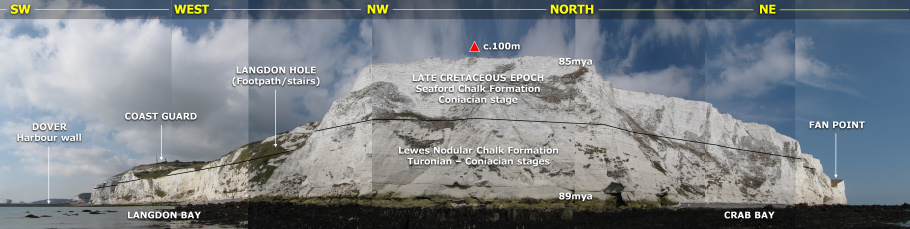
http://www.discoveringfossils.co.uk/dover_geological_panoramic.jpg
http://www.discoveringfossils.co.uk/dover_fossil_10.jpg
see the second photo, you can just make out tiny layers in the chalk.
now for some experimental calculations.
the cliff face in the top photo is 330 feet high.
the micraster fossil, in the second photo, is about 3 inches in height, its resting on its side.
i can just make out tiny layers in the chalk around the micraster fossil. counting the layers and estimating that there are 200 layers per 3 inches of chalk in the dover cliffs.
this means that, conventionally, each tiny layer would have taken 15 years to deposit.
so to cover the micraster fossil with chalk layers in that second photo it would take 3,030 years.
yet there is no evidence on the top of the fossil of 3,030 years of erosion or decomposition or covering with precipitants of other life-forms growths, etc.
also, how, and why, would there be a visible layer every 15 years of chalk deposition. i cannot think of any reason for a layer to appear every 15 years.
anyway, so i got thinking.
if the layers were in fact a days worth of chalk deposits. the chalk is made of cocolithophores. so if cocolithophores lived for a short time, which they do. they live for a few days or weeks. so if there was a significant death of cocolithophores each day, lets say at night when the sun goes down and the older cocolithophores which are losing the power to photosynthesize have a mini mass die-out and create a layer of descending cocolithophore shells. they are so tiny they take time to settle out of the water.
so if the layers were created each day, or represent a days worth of sediment then that would make the cliffs in the top photo which are 330 feet high, not 4 million years worth of sediment but 722 years worth of sediment.
and the timespan from the top to the bottom of the cliffs is not 4 million years but 722 years.
http://www.discoveringfossils.co.uk/dover_flint.jpg
so, a silly idea, i thought. but can i find anything else interesting in the cliff.
so i see that every 5 feet or so there is a layer of flint nodules representing the mortal remains of sponges.
so counting the tiny layers again i find that there is a period of 59,940 years, apparently, between each layer of sponges.
now, this is unaccountable. i already know that sponges mostly live for just a few years, but to live for and to die every 59,940 years is just strange.
so again, i applied my little idea that a tiny layer represents a day and now i find that the layers of sponges every 5 feet represent not 59,940 years but 10.9 years.
and what happens cyclically every 11 years, yup, the 11 year solar cycle.
so its possible that the slight dimming of the sun every 11 years was just enough to kill off a few of those deep living sponges which were living at the very maximum of their tolerance.
and so, in a few deft moves, we have explained why the micraster fossil did not erode; why there are tiny perfectly regular layers in the chalk deposits; why there are sponges deposited in perfect layers; and why the sponges are deposited regularly every 11 year solar cycle.
we also now have a true age for that 330 foot cliff. its 722 years old. or rather it took 722 years to deposit all that chalk, not 4,000,000 years.



 Great analogy.