
On some Eastern Catholic vestments

  • Thread starter Thread starter AXO
  • Start date Start date
Status
Not open for further replies.
A

AXO

Guest
Hello, I’m really confused about some of the gear. I see Syriac Patriarch Ignatius Joseph III always wearing what seems to be a kamelaukion (supposedly a Byzantine vestment):
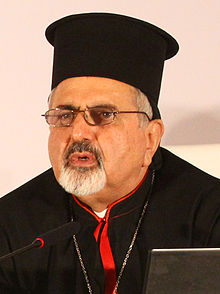
Also apparently Latin ones:
(Please Note: This uploaded content is no longer available.)
I can find that it appears to be longstanding. Patriarch Ignatius Behnam II (1893-1897) (is he wearing a fascia?):
(Please Note: This uploaded content is no longer available.)
Patriarch Ignatius George V:
(Please Note: This uploaded content is no longer available.)
It’s even in the emblem of the church:
https://upload.wikimedia.org/wikipedia/en/a/a6/Syriac_Catholic_Church_logo.jpg

Am I wrong? Is this rooted within Syrian tradition? Thanks in advance.
 
The Ottomans had a long standing a rule that each sect’s clerical clothing had to have its own distinguishing characteristics. Hence the variations in the eskeemo, and also those between the Maronite tobiyye, SOC koub’ono, COC 'emmeh, ACoE kousita and Chaldean shash. In keeping with that rule, the SCC and CCC adopted variants of the Greek kamilavkion (perhaps due to pressure from Rome). Notice that the SCC patriarchal version has a small gold know on the top. The only ones who seem to have escaped the Ottomans and their rule were the Melkites, and I think that the historical circumstances of their “reunion” explain why. The churches in India were never affected by the Ottomans.
 
In keeping with that rule, the SCC and CCC adopted variants of the Greek kamilavkion (perhaps due to pressure from Rome).
What would, then, be the traditional element of those churches? And for the SCC and CCC, the koub’ono and 'emmeh, respectively?

Anyway, I still don’t know the answer to the use, by SCC patriarchs, of supposed Latin gear (mitre, baculum, etc.).
 
What would, then, be the traditional element of those churches? And for the SCC and CCC, the koub’ono and 'emmeh, respectively?
Were it not for the Ottoman dress code, yes. 🙂
Anyway, I still don’t know the answer to the use, by SCC patriarchs, of supposed Latin gear (mitre, baculum, etc.).
The mitre is strictly a latinization. By “baculum” I presume you mean a crozier, and if so, the “shepherds crook” style is also a latinization.
 
Anyway, I still don’t know the answer to the use, by SCC patriarchs, of supposed Latin gear (mitre, baculum, etc.).
Instead of a mitre, the Traditional vestment would be the masnaphto - used by the Indian Orthodox, Syriac Orthodox and Malankara Syrian Catholics.

“If the celebrant is a prelate, he puts on the masnaphto ‘turban’, a head-cover which symbolizes the cloth with which the Lord’s head was bound for His burial. He makes the sign of the cross twice on it and wears it reciting Psalm 4:6-7: Who can show me He who is good? May the light of Thy countenance shine upon us, O Lord, Thou hast given gladness to my heart.”
Margoneetho: Syriac Orthodox Resources Margoneetho: Syriac Orthodox Resources

The Traditional mooroneetho in the West Syriac Rite is not a crook but a serpent head. The double serpent head is used by the Patriarch, Catholicos and ‘may be used’ by other bishops depending on the situation.
“Then the prelate takes the crosier (mooroneetho) in his left hand, which symbolizes the bishop’s authority and reminds us of the shepherd’s staff, reciting Psalm 110:2: The Lord will send forth the sceptre of Thy power out of Zion: thou shalt rule in the midst of thine enemies. He also takes a hand Cross in his right hand, from which a cloth called mqablonitho ‘veil’ is hung reciting Psalm 44:5: For Thy cause we shall combat our enemies and for the cause of Thy name we shall trample those who hate us. Upon completing this, the celebrant washes his hands.”
http://sor.cua.edu/Vestments/BPAll.jpg
 
The Traditional mooroneetho in the West Syriac Rite is not a crook but a serpent head. The double serpent head is used by the Patriarch, Catholicos and ‘may be used’ by other bishops depending on the situation.
True but not for the Maronites. The traditional usage (which is one of the VERY few things that has been generally restored in the past 40 years) is a simple staff, preferably of wood, surmounted by a an orb and topped with a small cross. The “shepherd’s crook” which was used exclusively starting in the 17th century (and which is still seen today) is strictly a latinization.

It seems to me that the double-serpent style is more of a byzantinization in the SOC (and its daughter Churches) than anything else. In that way, it’s similar to the panagia.
 
It’s not at all surprising to me that Ethiopian CC bishops wear Roman cassocks. So do the Coptic CC, the Syro-Malabars, and the Chaldeans. So, too, the the Syriac CC, and the Maronites, sometimes with very slight variations in cut and fit. Now, the reason why there’s a difference between the ECC and EOC qob I don’t know. My guess would be that it was imposed by Rome, but that’s just a guess.

As for the panagia used by the Ethoipian Orthodox, that derives from the Coptic Orthodox. OTOH, I wouldn’t call it authentic to the Alexandrene tradition. It’s a byzantinization, just as it is among the Syriac Orthodox.
 
As for the panagia used by the Ethoipian Orthodox, that derives from the Coptic Orthodox. OTOH, I wouldn’t call it authentic to the Alexandrene tradition. It’s a byzantinization, just as it is among the Syriac Orthodox.
It seems to be a relatively recent one in its propagation at that. I was looking at pictures of previous SOC patriarchs with bishops (50+ years ago) and the bishops were not wearing panagia, and going further back I did not see the patriarchs wearing panagia.

(Please Note: This uploaded content is no longer available.)
Here, the SO are even wearing the outtercassock in the split manner that the Maronites still have it, as opposed to their modern Greek riassa hybrid with the crossed front.
 
That hat is technically only supposed to be used outside the Qurbono, and only by priests - however, in Malankara, it became custom to sew the “Elbishto d’Kurobo/Phiro d’Kohnutho” (cap for offering the sacrifice/the Fruit of Priesthood) into that cylindrical secular cap and is used by anyone even in minor order beyond the first level of deacon. The corepiscopoi will wear a taller version of the same in Malankara, in addition to the cope, denoting higher rank.
 
That hat is technically only supposed to be used outside the Qurbono, and only by priests - however, in Malankara, it became custom to sew the “Elbishto d’Kurobo/Phiro d’Kohnutho” (cap for offering the sacrifice/the Fruit of Priesthood) into that cylindrical secular cap and is used by anyone even in minor order beyond the first level of deacon. The corepiscopoi will wear a taller version of the same in Malankara, in addition to the cope, denoting higher rank.
Is it used by all Malankara churches, including Catholic?
 
Is it used by all Malankara churches, including Catholic?
No. The phiro and cap was used by Malankara Catholics, but somehow fell into disuse. My inquiry hit a dead end on this - the only answer I received was that it was somehow to make the Syro-Malabars and Latins feel more comfortable but no evidence to show how, when, etc…
Technically, the phiro or another headdress could be revived, I suppose, since Syriac Catholics and Maronites still have a form. However, the cylindrical cap is basically an Orthodox identifier and would probably never be used by Malankara Catholics.
 
You mean the leather belt, or the black one (similar to formal Latin cassock)?
 
You normally wouldn’t see that black belt on a Malankara Catholic, Syriac Orthodox (outside India) or Syriac Catholic priest’s cassock - it is most likely an adaptation mimicking the Church of South India minister’s style, many Orthodox in India also adapted to wearing the Anglican style of cassock with the two buttons on top. The black cumberbund looking vestment is used by Malankara Catholic priests in a more formal setting, not in every day wear, although nothing objectionable about it. I’ve seen them in both the style that is in the photo and in the Latin style with the waistband and the longer hanging end.
 
Status
Not open for further replies.
Back
Top