P
Pathway2
Guest
We have a problem. Camels didn’t arrive to Israel until centuries after Abramham. Even if He got them from Mesopotamia, we need the proof of what remained of those camels.
Last edited:

We do? They’re most likely camel dust for thousands of years by now.we need the proof of what remained of those camels.
Why? Abraham got where he was going. He used camels. Or he used mules or horses, or he walked.We have a problem. Camels didn’t arrive to Israel until centuries after Abramham. Even if He got them from Mesopotamia, we need the proof of what remained of those camels.
Also what po18guy said.Where is the ‘proof’ that Camels did not arrive until centuries later? Who asserted this? How could they possibly know, and what was their agenda?
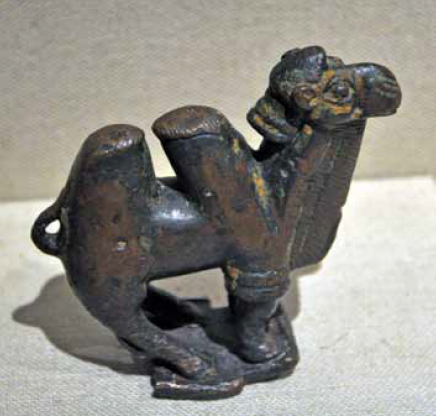
which was interesting.The dromedary camel arrived in south-eastern Arabia about 5000–6000 years ago (Uerpmann & Uerpmann 2002). It is absent in late prehistoric art but is often depicted with Thamudic inscriptions (Parr et al. 1978; Khan 2007).
(Please Note: This uploaded content is no longer available.)But since I have no idea what year you think Abraham lived, I don’t really know how far back you want us to look.

Are you:I am not dismissing that trouble is what would have happen after he arrived in Judea?
What would you expect to happen? The Hebrew word gamal (camel) commonly occurs in the OT in three contexts: Livestock considered as property; a means of transport; camel meat not kosher. Examples:I am not dismissing that trouble is what would have happen after he arrived in Judea?
And you’re worried about Pharaoh not having camels to give to Abram?14 When Abram came to Egypt, the Egyptians saw that Sarai was a very beautiful woman. 15 And when Pharaoh’s officials saw her, they praised her to Pharaoh, and she was taken into his palace. 16 He treated Abram well for her sake, and Abram acquired sheep and cattle, male and female donkeys, male and female servants, and camels.
And you’re worried about a random girl not being familiar enough with camels to volunteer to water them?Abraham was now very old,…
10 Then the servant left, taking with him ten of his master’s camelsloaded with all kinds of good things from his master. He set out for Aram Naharaim and made his way to the town of Nahor. 11 He had the camels kneel down near the well outside the town; it was toward evening, the time the women go out to draw water.
12 Then he prayed, “Lord, God of my master Abraham, make me successful today, and show kindness to my master Abraham. 13 See, I am standing beside this spring, and the daughters of the townspeople are coming out to draw water. 14 May it be that when I say to a young woman, ‘Please let down your jar that I may have a drink,’ and she says, ‘Drink, and I’ll water your camels too’—let her be the one you have chosen for your servant Isaac. By this I will know that you have shown kindness to my master.”
Camels were domesticated 10th century BCAbraham is somewhere between 1700 BC and 1500 BC
News flash - some of the facts presented in ancient scripture are inaccurate. This should not be troubling to Catholics (or Anglicans, as it appears you are), as we do not hold a “fundamentalist” or historical inerrancy view of scripture.We have a problem. Camels didn’t arrive to Israel until centuries after Abramham. Even if He got them from Mesopotamia, we need the proof of what remained of those camels.