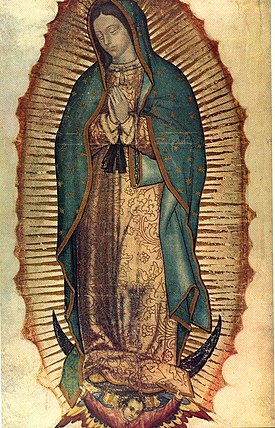
Patrick, this is the first I have ever heard of a “retouching” of the image. The picture you show is the same image I saw in the early 1970’s when I visited Mexico City. Located as it was behind the high altar, and being on view constantly, when might someone have had the occassion to take it down to “touch it up?” Someone might have noticed a ladder.
These retouches or additions were undertaken
way before the 1970s, perhaps even before the image was actually placed inside the old basilica, the construction of which was only finished in 1709. One of the earliest copies of the Guadalupe image (said to have been carried by Genoese admiral
Giovanni Andrea Doria during the Battle of Lepanto in 1570), now located in
Santo Stefano d’Aveto in Italy, is more or less similar to our present image. There is also the controversial
Codex 1548 (aka Codex Escalada),
discovered in 1995, again showing many of the elements which Callahan and Smith have thought to be painted additions.
If Callahan and Smith are correct in their conclusions that the image has been added to, and if the Codex Escalada is indeed genuine, the latest possible date for additions to the image would be before the time period between 1548 (the year in which the leather sheet was supposedly drawn) and 1570 (when Admiral Doria brought the copy with him to Lepanto).
Remember that the image was originally just fitted onto a wooden frame, without any protective glass (the lines around the cuffs and knee areas are the result of the frame’s crosspieces), exposed to the touch of thousands of people, the smoke of candles, as well as the general humidity of the area - it stayed that way for about a hundred years (at least before 1647). And even after it was encased behind glass, it was still removed at periodic intervals to allow the faithful to have contact with it. The tilma itself remarkably does not seem to show any damage despite the conditions of the area, but the repeated touching somewhat puts the image itself at some risk of wear and tear. Many of these retouchings thus seems to be an attempt to fix abrasions the original image had sustained.
Sometimes the appearance or disappearance of certain elements of the image could lead to controversy, such as that time when Our Lady’s crown just disappeared (yes, the image did have a crown at some point, as you could see from the Aveto copy and other early reproductions; though again, there is also the idea that it was an addition, and
some judged it to be a rather poorly-painted one at that, so it was better that it went away in their opinion), rather coincidentally just before the image was to be canonically crowned in the late 1890s.



 Relatively little change has occurred in fashions in Palestine throughout the ages, as you would see in the pic below.

