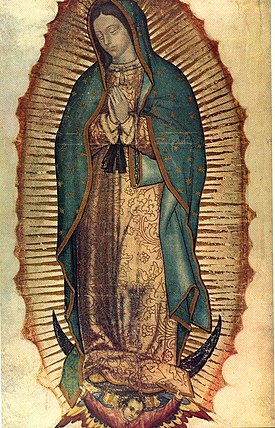
Our Our Lady of Guadeloupe picture and its symbolism

  • Thread starter Thread starter Benay
  • Start date Start date
Status
Not open for further replies.
B

Benay

Guest
I was looking at a large copy of Our Lady of Guadeloupe and was struck by the flowers on her dress. They looked very “science fiction a la Star Trek” than any kind of a flower I have ever seen.

I searched the net and found an explanation of almost everything about the picture on EWTN excpet for the flowers and the thin bracelets she is wearing.

EWTN says that the 8 petals on the flower represent mountains in Aztec symbolism. But what of the rest of the flower? It must have some Aztec symboilsm but no one has said. I find myself staring at her p;icture, fascinated by all the symbolism, but I would like to know what it represents.
 
Is there a consolidated location for all of the symbolism contained in the image somewhere?
 
maryourmother.net/Guadalupe.html

Seems to be a stylized Jasmine flower known to the Aztecs. The description’s symbolism makes sense given the context and reason of Our Lady’s appearance.
This is the quote about Mary’s dress at this site: “Her rose dress, adorned with a jasmine flower, eight petal flowers, and nine heart flowers symbolic to the Aztec culture, is that of an Aztec princess”

So now we know that Aztec princesses wore gowns with that flower for a design. I had not known that. Thanks!
 
OF all the images of Mary, Our Lady of Guadalupe is by far the most spectacular. Most of her images are fairly subdued and simple, but this one is fit for a Queen. The colors and design are regal and bright. The gold rays and trim are almost gaudy, but emphasizes her role as Queen of the Universe.

Usually her robes are one or two colors, and almost always without any sort of design or adornments. She must have been on her way to a heavenly ball or major event.
 
OF all the images of Mary, Our Lady of Guadalupe is by far the most spectacular. Most of her images are fairly subdued and simple, but this one is fit for a Queen. The colors and design are regal and bright. The gold rays and trim are almost gaudy, but emphasizes her role as Queen of the Universe.

Usually her robes are one or two colors, and almost always without any sort of design or adornments. She must have been on her way to a heavenly ball or major event.
I’d classify the defining moment that converted millions of Indians in Mexico as the event for which Our Lady was dressed. 🙂
 
John, here is the best description I could find on the image of Our Lady of Guadeloupe. It’s on the EWTN website.

(ewtn.com/jp99/image.htm
Right EWTN did a few shows on the Tilma. Profound really, Juan Diego appears in her eye, the constellation on her garment etc. All simply amazing.

Peace
 
OF all the images of Mary, Our Lady of Guadalupe is by far the most spectacular. Most of her images are fairly subdued and simple, but this one is fit for a Queen. The colors and design are regal and bright. The gold rays and trim are almost gaudy, but emphasizes her role as Queen of the Universe.
Sorry to burst bubbles, but there actually is a theory based on the conclusions of Philip Callahan and Jodi Brandt Smith (who studied the image in 1979-1981) that the original image was actually just that, fairly subdued and simple: just a three-quarter image of Our Lady in a mantle and robe with no frills. As time went on though, the image has undergone the addition of certain elements (including the rest of Our Lady’s body, the black outlines, the sunburst rays, the crescent moon, the brooch, the angel, the stars on the mantle, the cincture, and even a crown, which has now disappeared) and some retouching. The first additions would have been made as early as the late 16th-early 17th century (based on copies), perhaps even within a couple of decades since 1531. Another opinion is that the image was more or less the same as it is now since the beginning, though there is no denial that retouching or enhancing did happen at times.

These additions or retouches (whichever they actually are), unlike the very well-preserved main image, has survived the ravages of time rather badly: you can notice it in a photo of the original tilma. Take for example the black crescent - which is actually silver that had oxidized - and the golden rays.


It’s also a common belief that Our Lady appeared as an Aztec, in the guise of an Aztec princess, but based on contemporary records, Aztec women actually wore a blouse called huīpīlli and a skirt called cuēitl (in fact, the couplet cueitl huipilli “skirt [and] blouse” was used metaphorically to mean “woman”), in contrast to the Virgin’s full-length robe and mantle. If anything, the garments Mary are wearing in the image are actually that of a Jewish woman, so she is portrayed as wearing clothes evocative of those she might have worn 2000 years ago: she is being herself. 😉 Relatively little change has occurred in fashions in Palestine throughout the ages, as you would see in the pic below. 🙂


Aztec women in huīpīlli and cuēitl

(Please Note: This uploaded content is no longer available.)
19th century women in Siloam
 
Patrick, this is the first I have ever heard of a “retouching” of the image. The picture you show is the same image I saw in the early 1970’s when I visited Mexico City. Located as it was behind the high altar, and being on view constantly, when might someone have had the occassion to take it down to “touch it up?” Someone might have noticed a ladder.

It has been examined by others than the ones you have cited and was found not to be a painting of any kind. Any attempts at a touch up would be obvious which may be what you are citing.Someones attempt at touch up. The interesting thing is that the tilma which should have disintegrated long ago remains intact and the image has not been painted on.

Yes, perhaps Mary’s gown and cloak were common in Israel during her liftime, how do you explain the flower decoration on her dress? The picture you shared with us shows two women in gowns without any decoration.

The original question was about the flower decoration and what they signified. Did you find any information on that?
 
Patrick, this is the first I have ever heard of a “retouching” of the image. The picture you show is the same image I saw in the early 1970’s when I visited Mexico City. Located as it was behind the high altar, and being on view constantly, when might someone have had the occassion to take it down to “touch it up?” Someone might have noticed a ladder.
These retouches or additions were undertaken way before the 1970s, perhaps even before the image was actually placed inside the old basilica, the construction of which was only finished in 1709. One of the earliest copies of the Guadalupe image (said to have been carried by Genoese admiral Giovanni Andrea Doria during the Battle of Lepanto in 1570), now located in Santo Stefano d’Aveto in Italy, is more or less similar to our present image. There is also the controversial Codex 1548 (aka Codex Escalada), discovered in 1995, again showing many of the elements which Callahan and Smith have thought to be painted additions. If Callahan and Smith are correct in their conclusions that the image has been added to, and if the Codex Escalada is indeed genuine, the latest possible date for additions to the image would be before the time period between 1548 (the year in which the leather sheet was supposedly drawn) and 1570 (when Admiral Doria brought the copy with him to Lepanto).

Remember that the image was originally just fitted onto a wooden frame, without any protective glass (the lines around the cuffs and knee areas are the result of the frame’s crosspieces), exposed to the touch of thousands of people, the smoke of candles, as well as the general humidity of the area - it stayed that way for about a hundred years (at least before 1647). And even after it was encased behind glass, it was still removed at periodic intervals to allow the faithful to have contact with it. The tilma itself remarkably does not seem to show any damage despite the conditions of the area, but the repeated touching somewhat puts the image itself at some risk of wear and tear. Many of these retouchings thus seems to be an attempt to fix abrasions the original image had sustained.

Sometimes the appearance or disappearance of certain elements of the image could lead to controversy, such as that time when Our Lady’s crown just disappeared (yes, the image did have a crown at some point, as you could see from the Aveto copy and other early reproductions; though again, there is also the idea that it was an addition, and
some judged it to be a rather poorly-painted one at that, so it was better that it went away in their opinion), rather coincidentally just before the image was to be canonically crowned in the late 1890s.

 
It has been examined by others than the ones you have cited and was found not to be a painting of any kind. Any attempts at a touch up would be obvious which may be what you are citing.Someones attempt at touch up. The interesting thing is that the tilma which should have disintegrated long ago remains intact and the image has not been painted on.
Four technical studies were conducted on the tilma (three out of four published their findings), the first of which was conducted in 1751-2. In all of these cases, the researchers were always commissioned by the custodians of the tilma, and the investigators had direct and unobstructed access to it.

The three most recent inspections agree that additions have been made to the image, some of which were subsequently removed (according to some, someone even added figures of angels flanking Our Lady at one point, which were eventually erased), and that the original image has been abraded and retouched in places. As I noted on the previous post, some flaking is visible at parts - mostly along the line of the vertical seam, or at passages considered to be later additions. They also agree that the tilma was never varnished, is in a remarkable state of preservation, and is surprisingly soft to the touch despite it looking like a coarse weave of palm threads to the eye.

They disagree on other details though: Callahan and Smith asserted that there were no brushstrokes on the original or core image (aside of course from the painted additions); former director of the Center for the Conservation and Listing of Heritage Artifacts of the National Institute of Fine Arts (INBA) José Sol Rosales meanwhile claims that brushstrokes are present in one minute area of the original (“her eyes, including the irises, have outlines, apparently applied by a brush”). Rosales also purports that primer had been “applied irregularly” to the tilma, while Callahan-Smith (and painter Miguel Cabrera in 1756) claims that the image was never primed. (Rosales never clarifies whether he means that majorly the entire tilma was primed, or just certain areas, such as those areas of the tilma extrinsic to the image, where Callahan-Smith agrees had later additions.)

Rather than drone on and on about this, I suggest you just go straight to the horse’s mouth and read Jodi Brandt Smith’s book about the image.
 
For the record, that the image was retouched was already something that was noticed and theorized long before the recent studies were even performed. (The late 18th century, to be specific.)
Yes, perhaps Mary’s gown and cloak were common in Israel during her liftime, how do you explain the flower decoration on her dress? The picture you shared with us shows two women in gowns without any decoration.
Well, they don’t have any stars or gold lining on their mantles either. 😉
The original question was about the flower decoration and what they signified. Did you find any information on that?
One interpretation I read about once was that the design was actually a sort of symbolic map of Mexico: with the leaves representing certain mountains and such.
 
For the record, that the image was retouched was already something that was noticed and theorized long before the recent studies were even performed. (The late 18th century, to be specific.)

Well, they don’t have any stars or gold lining on their mantles either. 😉

One interpretation I read about once was that the design was actually a sort of symbolic map of Mexico: with the leaves representing certain mountains and such.
Partrick, do you believe in the miracle of Our Lady of Guadalupe at all? Just wondering. 🙂 Have a blessed Lent. :cool:
 
Partrick, do you believe in the miracle of Our Lady of Guadalupe at all? Just wondering. 🙂 Have a blessed Lent. :cool:
Three words: yes I do. 🙂 I believe that Mary appeared to a native named Juan Diego and that the original image is miraculously made, though IMHO we certainly could not totally discount the possibility that man has also left his mark on the cloth.

The Virgin has some significance to me: Our Lady of Guadalupe is one of the very first images of Mary that I came to know of. For the record, Our Lady was designated Patroness of the Americas AND the Philippines; as a half-Filipino I’m really proud of that.
 
Three words: yes I do. 🙂 I believe that Mary appeared to a native named Juan Diego and that the original image is miraculously made, though IMHO we certainly could not totally discount the possibility that man has also left his mark on the cloth.

The Virgin has some significance to me: Our Lady of Guadalupe is one of the very first images of Mary that I came to know of. For the record, Our Lady was designated Patroness of the Americas AND the Philippines; as a half-Filipino I’m really proud of that.
That’s good! I was just wondering. Our Lady of Guadalupe is my favorite image and apparition of the Blessed Virgin.

May we both have a repentant, though-provoking, and joyous Lent, through the prayers of Our Lady of Guadalupe. :signofcross:
 
Thank you Patrick for all the information on the wear and tear of the tilma over time. Since I do not have a copy of the book with me at the moment, would you mind looking to see if it contains the answer to my original question?

What do the flowers on Our Lady’s dress represent?
 
Status
Not open for further replies.
Back
Top