Outspoken Pastor Ousted from LCMS

  • Thread starter Thread starter qui_est_ce
  • Start date Start date
Status
Not open for further replies.
Friend, don’t make this personal: This is not "Harrison vs. Becker."

This is Becker vs. the very core teachings of the LCMS - the church with which he claimed to be walking together. The Synod rightly defended its teaching from a man who refused to conform to orthodox Lutheranism. The Synod has the responsibility to renounce false teachers and discipline them until they repent. Harrison has done his expected duty.

But this is very similar to what the CC did to Martin Luther…and the CC is vilified for it. 🤷
 
The Conservative Pastor’s theology and there were NO priests in the early church only leaders and 10 out of 27 were women. So the early church saw women on a equal status with men until the creation of a celibate priesthood. And that is a separate issue.
 
More info.

Restriction of the office of the ministry is scriptural, confessional, and doctrinal. But the liberal movement within the LCMS is using the typical tactics, as expressed by Charles Portfield Krauth:

But the practical result of this principle [of the church tolerating within her bosom those who claim she is teaching error] is one on which there is no need of speculating; it works in one unvarying way. When error is admitted into the Church, it will be found that the stages of its progress are always three. It begins by asking toleration. Its friends say to the majority: You need not be afraid of us; we are few, and weak; only let us alone; we shall not disturb the faith of others. The church has her standards of doctrine; of course we shall never interfere with them; we ask only for ourselves to be spared interference with our private opinions. Indulged in this for a time, error goes on to assert equal rights. Truth and error are two balancing forces. The Church shall do nothing which looks like deciding between them; that would be partiality. It is bigotry to assert any superior right for the truth. We are to agree to differ, and any favoring of the truth, because it is truth, is partisanship. What the friends of truth and error hold in common is fundamental. Anything on which they differ is ipso facto non-essential. Anybody who makes account of such a thing is a disturber of the peace of the church. Truth and error are two co-ordinate powers and the great secret of church-statesmanship is to preserve the balance between them. From this point error soon goes on to its natural end, which is to assert supremacy. Truth started with tolerating, it comes to be merely tolerated, and that only for a time. Error claims a preference for its judgments on all disputed points. It puts men into positions, not as at first in spite of their departure from the Church’s faith, but in consequence of it. Their recommendation is that they repudiate that faith, and poistion is given them to teach others to repudiate it, and to make them skilful in combating it. (From The Conservative Reformation and Its Theology. Philadelphia: J.B. Lippincott & Co., 1872, pp. 195-96.)

Exactly what Becker and his supporters are doing.

Jon
I would like to quote this:

When error is admitted into the Church, it will be found that the stages of its progress are always three.

I think this ties to the core of why Martin Luther was excommunicated…to prevent error from entering the Church.

And as history bears out, Luther thought otherwise. 🤷
 
Having read the article by Aaron Wolf, I found this kind of interesting:

His condescending reference to the “tattooed priestesses” of the ELCA is to ELCA pastor Nadia Bolz-Weber, founder of House for All Sinners and Saints in Denver, CO. I think she’s a fantastic pastor and I’ve been very inspired by her recent book Patrix: The Cranky, Beautiful Faith of a Sinner and Saint (New York: Jericho Books, 2013). I also find it a little amusing that Wolf has put the word “sic” in parentheses after the word “Church” in the ELCA’s name, implying that it’s not a real church.
Well…what do you think constitutes a real church?
 
But this is very similar to what the CC did to Martin Luther…and the CC is vilified for it. 🤷
From the Roman Catholic perspective, it may appear that way. To Lutherans, the Roman Catholic Church had implemented novel doctrines by the 1500’s, and the Lutheran Reformation was simply a return to the pure, unadulterated catholic faith (which the RCC had always contained, and does still today).

Becker and the Leftists, in contrast, know that they are advocating something new and they make no secret of this. They want to fundamentally recreate the faith in their image. They want to jettison Scripture, not live by it.

This is entirely different from the Lutheran Reformation.
 
Well…what do you think constitutes a real church?
Good question…Catholics frequently say in this forum that the ELCA and the LCMS and other non-Catholics denominations are not “churches” at all but only “ecclesial communities”. 😉
 
I’ve never been able to comprehend the notion that a punishment such as this is done out of love.
The Church is responsible for Becker’s holiness and integrity. If a man says he is one thing (faithful to Lutheran and Christian doctrinal tradition) but he really is another thing (glued to the secular media culture), that’s dishonest. Dishonesty tends to expand in a person. For the Church to allow the situation to situation to continue would hurt Becker and his integrity; eventually affecting his holiness. A “loving” church would not allow that deception to go on.

Even if you thing Becker’s new position is “better” in some larger theoretical sense than the LCMS, the reality is that it is NOT LCMS.
 
The Church is responsible for Becker’s holiness and integrity. If a man says he is one thing (faithful to Lutheran and Christian doctrinal tradition) but he really is another thing (glued to the secular media culture), that’s dishonest. Dishonesty tends to expand in a person. For the Church to allow the situation to situation to continue would hurt Becker and his integrity; eventually affecting his holiness. A “loving” church would not allow that deception to go on.
Becker is not Catholic, so in what way does the Church (by which I suppose you mean the Catholic Church) have a responsibility for Becker’s holiness and integrity? If Becker changes to the ELCA which he apparently intends to do, he will still be considered a Lutheran who is faithful to the Lutheran and Christian tradition as this is understood by the members of that church.
 
Good question…Catholics frequently say in this forum that the ELCA and the LCMS and other non-Catholics denominations are not “churches” at all but only “ecclesial communities”. 😉
Okay…how about answering the question…according to you…what constitutes a real church?
 
and there were NO priests in the early church only leaders
the grace given me by God to be a minister of Christ Jesus to the Gentiles in the priestly service of the gospel of God, so that the offering of the Gentiles may be acceptable, sanctified by the Holy Spirit”*(Rom. 15:15-16).

I don’t get it. St. Paul calls himself a priest, you say there are no priests. Should I believe you or him?
 
the grace given me by God to be a minister of Christ Jesus to the Gentiles in the priestly service of the gospel of God, so that the offering of the Gentiles may be acceptable, sanctified by the Holy Spirit”*(Rom. 15:15-16).

I don’t get it. St. Paul calls himself a priest, you say there are no priests. Should I believe you or him?
1 Timothy 4:14
Do not neglect the gift you have, which was conferred on you through the prophetic word* with the imposition of hands of the presbyterate.i
  • i Imposition of hands: this gesture was used in the Old Testament to signify the transmission of authority from Moses to Joshua (Nm 27:18–23; Dt 34:9). The early Christian community used it as a symbol of installation into an office: the Seven (Acts 6:6) and Paul and Barnabas
The English word “priest” is derived from the Greek word presbuteros, which is commonly rendered into Bible English as “elder” or “presbyter.” The ministry of Catholic priests is that of the presbyters mentioned in the New Testament (Acts 15:6, 23). The Bible says little about the duties of presbyters, but it does reveal they functioned in a priestly capacity.
They were ordained by the laying on of hands (1 Tm 4:14, 5:22), they preached and taught the flock (1 Tm 5:17), and they administered sacraments (Jas 5:13-15). These are the essential functions of the priestly office, so wherever the various forms of presbuteros appear–except, of course, in instances which pertain to the Jewish elders (Mt 21:23, Acts 4:23)–the word may rightly be translated as “priest” instead of “elder” or “presbyter.”
catholic.com/quickquestions/where-in-the-new-testament-are-priests-mentioned
 
I would like to quote this:

When error is admitted into the Church, it will be found that the stages of its progress are always three.

I think this ties to the core of why Martin Luther was excommunicated…to prevent error from entering the Church.

And as history bears out, Luther thought otherwise. 🤷
We are not talking about Martin Luther and the Catholic Church. We are talking about heresy in the LCMS.
 
The Conservative Pastor’s theology and there were NO priests in the early church only leaders and 10 out of 27 were women.
Lutherans don’t have priests.
So the early church saw women on a equal status with men
You are confusing equality with ministerial functions.
until the creation of a celibate priesthood.
Celibacy is a practice, not a doctrine. Celibacy was not a requirement in the early Church. In the Eastern Churches, celibacy is not a requirement. Not all priests in the Latin rite are celibate either.
And that is a separate issue.
🤷

Jewish practice had its priests refrain from marital relations for a period before offering sacrifice. Paul himself says it is better to remain unmarried, if it is possible.
 
We are not talking about Martin Luther and the Catholic Church. We are talking about heresy in the LCMS.
Yes, I know. I am only noting the similarities with the excommunication of Luther with what is happening today in the LCMS.
 
The Conservative Pastor’s theology and there were NO priests in the early church only leaders and 10 out of 27 were women. So the early church saw women on a equal status with men until the creation of a celibate priesthood. And that is a separate issue.
There were bishops…first, or bishop-priests…and as the church grew, the line between bishops and priests became more pronounce.

This was written around AD 90:

Then, Clement of Rome writes this in his Epistle to Corinth…
earlychristianwritings.com/text/1clement-lightfoot.html

1Clem 42:4 So preaching everywhere in country and town, they appointed their firstfruits, when they had proved them by the Spirit, to be bishops and deacons unto them that should believe.
1Clem 44:2 For this cause therefore, having received complete foreknowledge, they appointed the aforesaid persons, and afterwards they provided a continuance, that if these should fall asleep, other approved men should succeed to their ministration.
57:1 Do ye, therefore, that have laid the foundation of the sedition submit yourselves to the presbyters, and be chastised to repentance, bending the knees of your hearts.
 
The LCMS is a house divided. What used to be a beacon and bastion of orthodox “old Lutheranism” is crumbling before our eyes. It’s sad. The only option that was left for me was to jump to the WELS/ELS. And I am so happy I did that.
Could you or someone give a brief history of Lutheranism in the U.S… I have no Idea what WELS/ELS stands for. I know there are national L Churches for instance in Sweden . Its called the Church of Sweden, Church of Norway, Church of Denmark.

My understanding is the German LC doesn’t have bishops. Sweden, Norway and Denmark do have bishops. Those countries did much as Henry VIII did forming national churches that have no sense of communion with other L national churches. Thanks
 
Could you or someone give a brief history of Lutheranism in the U.S… I have no Idea what WELS/ELS stands for. I know there are national L Churches for instance in Sweden . Its called the Church of Sweden, Church of Norway, Church of Denmark.

My understanding is the German LC doesn’t have bishops. Sweden, Norway and Denmark do have bishops. Those countries did much as Henry VIII did forming national churches that have no sense of communion with other L national churches. Thanks
WELS is Wisconsin Evangelical Lutheran Synod. ELS is Evangelical Lutheran Synod. They are in full fellowship with each other, and are often shorthanded as WELS/ELS. They are not in fellowship with the Lutheran state or formerly-state churches.

Firstly, history is complex; no account will be totally comprehensive. That said, the basics from Bible Hub are the most [generally] accurate that I’ve found online.

Lutheranism in the US is not dissimilar to Orthodoxy, in that various Lutheran bodies started missions without communicating with other bodies (communication wasn’t exactly easy in 1619). So there were many overlapping and, in some cases, competing jurisdictions. This was a benefit at times, when entire Lutheran synods would call other Lutheran synods to repentance from unsound doctrine. Entire synods would break fellowship until the issue was fixed, then return to fellowship. (Sound familiar Orthodox, friends?) Language barriers and leftover nationalism in the New World was also an issue. It didn’t simplify things any that the European secular powers traded/conquered land from each other and imposed their own laws regarding religion. European politics did more to sow confusion than anything.

The Danes, Dutch and Swedes emigrated first, followed by several waves of Germans. Each group brought with them their respective cultures and worship rubrics that had developed through the centuries. Generally, the Scandinavian Lutherans tended to be more “high church” (which makes sense, as they always maintained their bishops and the traditional hierarchy and canons). The Germanic Lutherans tended to be a bit more focused on the local church, rather than church order. Rather than bishops, they used “Superintendents,” who essentially did the same things. Despite these differences, their theology was identical in the essentials; generally, none had any difficulty sharing pulpit or altar fellowship with the others. Most of those early Lutheran churches ended up in English lands, so they eventually became Episcopalian, which they remain today.

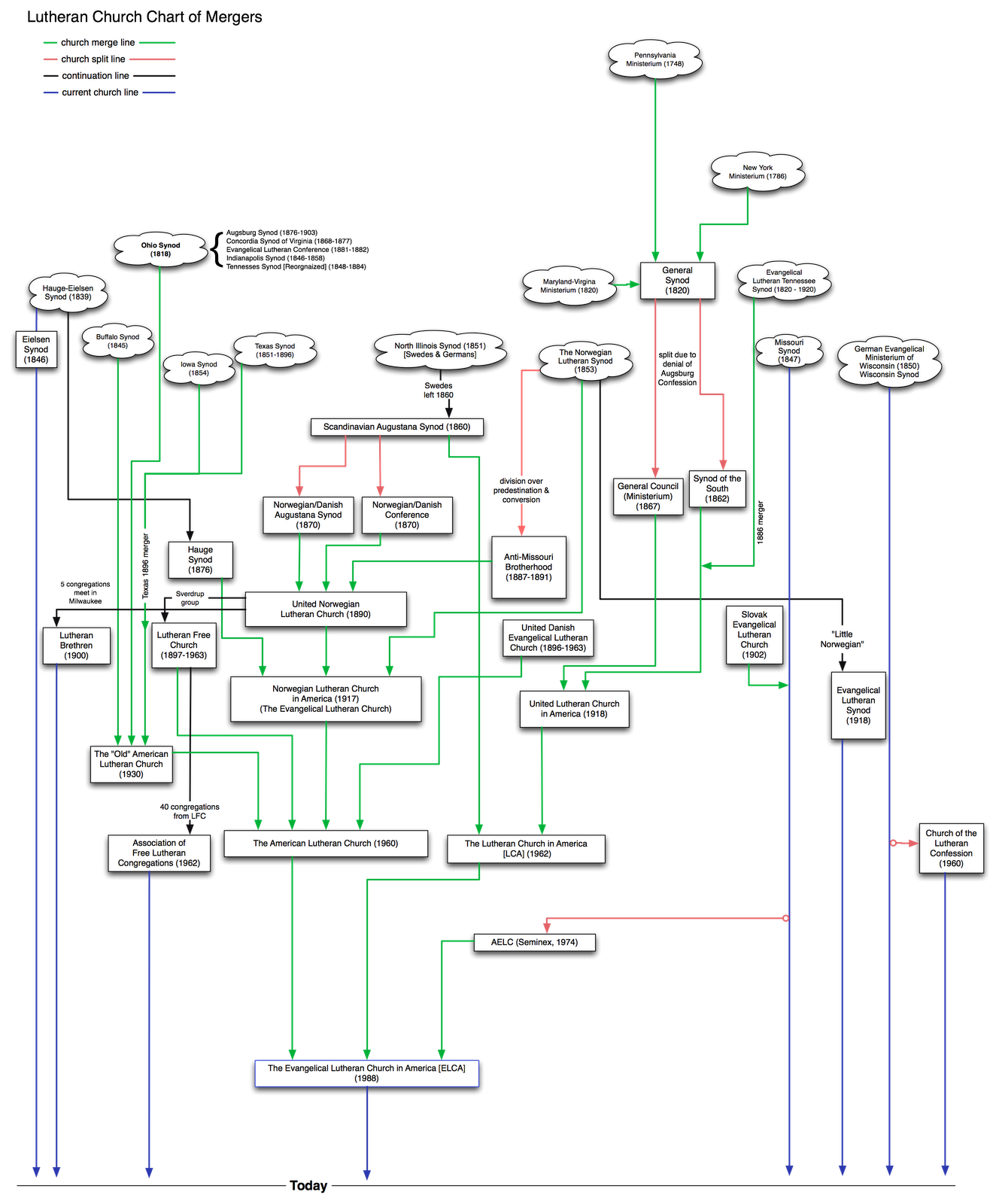
While the early Scandinavians were quick to work with Anglicans, later waves of (mostly German) immigrants were more wary of working with others because they had been oppressed and persecuted by Reformed leaders in their old countries. These “Old Lutherans” held to the Lutheran Confessions, and started many Lutheran churches in America in the 1800’s. These various bodies have been in and out of fellowship at various times. The chart below does a good job at showing some of the links between bodies, but it doesn’t note all the times that each body was in communion with the others (Basically all of Lutheranism in America was in fellowship from 1866 to the turbulent 1960’s as the General Council of the Evangelical Lutheran Church in North America.):


Today, the ecumenism-at-the-cost-of-doctrine/potically-Left-leaning Lutherans have all merged into the ELCA. It is in full pulpit and altar fellowship with the Episcopal Church and several Reformed bodies. Confusingly, it is also home to small pockets of doctrinally-traditional Lutherans (Confessional Lutherans) who have managed to stay the course.

Confessional Lutherans have maintained the beliefs of the original Lutheran Reformers in the LCMS, WELS and ELS. Those three bodies do not currently share full pulpit and altar fellowship (mostly due to a few misguided decisions of the LCMS during the 1960’s, and continued disagreement over whether women’s suffrage at congregational meetings is permitted by Scripture), but their leaders still meet to discuss theology and whatnot at various conferences.

If dichotomies are your thing, a good way to think of Lutheranism today is in terms of the International Lutheran Council (Conservative) and Lutheran World Federation (Liberal).

Clear as mud?

 
WELS is Wisconsin Evangelical Lutheran Synod. ELS is Evangelical Lutheran Synod. They are in full fellowship with each other, and are often shorthanded as WELS/ELS. They are not in fellowship with the Lutheran state or formerly-state churches.

Firstly, history is complex; no account will be totally comprehensive. That said, the basics from Bible Hub are the most [generally] accurate that I’ve found online.

Lutheranism in the US is not dissimilar to Orthodoxy, in that various Lutheran bodies started missions without communicating with other bodies (communication wasn’t exactly easy in 1619). So there were many overlapping and, in some cases, competing jurisdictions. This was a benefit at times, when entire Lutheran synods would call other Lutheran synods to repentance from unsound doctrine. Entire synods would break fellowship until the issue was fixed, then return to fellowship. (Sound familiar Orthodox, friends?) Language barriers and leftover nationalism in the New World was also an issue. It didn’t simplify things any that the European secular powers traded/conquered land from each other and imposed their own laws regarding religion. European politics did more to sow confusion than anything.

The Danes, Dutch and Swedes emigrated first, followed by several waves of Germans. Each group brought with them their respective cultures and worship rubrics that had developed through the centuries. Generally, the Scandinavian Lutherans tended to be more “high church” (which makes sense, as they always maintained their bishops and the traditional hierarchy and canons). The Germanic Lutherans tended to be a bit more focused on the local church, rather than church order. Rather than bishops, they used “Superintendents,” who essentially did the same things. Despite these differences, their theology was identical in the essentials; generally, none had any difficulty sharing pulpit or altar fellowship with the others. Most of those early Lutheran churches ended up in English lands, so they eventually became Episcopalian, which they remain today.

While the early Scandinavians were quick to work with Anglicans, later waves of (mostly German) immigrants were more wary of working with others because they had been oppressed and persecuted by Reformed leaders in their old countries. These “Old Lutherans” held to the Lutheran Confessions, and started many Lutheran churches in America in the 1800’s. These various bodies have been in and out of fellowship at various times. The chart below does a good job at showing some of the links between bodies, but it doesn’t note all the times that each body was in communion with the others (Basically all of Lutheranism in America was in fellowship from 1866 to the turbulent 1960’s as the General Council of the Evangelical Lutheran Church in North America.):

http://1.bp.blogspot.com/_J6xqrkD5O...ACA/AQWBegDNBz0/s1600/LutheranMergerChart.png

Today, the ecumenism-at-the-cost-of-doctrine/potically-Left-leaning Lutherans have all merged into the ELCA. It is in full pulpit and altar fellowship with the Episcopal Church and several Reformed bodies. Confusingly, it is also home to small pockets of doctrinally-traditional Lutherans (Confessional Lutherans) who have managed to stay the course.

Confessional Lutherans have maintained the beliefs of the original Lutheran Reformers in the LCMS, WELS and ELS. Those three bodies do not currently share full pulpit and altar fellowship (mostly due to a few misguided decisions of the LCMS during the 1960’s, and continued disagreement over whether women’s suffrage at congregational meetings is permitted by Scripture), but their leaders still meet to discuss theology and whatnot at various conferences.

If dichotomies are your thing, a good way to think of Lutheranism today is in terms of the International Lutheran Council (Conservative) and Lutheran World Federation (Liberal).

Clear as mud?
Well, a little clearer to us poor non Lutherans now than our knowledge was before reading your post.
 
WELS is Wisconsin Evangelical Lutheran Synod. ELS is Evangelical Lutheran Synod. They are in full fellowship with each other, and are often shorthanded as WELS/ELS. They are not in fellowship with the Lutheran state or formerly-state churches.

Firstly, history is complex; no account will be totally comprehensive. That said, the basics from Bible Hub are the most [generally] accurate that I’ve found online.

Lutheranism in the US is not dissimilar to Orthodoxy, in that various Lutheran bodies started missions without communicating with other bodies (communication wasn’t exactly easy in 1619). So there were many overlapping and, in some cases, competing jurisdictions. This was a benefit at times, when entire Lutheran synods would call other Lutheran synods to repentance from unsound doctrine. Entire synods would break fellowship until the issue was fixed, then return to fellowship. (Sound familiar Orthodox, friends?) Language barriers and leftover nationalism in the New World was also an issue. It didn’t simplify things any that the European secular powers traded/conquered land from each other and imposed their own laws regarding religion. European politics did more to sow confusion than anything.

The Danes, Dutch and Swedes emigrated first, followed by several waves of Germans. Each group brought with them their respective cultures and worship rubrics that had developed through the centuries. Generally, the Scandinavian Lutherans tended to be more “high church” (which makes sense, as they always maintained their bishops and the traditional hierarchy and canons). The Germanic Lutherans tended to be a bit more focused on the local church, rather than church order. Rather than bishops, they used “Superintendents,” who essentially did the same things. Despite these differences, their theology was identical in the essentials; generally, none had any difficulty sharing pulpit or altar fellowship with the others. Most of those early Lutheran churches ended up in English lands, so they eventually became Episcopalian, which they remain today.

While the early Scandinavians were quick to work with Anglicans, later waves of (mostly German) immigrants were more wary of working with others because they had been oppressed and persecuted by Reformed leaders in their old countries. These “Old Lutherans” held to the Lutheran Confessions, and started many Lutheran churches in America in the 1800’s. These various bodies have been in and out of fellowship at various times. The chart below does a good job at showing some of the links between bodies, but it doesn’t note all the times that each body was in communion with the others (Basically all of Lutheranism in America was in fellowship from 1866 to the turbulent 1960’s as the General Council of the Evangelical Lutheran Church in North America.):

http://1.bp.blogspot.com/_J6xqrkD5O...ACA/AQWBegDNBz0/s1600/LutheranMergerChart.png

Today, the ecumenism-at-the-cost-of-doctrine/potically-Left-leaning Lutherans have all merged into the ELCA. It is in full pulpit and altar fellowship with the Episcopal Church and several Reformed bodies. Confusingly, it is also home to small pockets of doctrinally-traditional Lutherans (Confessional Lutherans) who have managed to stay the course.

Confessional Lutherans have maintained the beliefs of the original Lutheran Reformers in the LCMS, WELS and ELS. Those three bodies do not currently share full pulpit and altar fellowship (mostly due to a few misguided decisions of the LCMS during the 1960’s, and continued disagreement over whether women’s suffrage at congregational meetings is permitted by Scripture), but their leaders still meet to discuss theology and whatnot at various conferences.

If dichotomies are your thing, a good way to think of Lutheranism today is in terms of the International Lutheran Council (Conservative) and Lutheran World Federation (Liberal).

Clear as mud?
And there were some really early Lutherans (1709-1711) in New York in the Hudson and Schohairie valleys. My dad’s family was from the “East Camp” Palatine group. Interestingly, the Lutherans and the Reformed often shared a single log church, with respective pastors baptizing as they came through.

History of St. Paul’s

Some of these churches were eventually absorbed into what became the ELCA.
 
Status
Not open for further replies.
Back
Top