WELS is Wisconsin Evangelical Lutheran Synod. ELS is Evangelical Lutheran Synod. They are in full fellowship with each other, and are often shorthanded as WELS/ELS. They are not in fellowship with the Lutheran state or formerly-state churches.
Firstly, history is complex; no account will be totally comprehensive. That said, the basics from
Bible Hub are the most [generally] accurate that I’ve found online.
Lutheranism in the US is not dissimilar to Orthodoxy, in that various Lutheran bodies started missions without communicating with other bodies (communication wasn’t exactly easy in 1619). So there were many overlapping and, in some cases, competing jurisdictions. This was a benefit at times, when entire Lutheran synods would call other Lutheran synods to repentance from unsound doctrine. Entire synods would break fellowship until the issue was fixed, then return to fellowship. (Sound familiar Orthodox, friends?) Language barriers and leftover nationalism in the New World was also an issue. It didn’t simplify things any that the European secular powers traded/conquered land from each other and imposed their own laws regarding religion. European politics did more to sow confusion than anything.
The Danes, Dutch and Swedes emigrated first, followed by several waves of Germans. Each group brought with them their respective cultures and worship rubrics that had developed through the centuries.
Generally, the Scandinavian Lutherans tended to be more “high church” (which makes sense, as they always maintained their bishops and the traditional hierarchy and canons). The Germanic Lutherans tended to be a bit more focused on the local church, rather than church order. Rather than bishops, they used “Superintendents,” who essentially did the same things. Despite these differences, their theology was identical in the essentials; generally, none had any difficulty sharing pulpit or altar fellowship with the others. Most of those early Lutheran churches ended up in English lands, so they eventually became Episcopalian, which they remain today.
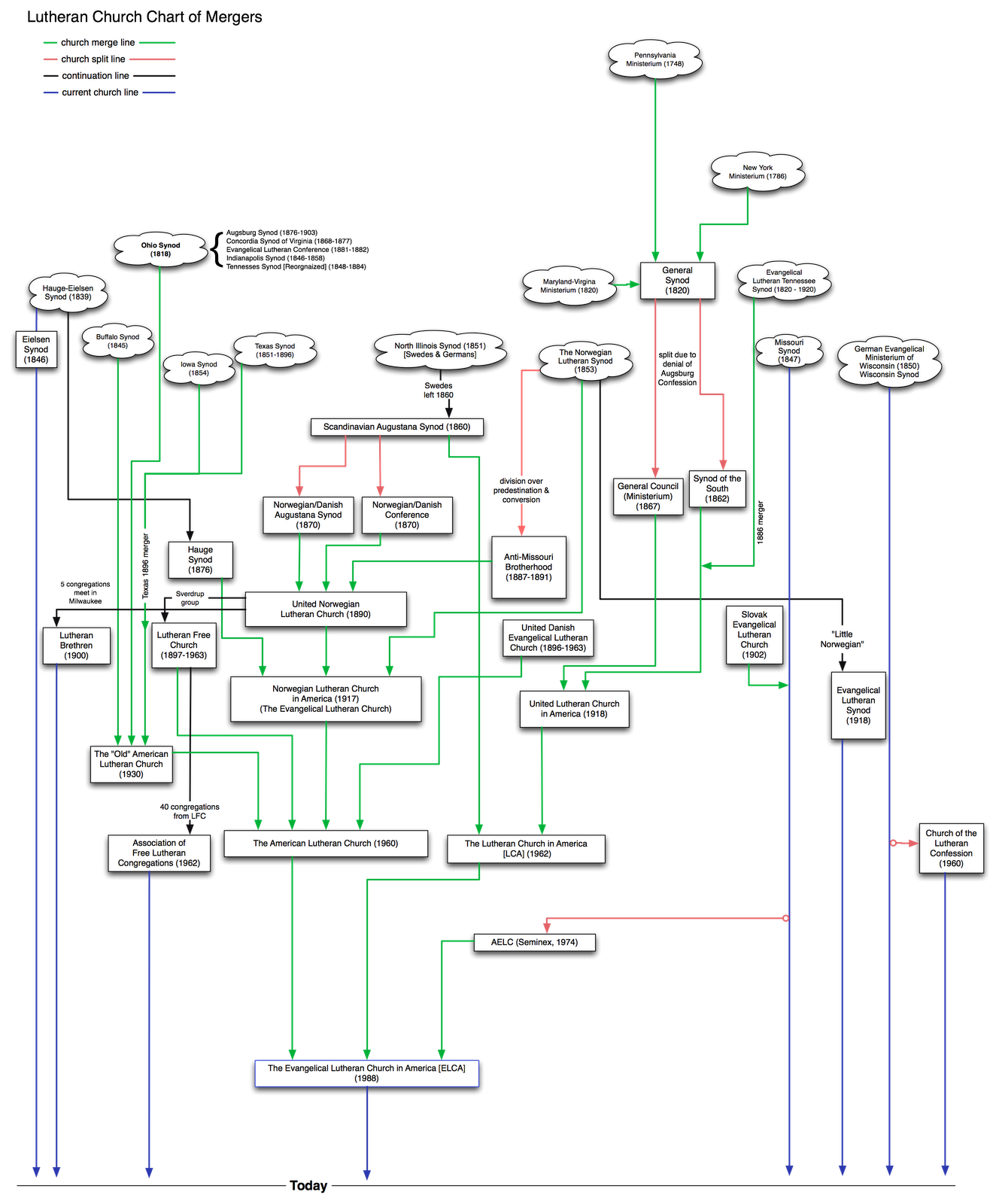
While the early Scandinavians were quick to work with Anglicans, later waves of (mostly German) immigrants were more wary of working with others because they had been oppressed and persecuted by Reformed leaders in their old countries. These “Old Lutherans” held to the Lutheran Confessions, and started many Lutheran churches in America in the 1800’s. These various bodies have been in and out of fellowship at various times. The chart below does a good job at showing some of the links between bodies, but it doesn’t note all the times that each body was in communion with the others (Basically all of Lutheranism in America was in fellowship from 1866 to the turbulent 1960’s as the
General Council of the Evangelical Lutheran Church in North America.):
http://1.bp.blogspot.com/_J6xqrkD5O...ACA/AQWBegDNBz0/s1600/LutheranMergerChart.png
Today, the ecumenism-at-the-cost-of-doctrine/potically-Left-leaning Lutherans have all merged into the ELCA. It is in full pulpit and altar fellowship with the Episcopal Church and several Reformed bodies. Confusingly, it is also home to small pockets of doctrinally-traditional Lutherans (Confessional Lutherans) who have managed to stay the course.
Confessional Lutherans have maintained the beliefs of the original Lutheran Reformers in the LCMS, WELS and ELS. Those three bodies do not currently share full pulpit and altar fellowship (mostly due to a few misguided decisions of the LCMS during the 1960’s, and continued disagreement over whether women’s suffrage at congregational meetings is permitted by Scripture), but their leaders still meet to discuss theology and whatnot
at various conferences.
If dichotomies are your thing, a good way to think of Lutheranism today is in terms of the International Lutheran Council (Conservative) and Lutheran World Federation (Liberal).
Clear as mud?