
Papal Problems...:(

  • Thread starter Thread starter Alexius
  • Start date Start date
Status
Not open for further replies.
Hilary

“Concerning the Holy Spirit . . . it is not necessary to speak of him who must be acknowledged, who is from the Father and the Son, his sources” (The Trinity 2:29 [A.D. 356]).

Epiphanius

“The Father always existed and the Son always existed, and the Spirit breathes from the Father and the Son” (The Man Well-Anchored 75 [A.D. 374]).

Augustine

“If that which is given has for its principle the one by whom it is given, because it did not receive from anywhere else that which proceeds from the giver, then it must be confessed that the Father and the Son are the principle of the Holy Spirit, not two principles, but just as the Father and the Son are one God . . . relative to the Holy Spirit they are one principle” (The Trinity 5:14:15 [ca. A.D. 405]).

Cyril of Alexandria

“Since the Holy Spirit when he is in us effects our being conformed to God, and he actually proceeds from the Father and Son, it is abundantly clear that he is of the divine essence, in it in essence and proceeding from it” (Treasury of the Holy Trinity, thesis 34 [ca. A.D. 424]).
 
Fulgence

“Hold most firmly and never doubt in the least that the same Holy Spirit who is Spirit of the Father and of the Son, proceeds from the Father and the Son” (ibid. 54 [A.D. 524]).
 
It seems that the arguments are strong both for and against Papal Infallibility and Supremacy. Everytime I am ready to take one position, I find an argument that makes more sense and I have to change because I can’t argue with it.
what if we question orthodox churches about when it was ever declared that ecumenical councils had the supreme authority for appeals before the scism, before they separated from the catholic church.
 
Isaiah:

" They hear and hear, but do not understand; see and see, but do not perceive"
 
It just seems like in the early Church, the Emperors took the place as the Pope. The Emperors convened councils and seemed to have a vast amount of power over Church officials, even the Pope. After the Schism, it seems the Popes took the place of the Byzantine Emperor and reserved most of the rights to themselves (they were, afterall, the sole Patriarchs of the West). The Orthodox, on the other hand, continued to be watched by the Emperors, but as the borders became weak, they were unable to hold councils, etc. That’s when they sought reunion. When that didn’t occur and the Empire collapsed, the Orthodox were left with the classical system (without the Emperor, though). This is all speculation, but…

Prayers and petitions,
Alexius:cool:
 
Hilary

“Concerning the Holy Spirit . . . it is not necessary to speak of him who must be acknowledged, who is from the Father and the Son, his sources” (The Trinity 2:29 [A.D. 356]).

Epiphanius

“The Father always existed and the Son always existed, and the Spirit breathes from the Father and the Son” (The Man Well-Anchored 75 [A.D. 374]).

Augustine

“If that which is given has for its principle the one by whom it is given, because it did not receive from anywhere else that which proceeds from the giver, then it must be confessed that the Father and the Son are the principle of the Holy Spirit, not two principles, but just as the Father and the Son are one God . . . relative to the Holy Spirit they are one principle” (The Trinity 5:14:15 [ca. A.D. 405]).

Cyril of Alexandria

“Since the Holy Spirit when he is in us effects our being conformed to God, and he actually proceeds from the Father and Son, it is abundantly clear that he is of the divine essence, in it in essence and proceeding from it” (Treasury of the Holy Trinity, thesis 34 [ca. A.D. 424]).
I once spent a lot of time and effort answering on a thread on the Filioque. Said thread doesn’t exist anymore as far as I know, so I’m not going to repeat.
 
It just seems like in the early Church, the Emperors took the place as the Pope. The Emperors convened councils and seemed to have a vast amount of power over Church officials, even the Pope. After the Schism, it seems the Popes took the place of the Byzantine Emperor and reserved most of the rights to themselves (they were, afterall, the sole Patriarchs of the West). The Orthodox, on the other hand, continued to be watched by the Emperors, but as the borders became weak, they were unable to hold councils, etc. That’s when they sought reunion. When that didn’t occur and the Empire collapsed, the Orthodox were left with the classical system (without the Emperor, though). This is all speculation, but…

Prayers and petitions,
Alexius:cool:
That the Church has not held another Ecumenical Council does not mean that she hasn’t had councils. There have been several Pan-Orthodox Councils: Constantinople IV (879), Constantinople V (1341-1351), Iasi (1642), Jerusalem (1672),etc. Btw, the three patriarchs under the Muslims were unable to participate in the last Ecumenical Council, so it was only Old and New Rome. That doesn’t make it any less Ecumenical.
 
what if we question orthodox churches about when it was ever declared that ecumenical councils had the supreme authority for appeals before the scism, before they separated from the catholic church.
We are the Catholic Church.

“Just as the four books of the holy gospel, so also I confess to receive and venerate four councils.” Pope Gregory the Great of Rome, 6th cent.
 
How about pre-Constantinian times?
That actually is at the crux of the issue about Ecumenical Councils. It is not that the emperor called them that made them Ecumenical. It is that the Church was able to function as a legal institution that made them humanly possible, the ability to gather from all the Churches in one place to address an issue and submit it to the Church as a whole.
 
We are the Catholic Church.

“Just as the four books of the holy gospel, so also I confess to receive and venerate four councils.” Pope Gregory the Great of Rome, 6th cent.
first my question was not answered. i dont deny you being in the catholic church just not in communion with the one holy catholic church of Peter’s successor the key holder.
 
It just seems like in the early Church, the Emperors took the place as the Pope. The Emperors convened councils and seemed to have a vast amount of power over Church officials, even the Pope. After the Schism, it seems the Popes took the place of the Byzantine Emperor and reserved most of the rights to themselves (they were, afterall, the sole Patriarchs of the West). The Orthodox, on the other hand, continued to be watched by the Emperors, but as the borders became weak, they were unable to hold councils, etc. That’s when they sought reunion. When that didn’t occur and the Empire collapsed, the Orthodox were left with the classical system (without the Emperor, though). This is all speculation, but…

Prayers and petitions,
Alexius:cool:
No one is supporting the idea of an emperor running the church.

When civil authorities come to dominate the church anywhere it is always an abuse. East and west secular princes and kings seized the power to select bishops away from the local synods.

Bishops of Rome also were selected in this manner, sometimes directly by one powerful prince or indirectly by influencing the electors, for a long period (several centuries) it was also the political football of powerful old families in central Italy. Later for a time influenced by the royal monarchy of the Holy Roman empire and still later of France. This is always abuse at any level, but the church has muddled through it everywhere at different times.

But that kind of abuse was not always the case in the east nor the west. In the East as the borders of empire shrank the administration of the church returned by degrees to a model closer to the pre-Constantinian model. The local synods regained their independence, which is why John V Palaiologos (whose mother was a Latin Catholic from Savoy) could not trade the church for military support.

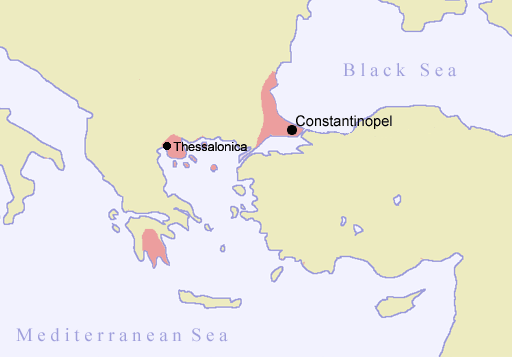
Here is a map of the Byzantine empire at the time of the Council of Florence…


For military support, the emperor tried to pawn the entire communion of Orthodox churches from North Africa, across the Levant, the Balkans and all the way to the Arctic circle! These churches had been free of any influence of his court for generations, and were governing themselves normally as local synods. In essence, one small country was attempting to barter something that did not rightfully belong to him for political reasons. The era was long past that he could do such a thing.

Through each difficult period, the church in east and west endured the imposition of outside influence, and snapped back after the age had passed. So here we are in the current age with a church in the east relatively free from outside dominance by the any of the dozens of civil authorities in dozens of countries through the Levant, Africa the Balkans or Eastern Europe and the church is functioning under a model much closer to the Apostolic process.

In the west the church is also relatively free from abuse and dominance from civil authorities these days but it long ago diverged from the Apostolic model and has chosen to enshrine a medieval patch job model of governance in dogma rather than allow the local synods the ability to select their own bishops as was the case before Constantine. The Papacy was able to preserve and reinforce it’s position into modern time by making concordats with various governments, beginning with Napoleon (if I am not mistaken).

We don’t need that western model and we don’t want it. The ultramontane model is not Apostolic and not proper to the church.

Michael
 
It just seems like in the early Church, the Emperors took the place as the Pope. The Emperors convened councils and seemed to have a vast amount of power over Church officials, even the Pope. After the Schism, it seems the Popes took the place of the Byzantine Emperor and reserved most of the rights to themselves (they were, afterall, the sole Patriarchs of the West). The Orthodox, on the other hand, continued to be watched by the Emperors, but as the borders became weak, they were unable to hold councils, etc. That’s when they sought reunion. When that didn’t occur and the Empire collapsed, the Orthodox were left with the classical system (without the Emperor, though). This is all speculation, but…

Prayers and petitions,
Alexius:cool:
you mean the emperors were popes for the west orthodox? they decided and resolved the problem when dispute would come up in matters of faith and doctrines with the bishops?
 
“Eucharistic ecclesiology.”

is this a believe of the apostles time?

is this what the early christians believed?

or is this a new theology on the west?
 
*When the evangelists recount how Jesus selected the twelve, Peter is at the top of the list in Mark 3:16; Luke 6:14

*When the evangelists mention the apostles together, Peter is often singled out from the group in a way that is not done with any other people in Mark 1:36; 16:7; Luke 9:32

*When the collectors of the Temple tax approached the apostles for the annual half-shekel, they approached Peter in Matthew 17:24-27

*When Peter spoke with Jesus, he often did so on behalf of the twelve such as found in Mark 8:29; Luke 12:41; John 6:66-69

*Peter was one of three apostles given special attention by Jesus as seen in Mark 5:37; Mark 9:2; Mark 14:33

*Peter was also one of the three who were renamed by Jesus as found in Mark 3:16; Mark 3:17

*On the night of the betrayal, Jesus told Peter that he had prayed for him personally that he might turn again and stead the faith of his brother apostles as read in Luke 22:31-32

*On Easter morning, Peter and John raced to the tomb. Peter was allowed in first as found in John 20:3-8

*Later on Easter day, Jesus appeared to Peter in private making him the first witness to the resurrection as found in Luke 24:34; 1 Cor 15:5

*Jesus made promises to Peter that he never made to any other apostle. He promised to build his Church on Peter in Matthew 16:18 and that he alone would be the keeper of the keys in Matthew 16:19 and that he alone would be the head shepherd in charge of Christ’s sheep in John 21:15-17.

No other apostle figures so prominently in NT history. No other apostle is asked to shoulder such responsibilities. If you believe Scripture, it is clear that Peter held the position of primacy.

See also:

**Acts 1:15-26 **Soon after Jesus ascended, it was Peter who initated and oversaw the replacement of Judas

Acts 2:14-36 - Peter delivered the inaugural sermon of Church history to the throngs of Jerusalem

Acts 2:37-41 - Peter urged them to repent and receive Baptism

Acts 3:1-10 - Peter performed the first healing in Church history

Acts 4:5-12 - Peter was the one who addressed the Sanhedrin and gave powerful witness to the gospel

Acts 5:1-11 - Peter handles the first recorded case of ecclesial discipline exercised in Church history

Acts 8:14-17 - As the gospel spread to Samaria, it was Peter who brought the Spirit to endorse this new mission

Acts 10:1-48 - when God arranged for the first Gentile conversions, Peter was sent

Acts 15:6-11 - When the first recorded council in Church history convened in Jerusalem, it was Peter who stood up to end the debate with a solemn proclamation of Christian doctrine

If you have read while accompanied by the Holy Spirit the wealth of information on Catholic Answers in regard to Peter, the Primacy, Apostolic Succession and what Infallibility REALLY means you already possess the truth. What you do with it is up to you.

Peace be with you,

Kelly
 
Status
Not open for further replies.
Back
Top