It has some errors in it I think. It does depict the brutality of the Passion for sure but, scholars and historians believe that Jesus only carried the cross bar of the cross to his crucifixion, which was common Roman practise. He didn’t carry the full on cross. Rest assured though that cross bar was heavy and I do believe Simon did help Jesus carry this.
That is not the only historical inaccuracy in the film. There are actually a lot of it (NOTE: Don’t take the following list as derailing The Passion of the Christ; I just collected the following historical tidbits from the internet and whatnot):
THE NITPICKER’S LIST OF THE HISTORICAL INACCURACIES WITHIN THE PASSION
-In the film, the garments of the Jews are depicted as similar to that of present-day Arabs whereas by the 1st century, Jews would have worn clothes which would rather resemble Roman clothing in many places; save that they have tassels (tsitsit) on their garments in obedience to the Law.
-In the film, the Roman soldiers’ armor (their Lorica Segmentata) is made of leather (true Roman armor is made of metal) and the helmets they wear rather resemble
Imperial Gallic-type helmets, which only came into use by the late 1st-early 2nd century; by the time of Jesus Roman soldiers would have used Coolus-type helmets (examples
here and
here).
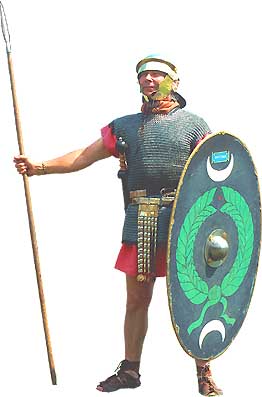
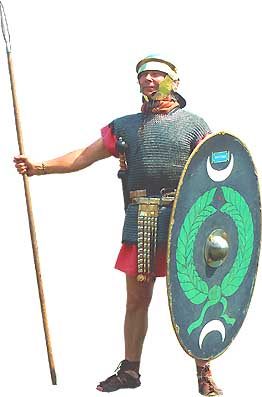
Note that the type of armor shown in the Passion of the Christ (and in most movies about Jesus) are Legionary armor. But more likely, the soldiers who crucified Jesus were probably not part of a Roman legion, but were Auxiliaries. Since Judea at the time of Jesus’ birth was a client kingdom, ruled by Herod the Great under Rome’s authority, He probably would have had his own troops for security and general military needs, though Rome may have sent him temporary reinforcements when necessary. Some thirty years later, by the Crucifixion, Judea had become an equestrian province with Pontius Pilate as the current procurator or prefect. He was of equestrian rank, not a senator, and therefore was not of high enough status to command a legion.
A Roman auxiliary would have dressed like this (note the use of mail armor):
-The Aramaic in the film is not THE actual Aramaic as used by Galileans and Judeans at the 1st century respectively (
Old Judean and
Galilean Aramaic respectively), but is a reconstruction based on Hebrew, 4th century Syriac and Post-Achaemenid Imperial Aramaic (aka
Biblical Aramaic, due to its use in Daniel and Ezra), which became widespread in the western Persian Empire in 500 BC (to his credit, at least Fr. Fulco SJ did a painstaking and great job)
-Herod Antipas is depicted as a flamboyant, rather effeminate man with a rather decadent-looking court (which comes from medieval Passion Plays) whereas Josephus records (and the Gospels testify indirectly) that Herod is somewhat of a womanizer. (Thus I honestly never really liked the film Herod)
-Despite iconography starting from the late Medieval period depicting Jesus crucified with three nails (two in both hands and one in the feet, which are jouned together on a stand); it is more likely that the Romans crucified someone with four nails (as per early iconography), which are driven somewhere around the region of the feet (for example, the heels). A piece of wood is nailed on the cross as a ledge where a crucified man can rest. This is called a
sedile (there are reported cases where nails are also driven through the genitals to fix the body into the sedile)
-Not really a nitpick, but a question: Isn’t it odd that the Two Thieves are less bloodied than Jesus, indeed they do not seem to have much wounds at all excluding the nail wounds, when they should have been as blood-covered as Him (scourging being a preliminary part of crucifixion)?


 **believed in Jesus’ resureection. She asked me like I was crazy but this is the same girl who believes in and watches all those ghost hunter shows. She may not believe in a risin Lord but she believes in ghosts…which btw just look like glare on the camera. I don’t think a picture of a light blob qualifies as proof of ghosts.