Pope Francis denounces ‘trickle-down’ economic theories in critique of inequality

  • Thread starter Thread starter Birdpreacher
  • Start date Start date
Status
Not open for further replies.
Bailouts are not a conservative position. It’s government picking winners and losers.
It’s not only bailouts. What about those that know how to game the system? Take someone like Trump, for example. Borrows to the limit, pockets a lot of profit, and then declares his company bankrupt. Do that four times and then wonder why groups like the Occupy Party come to be.
 
“Both Republicans and Democrats should be happy to hear Pope Francis-”
I was beginning to think I would never hear those words spoken and frankly as a Catholic I felt it was a terrible scandal for
Catholics to be so plagued by divisiveness. Don’t misunderstand me . There is a real need for Conservatives and Progressives to have
strong positions in dialogue. That is healthy. Scripture tells us Our struggle is not against flesh and blood but against the spiritual powers of darkness." The way these powers divide us against one another is through “ideologies” - Insidiously extreme concepts of right and wrong. Ideologies take some part of truth and hold it as right so that
anyone who disagrees with them is wrong. In other words they make the part of truth stand for the whole and for Catholics Only Christ
is the Living Fullness of Truth. The tragedy then is that they cannot dialogue with each other even though what the other has is just
what each side needs. These dark powers are m(name removed by moderator)ulating both parties.
Divisiveness is a great evil because it is diametrically opposed to what Jesus prayed for and made the main intention of his
Sacrificial Offering at the Last Supper. “That they may be One in Me, Father-as You and I are One.”
 
For most on the bottom rungs of society, trickle-down equals being trickled on.
 
It’s not only bailouts. What about those that know how to game the system? Take someone like Trump, for example. Borrows to the limit, pockets a lot of profit, and then declares his company bankrupt. Do that four times and then wonder why groups like the Occupy Party come to be.
One of the problems is that our bankruptcy laws give an incentive to take excessive risks. After all, if the market moves against you then you just pass off the loss to the lender. There is nothing morally redeeming about leveraging yourself to the hilt, having the market move in your favor and then walking away with a bundle.
 
=ProVobis;11453348]It’s not only bailouts. What about those that know how to game the system? Take someone like Trump, for example. Borrows to the limit, pockets a lot of profit, and then declares his company bankrupt.
I think you’re talking about crony capitalism and I’m not sure if Trump participates in that, but maybe you just mentioned because you are trying desperately to pin this on the right?
Do that four times and then wonder why groups like the Occupy Party come to be.
:rotfl:

You mean the group that was formed in the hopes of getting young people out to vote against Romney to get Obama re-elected? Or did you really think it was about noble principle?

And how about those rape tents?
 
The righties aren’t doing that much better. Remember Solomon Bros, Bear Stearns, Novastar, AIG, Lehman Bros, etc? They were in that beggar category themselves.
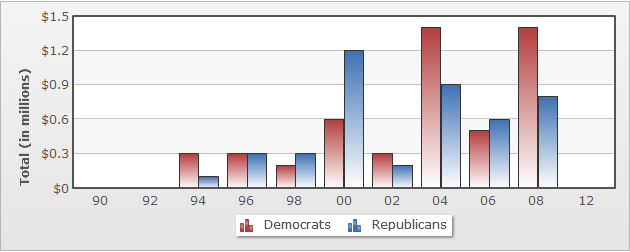
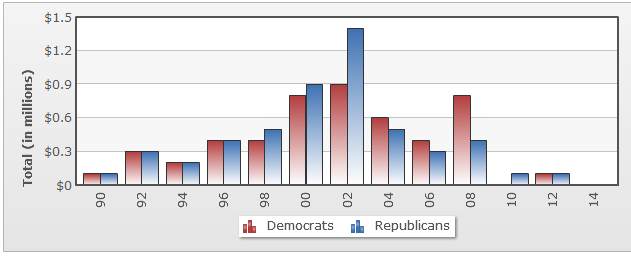
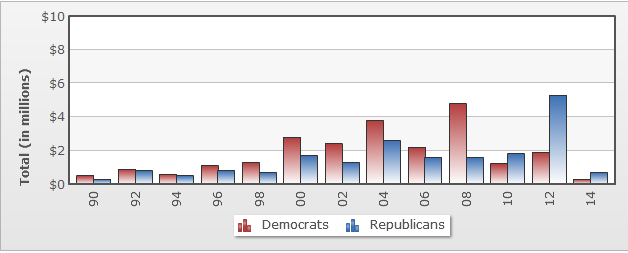
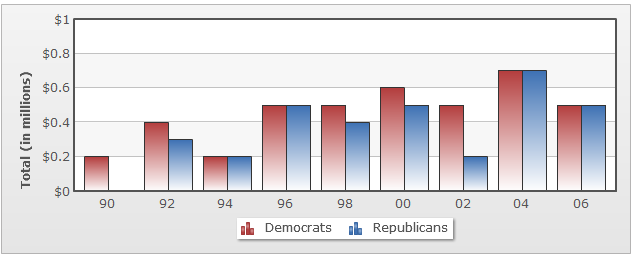
I would not necessarily assume that banks and investment firms are automatically “righties”

For example,

Lehman Brothers:


AIG:


Goldman Sachs:


Bear Stearns:


You would also find the same thing with the “military-industrial complex” and other large industries. In general, these folks will contribute to candidates where they feel they have the biggest bang for the buck.

One other point, if you think about Porter’s Five Forces model, it is in the interest of big industry to lobby for government regulation…as it acts as a barrier to entry for potential competitors.

NOTE: I am not saying that industries are big lefties either…but political alignment is not something that should be assumed.
 
Oh, is that why big governments in the Third World are so prosperous? :rolleyes:
Actually, most third world countries have a small government as a fraction of GDP. For example, Guatemala’s government takes up 13.7% of GDP. Haiti is 18.2% of GDP.
 
There have been several responses to Pope Francis recent letter but this is one of the best so far:

nationalreview.com/corner/365004/pope-francis-and-poverty-samuel-gregg

Perhaps the simplest criticism is of his naive treatment of Islam:

Simply put, our pope is demonstrably and gavely wrong on this matter as even a cursory review will reveal. The most generous interpretation is that the pope is expressing a wish or preferene or seating himself as the supreme imam of Islam and thereby issuing an authoritative teaching.

His pronouncements on economics are more complicated but equally troubling insofar as they advance a straw man argument: that unfettered capitalism is anywhere to be found. It is sad, indeed, to see the supreme teacher of the world advancing an argument by means of fallacy.
I very much like and appreciate the direction Pope Francis has taken. Sometimes, he has had to correct the record to show that he is in line with past popes, Pope Benedict for example. Paragraph 253 of Evangelii Gaudium may be one such instance.

In Paragraph 253 of Evangelii Gaudium, the statement that “the proper reading of the Koran are opposed to every form of violence,” is is profoundly wrong in a way that cannot be reconciled with either the facts of the Qur’an as stated and defined by Islam or with reason. A brief review of a few Quranic verses from the perspective of a text of Islamic law will explain.

The Islamic law of record in English, Reliance of the Traveller, is approved by the Muslim Brotherhood in America, the Islamic world through the OIC’s Fiqh Academy in Jedda, and by the al-Azhar, the entity with which the Vatican undertakes its interfaith effort. It is sold in most mosque affiliated bookstores and at Islamic events that senior members of the USCCB attend.

Reliance defines jihad as “warfare against non-Muslims … to establish the religion (of Islam).” (Reliance, 599) It goes on and provides a Quranic basis for jihad, making it a divine requirement when stating that “the scriptural basis for jihad, prior to scholarly consensus is such Koranic verses as: (1) “Fighting is prescribed for you” (Koran 2:216); (2) “Slay them wherever you find them” (Koran 4:89); (3) “Fight the idolators (sic) utterly” (Koran 9:36); and such hadiths as the one related by Bukhari and Muslim that the Prophet (Allah bless him and give him peace) said: ‘I have been commanded to fight people until they testify there is no god but Allah and that Muhammad is the Messenger of Allah,’ …” (Reliance, 599)

Bukhari is the most authoritative hadith scholar in Islam. From his collection Sahih Bukhari, it states “all Muslim scholars are agreed that Sahih Al-Bukhari is the most authentic and reliable book after the Book of Allah” (i.e., the Qur’an). (Sahih Bukhari, cover) When Reliance says “prior to scholarly consensus” or when Sahih Bukhari says “all Muslim scholars are agreed,” they asserting the Islamic doctrine of “Ijma” that makes the claim a universally held tenet of Islam that is apostasy to disobey. From Reliance on Ijma, when the “necessary integrals of consensus exist, the ruling agreed upon is an authoritative part of Sacred Law that is obligatory to obey and not lawful to disobey.” This status becomes permanent once established because once a rule has been “verified by scholarly consensus, (it) is an absolute legal ruling which does not admit of being contravened or annulled.” (Reliance, 24) In the section of “Reliance” on apostasy, it states twice that it is apostasy to violate scholarly consensus (Ijma) (Reliance, 597,8) where the punishment is death. (Reliance, 595)

This means that the explanations for jihad are divine, absolute and irrevocable. It also necessarily means that the statement of Paragraph 253 is absolutely and irrevocably incorrect. This matters.

There is more on point that could be added but for now it is sufficient to point out that whether it’s the Church in America conducting interfaith activities with mosques known to be associated with the Muslim Brotherhood or the Vatican with regard to al-Azhar, they are working with people who believe it is obligatory to lie to them in order to advance Islam’s cause. From Reliance – “If a praiseworthy is attainable through both telling the truth and lying, it is unlawful to accomplish through lying because there is no need for it. When it is possible to achieve such an aim by lying but not by telling the truth, it is permissible to lie if attaining the goal is permissible … and obligatory to lie if attaining the goal is obligatory.” (Reliance, 745)

It is this statement of Islamic law on the duty to lie that makes Paragraph 253 challenge reason. If Church policy is supposed to be based on EG, it raises the question whether, instead of undertaking a direct examination of Islam based on its own published doctrines, those supporting the interfaith effort simply relied on the statements of their Muslim counterparts, almost always easily associated with the Brotherhood, where it is known (or should have been known) that they are required to lie to advance Islam. While Paragraph 253 cannot be shown to align with known Islamic law on the subject matter, it is in line with Muslim Brotherhood narratives that can be shown to be operative.

 
The righties aren’t doing that much better. Remember Solomon Bros, Bear Stearns, Novastar, AIG, Lehman Bros, etc? They were in that beggar category themselves.
The people who have objected to this the strongest and the longest are the Tea Party movement. Obama in fact doubled down on the bailouts and was very much a part of that too big to fail crowd.

Rewarding failure through bailouts is not a position of the right. Conservatives should not be thought of as for big corporations and against the little guys. That is a caricature that the Democratic party uses to put Republicans in a bad light.

But it is simply not true. I would hope that fair minded people who value truth over their own position would stop using these caricatures…
Bailouts are simply not a feature of free enterprise. The extreme of laissez faire economics means to let things be and to let the market find its own way. The right wing of today calls on the government to do less in terms of interfering with and manipulating the markets to serve their own purposes, not more.

I am not sure what the position of the pope would be though. Recall that this kind of bailout was part of the Bush compassionate conservatism package, and the reason why certain banks were deemed too big to fail was that if the banking system failed, it would be people and the little guys who would lose everything.
 
…but political alignment is not something that should be assumed.
I think that’s what my initial argument should have been. I usually get into trouble when I argue the leftie…rightie thing. I spent too much time with the Libertarian Party and studying the Fed. 🙂
The people who have objected to this the strongest and the longest are the Tea Party movement.
But they didn’t get vocal enough at the right time apparently. And then some of their members were carrying “Government get out of my Medicare” placards. Didn’t give them much credibility there.

We’ll see how they protest the (“loose money”) Janet Yellen nomination.
 
One of the problems is that our bankruptcy laws give an incentive to take excessive risks. After all, if the market moves against you then you just pass off the loss to the lender. There is nothing morally redeeming about leveraging yourself to the hilt, having the market move in your favor and then walking away with a bundle.
The only way that banks would lend excessively is that government already underwrites their risks. If the borrower walks away with the bundle, that means the lender is left with the bad debt.
The principles of sound lending are not new principles. It is not just laws and regulations that ensure that the principles are followed but the threat of losing one’s shirt that keeps the bankers themselves in line.

One of the problems that led to the housing bubble was that governments legislated social policy into the lending policy of the banks. It was deemed good to own a home, and government deemed it good social policy that everyone ought to be able to.
Banks were thereby expected to lend to people that they would otherwise not lend to, or face punishment for going against government policy.
This worked out great for the banks, because they received the interest on the loans, high risk or not, as long as the market kept climbing.
And when it burst, the government in effect had underwritten the banks excessive risks through making the laws that encouraged those high profit risks in the first place.

Markets are normally self-correcting, nay they are always self-correcting. With governments enormous fingers on the scales, corrections are merely deferred to a time when the correction become of enormous scale.
 
But they didn’t get vocal enough at the right time apparently. And then some of their members were carrying “Government get out of my Medicare” placards. Didn’t give them much credibility there.

We’ll see how they protest the (“loose money”) Janet Yellen nomination.
The Tea Party got plenty vocal enough right from its inception. They got people’s attention in a big way. I don’t remember them as quiet in any way.
They lost credibility not because they were too lax on government spending, but because the left wing did not like their message and labeled them as racist.
 
Actually, most third world countries have a small government as a fraction of GDP. For example, Guatemala’s government takes up 13.7% of GDP. Haiti is 18.2% of GDP.
Fractions of GDP do not account for regulatory corruption.

Interesting too how you left out Iran and Saudi Arabia.
 
Actually, most third world countries have a small government as a fraction of GDP. For example, Guatemala’s government takes up 13.7% of GDP. Haiti is 18.2% of GDP.
That doesn’t mean that third world countries don’t have economies that are tied up in red tape, and subject to the corruption and graft of government organizations of all kinds. Recall that that was exactly the kind of thing that set off the Arab Spring.

What it does mean is that these governments do not have access to the kind of taxation wealth that would be able to fund social programs such as happens in the big government first world.
 
The only way that banks would lend excessively is that government already underwrites their risks.
Actually, if you read your history, you will see that there have been plenty of times where banks lent excessively without the assistance of the government.
If the borrower walks away with the bundle, that means the lender is left with the bad debt.
The principles of sound lending are not new principles. It is not just laws and regulations that ensure that the principles are followed but the threat of losing one’s shirt that keeps the bankers themselves in line.
And lenders sometimes ignore them. Also there is imperfect information between borrowers and lenders. Borrowers sometimes understate the risks of the projects that they are borrowing money for.
One of the problems that led to the housing bubble was that governments legislated social policy into the lending policy of the banks. It was deemed good to own a home, and government deemed it good social policy that everyone ought to be able to.
Banks were thereby expected to lend to people that they would otherwise not lend to, or face punishment for going against government policy.
This worked out great for the banks, because they received the interest on the loans, high risk or not, as long as the market kept climbing.
And when it burst, the government in effect had underwritten the banks excessive risks through making the laws that encouraged those high profit risks in the first place.
Think of the crash of the jumbo lenders. The government had nothing to do with jumbos and lenders still acted like lemmings. Think of Lehman Brothers, the government did nothing to encourage Lehman purchase risky mortgages from lenders.
Markets are normally self-correcting, nay they are always self-correcting. With governments enormous fingers on the scales, corrections are merely deferred to a time when the correction become of enormous scale.
The problem is, when it comes to other people’s money, there are always incentive problems. Taking excessive risk with a lender’s money is just one of them.
 
Actually, if you read your history, you will see that there have been plenty of times where banks lent excessively without the assistance of the government.
I am sure there have been.🙂
It doesn’t mean that the historic example that I gave was incorrect.
The corrective to bad banking practices must be for the banks to not be rewarded for unsound lending practices. That is the ultimate safeguard.
And lenders sometimes ignore them. Also there is imperfect information between borrowers and lenders. Borrowers sometimes understate the risks of the projects that they are borrowing money for.
I am sure they do. Buyer beware applies to the lines that bankers must follow too.
Fraudulent claims are but one of the difficulties of the business.
Think of the crash of the jumbo lenders. The government had nothing to do with jumbos and lenders still acted like lemmings. Think of Lehman Brothers, the government did nothing to encourage Lehman purchase risky mortgages from lenders.
And what happened to the Lehman brothers? Bad decisions have a way of self-correcting, as painful as that is.
The problem is, when it comes to other people’s money, there are always incentive problems. Taking excessive risk with a lender’s money is just one of them.
The business of taking on risks is a risky business indeed.😉

I don’t think that your examples are disagreeing with me.
 
Status
Not open for further replies.
Back
Top