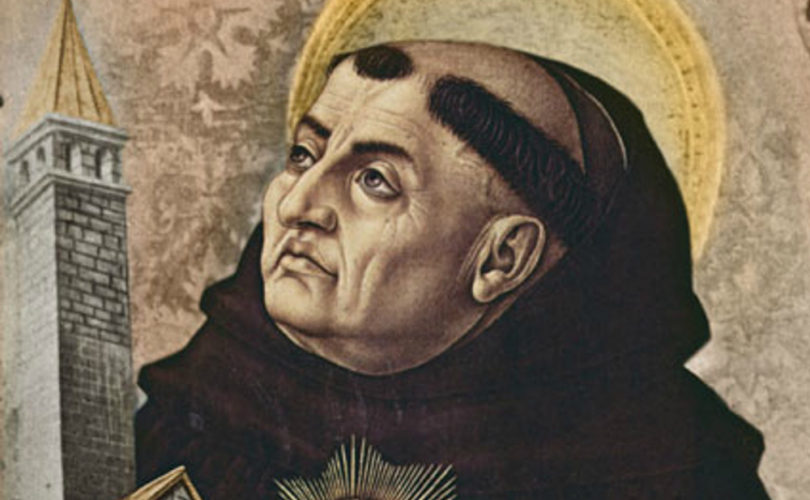
Pope to Jesuits: Help Critics of Amoris Laetitia to See Its Morality Is Thomist

  • Thread starter Thread starter oppositeman13
  • Start date Start date
Status
Not open for further replies.
(Please Note: This uploaded content is no longer available.)
 
I mean no disrespect to the Holy Father but Amoris Laetitia is the furthest thing from being thomist.
 
It is actually risible to call Amoris Laetitia a Thomist document. This is getting more embarrassing by the hour.

At least Cardinals Parolin and Mueller are now calling for discussion. They’re well aware this game is out of control.
 
I think this just shows how well-meaning, intelligent, educated, loving people have become so tangled up by decades of poor communication and poor catechesis that they can sincerely and honestly feel that they are saying X and the ones listening can equally sincerely and honestly feel that they are saying ‘not-X’.

“What we have here is a failure to communicate”. . .with a vengeance.

IMO, what we need is a clear and complete revamping of Catholic teaching a la Baltimore catechism, with a nice little glossary of every new word/concept.

I know we are highly enamored of the idea that ‘nothing is black and white’. Well, I for one don’t want to live in a world where color is so poorly understood that it’s nothing but a gray MESS. I want a world where we know that black is black and white is white, and once we know that we can see that there are SHADES and HUES. We won’t make the mistake of thinking that something that is deep gray is ‘less black and more white’ but rather that it is ‘deep gray’ while something else is full black and another full white. We won’t think that something green should be blue if somebody likes blue better.

We need basics before we can start seeing ‘higher things’. Trouble is, everybody and his mother who can use a device and access Wiki now considers himself/herself an expert ALREADY. News flash. We aren’t.

"Unless ye become as little children’. . .
 
(Please Note: This uploaded content is no longer available.)
 
The Pope deferred to Cdl Schonborn for explaining AL, but we seem to hear nothing from the Cdl.
 
Cardinal Schoenborn has commented several times on Amoris Laetitia since its release. The Pope initially referred to the Cardinal’s intervention at the release of the document two years ago, and it appears he (the Pope) has not changed his opinion.

There are some YouTube videos out there of Schoenborn giving presentations on Amoris Laetitia, one of those to the International Theological Institute, that I would highly recommend watching and rewatching.
 
As a thought, why don’t we take the Pope at his word, presume the morality undergirding Amoris is Thomistic, and read the document with an open copy of the Summa in one hand? A good place to start would be simply to look up the references to the Summa in the footnotes of Amoris.
 

You can find Dominicans who say yes and who say no. Cardinal Schönborn was appointed by Pope Francis to do just this, find that Amoris Laetitia is Thomistic. And so it is. Whether it actually is or not, or whether Amoris Laetitia accords with Scripture or tradition or not is still an open question, subject to debate.
 
Last edited:
With due deference to St. Thomas, calling a work “Thomistic” does not make it so. As experts on ‘both sides’ have noted, some experts see it as such, some see it as not such at all.

Again, it shows what a label-loving, box-loving, sound-byte loving world we have become. If we are told that a word means “X” by those we trust, then by golly we will call it X as well. And if we are told that the same word means not-X by those we trust, we will call it not-X as well. Then you have the enlightening sight of ‘experts’ who are just yelling back and forth, “Yes it is, no it isn’t”. But how few are the ones who will come out and say, "Wait. According to the definition given by person/group/experts A, X means blah blah blah. According to the definition given by person/group/experts B, X means the opposite, halb, halb, halb. Therefore when you hear the word X used, you need to know which GROUP is using the word, because group A will be using it to mean blah and group B will be using it to mean halb. If YOU in your own study have come to understand X as blah, and you’re listening to group B talking about it, you’re going to think they have it crazy wrong; ditto to a halb person listening to group A. BUT you won’t be thinking that the definition ITSELF might be wrong, you’ll be thinking it is all one group or other who ‘gets it right’ and so in essence you aren’t addressing the actual understanding of the word (i.e. Thomistic), you will be either extolling or condemning the group who uses the word the way you think it should be used.

IOW, you aren’t trying to determine the real meaning or get the other group to change their meaning; you’re either building up the group you like, or tearing down the one you don’t, by calling them wrong and stupid, instead of asking both groups, “How did you determine the definition you use? Can you give us examples of what you mean by Thomistic, in 'layman’s terms?” Can you give us a point by point comparison in several places where you can show how a current teaching or understanding in AL parallels teachings in the Summa?"

That way is neutral and it’s truly educational. It doesn’t involve arguments like, “Because I said so” or giving ONE example and just SAYING that it ‘is’ Thomistic, or referring to an expert who isn’t answering questions but who is supposed to have addressed them at various places, you just go through everything he’s written in the last couple of years and somehow you’ll see the ‘correct take’ on AL.

I surely do hope that sooner or later we will start getting people really looking, comparing, and being intellectually honest enough to present ‘both sides’ clearly and fairly.

 
Here is one of the filial corrections signers, Fr. Thomas Crean, O.P. talking about if AL is Thomist or not. I thought the interview was helpful for addressing specific paragraphs and quotes. I don’t like how the automatic titling is summarizing the link though.

 
I think the last time a pope asked the Jesuits to bring about intellectual defense of a papal document was in 1968 when Pope Paul VI asked them to help explain and defend Humanae Vitae. (There was very little defense offered).

Have Jesuit Theologians or philosophers come forward in response to the current call?

I find it odd that the pope would ask the Jesuits rather than the Dominicans to specifically explain how the document is Thomist. I would think there are more Thomist Dominican scholars than Jesuits, but I don’t know.
 
The Pope’s comments were made to a conference of Jesuits in a particular local, not to the Jesuit order as a whole. He was not designating them as official interpreters of Amoris Laetitia, nor was he commissioning them specifically to demonstrate the Thomistic morality which he says undergirds the document. It was more like an attempt to enlist their help.

As has been pointed out, there are Dominicans out there who agree that the undergirding morality in Amoris Laetitia is Thomistic, and there are Dominicans that disagree. The “official” interpreter of the document - Card. Schoenborn - is a Dominican who believes the document itself is Thomistic. That there are Dominicans who disagree with him does not refute his interpretation.

As I’ve said before; let’s take the pope at his word. He claims the document - specifically the undergirding morality - is Thomistic. Let’s pull Amoris off the shelf, actually (and carefully) read the document, and then crack open the Summa and start by looking up the footnotes to gain a better grasp of what the Holy Father is getting at. He says the document is Thomistic, so let’s interpret it through a Thomistic lens. Perhaps that would give us some clarity on the “ambiguities” that so many claim plague the document.
 
+Mueller, like +Burke, has been effectively retired early… very early for a Cardinal. He’s not in the “inner circle” and I doubt anything will come of his comments.
 
The Pope is a Jesuit. That is, I would think, his core identity first and foremost, for that is his vocation - he was called to be a Jesuit and made vows as a Jesuit. It would make sense that he would rely on them in a special way. On another occasion, he also asked Jesuits to teach other priests discernment and to be less “rigid”.
 
How is this possible when one of the footnotes in Amoris Laetitia actually cites one of Thomas Aquinas’ objections as support of a proposition within AL itself?
 
I’ve heard this before, but I can’t remember the specific footnote. Would you mind sharing?
 
Status
Not open for further replies.
Back
Top