Woah, there, I’m not aware that anybody is trying to say that. If that is what you are disputing then I agree with you, but it’s not what the science says so I wonder if you’re arguing against a straw man.
For your information, it was Charles Darwin himself who used that argument. You can find it in his book,
The Origin of Species, Ch. XIV. Begin reading at the last paragraph of p. 338 in the link provided. (Just click on the page or on the edge of the page to turn the page.)
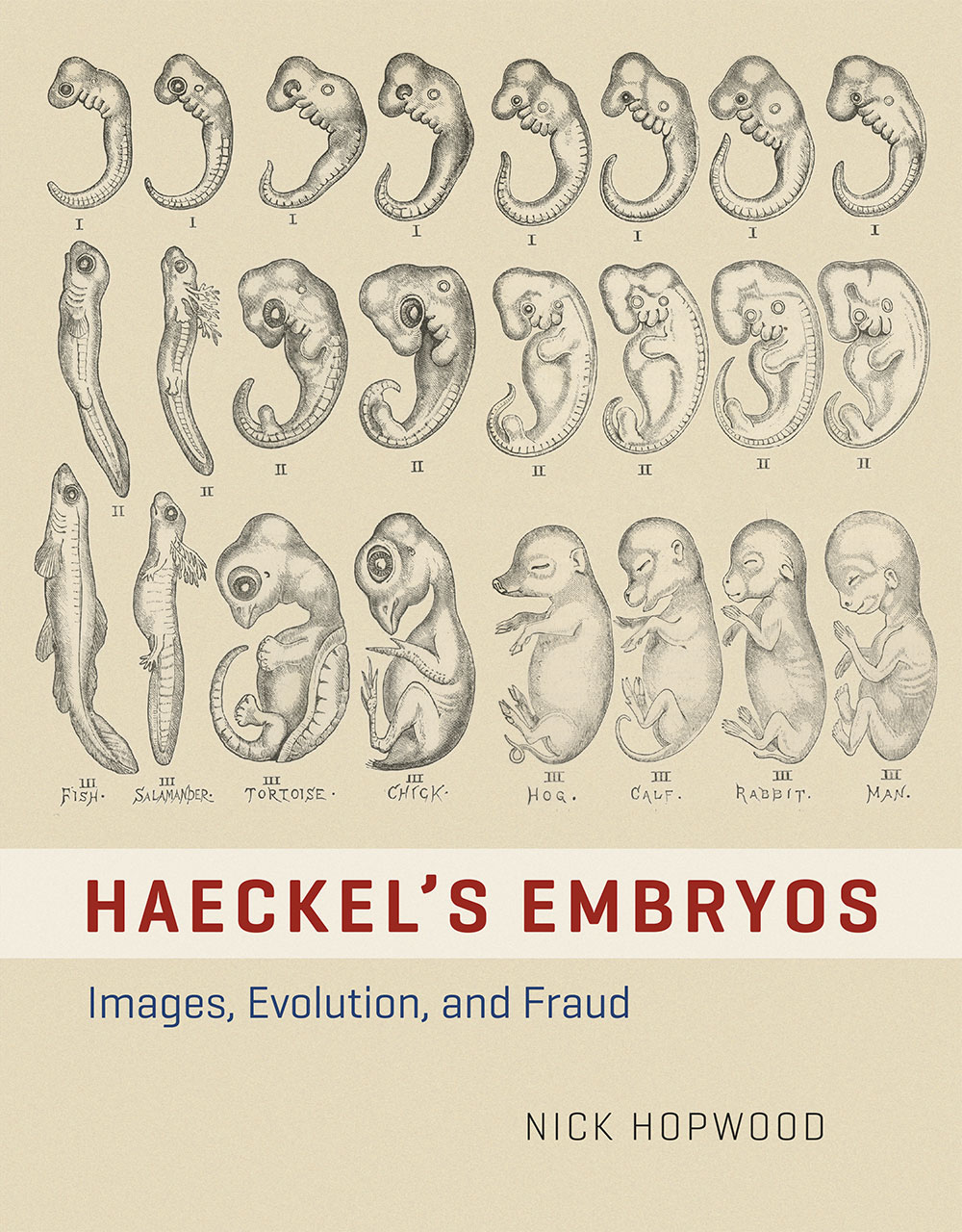
The drawings were made by Prof. Ernst Haeckel, who deliberately tweaked the drawings to make the embryos look alike in the early stages. The fraud was exposed just a few months after he published his book.
As far as I know the same evidence is still being used today. See
this link, for example. It is not a straw man that I just made up. But if you have evidence from embryology that is different from what I presented, this is your opportunity to present it now and I will be happy to review it.
To help me out, can you explain what you would accept as being empirical evidence for evolution?
An empirical evidence is something that can be verified. For example, give me a documented case of a population of interbreeding organisms that has no eyes at any time before time T1, and the same population of interbreeding organisms that developed eyes at a later time T2. The new body part does not have to be an eye. But the development of a new body part, such as an eye, a limb, a wing, etc., in an interbreeding population that previously
never had that part , will be a great argument for super-evolution, rather than a population of organisms that merely changed their appetite, their behavior, their resistance to a harsh environment, the color of their eyes, the size of their limbs, the length of their antennae, etc. These latter examples can be achieved by selective breeding, adaptation and natural selection, but they will not be a good evidence for super-evolution because they do not prove a gain in new genetic information. Equally unacceptable would be the growth of additional organs that were already in an organism (such as a third eye in a two-eyed organism), or the recovery of an organ in the members of a population whose members already had the same organ but lost it. In these cases the genetic information was already in the biocosm, and therefore does not prove a gain in new genetic information.
If you don’t hear from me tomorrow, then I wish you HAPPY NEW YEAR!!!