
Protestant music during Mass

  • Thread starter Thread starter calinorth86
  • Start date Start date
Status
Not open for further replies.
have ancient chants and used to sing the whole Mass.
There was a time when the organ was considered a blasphemous pagan instrument. Later, there was a time when polyphony was nearly banned from use in the Liturgy. So not everything new is necessarily bad. However, I do agree with you that adopting Protestant hymns is less than desirable.

If we use hymns of the heresiarch Martin Luther, why not also use hymns from heresiarch Arius? And if we’re gonna adopt hymns from heresiarchs, why not adopt Hindu or Muslim hymns as well?

We have a massive repertoire of orthodox, traditional hymns from Saints and Doctors of the Church. Something is very wrong in a parish when the people hear 0 hymns from St. Ambrose in a year and 200 hymns from Joe Protestant.
 
Last edited:
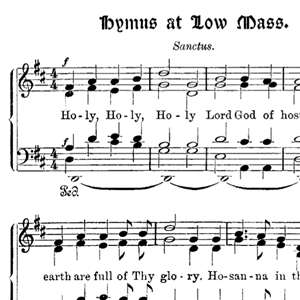
And we don’t sing things like introits or graduals which are very much Catholic. In fact the Catholic Church has an extensive ‘hymn book’ that gets ignored. I’d bet most Catholics don’t even know such things exist.
 
St Paul encouraged the church at Ephesus to:

And do not get drunk on wine, in which lies debauchery, but be filled with the Spirit,
addressing one another [in] psalms and hymns and spiritual songs, singing and playing to the Lord in your hearts,giving thanks always and for everything in the name of our Lord Jesus Christ to God the Father
.
 
#104 ‘The Song of Sola Scriptura’
#517 ‘Call No Man Father’
not to mention the old favorite #96 ‘All It Takes To Get To Heaven is to Be a Good Person’
Closing with ‘All Praise Pelagianism’
That would be hilarious.
 
Hymns are a Protestant thing to begin with.
Not at all. Hymns have been used in the Divine Office since well before the reformation, or even the great schism. St. Ambrose introduced them, and St. Benedict borrowed them when he designed the monastic Divine Office. He called them the “ambrosian”. They came later to the Roman office though, around the 13th Century. Since then, they have been a firm feature of the Divine Office for centuries, essentially the only part of the Office that is not scriptural.

Many of the hymns in the current Mass hymnals are in fact based on, or paraphrases of psalms, and in that sense they are even more scriptural than the DO hymns which have no direct connections to psalms or scripture.

Hymns are essentially poetry and theological teaching instruments (their traditional role in the Divine Office). The Gregorian hymns, unlike most chant are metered, with the two most common meters being iambic and sapphic.
And we don’t sing things like introits or graduals which are very much Catholic. In fact the Catholic Church has an extensive ‘hymn book’ that gets ignored. I’d bet most Catholics don’t even know such things exist.
Well this one does, I use the Graduale every time I go to Mass because that’s what’s used where I attend Mass in the OF (Benedictine abbey). I use the Triplex version in fact (with the original neumes from Laon and St. Gall superposed above and below the 4-bar staff).

That said, yes hymns were used long before the council. At low Masses, often a popular hymn in the vernacular would be sung.


Last edited:
They often change the lyrics around to be more “Catholic”.

Edited to remove example since I checked and the lyrics weren’t really changed that much.
 
Last edited:
They often change the lyrics around to be more “Catholic”.

Edited to remove example since I checked and the lyrics weren’t really changed that much.
That is true in some cases.

In the LOTH a hymn from arch-heretic Martin Luther is used, but it was adapted by a Catholic scholar.

It’s actually a nice hymn, I just get uncomfortable using it because in all honesty I truly despise Martin Luther. As a counter-Reformation Father once said “he took vows of poverty, yet became exceedingly rich. He took vows of obedience, yet went into open defiance and hostility towards the Church. He took vows of chastity, yet took a wife.”
 
Last edited:
I am referring to this kind of music which is not in any way ancient:


I enjoy Spirituals and like Johnny Cash and the Carter family. I just don’t think it is music for Mass.
 
Yeah, my mother hated singing “Protestant hymns” even if they were in the Catholic hymnal with new words.

I remember asking her something once about “A Mighty Fortress”, like why didn’t we ever sing that in church because it was in the hymnal, and getting a disdainful reaction
 
Last edited:
I remember asking her something once about “A Mighty Fortress”, like why didn’t we ever sing that in church because it was in the hymnal, and getting a disdainful reaction
She sounds like my kind of woman.

No nonsense devout old-school women with zero tolerance for heresy or peddlers of heresy.

The two holiest women I ever knew in my life - my grammy and a family friends 90 yr old mother - were both the exact same way.
 
Last edited:
In the LOTH a hymn from arch-heretic Martin Luther is used, but it was adapted by a Catholic scholar.

It’s actually a nice hymn, I just get uncomfortable using it because in all honesty I truly despise Martin Luther. As a counter-Reformation Father once said “he took vows of poverty, yet became exceedingly rich. He took vows of obedience, yet went into open defiance and hostility towards the Church. He took vows of chastity, yet took a wife.”
Martin Luther was a great hymn writer. But he was not a very good Catholic. In fact he was a terrible Catholic. He rejected the Church. The best hymns people are most familiar with and like are written by people who rejected the Church. When the Church has a long tradition of songs written by faithful Catholics it seems odd to draw from writers who opposed the Church.
 
It’s not like there were many “Catholic” hymns in English before VII to choose from. I know protestants that like “Catholic” songs all the same. Heck, I’ve sung the Battle Hymn of the Republic in church, not exactly your standard “Catholic” song.
 
When the Church has a long tradition of songs written by faithful Catholics it seems odd to draw from writers who opposed the Church.
I understand the reasoning behind it…

Trying to be inclusive so as to warm relations and draw them back into the Church, showing solidarity with them, etc.

However, it’s been over half a century and time has proven that such thinking doesn’t bring them to conversion… If anything it hardens them against the Church even more and confirms them in their errant beliefs.

It’s high time to abandon this type of thinking and have a true aggiornamento (updating/reform) and ressourcment (return to the sources) where we Catholics return to our venerable traditions.

It’s already happening in many places. Summorum Pontificum and Anglicanarum Coetibus, the spread of the FSSP and the EF. More traditional celebration of the OF Liturgy. A more accurate translation of the Missal and a forthcoming one of the Office.

The “progressives” - mainly among the baby boomers - are on their way out, and the new generations of Catholics are all about holy Tradition. The modernists can drag their heels all they want - it won’t stop the direction the Holy Spirit is leading the Church.
 
Last edited:
Was that really why they had protestant hymns though?

My parish has them because they simply find it beautiful. I doubt most people even know the origins of the songs?
 
Was that really why they had protestant hymns though?
One of the big reasons was because many of the Catholic hymns were in Latin and were not translated satisfactorily, so they adopted Protestant hymns which people knew.

In the new translation of the LOTH which is due out in a few more years, all the ancient Latin hymns have been translated into English - hundreds of them.

That will be a HUGE help in doing away with the Protestant stuff and moving to truly Catholic hymns.

Give it time.

I believe by the 2030’s, most Catholics will be hearing nothing but solid Catholic hymns, many written by Saints, when they go to Mass.

The days of Protestant hymns in Catholic Liturgy are numbered.

I’m only 29, but I have instructions that at my funeral Mass I want Dies Irae as the processional hymn, - “the Day of Wrath,” Let all mortal flesh keep silence as the Offertory hymn, Ubi Caritas as the Communion hymn, and Te Deum Laudamus as the recessional sung at my Requiem. Also, during the Intercessory Prayers I want several explicit prayers made for the forgiveness of my sins and repose of my soul. And I want the homily to be focused on repentance and prayer, especially prayer and sacrifice for the dead.

I also include explicit instructions not to include any non traditional or Protestant hymns at all. Oh and copious amounts of incense. Lots and lots of incense!

And the coffin I want is a simple pine coffin made by Orthodox monks of the Holy Assumption Monastery.

(Please Note: This uploaded content is no longer available.)
 
Last edited:
My great-grandmother refused to sing “Here I am, Lord.” Her reasoning was thus: “Well if I’m not ready, if I haven’t been up to the priest for a confession yet, how do I know I’m ready?” She was 98 so probably dementia setting in.

Many Protestants sing Catholic hymns without knowing it. “Lead, Kindly Light” being one of the big ones. I don’t mind hymns being written by Protestants sung at Mass. It’s the lyrics that count.

One that I particularly like is “Let the Lower Lights Be Burning.” Here is a wonderful production of that hymn, with a short history of the hymn before.

 
To the tune of “Stand Up, Stand Up For Jesus”

Cast down the heathen statues
And trample them to dust
Thou shalt not worship idols
Veneration is a bust.
 
Many Protestants sing Catholic hymns without knowing it. “Lead, Kindly Light” being one of the big ones. I don’t mind hymns being written by Protestants sung at Mass. It’s the lyrics that count.
I sang a Catholic hymn growing up at Protestant church camp. I didn’t know it. The thing is it was a song perfectly suited for children’s summer camp, especially Protestant camp where we had acoustic guitar outside by a fire. It’s called ‘They’ll Know We Are Christians’. It was written by a priest. Well, he was at the time. He left the priesthood.

Anyway, as I got older it didn’t seem like a song for adults to sing at church, and I mean that even for my old Protestant church. The style very closely resembles most other modern Catholic hymns I hear.
 
Status
Not open for further replies.
Back
Top