
Protestants no longer the majority in U.S

  • Thread starter Thread starter markomalley
  • Start date Start date
Status
Not open for further replies.
M

markomalley

Guest
From the AP:
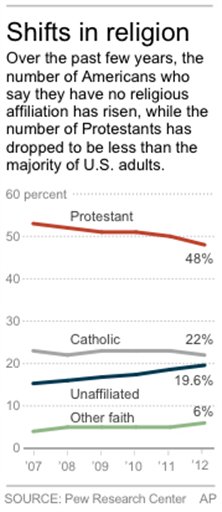

For the first time in its history, the United States does not have a Protestant majority, according to a new study. One reason: The number of Americans with no religious affiliation is on the rise.

The percentage of Protestant adults in the U.S. has reached a low of 48 percent, the first time that Pew Forum on Religion & Public Life has reported with certainty that the number has fallen below 50 percent. The drop has long been anticipated and comes at a time when no Protestants are on the U.S. Supreme Court and the Republicans have their first presidential ticket with no Protestant nominees.

Among the reasons for the change are the growth in nondenominational Christians who can no longer be categorized as Protestant, and a spike in the number of American adults who say they have no religion. The Pew study, released Tuesday, found that about 20 percent of Americans say they have no religious affiliation, an increase from 15 percent in the last five years.

Scholars have long debated whether people who say they no longer belong to a religious group should be considered secular. While the category as defined by Pew researchers includes atheists, it also encompasses majorities of people who say they believe in God, and a notable minority who pray daily or consider themselves “spiritual” but not “religious.” Still, Pew found overall that most of the unaffiliated aren’t actively seeking another religious home, indicating that their ties with organized religion are permanently broken.
NOTE: The point of posting this article is not to debate the validity or non-validity of various religious beliefs…had that been the purpose, I would have posted it in “non-Catholic religions”.

COMMENT: I think that this is a troubling trend…although the headline is “Protestants no longer the majority” – please note the trend line on Catholics as well…it’s no better.

The trend toward secularization, I think, will have major impacts on the US political landscape.
 
This is happening in all Western nations. Why is the West so determined to erase it’s Christian heritage?
 
Wow, I have seen this among my own circle and with my young adult children’s circles but to see it in hard numbers is so sad and discouraging. I am a former Methodist, now Catholic and I know that the decreasing numbers of our young people attending Church and holding onto the faith they were raised in crosses across Christian lines. The Year of Faith is just in time.
 
The trend is the ‘successful’ work of a generation of secularists who want to escape the guilt of sin by pretending-- and teaching our children-- that sin does not exist. Look at the trend lines for homosexual ‘marriage’ and availability and societal acceptability of abortion. We are being driven more and more toward a society of immorality without consequence. For too long, Christians of all flavors have sat silently by as our right to the ‘free exercise’ of religion was nibbled away bit by bit-- an almost unnoticeable erosion-- allowing for the gradual secularization of our society. But the Lord works in mysterious ways.

Thank God for giving us a president who attacked the right to religious liberty so directly that it shocked a great and growing number of people of faith into action in its defense. We need to stand and fight.
 
Catholics and Protestants are in the same battle , on the same horse on this one., both numbers are down.
 
Hope in the American Catholic Church is that 18 - 29 year olds are embracing a more traditional faith than grandparents and parents
 
This has been a topic of discussion in our parish as well. What I think is missing is that we are entering a profound and perhaps permanent contraction in terms of economic mobility, material choices in our lifestyle, etc. In turn, this means that the world has less to offer people in the way of any lasting satisfaction – the secular worldview of material prosperity is basically obsolete by now, meaning that people are inevitably going to start looking for a source of more lasting satisfaction in their lives. I don’t know if it’ll be a religious one, necessarily, but I wouldn’t rule it out.
 
huffingtonpost.com/2012/10/09/no-religion-pew-report_n_1949598.html

So the title of this article seemed like a bit of a no-brainer to me. We know that religious affiliation is on the decline in much of the country. But what struck me as interesting is how many people prefer to self-define God and His rules. It seems to me that this is faith in its most non-committal form. I couldn’t help but think of Revelation 3:16, “And you are lukewarm and neither cold nor hot, I am going to vomit you from my mouth.” Is it possible this is the lukewarm attitude that was revealed to John? I pray for a fire to be lit in all of our bellies, that we might love and serve with fervent desire, hopeful love, and undying grace.
 
When counting Protestants, the study did not include Christians who are in non-denominational churches. The article stated, "Among the reasons for the change are the growth in nondenominational Christians who can no longer be categorized as Protestant, and a spike in the number of American adults who say they have no religion."

I would still consider most non-denominational communities to be Protestant. They have just taken things further. They are not only protesting Catholicism, but also the organized communities that the Protestant Reformation produced.

The fact is, within these non-denominational groups there are often splits. They are definetely Protestant in nature.
 
COMMENT: I think that this is a troubling trend…although the headline is “Protestants no longer the majority” – please note the trend line on Catholics as well…it’s no better.

The trend toward secularization, I think, will have major impacts on the US political landscape.
Yes, a 2010 Pew report predicted that the percentage of Protestants in the US would soon dip below 50%.

That same report also indicated that the number of native-born US Catholics is declining even faster. The only reason the percentage of Catholics has not fallen is due to large numbers of immigrants from Latin America.
While those Americans who are unaffiliated with any particular religion have seen the greatest growth in numbers as a result of changes in affiliation, Catholicism has experienced the greatest net losses as a result of affiliation changes. While nearly one-in-three Americans (31%) were raised in the Catholic faith, today fewer than one-in-four (24%) describe themselves as Catholic. These losses would have been even more pronounced were it not for the offsetting impact of immigration. The Landscape Survey finds that among the foreign-born adult population, Catholics outnumber Protestants by nearly a two-to-one margin (46% Catholic vs. 24% Protestant).
religions.pewforum.org/reports
 
It’s because, IMO, education has become so bad in this country. Most atheistic arguments that I hear are based on:
  1. positivism, which is utter bunk.
  2. ad hominem attacks, and they don’t seem to understand why ad hominem attacks are not valid.
 
From the author’s commentary, it sounds like they do not classified “non-denominationals” as Protestants. I strongly disagree with them, and I think it distorts the numbers to separate them from so-called “mainline” groups. They all rely on the three Solas.
 
I am a younger Catholic and l like the more traditional masses I see on EWTN however my priest who I think the world of is not as inclined to do a traditional mass. My poor mom asked on Sunday if she could start a rosary group before mass but he asked if she could do it after mass because people like to talk to one another before mass and he thinks that is nice for people to greet one another before mass. However some of us don’t like it because we are supposed to be preparing for Jesus and it is distracting and annoying to listen to people talk. He also omits the Apostles Creed for some reason which is wrong in my opinion. Any suggestions?
 
It’s because, IMO, education has become so bad in this country. Most atheistic arguments that I hear are based on:
  1. positivism, which is utter bunk.
  2. ad hominem attacks, and they don’t seem to understand why ad hominem attacks are not valid.
I agree that education is part of the problem—when I was in college, it was full of professors who attacked conservatism, Christianity, and capitalism…the walls outside professors offices were filled with communist, atheist, messages. If you protested, stood up for your faith and the truth–even with documentation from many sources, you risked your grade in the class. I was willing to risk my grade and have paid for it repeatedly trying to get jobs 15-20 yrs later–what’s your GPA? Well, not as good as some, but I know what I’m doing and am smarter than some, but wasn’t a sycophantic student. I also didn’t try to get the easy professors. I was taught in primary school that it was ok to disagree so long as I had a reasoned and supported argument, that I could question my teachers so long as I did so respectfully and with evidence—but that is untrue at the college level. A lot of these kids are getting to college and it’s the first time they’ve been able to make a decision or a choice.

And now, even Catholic colleges aren’t teaching what they should—I have a friend that pulled his support from his Dominican alma mater because they were supporting gay marriage and abortion.

For whatever reason, kids are listening to their professors instead of their parents. Maybe their parents never told them the “why” behind what they believe or do…I know a couple of girls that I met who were Muslim used to be Christian and I asked them why they converted, one was an ex-Catholic and the other ex-Baptist—they both said the same thing, consistency and someone explained “why” of the beliefs. As a child, even with conservative Christian parents and being raised in the church, we were all allowed to question things, to ask why, we got answers, if we wanted to visit another church, fine, visit and learn, ask questions, we knew there were consequences to certain behaviours, but always knew that no matter what we decided, we would be loved and accepted by our parents. If we got money for Christmas or from babysitting, we were not told what to do with it, we were allowed to do what we wanted with it and face the consequences–if I spend it on candy or shoes or save it, etc–, that sort of thing, we knew long before teen years how to make a choice on our own, and if we needed guidance you ask mom and dad…as adults we are all still good and faithful Catholics.
 
I am a younger Catholic and l like the more traditional masses I see on EWTN however my priest who I think the world of is not as inclined to do a traditional mass. My poor mom asked on Sunday if she could start a rosary group before mass but he asked if she could do it after mass because people like to talk to one another before mass and he thinks that is nice for people to greet one another before mass. However some of us don’t like it because we are supposed to be preparing for Jesus and it is distracting and annoying to listen to people talk. He also omits the Apostles Creed for some reason which is wrong in my opinion. Any suggestions?
Let him know that the talking in the nave is distracting and that if people want to talk could the please do it outside so that those inside can be in sacred silence direct their thoughts to the sacrifice of the Mass.
 
For whatever reason, kids are listening to their professors instead of their parents. Maybe their parents never told them the “why” behind what they believe or do…
I think this is exactly it. I went to a Protestant school for elementary and middle school, then a Catholic high school, and then a secular college. My faith grew deepest after college, believe it or not. I never heard a word about St. Thomas Aquinas in high school, I never heard about what the Mass was about, I never learned much about the catechism or natural law. What turned on the faith for me was my own private study. Seriously. The problem has to be the education and the experience.

I don’t want to turn this into another Mass debate, but when you take the sacredness out of the liturgy and instead replace it with banal music and the whims of the priest (like having everyone stand around the altar), then what are you really experiencing that’s different from the world? Sure, the Eucharist, of course, but it never got much emphasis in my education. The music should be uplifting and the rite should be rich and with traditional reasons for everything. I came out of high school feeling bored with Catholicism and the Mass.

It’s my strong opinion that the revival of Catholicism begins by offering something DIFFERENT than the world; the Church will not add to its numbers by trying to imitate the world. When it comes to being like the world, the world always wins. The Church must offer something different, something rich and edifying. Pop music the culture of “we must get through Mass as quickly as possible so ignore the smells and bells” seems to really be pushing people away from the Mass.
 
Let him know that the talking in the nave is distracting and that if people want to talk could the please do it outside so that those inside can be in sacred silence direct their thoughts to the sacrifice of the Mass.
That is basically what my mom said and why she wanted to do a rosary but he said that the church has operated this way for 25 years and he had no plans on changing this tradition. I wanted to blurt out that we aren’t supposed to follow traditions of man but I have to be respectful.
 
That is basically what my mom said and why she wanted to do a rosary but he said that the church has operated this way for 25 years and he had no plans on changing this tradition. I wanted to blurt out that we aren’t supposed to follow traditions of man but I have to be respectful.
Not that I want to start a fight, but this “tradition” is not respectful of those who want to pray and be in silence before Mass as the GIRM demands.
 
I am a younger Catholic and l like the more traditional masses I see on EWTN however my priest who I think the world of is not as inclined to do a traditional mass. My poor mom asked on Sunday if she could start a rosary group before mass but he asked if she could do it after mass because people like to talk to one another before mass and he thinks that is nice for people to greet one another before mass. However some of us don’t like it because we are supposed to be preparing for Jesus
I think rosary before Mass is traditional for the very reason you mention, so I find the explanation offered to be a little hard to understand. Aren’t coffee and doughnuts typically offered after Mass in order to promote socializing?

I don’t have any suggestions, but you might want to discuss this matter in the Spirituality forum.
forums.catholic-questions.org/forumdisplay.php?f=19

I bet some of the regulars there have some ideas. That might be the place to discuss smndtupidisaftr’s objection, which seems a valid concern.
 
Not that I want to start a fight, but this “tradition” is not respectful of those who want to pray and be in silence before Mass as the GIRM demands.
I am pretty sure he would tell us that we might need to find a new church.
 
Status
Not open for further replies.
Back
Top