Purgatory vs. "rest in the sleep of peace" in the Canon of the Mass

The_Reginator

Active member
For the Vigil of Pentecost our parish (which celebrates the Novus Ordo rite only) used the Canon of the Mass (Eucharistic Prayer #1).
It was nice to hear the ancient Canon which for centuries was the one and only Eucharistic Prayer in the Roman Rite.
But ...
An old problem was brought back to my mind. From my 1962 Latin/English Missal:
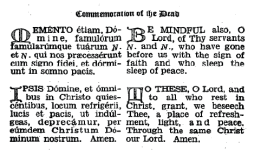
Remember also, O Lord, Thy servants and handmaids N. and N. who are gone before us with the sign of faith, and rest in the sleep of peace.
I was taught, or somehow came under the impression, that after death comes judgement, then heaven or hell. Most people who are destined for heaven pass through purgatory first -- "The Church Suffering". Purgatory is not "resting in the sleep of peace", but rather a time of suffering (hence the title "The Church Suffering"). We have no reason to pray for the souls who are damned to hell or those who are already in heaven.

I once looked up something called "soul sleep" which is a protestant idea that everyone's souls simply sleep until the resurrection. Many protestants do not seem to understand or accept the "resurrection of the body", but rather think that our souls, too, await Christ's second coming before they are resurrected, body and soul.

Why does the Church use the phrase "rest in the sleep of peace" rather than simply pray for the poor, holy souls in purgatory? How ancient is this??

Thanks for your input, Reg
 
Here is the relevant passage, this from the Lasance missal:

1780109094717.png

At the very least, it goes back to the promulgation of the Tridentine missal in 1570 by Pope St Pius V, and very likely way before then, Pius did not just create a eucharistic canon out of whole cloth, the Tridentine missal was basically the pre-existing missal of the diocese of Rome. What we familiarly call the "traditional Latin Mass" goes back at least to the time of St Gregory the Great and is sometimes referred to as the "Gregorian Mass". You raise a good point, it seems strange to ask Our Lord to "be mindful" of those who have either gone straight to heaven or have finished their expiation in purgatory, viz. "sleep the sleep of peace" (dormiunt in somno pacis). In the next sentence, though, we beseech Him to grant them this very peace.

I have to think there would be great peace in knowing that you can no longer sin, and can no longer go anywhere but heaven. Beyond that, I really can't parse that particular turn of phrase in the missal.

I attend the Traditional Latin Mass every Sunday and follow along in the missal, so I have seen this many times, but never gave it any thought.
 
Hey HomeschoolDad!

I never really thought about it until, as I said in the O.P., I came across something either on Facebook or a (largely) protestant online forum about "soul sleep" and the difference in the understanding of what the resurrection is between Catholics and protestants.
My understanding of the "Tridentine Mass" is that it traces its roots right back to the Last Supper. Originally it was celebrated without any true "form" I suppose, but as the Church grew in her size and understanding the simple celebration of the original Christians became more codified, and turned into an actual "rite" with rules so that Transubstantiation always took place. That's my understanding of the "organic development" of the Mass.
As to why we use the phrase "sleep/rest in the sleep of peace" I think I'll ask Mr. Internet about the development of the Canon of the Mass.

Dominus tecum, Reg
 
Hey HomeschoolDad!

I never really thought about it until, as I said in the O.P., I came across something either on Facebook or a (largely) protestant online forum about "soul sleep" and the difference in the understanding of what the resurrection is between Catholics and protestants.
My understanding of the "Tridentine Mass" is that it traces its roots right back to the Last Supper. Originally it was celebrated without any true "form" I suppose, but as the Church grew in her size and understanding the simple celebration of the original Christians became more codified, and turned into an actual "rite" with rules so that Transubstantiation always took place. That's my understanding of the "organic development" of the Mass.
As to why we use the phrase "sleep/rest in the sleep of peace" I think I'll ask Mr. Internet about the development of the Canon of the Mass.

Dominus tecum, Reg

All forms of the Mass trace their roots back to the Last Supper. The earliest liturgies were actually in Hebrew, Aramaic, and Greek. The Roman Rite emerged in, of course, Rome, which was at the beginning a kind of "outpost" of the nascent Catholic Church, but in time became the center of what became the Western Church and the see of the successors of St Peter, viz. the Popes. What we know as the "Tridentine" Mass (from the missal of St Pius V in the wake of the Council of Trent) dates back to St Gregory the Great and possibly before. Pius V codified the Mass in response to a wide variation in rites of the Mass up to then, he judged that a certain standardization was needed. The Mass of Paul VI (Novus Ordo Missae) was a major overhaul of the Tridentine missal (to say the least).
 
Back
Top