
Religious affections and love for God

  • Thread starter Thread starter Reformed
  • Start date Start date
Status
Not open for further replies.
I actually revealed in His Holy Word as compared to what the Catholic Magesterium requires you to believe.
It has nothing to do with intellligence, skilled and well educated men.

Luke 10:21
l
In that same hour he rejoiced in the Holy Spirit and said, “I thank you, Father, Lord of heaven and earth, that you have hidden these things from the wise and understanding and revealed them to little children; yes, Father, for such was your gracious will.

Christ the Wisdom and Power of God - 1 Cor 1
18 For the word of the cross is folly to those who are perishing, but to us who are being saved it is the power of God. 19 For it is written,

“I will destroy the wisdom of the wise,
and the discernment of the discerning I will thwart.”

20 Where is the one who is wise? Where is the scribe? Where is the debater of this age? Has not God made foolish the wisdom of the world? 21 For since, in the wisdom of God, the world did not know God through wisdom, it pleased God through the folly of what we preach to save those who believe. 22 For Jews demand signs and Greeks seek wisdom, 23 but we preach Christ crucified, a stumbling block to Jews and folly to Gentiles, 24 but to those who are called, both Jews and Greeks, Christ the power of God and the wisdom of God. 25 For the foolishness of God is wiser than men, and the weakness of God is stronger than men.

26 For consider your calling, brothers: not many of you were wise according to worldly standards, [2] not many were powerful, not many were of noble birth. 27 But God chose what is foolish in the world to shame the wise; God chose what is weak in the world to shame the strong; 28 God chose what is low and despised in the world, even things that are not, to bring to nothing things that are, 29 so that no human being [3] might boast in the presence of God. 30 And because of him [4] you are in Christ Jesus, who became to us wisdom from God, righteousness and sanctification and redemption, 31 so that, as it is written, “Let the one who boasts, boast in the Lord.”
Code:
 These passages are all great reminders of us, that when we accept our littleness...when we come before the Lord as little children, He can work through us and accomplish GREAT things!

Reformed, we are not "debating" with you here because we feel that we are more educated, more wise, or more scholarly. Indeed, it is not human understanding or wisdom which brings us to the truth.  We are not debating to prove our own understanding of scripture. We are sharing and defending the truth which has been handed to us through the apostles!
In our littleness, we come before the Lord in every mass. And though we cannot in all our understanding combined ever fathom the mystery of His grace, we still OBEY him, as little children. We obey and we believe. We take part in the body, blood, and divinity of Christ and share in the communion of saints in heaven and on earth!

No one can come to the Lord out of their own wisdom or understanding. We cannot by debating show you these things. But we can share Christ’s love and urge you to come as a little child before Him, and accept Him in His church!

Do you think it is out of our own knowledge, our human understanding, that we accept Christ in the Eucharist? Do you believe we are trusting our own understanding when we profess our faith? When we believe in the great mysteries? We can never understand these things, and yet we know them to be true! Because God has revealed them in our hearts!

Every Catholic has doubts, questions, and concerns when they learn about their faith. That is why we fail so often…because our human nature is to deny those things we cannot understand, or dont’ want to believe. The church’s firm stance on contraception for example, is a huge stumbling block for many. Why accept and believe a teaching that you are not willing to apply in your own life? Why follow a church that teaches things you simply can’t understand or agree with? The answer is because we trust the church. We trust CHRIST when He promised to protect His church. And we Love our Lord. We believe, though we may not always understand, and we follow, though we know we will often fail. We strive for holiness, though we know we will never attain it unless we reach heaven! We love our Lord and our faith we are God’s children and He loved us enough to sacrifice himself. So we sacrifice ourselves, day by day, in the little ways we can. By committing little bits of our wills and conforming ourselves little by little to Him.
Is not the very notion that one can interpret scripture on their own, and reach their own conclusions, thus declaring himself infallible and un accountable to anyone else for truth, UN-childlike? Do we not puff up ourselves and boast of our own wisdom when we pour through the scripture and tell others “read them as I read them! If you do not see what I BELIEVE they are saying, then read them again!”

Being little is about submission and obedience. Being little is about loving our Lord as the children that we are:)

But we also know that the Lord asks us to stand firm! To gird ourselves with the armor of God! (Ephesians) Though we are like little children, we are also great soldiers of Christ! Because we defend and profess the truth. The truth unchanged, unwaivering, since the beginning of time. We profess Christ and His salvation, and what it means to LIVE for Christ, and His way has not changed for 2000 years.

We live and immerse ourselves in the LIFE of Christ, not just the belief in Christ! We sacrifice our pride and arrogance, and strive to be little.

What was “little” about the reformation? Where is the child like obedience and faith in declaring that the Church, which had always been the guardian of truth was wrong, and that mere men knew how to correct her?
 
I sent a PM to the moderator asking for an explanation why the Galatians Bible Study needed to be moved to the Catholic Apologetics section. I have yet to get an answer. I hope everyone realize that Galatians and Romans are the essential books that sparked the Protestant Reformation.
 
What was “little” about the reformation? Where is the child like obedience and faith in declaring that the Church, which had always been the guardian of truth was wrong, and that mere men knew how to correct her?
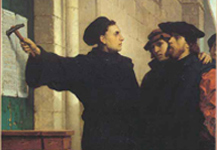
I want to know if you understand what were the central issues of the Protestant Reformation from the Protestant perspective. If you don’t know, then our conversations are really not very profitable.

en.wikipedia.org/wiki/Protestant_Reformation

reformed.org/documents/index.html?mainframe=http://www.reformed.org/documents/cambridge.html
 
I don’t think you understand the essentials of our division. You will soon learn little sister in the Lord. The Protestant Reformation was about what God actually revealed in His Holy Word as compared to what the Catholic Magesterium requires you to believe.
I really feel for you. I wish you could know what I know already. I wish I could communicate it to you in a way that you would understand and see. You need to soften your heart.
 
all you have to do is read the 95 thesis if you are confused on what the Protest reformation was about. Unfortunatly it reformed the wrong things and Martin Luther will have written ever angrier letters to his own followers. They got it all wrong, denying the Real Presence of Christ in the Eucharist and Mary’s perpetual virginity-all of which Luther held to:eek:
 
all you have to do is read the 95 thesis if you are confused on what the Protest reformation was about. Unfortunatly it reformed the wrong things and Martin Luther will have written ever angrier letters to his own followers. They got it all wrong, denying the Real Presence of Christ in the Eucharist and Mary’s perpetual virginity-all of which Luther held to:eek:
On the eve of Reformation Day, the 95 thesis was just a start of the mighty work of God. The essential issue of the Protestant Reformation was the recovery of the gospel of God’s grace according to the Word of God.

en.wikipedia.org/wiki/Five_solas

fivesolas.com/

monergism.com/

 
I want to know if you understand what were the central issues of the Protestant Reformation from the Protestant perspective. If you don’t know, then our conversations are really not very profitable.

en.wikipedia.org/wiki/Protestant_Reformation

reformed.org/documents/index.html?mainframe=http://www.reformed.org/documents/cambridge.html
I have read and re-read the “issues” of the reformation. I’ve visited your links. I’ve read writings from luther, calvin and other reformers.

I “understand” what they did, but understanding does not make it right.

Here is what your first link had to say:

"Many western Catholics were troubled by what they saw as false doctrines and malpractices within the Church, particularly involving the teaching and sale of indulgences. Another major contention was the practice of buying and selling church positions (simony) and what was seen at the time as considerable corruption within the Church’s hierarchy. This corruption was seen by many at the time as systemic, even reaching the position of the Pope.

The first problem I see in this summary, is that “many catholics were troubled by what THEY saw as false doctrines.” Where does Christ tell us that if we deem a teaching of His church false, that it must be so? Our own understanding of doctrine is greater than the truth protected by the Holy Spirit?
Then there is the “teaching and selling of indulgences.” Please note that these are two DISTINCT issues. The teaching of indulgences is, whether people understand it or not, a TRUTH. The selling of indulgences however, was a corrupt, abuse OF that truth. Luther was right to recognize that selling indulgences was wrong. Not the “teaching” of indulgences. The church has never taught that selling indulgences is acceptable.

And then there is “what was seen at the time as corruption in the church hierarchy.” Again, “seen by.” It is true, there have been corrupt priest, corrupt popes. But you confuse the CHURCH with the people who are part of it. Christ never promised the people in the church would be perfect and free of error. He promised the the church herself, and that TRUTH would never waiver. He promised the gift of infallibility on matters of teachings and morals. And not you, or anyone else, has been able to provide ONE INSTANCE or ONE OCCASION where the church has “changed” anything regarding TRUTH, teaching, or the gospel.

What is missing from the “issues concerning the reformers?” Where is their humility? What was ever “reformed” by seperating from the fullness of the truth?

Instead of reform, they ran away.
 
You keep saying “The issue was the recovery of the gospel of God’s grace according to the word of God.” OVER and over…but you have yet to show us where we LOST the gospel of God’s grace. If they had to recover it, what exactly had we LOST to begin with?
You cannot, have not, and refuse to answer this question!

Because the fact remains, the gospel of God’s grace has been taught and practiced and believed the same at the infancy of the Church, as it is today!
 
the mighty work of God.
If that were true then God’s mighty work revealed 30,000 different interpretations of the Gospel. Thats one for every denomination that disgrees with the others over what the Bible teaches. How do you know your interpretation is correct?<—that is an impossible question to answer for Protestants.
 
I want to know if you understand what were the central issues of the Protestant Reformation from the Protestant perspective. If you don’t know, then our conversations are really not very profitable.

en.wikipedia.org/wiki/Protestant_Reformation

reformed.org/documents/index.html?mainframe=http://www.reformed.org/documents/cambridge.html
Ashley,

For time sake, I will wait until you are able to tell me what were the central issues of the Protestant Reformation from the Protestant persepctive. I will refrain from communicating with you until you are able to give me the correct answers from a Protestant perspective. After-all, you claim to be ex-Protestant who converted to Roman Catholicism.
On the eve of Reformation Day, the 95 thesis was just a start of the mighty work of God. The essential issue of the Protestant Reformation was the recovery of the gospel of God’s grace according to the Word of God.

en.wikipedia.org/wiki/Five_solas

fivesolas.com/

monergism.com/

http://www.monergism.com/thethreshold/images/history_reformation.jpg
 
Ashley,

For time sake, I will wait until you are able to tell me what were the central issues of the Protestant Reformation from the Protestant persepctive. I will refrain from communicating with you until you are able to give me the correct answers from a Protestant perspective. After-all, you claim to be ex-Protestant who converted to Roman Catholicism.
There were several issues but they all centered on the PAPACY
 
Ok Reformed. You want to know what I thought as a protestant?

I thought the Catholic church was wrong. I thought that Luther, Calvin and the others were fighting against an authority, not ordained by God. I thought the church brainwashed its followers to follow a false gospel. I thought the church had too many “extra” things we didn’t need. I thought you should confess your sins to God alone, and catholics were crazy to go to confession. I thought communion was a “symbol” of OUR unity. I thought I could go on to study and become a female pastor. I thought contraception was the responsible thing to do in a marriage.

I thought the reformers had the “right idea” and opened people’s eyes to the lies they had been fed.

And like you, I had no basis other than what I had been taught about catholicism for these claims. I had no idea WHY the church had “extra” things that we “didn’t need.” I had no idea that though I believed in the five solas, that the FIVE SOLAS ARE NOT IN SCRIPTURE!

I thought that Christianity had began to unravel through the years until the reformers came and pieced it back together.

Does that explain what I thought as a protestant clearly enough?

How powerful is our loving God, that He still found my in that darkness of my own ignorance and rejection!
 
Ashley,

For time sake, I will wait until you are able to tell me what were the central issues of the Protestant Reformation from the Protestant persepctive. **I will refrain from communicating with you until you are able to give me the correct answers from a Protestant perspective. ** After-all, you claim to be ex-Protestant who converted to Roman Catholicism.
That’s two wonderful contributers you wont communciate with now. You do realise you are starting to look rediculous, don’t you.
 
Ok Reformed. You want to know what I thought as a protestant?

I thought the Catholic church was wrong. I thought that Luther, Calvin and the others were fighting against an authority, not ordained by God. I thought the church brainwashed its followers to follow a false gospel. I thought the church had too many “extra” things we didn’t need. I thought you should confess your sins to God alone, and catholics were crazy to go to confession. I thought communion was a “symbol” of OUR unity. I thought I could go on to study and become a female pastor. I thought contraception was the responsible thing to do in a marriage.

I thought the reformers had the “right idea” and opened people’s eyes to the lies they had been fed.

And like you, I had no basis other than what I had been taught about catholicism for these claims. I had no idea WHY the church had “extra” things that we “didn’t need.” I had no idea that though I believed in the five solas, that the FIVE SOLAS ARE NOT IN SCRIPTURE!

I thought that Christianity had began to unravel through the years until the reformers came and pieced it back together.

Does that explain what I thought as a protestant clearly enough?

How powerful is our loving God, that He still found my in that darkness of my own ignorance and rejection!
You didn’t even try to answer my question. I will continue to ignore you until you do your best to answer my question in regard to the central issues of the Protestant Reformation from a Protestant perspective. Take the time and study because you don’t have a very good understanding of historic Protetantism. You can make general statements and emotional responses which carry no weight for objective truth.
 
That’s two wonderful contributers you wont communciate with now. You do realise you are starting to look rediculous, don’t you.
Ag_not,

You are no longer in the world with the same goals and objectives of those in the world. It really doesn’t matter what men think. We need to grow out of being people pleasers and grow to be only God pleasers.

2 Timothy 2:10

Therefore I endure everything for the sake of the elect, that they also may obtain the salvation that is in Christ Jesus with eternal glory.

As we have said before, so now I say again: If anyone is preaching to you a gospel contrary to the one you received, let him be accursed.

For am I now seeking the approval of man, or of God? Or am I trying to please man? If I were still trying to please man, I would not be a servant of Christ. Gal 1
 
You didn’t even try to answer my question. I will continue to ignore you until you do your best to answer my question in regard to the central issues of the Protestant Reformation from a Protestant perspective. Take the time and study because you don’t have a very good understanding of historic Protetantism. You can make general statements and emotional responses which carry no weight for objective truth.
Why should a Catholic explain the central ideas of YOUR faith? Isn’t that for you to do and convince us of? Its certainly good to try to read and understand the other side, but its very likely we wont get it, just as you don’t seem to understand the Catholic perspective.

We don’t however require you to espouse the teachings of the Catholic Church before you can post your questions so why do you ask us to give you the correct/good understanding of the Protestant view before you will answer the questions?

Are you the author of objective truth? Are you once again claiming to be infallibly guided by the Holy Spirit in all matters!?
 
You didn’t even try to answer my question. I will continue to ignore you until you do your best to answer my question in regard to the central issues of the Protestant Reformation from a Protestant perspective. Take the time and study because you don’t have a very good understanding of historic Protetantism. You can make general statements and emotional responses which carry no weight for objective truth.
Your question was have I studied, and do I understand the reformation?

You’ve asked me this time and again, ussually when you can’t think of a way to answer my questions! It’s your fall back, your safety net. If you are feeling uncomfortable, and you can’t simply say "I don’t know, " you refer me to study my reformation history!

I’ve told you my understanding of the reformation. I’ve explained that I have studied it thoroughly. But as we both agree, even the most learned scholars and the greatest wisdom is of no avail. We are to be as little children before God.

But why is it, when I continue to pursue the question…what seems to be the essentail most crucial question, you run away?

You say that the reformers were restoring the lost gospel of God’s grace.

What was lost about it? What did the church teach then that it does NOT teach now? What did the church believe about the gospel of God’s grace that changed, has changed, or is changing? And why did it need reformed?
 
I want to discuss how biblical theology grows our religious affections for God. Biblical truth when received, causes us to grow in our love for God, and enables us to fight the good fight of faith.
1 John 4:19
“We love him, because he **first **loved us.”

Without Him first infusing me with His love I’d be stuck in
some sort of state of advanced spiritual atherosclerosis…
 
You didn’t even try to answer my question. I will continue to ignore you until you do your best to answer my question in regard to the central issues of the Protestant Reformation from a Protestant perspective. Take the time and study because you don’t have a very good understanding of historic Protetantism. You can make general statements and emotional responses which carry no weight for objective truth.
Reformed; are you looking for a scripture verse competition or do you care enough to actually communicate here and see what you can learn. Its obvious so far the things presented to you that you can not explain just blank you out instead of raising you desire to look FURTHER instead of running behind yet another verse. I am sure most of us here are willing to share if your willing to hear.

"… A quote from St. Alphonsus Mary De Liguori (1696-1787), Bishop and Doctor* of the Church. St. Francis Jerome, when he visited the parents of St. Alphonsus shortly after his birth, made this prophecy: “This child will be blessed with length of days; he shall not see death before his ninetieth year; he will be a bishop and will do great things for Jesus Christ.” This prophecy certainly came true. One of the most accomplished of all the saints is Alphonsus Liguori. He was a lawyer in both civil and Church law before he dedicated his whole life to serving God. He was founder of a religious order, author of more than a hundred books, originator of modern moral theology, renowned preacher and confessor, bishop, musical composer and painter. For all of his 91 years on earth, he was also a man of prayer and deep personal holiness. He gives an example of true Christian living that all of us would do well to follow. Now the quote:
"A church which is not one in its doctrine and faith can never be the True Church … Hence, because truth must be one, of all the different churches … only one can be the true one … and out of that Church there is no salvation. Now, in order to determine which is this one true Church … it is necessary to examine which is the Church first founded by Jesus Christ, for, when this is ascertained, it must be confessed that this one alone is the true Church which, having once been the true Church must always have been the true Church and must forever be the true Church. For to this first Church has been made the promise of the Savior that the gates of Hell would never be able to overturn it (Matthew 16:18) … In the entire history of religion, we find that the Roman Catholic Church alone was the first Church, and that the other false and heretical churches afterwards departed and separated from her. This is the Church which was propagated by the Apostles and afterwards governed by pastors whom the Apostles themselves appointed to rule over her … This character can be found only in the Roman Church, whose pastors descend securely by an uninterrupted and legitimate succession from the Apostles of the world (Matthew 28:20)
"The innovators themselves do not deny that the Roman Church was the first which Jesus Christ founded … however, they say … that it was the true Church until the fifth century, or until … it fell away, because it had been corrupted by the Catholics … But how could that Church fall which St. Paul calls the “pillar and ground of truth” (I Timothy 3:15)? … No. The Church has not failed … The truth is … that all the false churches which have separated from the Roman Church have fallen away and erred … To convince all heretical sects of their error, there is no way more certain and safe than to show that our Catholic Church has been the first one founded by Jesus Christ; for, this being established, it is proved beyond all doubt that ours is the only true Church and that all the others which have left it and separated are certainly in error … But, pressed by this argument, the innovators have invented an answer: they say that the visible Church has failed, but not the invisible Church … But these doctrines are diametrically opposed to the Gospel.
“The innovators have been challenged several times to produce a text of Sacred Scripture which would prove the existence of the invisible church they invented, and we are unable to obtain any such text from them. How could they adduce such a text when, addressing His Apostles whom He left as the propagators of His Church, Jesus said: “You cannot be hidden” (Matthew 5:14)? … Thus He has declared that the Church cannot help but be visible to everyone … The Church has been at all times, and will forever be, necessarily visible, so that each person may always be able to learn from his pastor the true doctrine regarding the dogmas of faith … to receive the Sacraments, to be directed in the way of salvation, and to be enlightened and corrected should he ever fall into error…”
Continued at stas.org/apologetics/church/General/St.Alphonsus_contraref.shtml
 
What are you saying, that Protestant baptism are nullified until the person is in a RCIA class and now believes his non-regenerational baptism was a regeneration baptism?
I’m saying that Protestants sometimes come into RCIA without having been baptized because it wasn’t considered essential- salvific. Others come from backgrounds where it was considered thus. If two different doctors each prescribe the same medicine for my ailment, one doctor claiming that the medicine is necessary in order for me to live with the second maintaining that the medicine isn’t really necessary but a good step to take in order to feel better and I take the medicine and live and find out later that the first doctor turned out to be right-that I would’ve died without the medicine- I think I know which one I’d continue to see in the future. Who’s to determine whether Luther or yourself or anyone else is illumined by the Spirit on any given point?
 
Status
Not open for further replies.
Back
Top