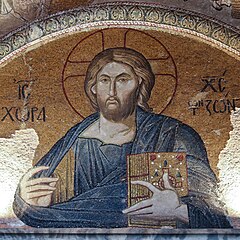
The thing about Robert Eisler is that he advocated the theory that the version of Josephus’ works preserved in Slavonic manuscripts (the so-called
Slavonic Josephus) was authentic. In his theory, the Slavonic Josephus was based on the first and now lost Greek editions of
The Jewish War, which was originally composed in Aramaic ca. AD 75. The Greek Josephus we all know today is actually a partly rewritten version primarily intended for a Greco-Roman audience. According to Eisler, the Christians who at that time relied on original texts by Josephus in turn tampered with these by adding some bits of text and removing others. Then, in the mid-13th century, a Lithuanian Jew with some sort of Christian background translated Josephus into the Old Russian from Greek texts, thereby producing the Slavonic Josephus. While doing this, he would also have interpolated more materials. Most scholars, however, were not convinced by Eisler’s theory - the Slavonic Josephus is nowadays generally deemed to be a medieval forgery, perhaps written as part of a larger ideological struggle against the
Khazars.
Now the extant manuscripts of the Josephus include references to Jesus and the origins of Christianity: the
Jewish Antiquities (written in the last decade of the 1st century) includes two references to Jesus in books 18 and 20 and a reference to John the Baptist in book 18. The reference to Jesus in 18.63-64 (the so-called
Testimonium Flavianum) is controversial because in its present form, it is blatantly Christian:
At this time there lived one Jesus, a wise man,
((if indeed one should call him a man.)) For he performed surprising deeds, and he was a teacher of men who gladly accept the truth. He won over many Jews and many of the Greeks.
((He was the Christ.)) When Pilate, on hearing him accused by men of the highest standing among us, had condemned him to the cross, those who first loved him did not stop.
((For he appeared to them on the third day, living again, for the divine prophets had foretold these and countless other marvelous things about him.)) And the tribe of the Christians, so called after this (man), has not died out to this day.
The general scholarly view today is that while the
Testimonium Flavianum is most likely not authentic in its entirety, it is broadly agreed upon that it originally consisted of an authentic nucleus with a reference to the execution of Jesus by Pilate which was then subject to Christian interpolation, the italicized and parenthesized parts of the quote being the most blatant examples.
Eisler believed that Josephus did write something about Jesus, and theorized that he may have first done so in
The Jewish War, which was later removed by Christians, yet have been preserved in a number of later quotes. Josephus could not reasonably have written appreciatively of Jesus and certainly not the
Testimonium as it now appears in the
Jewish Antiquities – in that case he would not immediately afterwards have written about another sad calamity which befell the Jews. Christians would, on the other hand, not have invented anything about Jesus that could be perceived as negative.
His solution was a simple subtraction: compile everything ever written about Jesus that was likely to come from Josephus, then discard all the bits favorable to Him (and therefore added by Christians) or reverse them. The remainder would then pretty well reflect what Josephus originally wrote. Using the Slavonic Josephus as a base, Eisler reconstructed this supposed reference to Jesus in
The Jewish War as he believed it originally appeared by using all the sources he could find, mainly the descriptions of Jesus by Byzantine writers (especially Andrew of Crete’s citation). The result (in part) was this (italicized parts are Eisler’s reconstruction):
At that time, too [during the governorship of Pontius Pilate], there appeared a certain man
of magical power, if it is permissible to call him a man,
whom (certain) Greeks call a son of God, but his disciples the true prophet, (said to) raise the dead and heal all diseases. His nature and his form were human;
a man of simple appearance, mature age, small stature, three cubits high, hunchbacked, with a long face, long nose, and meetng eyebrows, so that they who see him might be affrighted, with scanty hair (but) with a parting in the middle of his head, after the manner of the Nazirites, and with an undeveloped beard. Only in semblance was he superhuman, (for) he gave some astonishing and spectacular exhibitions. But again, if I look at his commonplace physique I (for one) cannot call him an angel. And everything whatsoever he wrought through some invisible power, he wrought through some word and a command. Some said of him, “Our first lawgiver [Moses] is risen again and displays many healings and (magic) arts,” others that “he is sent from God.” Howbeit in many things he disobeyed the law [Torah] and kept not the Sabbath according to (our) fathers’ custom. Yet he himself did nothing shameful or high-handed, but by (his) word he prepared everything. …